Thoughts From The 2012 Yuletide

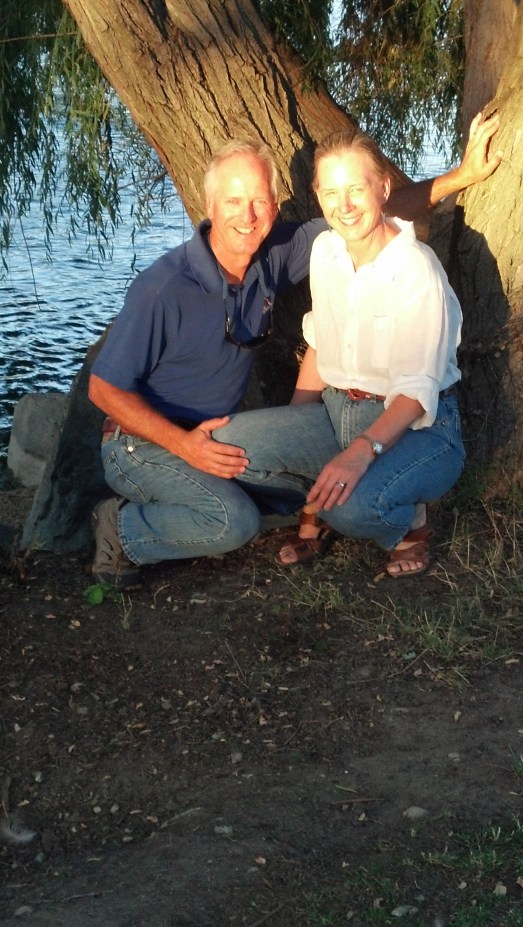
Cal and Dia sitting in a tree

(A rare photo of the two of us together taken this summer. BTW, the light emanating from our foreheads is enlightenment, not sun glare.  Don’t be fooled.)

We send out an annual Yuletide letter with our holiday cards each year.  This is it…and the sentiments it contains hold true for all of you as well.  Here’s wishing love and good will to all mankind.

Here’s wishing you the best of the season as we head down the final stretch of the year!  As usual, we sincerely hope you’re either thriving from the gifts or coping well with the stresses these holidays tend to bring, depending on which it is for you this time around.  At its best this season includes the spirit of caring and looking out for those more vulnerable.  For anyone who pulled the vulnerable straw this year we’d just like to say thanks for giving everyone else the chance to step up and don their better selves.  May we all take turns and strive to do both with as much grace as we can muster.

Last year was the first Yuletide season in nineteen that I didn’t write this letter or send out cards for which I apologize.  It was something of a short straw year for me. Nothing catastrophic fortunately, just a couple of scares, but it left me with nothing good to say so, per my mother’s perennial wisdom, I said nothing at all.  We really missed everyone though and want to thank all our card-exchange friends for still sending us your cards even when you didn’t get anything back.  They were more appreciated than you know.

On the news front nothing much changed around here this year except that Cal and I took up flatwater kayaking.  He’s been dreaming about it for quite a while now so I finally surrendered and entered into the spirit of the thing since it certainly beat the alternative of getting a motorcycle.

It’s been amazing actually.  I’ve never done much with boats and had no idea how different the natural world feels from the water.  It’s more mysterious somehow and I can see why sailors talk about the sea as a mistress.  I’ve felt it once or twice myself…that sense of an ephemeral feminine presence…only it felt more like a mother than a lover to me.  We’ve had some extraordinary experiences ranging from gliding over water so clear it was like floating in space to trying to rescue an abandoned gosling floating in a boat lane.  But my deepest impression so far comes from the night we went kayaking up at the reservoir in September under the harvest moon, paddling along trails of rippling light surrounded by looming mountain shadows.

Pretty much everything about paddling at night was new and unnerving, but the most curious thing happened a couple of hours out when I first heard some strange, strangled sounds coming from the shore nearby.  I had no idea what was making them but felt vaguely uneasy, wondering if whatever it was could swim out and reach us.  Then we heard the whirring sound of wings launching into the air…a lot of wings…after which we heard them coming out across the water straight for us.

When Cal and I talked about it later we found out both of us thought the same thing at first: Oh shit! Bats! Initially, we couldn’t see anything because they were hidden against a dark mountain background but once they streamed out across the sky we saw a couple hundred of them with wingspans the size of herring gulls.  I nearly panicked thinking BIG bats! but then realized they really were herring gulls.  I should have felt relief I suppose but instead the previous vision of being attacked by giant bats switched to grisly images from Alfred Hitchcock’s The Birds (thank you oh fear-generating machine of a subconscious mind.)  They must have noticed us out on the water…two awkward, splashing, fish-shaped things…and grown curious enough to fly out and investigate.

I felt pretty helpless sitting there…paddle clutched across my lap, bare head laid vulnerable to a sky full of sharp beaked shadows…but when they reached us all they did was wheel around, their ranks dividing in half to carve opposite, banking turns against the moon glowing behind them.  They were maybe twenty feet over our heads, close enough to hear the wind moving through thousands of feather tips, and my fear finally dissolved as we watched an unearthly sky-dance unfolding above us…a movement as graceful as any ballet.

It was a murmuration, an example of that mysterious communication among birds that lets them fly and wheel and turn as one, and as Cal and I leaned back in our kayaks surprised and slack-jawed, we watched rolling, rippling patterns of movement being woven into the sky.  Their synchronization was so flawless they looked like a single organism up there…some strange sky creature mimicking the fluid properties of the water below…endlessly dividing into multiple streams that peeled off and curled away only to swing back around and seamlessly join again, swelling and surging anew each time. They circled and swooped above us like that for maybe a minute or so until, their curiosity evidently satisfied, some invisible signal was given and they turned back towards shore all together, hanging there silhouetted against the moonlight for a few lingering moments before disappearing into the shadow of the mountain.

Afterwards we just sat there, stunned and stilled.  The whole thing seemed so primal…an ancient gift from the night and moonlight and water and sky…and I could feel it stirring some dim genetic memory inside me, like I was receiving an ancestral message of some kind.  Only of what, I really couldn’t tell you.  Maybe a simple reminder that, even in times of dark uncertainty, there’s still a mysterious, winged grace that can launch and locate me if I just clutch my courage tight enough and keep looking up.

This year…with the world looking as rich in uncertainty as it does right now…we hope that you, too, get to experience something unexpected and mysterious and breathtaking in the midst of it all, something that suspends all fear for a few heartbeats and leaves you reeling with wonder.  That kind of thing can help a lot with the rest.  It truly can.

As always, our continuing love and best wishes for you all.

Dia and Cal

CIMG0050-1

copyright Dia Osborn 2012

FUTURE FOODS? Insect Confections, Lab Meat Burgers, Seaweed Seasoning

teaser-insecten_0

Photo from Radio Netherlands Worldwide

Here’s odd.  A BBC article from July, Future Foods: What Will We Be Eating in 20 Years, discusses some of the ideas currently being explored for the not-too-far-from-now.  It covers not only alternative nutrient sources but some of the innovative ways we can be coaxed into actually eating them.

Most of the ideas in the article got me excited and then there’s one that leaves me cold, cold, cold.

First, insects.  I love this idea.  I’ve loved it since I first learned years ago that bugs have as high a protein content as animal meats only with a far smaller footprint and a more abundant supply.  There are cultures that have been using them as a traditional food source for basically ever (80% of the world’s population eats them) and I think it would be great if western cultures got over their squeamishness and adopted them as well. It would not only help solve a lot of problems, it would be healthier.

The article suggests easing the transition by turning our little friends into things like sausage and burgers…which I admit would help me a lot more than seeing them sprinkled on a cupcake.

Second, lab grown meat.  It involves taking cells from a living animal and growing them into strips of edible muscle tissue, something which has already been done successfully in trials.  This one appeals to me because it would save a majority of the animals currently subjected to the horrors of industrial agriculture.  A worthy outcome to say the least.  I have no idea what the final trade-off in footprints would be.

One drawback is that, while it could potentially provide an abundant supply of all our old favorites, it is a Frankenfood and I’m not a big fan.  For all kinds of reasons but mainly because I prefer simpler solutions.

Third, algae in all it’s many splendored forms.  This puppy is amazing stuff…nutrient rich, fast growing, and needing almost no fresh water to cultivate.  It has the added benefit of being good for all kinds of other uses including nutraceuticals, pharmaceuticals, palm oil, animal feed, and even a potential biofuel.  To my mind algae is golden and I’d eat it in a heartbeat.  (Even though it would have to be shipped in from the nearest ocean since there’s a shortage of saltwater here in Idaho.)

So what, you may be wondering, is the idea in the article that left me so cold?

There are various references made to efforts underway to manipulate the people eating the food in order to get them to accept it or taste it in a certain way.  As someone who detests being manipulated, my hackles immediately rose.  Whatever I wind up eating I want to know what it is and I want to make up my own mind about how it tastes to me.  I don’t want to be tricked into consuming something by making it “indistinguishable,” and I don’t want to be fooled into thinking a food is sweeter or fresher than it really is.

Look, I’m game for a lot.  I’m totally up for moving the global food supply in a more sustainable direction but, whichever way this winds up going, let’s be clear: I want to be informed about everything I’m putting in my mouth.  Like so many others, right now I don’t feel like I can trust a lot of what food companies, industry scientists, the FDA, and a majority of restaurants are telling me anymore.  You guys have major credibility issues and it’s all your own fault.  You should never have disrespected, manipulated…and sometimes even harmed…the people you’re supposed to serve.

Things could still turn around though.  If you can start being more forthcoming and refrain from trying to manipulate me, I can start trying to partner with and trust you again.  The fact is I don’t really want to go vegetarian, grow all my own food, and be mindlessly rigid about only buying local.

(Not that any of those things are bad!  It’s just that personally, I’d rather belong to not only my local community but a larger network of communities as well.  I’d like to see the cradle of mutual support contain as many people as is workable.)

It sure seems to me like the future holds both great uncertainty and great promise.  I love some of the innovative solutions coming down the pike.  I’d just really like the opportunity to participate in them willingly rather than having them foisted on me without my knowledge and consent.  Please.

copyright Dia Osborn 2012

Oh my aching heart…is this what the second amendment intended?

628x471

Photo from timesunion.com

Jesus God Almighty.  The news is unfolding right now about the dozens of small children gunned down in their Connecticut school room and I’m swinging wildly between anger and tears.  It was only a couple of days ago that innocent people were randomly gunned down in an Oregon mall and it seems like every week there’s another headline like this.

What have we come to?

I cannot believe that this is what our Founders intended when they crafted the second amendment.  I just can’t.  Please God help those governing us to find some of the wisdom and vision that guided our forefathers instead of the anger, suspicion, and stubbornness that blinds them today.  Our founding fathers never would have just sat on their thumbs and watched as our tiny, beautiful children and mothers and neighbors and friends were gunned down in cold blood like this, over and over and over again.

Year after year after year.

Surely we can find some way to bear guns wisely instead of just bear guns.

Please…something has to change.


Idaho City Councils Doing What The State Legislature Won’t: Protecting Their LGBT Citizens

logo

The Boise City Council voted tonight to join the City of Sandpoint up in northern Idaho and pass a non-discrimination ordinance making it illegal to “discriminate against someone in housing, employment, and public accommodation just because of their sexual orientation or gender identity.”

This is huge.  HUGE!!

Finally, members of one of our state’s most vulnerable communities will have an island of safety down here in the southern part of the state, in spite of the Idaho State Legislature’s relentless efforts to leave them exposed.  Gays, lesbians, bisexuals, and transgenders have been consistently singled out for exclusion from Idaho’s discrimination and hate crime laws, most recently in February when Idaho senators refused to allow a protection bill to so much as be introduced for discussion.

But now Idaho cities are starting to take the matter into their own hands, bypassing the state legislature and setting up their own ordinances.  Mayor Dave Bieter of Boise told the press tonight that he’s already receiving calls from other mayors in the state wanting information about what’s included in the Boise ordinance.

Thank God.  Maybe if enough of our cities step up to the plate the state legislators will finally start to realize that what they’re practicing has nothing to do with values and everything to do with targeted discrimination.

Bravo Boise and Sandpoint city councils and citizens!  You make us all proud.

Respect Can See Through Walls

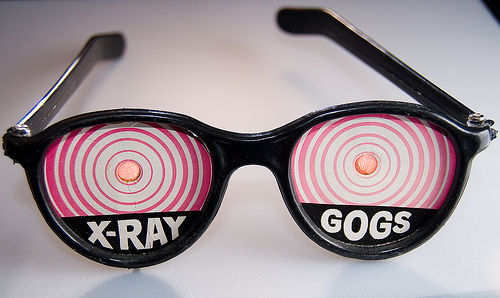
x-ray

(Photo from an interesting blog post on the possible development of real magic glasses–or Google glasses as they’re currently known.)

There’s a skill required in hospice work–the ability to hang one’s own opinions and views on a hook outside the door, the better to help the dying person and their loved one anchor into their own values and beliefs.

The name of this skill is respect.

When I began working with hospice I didn’t have it.  Did. Not. Have it.  In fact, I had its antithesis…a big, fat mouth.  I’ve always loved my own opinions a lot, so leaving them hanging on a hook outside the door was kind of painful for me.  And scary.  And hard.

A couple of transgressions was all it took though.  There’s nothing like watching the stupid, pointless harm an unwanted opinion inflicts on a person who’s already vulnerable and reeling, to make one try just a wee bit harder the next time.

Fortunately, it turned out I love not feeling like shit more than I love my own opinions.

(Barely.)

Then I noticed something unexpected happening each time I managed a modicum of genuine respect– whenever I stuck my arm down through the muck, grabbed my better self, and dragged her up for air.

It changed my eyes somehow, like I’d slipped on x-ray glasses and could see through things.  The person I was looking at would transform.

There’s a common misconception that dying people become “not themselves anymore.”  That just because they can no longer wipe or feed themselves, they turn into something that nobody should remember.  Or if they grow confused and forgetful then their very self–the person they became over an entire lifetime of becoming–ceases to exist.

But that’s so not true, something my new x-ray eyes revealed.

Respecting them helped my eyes see through all the things I used to identify as who a person is…their ability to think and accomplish, to choose and control.  Through their magically shrinking bodies and even their poop and pee (which was no small feat for me)…to where they still existed, underneath it all.

I discovered that even when they’d lost just about everything else the fighters kept on fighting, the controllers still tried to micro-manage, the takers were still demanding, and the dignified kept hitting walls because so much of the dying process just isn’t.

Generous people were still mostly concerned about those being left behind, grateful people were a real pleasure to work with because they could find value in just about anything (double-ditto for the humble) and I once watched a woman of deep faith continue to sing little songs about Jesus past the point when she could remember her own name.

It finally hit me that while we can and will lose control over everything…EVERYTHING…else, none of us ever stops being who we are.  We can’t.  Anymore than water can stop being wet.

And then, as my respecting skill improved, I started seeing something else that appeared to be deeper still.

There were these odd little moments when I’d glance up from adjusting a pillow or changing a diaper or wiping a chin to find this unraveling human being gazing into my eyes with a receptive stillness, a grace, that made me feel like I was like looking into…I don’t even know what.  Another dimension?  A place so tender and vulnerable and luminous it made me ache.

The funny thing is these moments could happen with any patient–fighter, controller, taker, generous, grateful, or humble.  It really didn’t matter.  While there were more of those moments with some than others, after a while even the most difficult people I worked with let their shields peel back to reveal that shining, beautiful place inside them.

Over time I learned that the more of my opinions I could leave outside the door, the more of these moments I experienced, and I suspect the reasons for this were two-fold.  First, because I just learned what to look for.  And second, the more respectful I was, the safer they felt revealing it to me.

Now I know what you must be thinking…did she transfer this skill to her life outside of hospice, too?

The answer is not so much.  I’ve found it’s harder to do in the regular world because it’s not practical to leave my opinions and attitudes, my values and beliefs, hanging on a hook outside my entire life.  That’s like cutting the rudder off my ship.  I need those things to navigate all the choices life presents.

I assume there must be another level to this skill that I don’t get yet, one where I can be fully present as me while still supporting others to be fully present as themselves.  A way to respect and harness both at the same time no matter how different they are.

I’m pretty sure if I could master that level I’d walk around in a state of wonder every day.

I’d love input.  Has anyone else ever experienced this kind of x-ray vision or…even better…gone to the next level?  If so what does it look like and how does it work?  I’m really curious.

copyright Dia Osborn 2012

The Unmistakeable Parallels Between Birthing and Dying

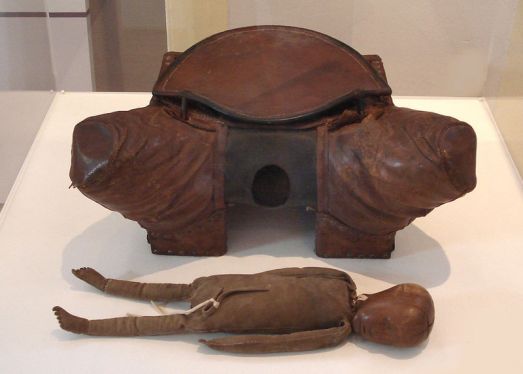
800px-Modelo-de-quadril

(Photo from Wikipedia: Model of pelvis used in the beginning of the 19th century to teach technical procedures for a successful childbirth. Museum of the History of Medicine, Porto AlegreBrazil.  Fascinating, no?)

I’ve been going back through my hospice journals while working on the rough draft and came across the following entry from 2005.  It has to do with the similarities between giving birth and dying, similarities that are widely recognized by everyone working in end-of-life care.

I thought I’d throw it up here since most of my writing energy is going into the book these days.  And for any of you still following in spite of the current paucity of posts…my deepest thanks, as always.

“I think part of what the three years working with hospice has taught me so far is that, with as huge and scary as the whole process intrinsically is, it’s still something I can prepare for.

It’s far less frightening to me when I have some kind of plan to deal with what’s going to happen—some kind of idea of what to expect–rather than going into it feeling totally helpless and ignorant.

This idea of having to squeeze back out of my body again reminds me so much of when I was preparing to give birth.

Of course I was scared as I looked down at my stomach-the-size-of-a-pig and realized oh my god, this thing has to come OUT.  Through a pea-sized hole.  And I was even more scared with the second birth because after the first time I had details.

But both times I was as prepared as I could get.  I’d taken my supplements, done my kegel exercises, gone to my check-ups, attended birthing classes and learned how to breathe.

I’d read books, asked questions, talked to other women who’d been through it and knew pretty much what to expect.

I knew it would be painful…I knew just how painful the second time…and I knew it would get more painful the farther into it we got.  I knew there were dangers involved.  I knew what position they were both in when labor started.  I knew what my red blood cell count was.

I had my team assembled.

I’d done everything I could to get ready and after that…well, it was just up to the birthing gods.  All I could reasonably do was offer up a prayer…please guide us, protect us, and give us safe passage…take a deep breath, and dive in.

I think of dying like that now.  I’m doing my best to prepare.  While working with hospice I’ve watched a variety of different approaches to dying and seen which of them work and which of them really, really don’t.

I’ve thought a lot about what decisions I’d make under a host of different circumstances…ceasing to eat at the last being a central possibility in terms of attempting to control the process from the outside.

But there’s another, even more important level of preparation to be made, and that has to do with developing my inner strength.  Gathering the ancient tools that have proved over time to be the most effective when dealing with dying.

Like courage.  Like endurance.  Like generosity.  Like grace.

Like surrender…that most difficult of all possible tools for a control maniac like me.”

copyright Dia Osborn 2012

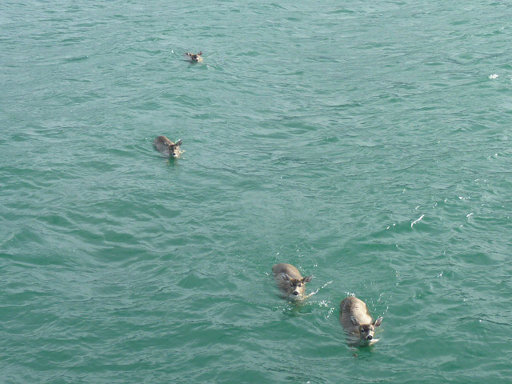
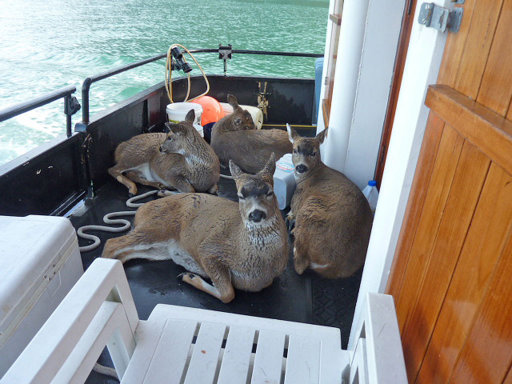
Wild Deer Ask For Passage On Boat

(Photos courtesy of Sharon Kelly and JuneauEmpire.com)

Happy Thanksgiving everyone!

I may be the last one to have seen this news story but was so touched by it that I had to put it up again anyway.

Four young Sitka deer got into trouble swimming through rough and frigid waters off the Alaska coast.  Exhausted and hypothermic they evidently spotted a charter boat sailing nearby and swam over to circle it, looking for some way to climb up out of the water.

The local family on board were amazed and sprang into action to pull the four up on the deck where they immediately collapsed.  By the time they reached land one deer was recovered enough to jump into the water and swim to shore by itself, two had to be coaxed but eventually made it to the woods, and one was still too weak to move.

So they loaded it into a wheelbarrow and rolled it up the dock to shore where they remained with it for a few hours until the deer could finally stand, wobbling but unassisted.

It’s an extraordinary story that once again breaks down some of the barriers we tend to build in our heads about what animal/human interactions and relationships can be like.  What particularly fascinated me was that the owner of the boat is a hunter but didn’t feel right about taking these deer.  I suspect he was responding to that deep instinct most of us have that we’re not allowed to harm something that has come to us for help.

The entire family was reportedly delighted and moved by the experience, considering it a gift.  In other words, they were grateful, thus earning their experience a respected place as a story worthy of Thanksgiving.

May this day be filled with the same for all of us…generosity, compassion, gratitude, and just a wee bit of magic.

copyright Dia Osborn 2012

If we were compasses…

(18th century bearing compass found on the L’Astolabe wreck)

…then we’d each have our own true north.

I think we do.  There seems to be this innate thing inside of us, this inner directional guidance system, and it’s unique and different in every person.  For instance some people steer naturally by honor and duty while others follow the promptings of love and faith.

It can be anything really…adventure and learning, family and loyalty, community and service, productivity and building, laughter and insight…but whatever anyone’s particular north/south polarity happens to be, it acts like an invisible, magnetic field that eventually aligns them along it’s axis no matter which way they try to go.  We can sometimes veer off for a while but always return to it again.  We have to.  There doesn’t seem to be any way to escape it.

My cardinal axis is truth and expression, which I both hate and love.

Hate, because even after all these years I’m still afraid of it so I try to keep my mouth shut for as long as I can, but of course that only ever makes things worse.  Sooner or later, when I wind up saying something anyway…as I always do because that’s what a cardinal direction does…there’s usually so much pressure built up behind it that the words spray out of my mouth like shrapnel.

And then moments latergazing at the carnage in surprise…I wish that I could just cut out my tongue, impale it with nails on a heavy, rough hewn, splintery  cross, and then drag the whole thing on my back up a shard-sharp, glass-jaggedy mountain in my bare feet where I’d lie down at the top on my face and be crushed under the load into dust and nothingness like I deserve.

That’s how awful it is to see that…that thing in their eyes.  That hurt or anger or reproach.  That mirror.

But then I love my true north, too, because…well, it’s truth.  Truth is purifying for me.  Truth is good.  Truth cuts through all the bullshit and spin and rationalization and denial…especially my own where it tends to grow thickest…and helps me feel slowly sane again.

That’s actually how I can tell whether something’s really true.  Not because it’s wise or painful or logical or inspiring or trustworthy…although truth can be all those things, too.

But because when something is true for me, it makes all the noise and screaming and confusion inside finally stop so I can be still again.  Whole.

I imagine everyone’s magnetic north is like that to some degree–something they both struggle with and rely on, something that makes them more vulnerable and more rooted at the same time.  The trick is probably to not resist it but embrace it…to just go ahead and be the compass I was born to be…just maybe strive for a little more skill and elegance with it day by day.

And a little less velocity.

Anyone else know their true north?

copyright Dia Osborn 2012

Massachusetts and Question 2: Should doctors be allowed to prescribe lethal doses?

Today citizens of the Commonwealth of Massachusetts will decide whether or not it should be legal for doctors to prescribe a lethal dose of medication for a patient with a terminal diagnosis who decides they want to end their own life.  It’s called the “Death With Dignity” Initiative, Question 2.  The legislation follows similar legislation in Oregon, Washington, and Montana and once again seeks to address a complex, emotionally charged, communication-resistant issue with the blunt instrument of legal policymaking.

I wish everyone could take a few deep breaths, actually sit down together, and finally talk about what’s really going on instead of skipping the discussion part and heading straight for the polls.

WE ALL NEED TO START HAVING THOSE LONG, THOUGHTFUL CONVERSATIONS WITH EACH OTHER…WITH OUR CHILDREN AND SPOUSES AND PARENTS AND FRIENDS, WITH OUR DOCTORS…ABOUT HOW SCARED WE ARE OF DYING AND WHAT WOULD HELP MAKE IT LESS SCARY FOR US.

One of the biggest obstacles I see to this happening right now is the fact that most people simply don’t know enough about what dying entails to have a useful conversation.  The amount of misinformation out there is incredible…not to mention the levels of pure superstition still operating…and there’s almost no practical, nitty-gritty kind of educational outreach to counter it all with.

Why?  Because most people don’t want to be educated about dying.  One of the oldest and most powerful superstitions around says that talking about dying is morbid and unhealthy at best and risky at worst, so for godsakes don’t do it yourself and definitely stay away from anyone else who’s talking about it.

Good luck trying to fill an About Dying classroom after that.

We’ve just battled through one of the variations on this superstition with my father-in-law, Mon Pere.  After years of no symptoms his cancer finally metastasized and started generating pain.  Lots and lots of pain.  Lots.  He was seeing three different doctors from three different offices with three different perspectives of what was going on, depending on their specialty.  In spite of the escalating urgency of the situation, it was often a week before any of them could see him after which they’d prescribe medications that were largely uncoordinated with no follow-up to make sure he was taking them correctly or that they were working.

Needless to say, none of this was getting his pain under control, but the meds were starting to have undesirable side-effects which made things even worse.  Mon Pere’s decline started to escalate and he was going downhill fast.  He’d wake up every morning and cry helplessly for hours, he couldn’t attend to a growing number of his own needs, and he was having some serious thoughts about suicide because, if his doctors couldn’t do anything, it was starting to look like death might be the only thing that would provide effective pain relief.

Here’s where the battle with the above-mentioned superstition began.

I wanted him to enroll in hospice care immediately.  Why?  Because one of the specialties of hospice lies in managing precisely the kind of escalating pain he was experiencing and I felt a good hospice team could probably get it under control and maybe even eliminate it.

I wanted him to enroll in hospice so he could return to his life and start living again.

And he was eligible for hospice care.  Mon Pere didn’t want aggressive treatment for his cancer…he wasn’t about to subject himself to chemo or radiation at his age or stage of illness.  But when I…along with two of his doctors, his physician-son, his R.N. daughter, and his nurse-practitioner ex-wife…first urged him to enroll in hospice, he balked.

“I don’t think I’m dying yet,” he told me and everyone else.  Again and again.  “I think I have a lot more time.”

Mon Pere was laboring under one of the most common misunderstandings about hospice.  He was afraid that signing up was tantamount to giving up, to being written off, or worse, actually hurried along to the grave, and because this pernicious superstition is so pervasive and widespread, like most people he was having trouble understanding what I kept trying to tell him, that we just wanted him under the care of the specialists who knew how to treat what he was actually dealing with.

We didn’t want him to enroll in hospice to die, we wanted him to enroll in hospice so he could LIVE again…right now and a hell of a lot better…because by that point he wasn’t living anymore.  Most people still don’t understand that uncontrolled pain is not just a misery, it’s a killer.  His pain had not only stripped him of any joy and pleasure in his life, it was actually speeding up his decline.

It’s really a testament to how much he loves and trusts his family that he agreed to enroll in spite of his confusion and misgivings.  And it’s been everything and more that we hoped for.  His pain symptoms started to ease up within a few days of the medication changes and are now pretty much gone.  He’s back to taking his walks, albeit with a cane, and savoring the colors of autumn.  He looked at me once, eyes widening a little with the surprise of it all, and said the world has never looked so beautiful before.  And he confided to the hubster the other day that if this is what dying is like…if there’s no pain and all he has to do is slow and then stop and eventually fall asleep and not wake up again…well then he can do that.

He was so relieved.

He can’t say enough good things about hospice now.  He’s like a convert because he understands what it’s really for…that it’s not a place to throw away dying people.  It’s a place for those who still truly, deeply want to live the time they have left.

Because this gross misunderstanding about hospice and palliative care continues, there are a whole lot of people out there missing out on the real gifts they bring to the table.  Too many people have come to believe, like Mon Pere did, that dying of necessity involves a cascade of escalating, uncontrolled, and unbearable symptoms that the medical system can no longer do anything about.  They believe there is no dignity in that kind of death and honestly, I agree with them.  When people die like that…and they still do, every day…it means that our whole system has totally failed.

But obviously, I don’t agree that suicide is the first and best alternative.  I believe it should be among the last options because, like Mon Pere, most people would rather live IF IT COULD STILL BE A GOOD LIFE.

Mon Pere did consider suicide at one point but not because he wanted to die, it was because he needed relief.  His life was fast becoming so unendurable that ending it seemed like the only alternative and, if our local legislation and resources had evolved to favor assisted suicide over hospice care, he might very well have availed himself of that option by now.

Which would have been another dismal failure of our system because dying wasn’t what he wanted at all.

The fact is a majority of people think about suicide at some point when facing a terminal diagnosis, especially in the early stages. It’s natural and there’s nothing wrong with it.  It’s usually either a panic response to the fear that they might wind up trapped in something unendurable or a despair response that the life they have left will be meaningless.

With the help of those experienced in end-of-life care, people usually get past this stage.  And sometimes they even move on to experience the sweetness and wonder of a world made luminous by dying in it.  And a lot MORE people could if we could just somehow get past that other pernicious superstition that gets in the way all the time, the one that claims dying is a taboo topic that should never be discussed.

It’s impossible you know, to explore solutions for a problem without actually talking about it.

I wish real, deep, wide-ranging, honest, courageous, mass conversations about dying could start taking place before we pass any more legislation making suicide so easily available by simple prescription.  It’s not that I believe suicide is immoral or sinful or wrong.  I don’t.  There are cases…both with those who are terminally ill and others…where someone’s life has truly become so chronically unendurable to them that death is a mercy and a gift.

But these cases are the rare exception and not the rule.  And long before reaching that point there are other really, really good options to explore, if only we’d be willing to TALK about them.

copyright Dia Osborn 2012

Massachusetts and Question 2: Should doctors be allowed to prescribe lethal doses?

Whoops.  I accidentally published this post half-written (…f*ckin’ little buttons that all look the same on four hours of sleep…)  Sorry.  The real post by the same title should show up a little later.  –Editor.

Could Fecal Implants Be A Cure All?

Fecal bacteria at 10,000x magnification.

(Pretty cool, eh?)

One of the most popular posts on this blog over time has turned out to be, of all things, Fecal Implants? Seriously?! (Yup.)  When I first read about the treatment almost two years ago now, frankly, I thought it was a joke.  But it quickly became apparent that, for a growing number of people suffering or dying from Clostridium difficile colitis…a spreading epidemic in hospitals and nursing homes…fecal implant treatments can often be more of a miracle than a punchline.

Well, buckle your seat belts again folks because it looks like not only do fecal implants provide an effective treatment for C. diff, they may also provide some measure of relief for a host of other gut-related illnesses.  In an Australian article from The Sydney Morning Herald this morningMore Than A Gut Feeling, Sydney gastroenterologist Professor Tom Borody is quoted.

”But there’s also some evidence that other conditions, including ulcerative colitis, chronic severe diarrhoea and IBS (irritable bowel syndrome) can be improved with FMT,” says Borody, who uses the technique in his  practice and believes we need more research to explore its potential.

The article talks about the growing awareness in medical circles that the legions of bacteria living in our guts, when knocked out of balance by things like sanitized environments, bad diets, and antibiotic use “may contribute to hard-to-treat problems such as allergies, autoimmune disease, irritable bowel syndrome, inflammatory bowel disease and even obesity and diabetes.”

(Evidently, a recent study by Dutch scientists shows some promise that transplanting gut flora from a healthy gut to a compromised one may improve insulin resistance.)

The wheels of research are finally starting to roll on this whole idea, which is absolutely fabulous.  I can’t help but wonder though when the far bigger wheels of industry will wake up and start moving in.  How-oh-how will the pharmaceutical companies and hospitals wind up packaging this one?  Poo packets?

Ideas anyone?

Actually, the formal name used for fecal transplant is Fecal (faecalmicrobiota transplantation (FMT) or stool transplant.  Which, when I climb out of my eight-year old self, actually seems more respectful to those who need help but don’t want to wind up as a punchline in someone else’s joke.  So from now on, FMT it is.

copyright Dia Osborn 2012

I Sing An Old English Round

I’m a shower singer these days but once upon a time, back in my college days, I loved playing guitar and singing folk and Celtic music, sometimes even where other people could hear.

One of my favorite things to sing were the old songs from oral traditions that could be sung in rounds.  I always wanted to get enough people together in one place to sing Rose, Our Poor Bird, and Heigh Ho together in eight to twelve rounds but it never happened.  So the dream languished and eventually died.

Then, lo and behold!  Here it is decades later, and I recently discovered software installed on my computer that miraculously enables me to sing all the parts by myself!  No choir assemblage required.  Playing around with it I was delighted and amazed to finally be able to hear all the harmonics involved, and I admit…I briefly returned to a distant dream I once nourished of growing up to be a folk singer some day.  (A dream that died a sad, unnatural death due to paralyzing stage fright, which was just as well since lack of voice training probably would have killed it off anyway.)

The audio tracks got out of sync in the middle for a couple of measures…sorry.  And the photos in the slideshow are from a trip we took to the Olympic rainforest a few years ago.  I thought they captured the same kind haunted feeling as the music.

(It feels a little weird to post this since it’s pretty much solely about me and…let’s face it…who cares?  But what the hell.  I love these songs and after thirty years of wondering what it would sound like, I might as well share, right?)

So anyway, here it is.

copyright Dia Osborn 2012

The Titanic and Something Mysterious Going On in the Dying Rooms

(Image from the blog Corazon’s Corner.)

I indulged in a day of lunch and theatre with an old friend from the hospice I used to work with recently.  Les Miserables.  Music to knock your socks off and blow your hair straight back…especially as we were sitting in the first row directly in front of a two-story speaker.  I couldn’t hear for an hour afterwards but I didn’t want to either, at least not until my body finally stopped vibrating with the memory.

It was a beautiful afternoon spent with a dear friend doing wonderful things.

He used to be the social worker for our small hospice before the owner died and everything fell apart so naturally, over lunch, we spent some of our time reminiscing about the old days.  We got to talking about dying and death in general and, before I had a chance to say anything, Dear Friend blurted out.

“Everyone is SO obsessed with death!”  He seemed excited which, for Dear Friend the Placid…the Even…was startling.  “It’s all you ever hear about!”

He went on to complain about the constant, battering stream of drug commercials, all the news coverage of new medical research that only ever talks about mortality rates and never about quality of life.

The assumption seems to be that if a person is alive, then of course that’s better than being dead…no matter what.  Even though when you actually talk to people on the street, the majority say that after a certain point of escalating suffering and loss (that quality of life thing again) they think they’d really rather just go ahead and die.

It was such a relief to me, to hear somebody else say it.  And it struck me again, how those who have worked around hospice generally wind up coming to the same conclusion.

Dying just isn’t that scary for us anymore.  We’ve seen it.  We’ve been around it a lot.  It’s become our familiar and we’ve made our peace with it.  We know we’ll be doing it and that’s no longer a problem.

Over time we came to see how dying fits into the grand scheme of things and how, more importantly, it can actually top off a life in a way that rights some of the wrongs that were made.  We’ve seen first hand, multiple times, how dying can deepen the beauty of a life, spread that beauty around to others, and even leave that beauty behind as a legacy of good that lasts a very, very long time.

Unlike a lot of people who say they know they’re going to die, we REALLY know it, and the knowledge has largely freed us from the constant, underlying fear that people usually don’t even realize they’re living with all the time.

What IS still scary though, even to us, is all the possible wrong choices around dying that are available in today’s world, choices that we know can make dying a lot harder, make the difficult parts of it even worse than they already are.

They’re choices that are proliferating at a blinding speed, too, that are being pursued, promoted, and paid for by that same deep, unconscious fear of dying that’s basically running everything at this point.  Our medical institutions and research facilities, our public health policies, our hospitals and doctor groups, our politicians, and our insurance companies have all evolved around this one, central terror of dying to the point where mortality rates have become the key measure by which everything else is judged.

Dying…and desperately avoiding it…has long since gobbled up the majority share.

There are a few people scattered around who, like Dear Friend and I, can see this, and some of them are even people in high places with a lot of influence.  Some of them watch the teetering tottering mess with the same dismay that we feel, while others rub their hands together with glee, jump into the chaos, and do what they can to further, then capitalize, on all the fear.

It’s a mess.  It reminds me of that classic scene sequence from the movie Titanic, where the iceberg has been hit, the ship is half sunk, and her decks have finally collapsed into a chaotic, milling scene of abject human terror and despair.

It’s quite grim.  The movie makers did a good job there.

And then…and then.  They do something magical.  The camera abruptly pulls back from the closeup coverage of all the chaos and noise, moving to a more distant, mid-range kind of shot from up in the sky and the noise and chaos are instantly reduced.  We can still hear the screaming but it’s now far away and less disturbing.  The ship, in all it’s eerie, glowing destruction is much smaller now, it doesn’t overwhelm us anymore, framed as it is by a huge sweep of dark, silent ocean that somehow manages to contain and quiet it all.

It’s true.  A larger perspective always helps.

But the magic isn’t over yet.  The camera suddenly pulls back again, to an even farther point up in the sky, a place so high that we can now see not only the vast ocean containing the tiny ship, but the vast night sky containing the vast ocean that contains the tiny ship.

From that height we can’t hear anything anymore.  Not a single visual or auditory detail of the tragedy is left and it’s a relief to be removed from it like that.  To be offered a perspective, a scope of time and place, so vast that it easily contains and cradles even that much suffering.

I think about it a lot, why spending time in the dying world helped to alleviate my own fear of it, and I think it’s because this same kind of thing happened.  Somehow, by being there with them—each rare and beautiful dying person—by laying my own hands on their quivering bodies and fears and dreams, it made the camera inside my eyes magically pull back, too.  Little by little, day after day, mostly to a midrange place where I could still hear and see all the suffering, only surrounded by a great stillness.

But then every once in a while, for some reason that I still don’t understand, (probably love come to think of it…love can do a real number on perception) my eyes would pull back farther than that, out to a place full of twinkling stars and deep time.  And in those moments the people I was looking at, the homes I was working in, would fall away into profound silence while everything started to glow.

The wasting body beneath my hands, the faces around me crumpling in pain or anger or grief, all the dying room litter of soiled wipes and used commodes, of sweaty, wrinkled clothing, ice chips, and pill cups, would transform into something that was simultaneously exquisite and heartbreaking—as if everything, all of us, were turning into a giant constellation of stars that were just hanging there, glowing and guiding, in some other kind of vast but invisible night sky.

Although no.  Not turning into.  It wasn’t so much like we were becoming a constellation of stars.  It was more like that’s what we’d always been but then we forgot, consumed as we are most of the time by the engaging, delightful, overwhelming barrage of all life’s little details.

And for those few luminous moments, I’d stand gazing around me slack-jawed and wide-eyed, my hands frozen in whatever task they’d been doing, my breath suspended with the wonder of what I was seeing.

And then whatever was causing it to happen would change and the camera in my eyes would zoom back into mid-range again, the glowing would disappear, the noise would resume, and I’d be able to move again.

Then later, when I’d leave the dying rooms and walk back into the noisy, chaotic world of regular living, my eyes would zoom back into close range again which, frankly, is where they are most of the time.  I’m usually just as overwhelmed by details as the next person.

But even though those strange, glowing moments were brief I can still remember them vividly.  I can return to them and touch them, over and over again, whenever I need to.  Those seconds of looking at the world from somewhere farther away and higher up, from a place where every ordinary, everyday, stinky, crumpled, decaying thing suddenly looked like a miracle and a gift.

And just remembering it, I’m surprised all over again each time.  Overcome.  It makes me fall head over heels in love with life yet again because somehow I still keep forgetting just how BIG this all is.  Big enough to tenderly hold not only the nubile and lovely, but the terrified and aching as well.

Big enough to contain even dying.  In the end it all really is just a blink.  A beautiful, hard slogging, transcendent, soul crushing, miraculous, grief filled, fascinating, bewildering, breathtaking, fragile, prostrating gift of a blink.

Thank God it eventually ends.  Who could take this kind of fabulous beating forever?

copyright Dia Osborn 2012

Breast Cancer: Pink October’s Long, Dark Shadow

by Raphael

I heard that this was happening before…a few times over the years actually.  But usually the voices of the women talking about it…the ones who are actually dying from breast cancer and therefore barred at the very pink door of Breast Cancer Awareness Month…wind up being drowned out by all the noise and hoopla.

So I thought this year I’d give their voices what little boost I have available.  For whatever it’s worth, this post is written for those of my brave and brilliant sisters (and brothers…men get breast cancer, too…) with Stage 4 or metastatic breast cancer who’ve been unfairly asked to stand behind the building and out of sight for a month while the rest of us gather inside to smile and shop and optimistically wave our pink ribbons in the air.

(About 30% of all breast cancers wind up reaching the metastatic stage by the way…a statistic that often makes the lucky and/or hopeful squirm and sidle away when they encounter anyone already there.)

For those who don’t have a clue what I’m talking about, here it is:

Most of the awareness raising efforts during Breast Cancer Awareness Month aim at benefiting women who are either still perfectly healthy or at least curable.  But for those women (and rare men) who aren’t as fortunate?  Those who’ve already crossed into the next scary…but still oh-so-exquisitely-alive…world of metastatic cancer?  Not so much.

In fact, not only does Breast Cancer Awareness Month NOT raise much awareness about these women and men–their courage, their deep love of life, and their profound need for research dollars– the net effect of the campaign actually winds up excluding them, leaving them feeling abandoned, or worse, unwelcome.

I realize that none of this is intentional…nobody means or wants to pile additional hurt on these women and men already grappling with so much…but it’s still appalling.  We can do better.  I know we can.  Here’s one possibility off the top of my head and it’s a very simple start:

Please…take the time to read this article by Joan Oliver Emmet titled Women with metastatic breast cancer: feeling alienated during Breast Cancer Awareness Month.  Ms. Emmet and the women from her breast cancer support group lay it out more eloquently than I ever could.  Then, if you feel inspired (and have a Facebook account) leave a supportive comment.

Read it because in doing so, you’ll actually be honoring the Awareness part of Breast Cancer Awareness Month as much as you could by running in a footrace (and probably more than buying the pink yogurt or watching Sunday football.)

Or read it because all the women and men with Stage 4 and metastatic breast cancer need to be pulled back into the circle of our arms even more than the rest of us, not less.

Or read it because if we can stop running blindly towards some seductive pink light at the end of an increasingly (let’s face it) corporately constructed tunnel, turning instead to clasp the hands of these women and men with incurable cancer…to stand and face the long shadow of death with them, shoulder to shoulder…our collective terror about the whole thing may actually lessen a little.

Caring and inclusion often have that kind of effect.  They tend to build courage and support clear thinking.

Or just read it because the article isn’t all that long, it’s well written, and it’s moving.

I’d love to see this month move beyond its strictly pink focus and maybe add some depth of color.  If pink ribbons signify a push for cure by early detection and treatment, then maybe we need another color that signifies a push for cure for later stage breast cancers?  Red maybe?  The color of pulsing, dynamic life?   And maybe another color to honor those women and men who can’t be cured at all yet…and those whom we’ve already lost for that matter. Maybe a pink and red ribbon laced with white?

Or then again, maybe we should just take the billions of dollars spent on paraphernalia, marketing, and advertising these days and donate it all straight to the research labs?  (Shooting for the moon, I know.)

But whatever we do, let’s at least pull all the beautiful and beloved women and men currently dying from metastatic breast cancer back into the building this month and hold them in our awareness, too; celebrating their lives, sharing the grief of their losses, and applauding the staggering courage they display every day.

And who knows?  Maybe if we let ourselves actually acknowledge the odds we’re still up against with this dreadful disease, it’ll add even more fuel to our search for cures.

Here’s hoping.

copyright Dia Osborn 2011

“I hope you don’t mind, but I’ve never died before so I have some questions.”

Mon Pere–the unquenchable, the ever entertaining–was out visiting mortuaries and cemeteries the other day and evidently that was one of his ice breakers.

He may have been half-serious…he is Mon Pere and takes his right to have all the information seriously…but I wasn’t there so couldn’t say.  Reports have it that by the time he left each place he had the staff in stitches.

copyright Dia Osborn 2012