Funeral Processions and Other Reminders We Don’t Want

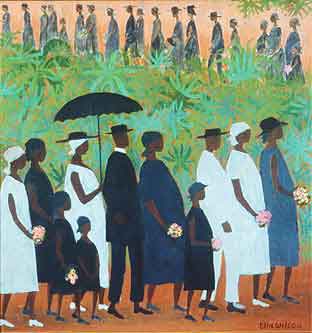
Funeral Procession by Ellis Wilson (1950), Aaron Douglas Collection, Amistad Research Center, Tulane University

Yesterday afternoon, while driving home from the dry cleaners, I was stopped at a major intersection by the longest funeral procession I’ve ever seen crossing in front of me.  Fortunately for everyone involved, I arrived just in time to see the hearse leading the procession go by so I understood what was happening and relaxed into the wait.  But I’m afraid that if I hadn’t seen it, being in my usual hurry, I probably would have missed all the other, subtler cues and, since I needed to turn right into the very lane all the mourners were using, would have done something stupid like trying to cut in.

It’s been so long since I’ve seen a funeral cavalcade that I’ve apparently grown fuzzy on the signs and protocols.  I mean sure, I drove in one during my hospice years, but that’s different.  I knew perfectly well why all the cars were lined up and all I had to do was follow the one in front of me.  But encountering one randomly out on the road required a little more awareness on my part; first, an ability to recognize the nature of the event, and second, a correct response.  Without the hearse, I’m pretty sure I would have failed at both.

Once upon a time I used to know that the cars in a funeral procession all have their headlights on, even during the afternoon on a bright sunny day.  (Check.)  And that funeral attendees generally dress up in crisp, dark colored, Sunday-best clothing, even in the middle of the week.  (Check.)  And that all other vehicles not in the procession are supposed to stop and wait until the the last car has passed, no matter what color the light is. (Check.) And if I somehow missed all these other clues, then the motorcycle cop sitting in the middle of the intersection aggressively waving his arm at me should have dispelled any remaining confusion.  (I wasn’t going to go.  I was just inching.)

It must have taken a full three or four minutes for the full procession to pass by, and as I sat there and witnessed the rolling continuum of face after silent, somber face looking forward in their car without smiling or chat, I unexpectedly started to feel the loss of this clearly beloved life myself.  All of a sudden it hit me; a life was now gone.  A LIFE. GONE.

Poof.

And suddenly, there in the middle of my buzzing, mundane, household errands (that noisy rabble of small concerns that are forever hijacking my life) a breath of something ancient and cold blew across my neck…and blessedly woke me up again.

I was glad and grateful for it.

It’s so easy to fall asleep and forget how brief this opportunity is that I have.  To be alive.  With others.  With fingers to touch theirs faces and lips, and a voice to sing with, or whisper, or cry out in pain.  With eyes drenched in moonlight, ears drowning in music, flavors exploding all over my tongue, and a nose wrinkling over a whiff of some faint stink that thankfully passes as quickly as it came.

These are miracles…miracles!…so how in the world do they get eclipsed by a stupid hour of busy tasks I won’t even remember by nightfall, much less at the end of my life?  It’s just weird, how easy it is to take the raw wonder of being alive for granted.  And scary, how forgetting it runs the risk of stranding me in a sad and shallow life.

*     *     *     *     *     *     *     *     *    *     *     *     *     *     *     *     *

Later on while thinking about the whole thing, the question hit me.  Why is it that I haven’t seen a funeral procession in so long?  What happened to them all?  Are they really fewer and farther in between?  Is it a tradition that’s fallen from favor?  Here are a few possibilities that sprang to mind:

1)  The rise of cremations and scattering of ashes has become a popular alternative to burial in a cemetery.

2)  Memorial services (as an alternative to the traditional funeral, procession, and graveside ceremony) take less time, offer greater scheduling flexibility, and also pair easily with a cremation choice.

3)  Then there’s the fact that police escorts for funeral processions are being scaled back as municipalities find themselves strapped for cash.

These are all likely reasons to be sure, but I can’t help wondering if there’s something more insidious going on, too.  Over the decades, as a culture, we’ve taken to disguising and hiding the trappings of death as we transfer our attention to the increasing hope of medical cures.

For instance, in spite of the rise in hospice care, the majority of people still die in hospitals.  But think for a moment, how many times have you actually seen a body in there?  Ever wonder why?  It turns out there’s a special fleet of gurneys that hospitals across the nation employ, cleverly designed with a secret compartment where the dead can be tucked away from public view.  Then, when they’re removed from the hospital morgue to funeral homes, they’re generally transferred through low traffic areas and back doors.

So instead of people having to step respectfully aside–momentarily hushed and awed–as a still, sheet-draped form rolls down the hallway in quiet dignity, everyone can instead hurry along uninterrupted, brushing past a seemingly empty cart hiding all evidence that one of the greatest mysteries in existence has just occurred.

Could it be that funeral processions are disappearing for the same reason?  To eliminate unpleasant reminders?  And is this wise?  Do we really want to transform our world into a place where there’s nothing left anymore to wake us up?

I realize that a big part of the reason for hiding death is to spare us the experience of fear, dread, and helplessness that facing it entails.  But really, does anyone think that strategy is working?  It doesn’t seem like we’re less scared.  In fact, it looks like our fear is mounting which, when you think about it, is the more logical outcome.  People are always more frightened by what they can’t see than what they can. Once freed from the tedious burden of hard facts, a fearful imagination usually launches into the stratosphere, heading straight for the heart of the worst possible scenario.  Honestly, I think hiding the fact that people are still dying, thereby stripping us of any chance at familiarity, is actually making things even worse and scaring the bejeezus out of us.

Maybe we’d be better served by slowing down a little, taking a deep breath, and gently lifting the sheet again for a closer look.  Yes, that would be sadder, scarier, and harder to do.

Definitely.

But it would also be braver and more dignified.  Which is who we really are anyway, so why not just do that?

In closing, for those of you who, like me, may be a little sketchy on the correct protocol for funeral processions, here are a few links that might help:

Funeral Procession Traffic Laws

Should You Stop For Funeral Processions?

Right-of-Way of Funeral Processions

copyright 2011 Dia Osborn

A Childhood Portrait Reminiscent of Alice in Wonderland and A Question Of Emotional Endurance

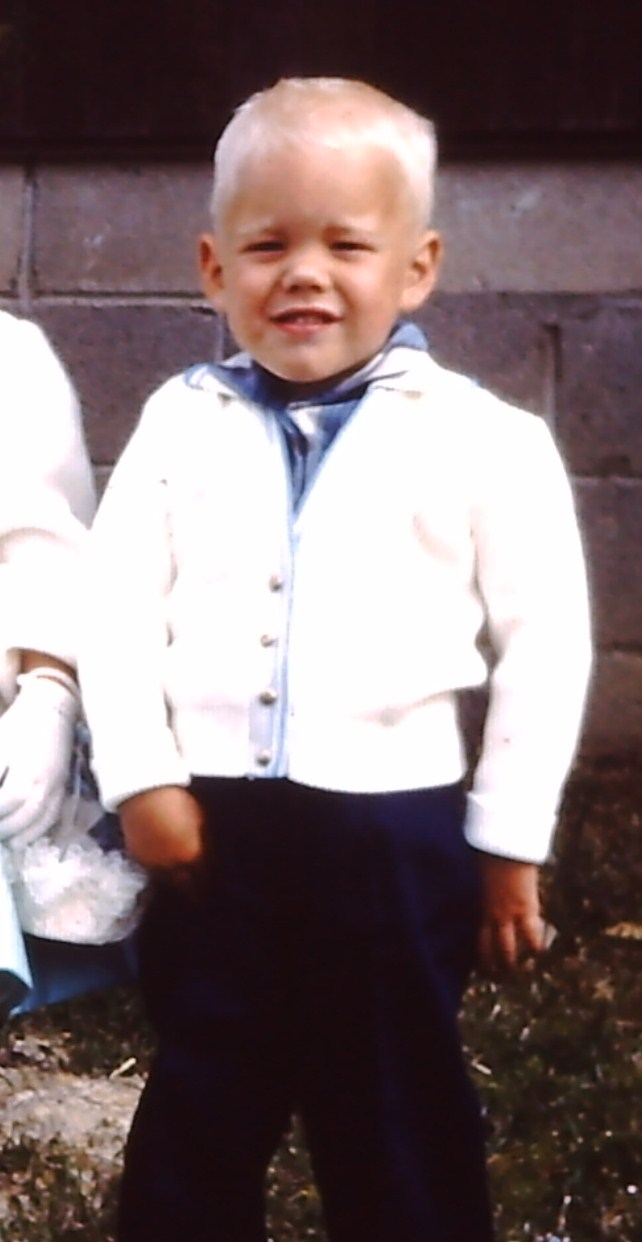
I’m the baby, fair budding to become a sunflower, second from left.  The young Queen Mother to my right is my only sister, while the boy doing the Winston Churchill imitation to her right is my middle brother.  Then there is the Eldest on the far left dignifying the portrait with his expression of Supreme Effort.  The youngest among us (who recently discovered this little treasure) was not yet born.

ABOUT WRITING:

LAST WEEK I RAN AWAY TO THE MOUNTAINS, and I think this is the first time I’ve ever missed posting on or around my Friday deadline.  Not a first-time I’m proud of or would like to repeat anytime soon.  I know there are tools available for scheduling a post to publish even when I’m gone so really, there’s no excuse.  (Not that I think it’s a life or death issue but still, the discipline is important for me as a writer.  So, note to self: research “scheduled publishing” tool and use it at least once before the end of the month.)

There.  Now on to the Easter Portrait.

ABOUT THE PHOTO:

My youngest brother became Guardian of the Box of Old Photos when my mother died a couple years ago and, during the ensuing sifting, has turned up a couple of gems like the one above.  We had no idea this thing existed.  Indeed, there are a whole series of Easter portraits that he’s uncovered, with a wide variety of outdoor backdrops (let’s play Guess What Military Base We Were Stationed At!), but this one clearly takes the cake.

The photo is of us but actually speaks volumes about my mother.  She was, like most women of her generation, trying to keep up with Jackie-O and, other than at Easter, we were always dressed in jeans and t-shirts, a fact that makes this snapshot-of-an-age even more absurd and delightful.

Ultimately though, I think it’s the accident of lighting that makes it most striking–we’re so illuminated it looks surreal, like we slipped down the rabbit hole in a string of held-hands and landed all dressed up in Wonderland.

ABOUT EMOTIONAL ENDURANCE AND THE DYING:

Moving on, I wanted to take a minute to answer a question about my last post.  In her comment afterwards, Linda over at Rangewriter asked what I meant by “emotional endurance.”  I thought it was a great question and, because emotional endurance is such a vital tool for dealing with difficult challenges of any kind, I wanted to address it in a regular post rather than just in the comment section.

Emotional endurance is just what it sounds like; the ability to endure one’s own emotions.  (Obviously, pleasant feelings don’t require much effort.  What I’m talking about are the painful ones like sadness, despair, anger, shame, loss, bitterness, guilt, regret, helplessness, etc.)  This skill was actually prevalent among the older generations but, during the current, unfolding age of budding-pharmaceutical options, has increasingly fallen into disuse.

And unfortunately, as a treat-and-cure cultural mindset has gradually replaced the older accept-and-endure one, the threshold of discomfort, pain, or uncertainty most people can continue to live and thrive with has fallen considerably.  Now…please.  I’m not saying medical advances aren’t a miraculous gift and blessing; they are.  Anyone who’d want to turn the clock back a century is, in my humble opinion, extreme.

However, there’s also profound value to be had from the old skill of knowing how to contain, endure, and navigate heavy emotions without needing to immediately escape them.  And nowhere was this made clearer to me than in the rooms of the dying.

In hospice I saw person after person after person, (all elders BTW,) deal with levels of emotional pain and loss that absolutely staggered me.  And, with only a couple exceptions, they ultimately did it without requiring antidepressants or a hastened death.  Over the course of their lives these people had somehow learned to navigate huge waves of overwhelm, fear, pain, and sorrow without losing sight of the beauty, love, and value that also populated their end.

I cannot begin to tell you what an eye opener this was for me.  I had no clue…no clue…how much stronger we are than I’d ever imagined, and if I could only pass on one bit of insight from all the wisdom I learned from the dying, that would be it.  Allow me say it one more time, because that’s just how important this is:

We are far, far, FAR stronger than most of us currently understand or believe.  By a multiple of thousands.  I know this, I’ve been there, I’ve seen it.  And I’m not talking about the rare hero, warrior, or saint, either.  (Although they are totally amazing.  Whew…)  No.  I’m talking about the rest of us.  All the ordinary, everyday, getting-along people like you and me that weren’t created for greatness; those of us who just want to raise our families, work a good job, have some hope, and live a decent life.  Us.

What I’d love to see is a cultural return to the recognition and development of this skill for emotional endurance, all the while keeping the growing arsenal of available treatments and interventions ready as back-up, just in case.  Y’know…for those rarer yet dangerous periods when life erupts into something that really is too much, too hard, too destructive, unendurable.

Can you imagine what we’d be capable of, what our lives would be like, what our world could become, with the power of inner endurance and medical relief at our disposal?

copyright Dia Osborn 2011

A Good Skill Set For Depressives (With or Without Drugs)

I’ve been living with clinical depression for a couple of decades now.  It can be challenging terrain…lots of sheer cliffs and deep canyons that are way too easy to get lost in, especially in the beginning when they can feel inescapable..but after twenty years I’ve learned how to get around.  Mapped out the local territory, made friends with the natives, and built a beautiful life there that I really love and am deeply grateful for.

I’ve done it without antidepressants.  And before anyone gets their panties all in a bunch, I’m not opposed to pharmaceutical treatment. (I so dislike that whole battle.  It’s divisive, distracting, and a waste of precious resources.)  It’s just that, back when I slipped into my first severe episode, I didn’t know what was happening to me.  Depression wasn’t the by-word it is today.  It took a while just to figure out what I was dealing with and, once that became clear, I still couldn’t afford long-term, continued access to drugs.

So it was fortunate I’d already pieced together an alternate treatment plan that was working for me.  It’s complex, eclectic, and tailored specifically to my life and strengths, so there’s no point in going into detail here.  But there were a handful of important skills I had to develop in order to make the whole thing work and I suspect they might be helpful no matter what treatment plan a person turns to.  So just in case that’s true, here they are:

A DEPRESSIVE’S SKILL SET:

1)  Develop emotional endurance.  A lot of it.  Do exercises.

2)  Trust your instincts, you’re not crazy.  Some studies have suggested that depressives actually have a more realistic view of the world than non-depressives.

3)  Question your conclusions.  Depressives can take that aforementioned realistic view (especially in a severe episode) and translate it to mean everything is futile and unbearable when it’s not.

4)  Develop emotional endurance.  Really.

5)  Depression annihilates confidence so cultivate stubbornness instead.  (Desperation is also a surprisingly effective motivation for short hauls but it’s tough on the adrenals.)

6)  Did I mention develop emotional endurance?

And 7)  Look for light.  It’s a discipline that can save you.  If you can’t find any immediately, then hang on to memories of old light until you can.  Living with depression is a lot like living at night.  Colors fade out and disappear during a descent, and the whole world falls into shades of gray.  But once you figure out where to look and start to see them, the stars in there will knock your socks off.

The Pillars of Creation

copyright Dia Osborn 2011

The Garden That Got Me To Settle Down

Gardens are not static environments.  You can’t just plant a flower bed and a tree and then expect them to stay put like, say, an arrangement of furniture.

No.

Those lovely flowers will instead grow (hooray!), bloom (yowza!), get spindly (huh?), wilt (wait a second…), and die (ugh) before scattering their seeds to areas of your property you wouldn’t have thought possible (WTF?!!).  At the same time that tree you planted will also grow (and grow and grow) until it eventually shades out the flowers below and the seed scattering which seemed like such a problem in earlier years will no longer be the issue.  It’s now the bare dirt where nothing survives.

Even though I fell in love with growing green things in adolescence when my first, obliging houseplant survived, I didn’t discover this longer-term, dynamic garden relationship until my forties.  This is because, for the first 37 years of my life, I didn’t live in the same house for longer than three and a half years.  For the first seventeen, I was a Marine brat and that’s how often my father was transferred.  The next six years of migration were the result of my on again/off again college attendance.  And the last fourteen involved first one husband who bought and fixed up properties (our homes) for resale, and then a second husband who was adventurous and highly mobile.

Due to this nomadic lifestyle, I’d never had a long-term, committed relationship with a garden before.  Oh, sure, I’d dated quite a few, but always with the understanding that it wouldn’t last.  I was basically in it for the botanical sex; sticking my seeds of choice into the fresh, fertile soil and then devouring the resulting, delicious fruits of the tryst before cinching up my roots and moving on to the next plot.

I was a confirmed bachelorette of the garden world…and perfectly happy with the life.  So when the hubster (adventurous husband #2) and I made our fifth jump in five years and landed in Boise, I had no reason to think this garden would be any different.

I went ahead and sunk my heart and soul into tearing out all the old landscaping (i.e. roses and grass) and replacing it with something more eclectic, but mentally, I always kept myself ready for the next move.  For the first five years, I told myself I could still dig everything up and take it with me when we moved again.  Then, once it became clear that this plan was delusional, I resigned myself to taking a smaller collection of favorite things; a few large rocks, all the container plants, and the old bathtub I’d rigged up as a fountain.  (Basically anything that weighed more than a quarter ton.  The hubster usually fell silent during this part of the conversation.)

This lie survived for eight more years before transitioning into the final period of denial where the hubster and I no longer talked about moving at all, but didn’t realize we were no longer talking about moving.

And then, in 2008, I suddenly realized I was trapped.  I’d held still for too long.  My roots…which had been kept oh-so-carefully tucked up in the belt for decades…had slipped loose while I wasn’t paying attention, snaked their way down into the soil, and transformed this house and garden from temporary way station into permanent home. We’d accidentally and unintentionally created something I could no longer afford to lose.

I had no idea until that moment just how badly I’d needed a home that I wouldn’t have to leave behind.

So.  That’s the story of how, over the last sixteen years, the garden and I (I call her Redbud) have become intimately acquainted.  She’s the lady who landed me, the one who finally got me to settle down.

But, as with any good relationship, I’m always discovering something new, too.  Redbud’s microclimates are constantly shifting with the changes in tree cover and watering experiments.  (I do so love to tinker.)

One of our recent successes involves a narrow strip of side yard on the north side of the house which leads from the front yard to the back.  It’s barely eight feet wide and, for the first nine years we lived here, I mistakenly assumed that nothing would grow there but shade plants.

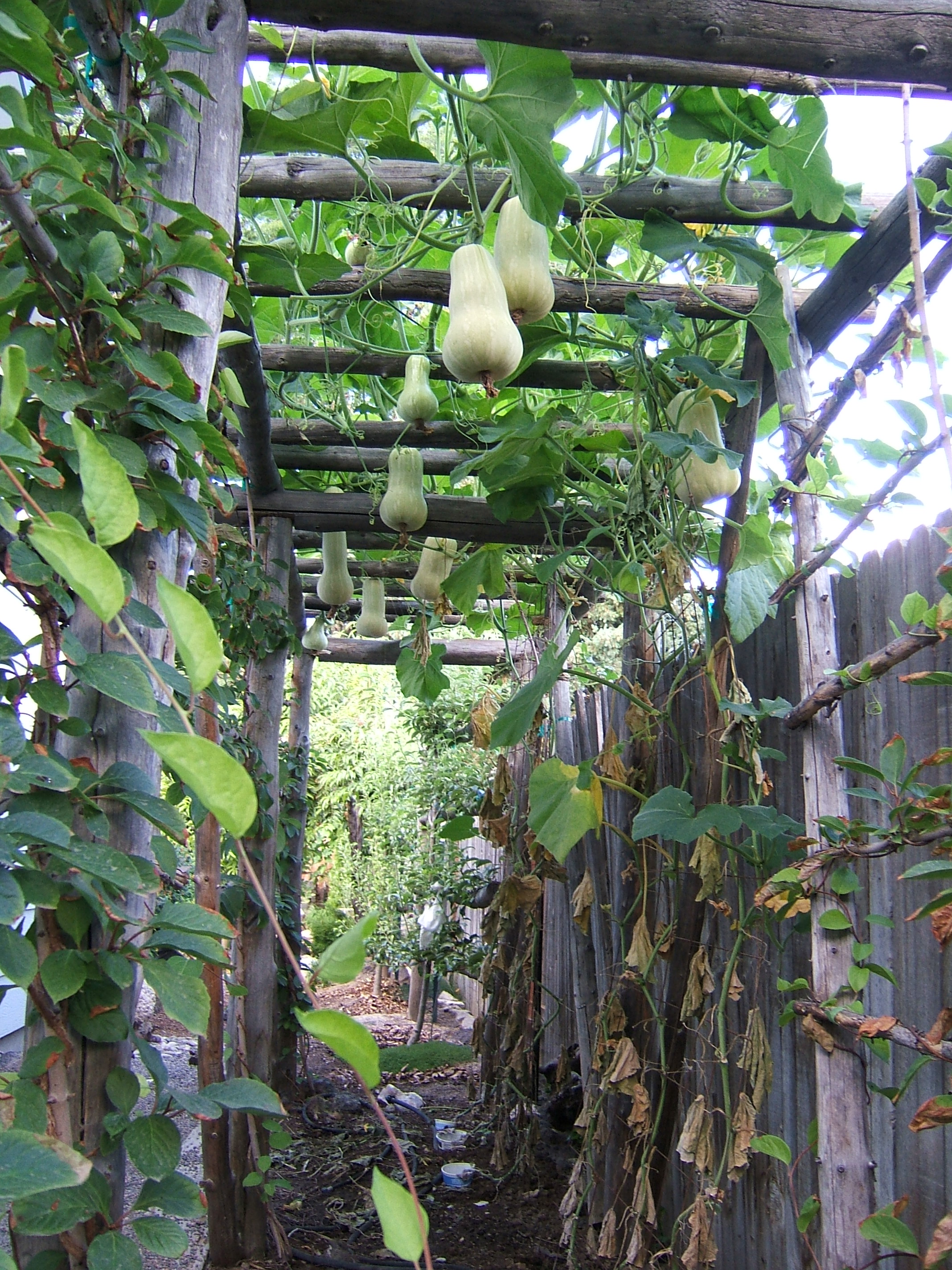
Upon closer study I realized about half this strip actually receives direct sunlight from May through early July, enough time for any seedlings planted to get a good head start.  So I began to think vertically.  I suspected that if I built a trellis tall enough, any vines started in May would be able to to chase the southward shifting sunlight high enough to escape the return of shade in mid-summer.

And lo and behold, I was right.

You can see how the lower squash leaves die off from lack of light (on the right) while the vines on top flourish. This year has been good for butternut squash.  I have six vines and will probably get fifteen or sixteen squashes.  I try and alternate years between winter squash and pole beans.

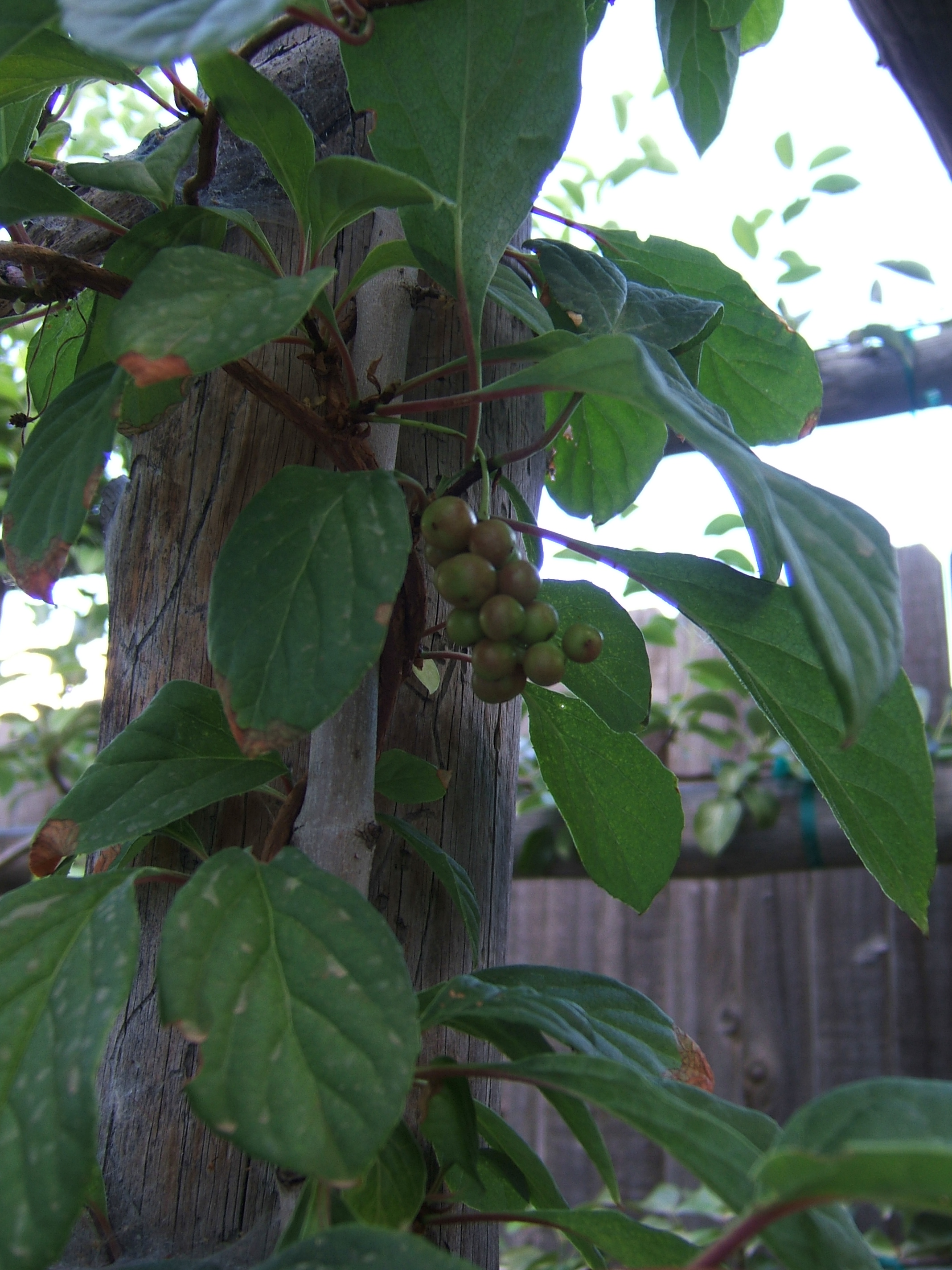
To utilize growing space, I planted four shade-loving Schisandra vines on the shadier (left) side of the trellis.  (They require both a male and female for cross pollination so the more vines one plants, the better the odds of getting one of each.)  Schisandra berries are supposed to be a powerful herbal remedy but I wouldn’t know anything about that.  After four years I’ll finally harvest a single cluster of berries this fall, which is not enough to have an herbal effect on anything.

Since the fence that continues along the northern border of the backyard has the best southern exposure on the property, I’ve lined it with espaliered fruit trees.  There are two pears and two apples, which all failed to produce this year because the f—g squirrels bit off almost all the fruit buds in late April.  Here are the espaliered pears:

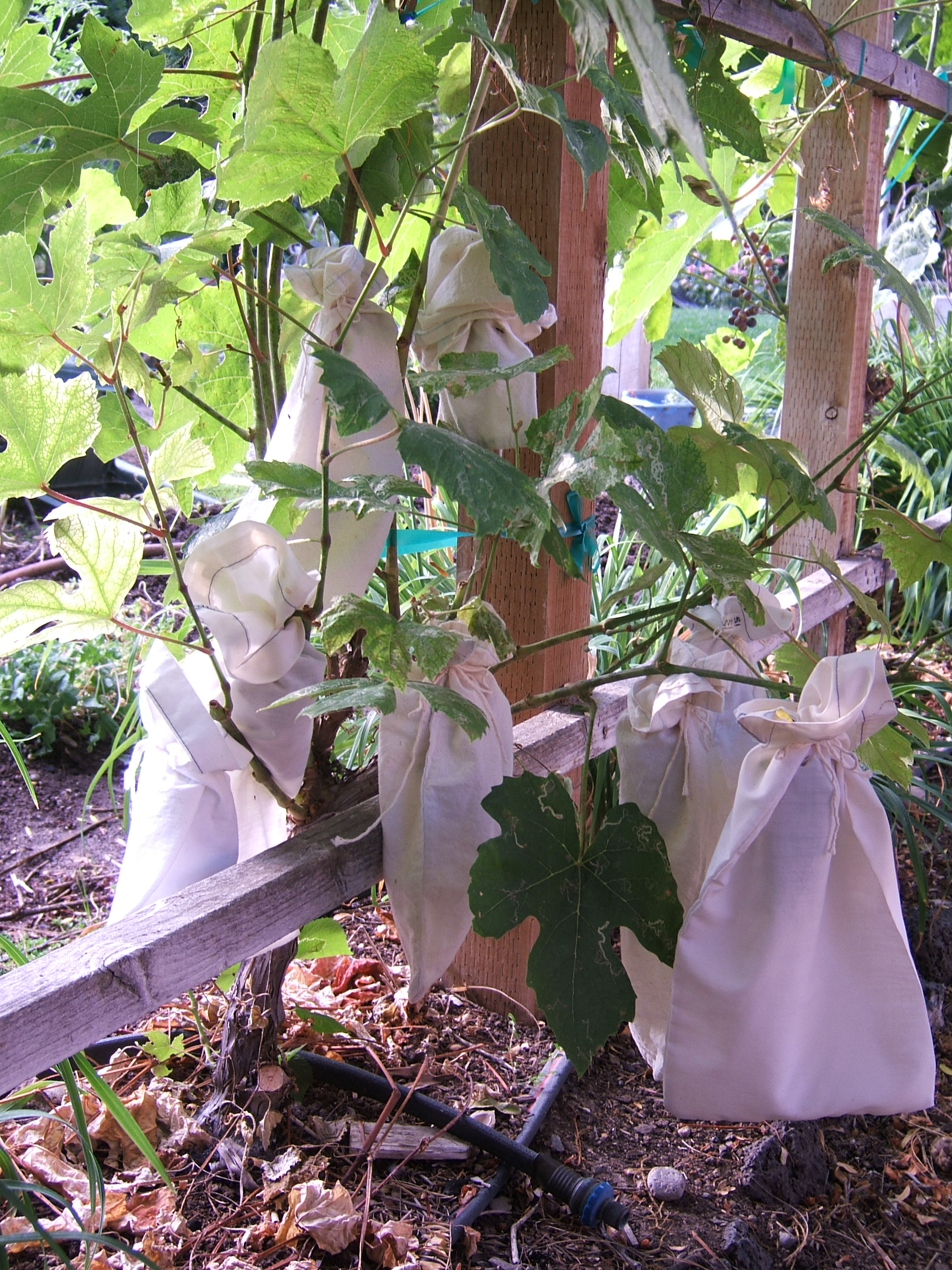
The two muslin bags in the lower right corner are protecting this years crop–two pears–from further depredation.  It’s working so far.

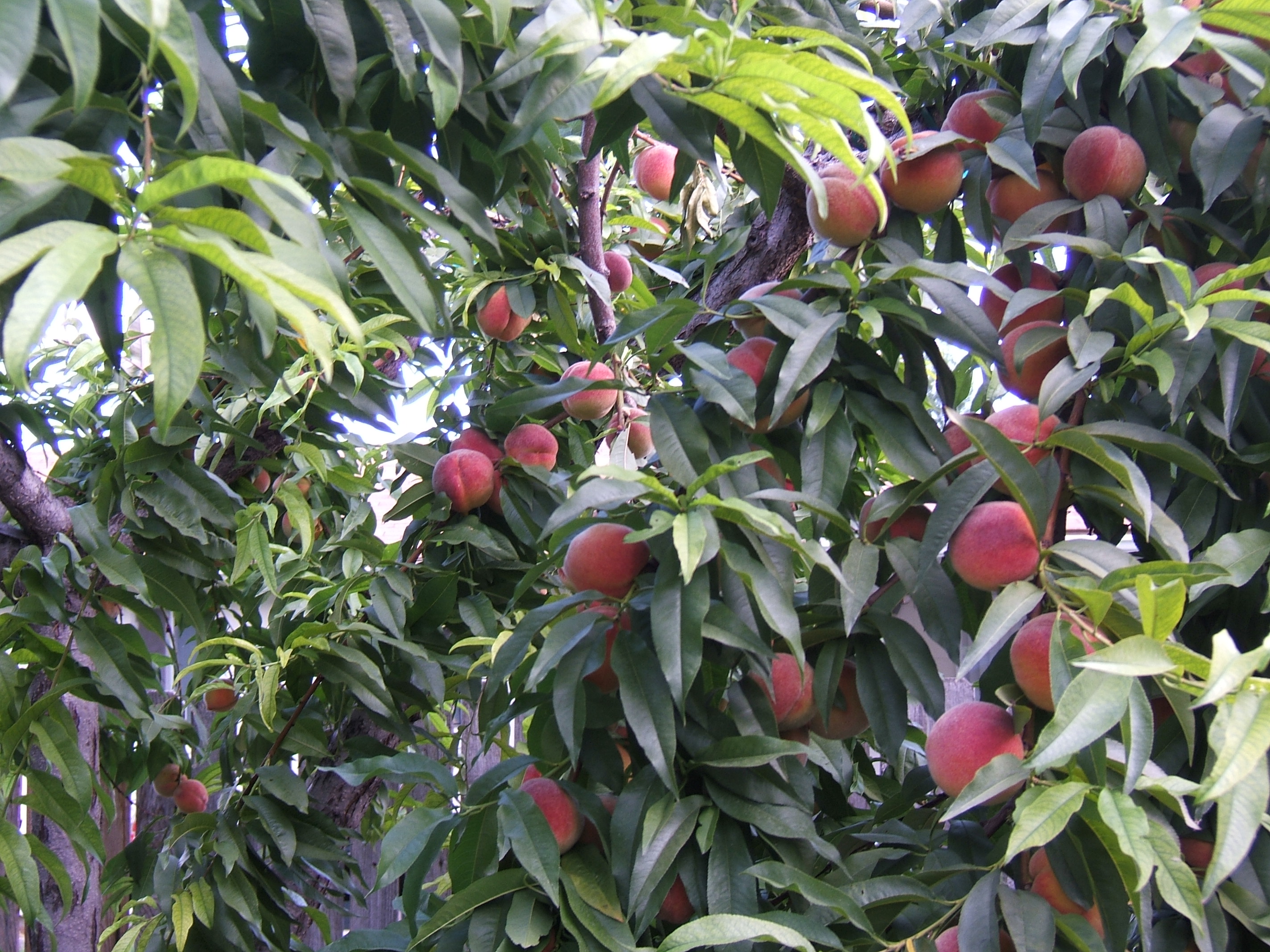
I’ve had better luck with the peaches; so much so in fact that, despite early fruit thinning, three branches have broken so far under the weight.

The squirrels are chewing off upwards of ten or fifteen fruits a day now, so I’ll probably revert to last year’s strategy and strip the tree early, allowing the green fruit to then ripen in a protected area.  While the taste is inferior that way, at least I win. Gardening, like any good, long-term, committed relationship, is full of compromises.

Redbud’s grape predators are threefold; squirrels, robins, and Dane the mangy rescue mutt. Muslin bags have been an effective deterrent for all three.

Occasionally, a frustrated squirrel will chew through the stem causing a grape cluster, bag intact, to fall to the ground.  Dane has discovered that if he picks these up and delicately mouths them, he gets a delicious shot of grape juice.  He therefore leaves the squirrels unmolested when they’re working around the vines.

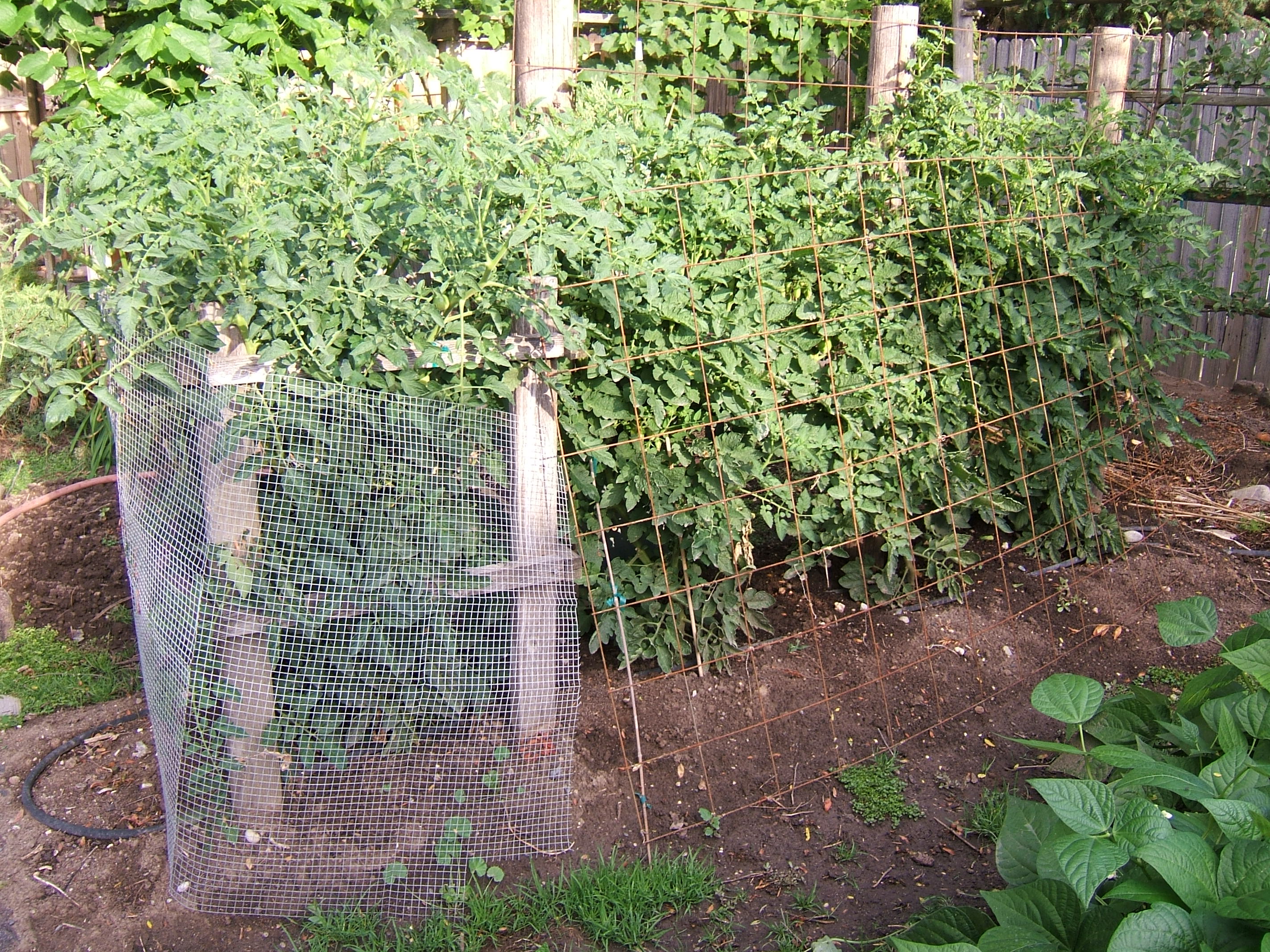
Dane is the sole predator of garden tomatoes.  He stripped the bushes once this year.

We were forced to cut down a couple of beloved but badly misplaced trees this year.  We decided to create pedestals out of them.  The driftwood are pieces we’ve collected from various spots along the Pacific Northwest coastline.


Clearly, there is no tree stump involved in the last photo but I like the driftwood and figured I’d toss it in anyway.

And now, I apologize for the abrupt ending but Redbud calls and I must away.  Happy gardening to you all!

copyright 2011 Dia Osborn


For Constance And The Other Pets We’ve All Lost

I learned that a big, flatulent, snore-prone, asthmatic bulldog died suddenly of a heart attack over in Wales a few days ago.  Her name was Constance and her bereft humans are John and Chris.  The news made me sad.  They’d only had her for about ten months…she was a kinda, sorta rescue dog…but in that short time they fell for her pretty hard. 

(Which was something of a puzzle to me, as it often is to non-bulldog people.  Bulldogs are not the most attractive of animals and she could be quite a bitch besides.  But I think that’s part of the reason WHY John and Chris loved her so much, because she was always so fearlessly and unapologetically herself, warts and all, and really, when I think about it, I kind of love that, too.  You go, girl.)

Today’s post was going to be about the dying music that’s come down to us through time, the valuable information embedded in that music regarding how to die, and how in the hell we’re supposed to extract said information all these years later, across changing attitudes, languages, and cultures.

But it doesn’t seem right.  Not today.  Instead, I’d rather play one of the songs I had in mind and dedicate it to Constance and the other beloved, joy-bringing, innocent, vulnerable, and deeply missed pets we’ve all lost over the years.  They’ve mostly died quiet and unnoticed by the wider world.  For some strange reason, we’re not usually given much room to grieve our animals when they die, in spite of the fact that their loss can be as painful and devastating as that of any other family member.  So today, I thought I’d make a little more room.

Goodbye Constance, and all you other beauties who graced our lives for a little while.  We love you.  We miss you.  We thank you.

Lyrics:

Oh all the money that e’er I spent
I spent it in good company
And all the harm that e’er I’ve done
Alas, it was to none but me
And all I’ve done for want of wit
To memory now I can’t recall
So fill to me the parting glass
Good night and joy be with you all

Oh all the comrades that e’er I’ve had
Are sorry for my going away
And all the sweethearts that e’er I’ve had
Would wish me one more day to stay
But since it falls unto my lot
That I should rise and you should not
I’ll gently rise and I’ll softly call
Good night and joy be with you all

copyright Dia Osborn 2011

Faithful More Likely To Seek Aggressive Treatment At End of Life

CBC News posted a brief but interesting article titled Aggressive end-of-life care more common among faithful: study.  I found the results intriguing because I’d noticed the trend myself while working with hospice.  Unfortunately, the study didn’t really address the reasons why people of faith are more likely to utilize aggressive treatment.

(Which of course unleashed some rabid exchanges in the comment section.  Religion and politics…sigh.  Everyone has an opinion.)

Contrary to the usual religious/anti-religious stereotypes, what I saw taking place in my work was always far more complex.  There were as many different, unique reasons for seeking (or not seeking) aggressive treatment as there were people making the choices.

Having said that, there was one thing I observed consistently:

Those who saw themselves as a part of something bigger…whether spiritually or community based…seemed to be able to cope more successfully with the hardships of dying.  The larger this framework was, the more value these people seemed to still find in what was left of their lives. (They were frequently, but not always, people of religious faith.  Some of the non-religious people I worked with had a spiritual, philosophical, or artistic dimension to their lives that provided them with the same kind of anchor that religion offered to others.)

On the other hand, those who identified most heavily with their individual choices and rights–their ability to control their situation, think clearly, and remain ambulatory and independent–seemed far more vulnerable to the ravages of anger and despair.  Their ability to cope with the changes and losses was reduced, as was their ability to still find value in the time they had left.

I learned a lot from this, about how important it is for me to stay connected to a more expansive perspective in my own life.  To make sure I walk up in the mountains, under the stars, and out in the storms as much as possible. To immerse in great music and art and literature, to constantly nourish my imagination and sense of wonder.  To resurrect my trust (over and over again) by reaching out to touch others in pain.  And to fight against the overpowering impulse to hide by sitting up anyway, and bravely asking my questions of the night.  Because those are the kinds of things that remind me that I really do belong here and I’m not alone.

We each have to find our own bigger picture, and part of that involves choosing what meaning we’ll weave out of the darker threads of our lives.  A lot of people turn to the traditional religions of the world for help because these institutions are old hands at confronting the overwhelming suffering of humanity.  Over the ages they’ve developed an extraordinary array of tools for extracting the beauty and value embedded in the horrors.

But there are a lot of other people for whom established religions no longer work.  And for them, the task of weaving an effective, helpful meaning for suffering can be a real challenge.  I have a growing suspicion that that’s actually one of our next, great tasks as human beings–to extend the weave of the old meanings in order to incorporate all the new, great stuff we’ve developed and learned along the way.

As regards the study, I suspect that just like everyone else in the world, some of the faithful involved sought aggressive treatment at the end because they were afraid to die, while others utilized it because they still longed for and valued their lives.  (In fact, they were all probably a blend of both.)  And if there were more faithful than non-faithful who still found enough value in their lives to keep fighting to live it, I suspect it’s because of the larger framework their religion offered them.

Here’s a poetic example of one person’s effort to expand that meaning beyond the realm of traditional religious understanding that I found curious and beautiful.  (And if you haven’t seen it, this blog is pretty amazing anyway.  It’s called I Wrote This For You, and from what I’ve been able to figure out it’s the partnership of a photographer in Japan and a poet somewhere in Scandinavia.  The short poetry reminds me of Rumi and Rabindranath Tagore, and can be heart wrenching, inspiring, and thought provoking all at the same time.  The photography is breathtaking.)

copyright Dia Osborn 2011

When NOT To Tell Someone They’re Dying

People who work in end-of-life care feel pretty strongly about telling people the truth.  If someone is dying and they want to know, then they damn well deserve to be told.

Why? Because wrapping up a life requires time to tie up the practical details, deliver final messages, bid farewells, and savor all the myriad “last times:”

Last birthday or bike ride, vacation or dance.

Last scent of fresh rain.

Last kiss of a beloved.

Last pang.

Last breath.

These moments are essential.  Validating.  Sacred.  They’re like rare, sparkling jewels scattered through a gathering dusk, and their aching sweetness is life multiplying itself a thousandfold as it picks up speed.

Yes, definitely–receiving the news that we’re going to die is a blow like no other, and trust me, delivering the message sucks, too.  But the alternative…to strip a person of their opportunity to gaze around in final wonder, to direct them instead to keep their head down and keep running, running, running on some exhausting, futile wheel of cure-seeking or worse, allowing them to die bewildered, panicked, or lost…is to strip them of life’s final and greatest miracle.

It’s selfish.

Now.  Having said all that, there’s one situation where it’s advisable not to inform someone they’re dying, even if they say they want to know.  It’s when they’re suffering from short term memory loss.  Whether the damage sources from dementia, brain injury, alcoholism, or pharmaceutical side-effect doesn’t really matter.  The effect is still the same.  Each time they hear it, it’s like hearing it for the first time all over again.

Personally, I think people in this situation should still be told initially, even though they’ll probably forget.  But telling them repeatedly would be kind of cruel.

Nobody needs that.

copyright Dia Osborn 2011

(The graphic above is by scottchan and, like many of the photos I use here, I found it on the terrific open source website: FreeDigitalPhotos.net.)

Learning How Not To Be Violent

With the vandalism and violence of so many (primarily) young men in London, I’ve naturally been thinking about our youth in general; how we’re supposed to teach them to behave in a civilized way, and what it looks like when we fail.

It made me think of a small incident I overheard last week.  There are three small children who live next door and, since they’re home-schooled, I often hear them playing in their backyard during “recess” while I’m working in the garden.  The youngest is three years old (with the shriek of a banshee) and, listening to an exchange she had with an older sister, it forcibly struck me,

1) just how not-civilized we are to start with, and

2) how grueling it is to train us to try and cooperate and respect the rules instead.

Only not in the way you’d first expect.

Third Child has reached the stage where she understands the basic rules of cooperation: Thou shalt not hit or call names or take anything by force, Thou shalt talk instead of scream, and Thou shalt use your words to try and work it out with your sisters before tattle-taling to mommy.  So when her older sister tried to pull a fast one and tell her that, no, no, no, you pick up the dog poop, Third Child understood that she had to raise her verbal fists and talk about it before resorting to other options.

Noooooo!!  We have to take turns!  We’re supposed to take turns!

I know…and it’s your turn.  (With age comes cunning.)

No it’s not!  It’s your turn! (Youth was not gullible.)  We have to take turns!  You have to take turns!!

Okay.  I’ll do it later.  (Age doubled back to try and throw her off the scent.)

No!  Nooooo!!  It’s your turn!!  You have to do it now!!  We have to take turns!!  We have to take TURNS!!!

By this time, Third Child had reached the limits of a three-year old’s self-control and her volume was climbing accordingly.  Older sister, realizing that mommy was likely to hear, finally capitulated and went off grumbling to pick up the poop while Third Child breathed raggedly for a minute or so, trying to de-escalate her emotions.

By this time I’d stopped what I was doing on the other side of the fence and was just standing there, fascinated and floored.  Third Child’s performance was absolutely amazing to me.  The discipline and effort she displayed in her attempt to deal with the problem in a civilized fashion (the above version is actually abbreviated–in reality she must have repeated We have to take turns! twenty or thirty times before she finally started to lose it) was really, truly impressive.

And, not to take away from Third Child’s achievement in any way, but I also instantly recognized the amount of mind-numbing, soul-sucking time, patience, and repetition required on her parents’ part, to get her to the point where she finally internalized the rule she kept repeating. Children don’t learn something as complex as what it means to be civilized from just telling them to do it once.  Either do adolescents or adults for that matter.  It’s the kind of thing we all need to hear over and over again, to observe by example in the behavior of others around us over and over again, to practice for ourselves–making lots of initial mistakes while being patiently corrected–over and over again, before it can finally be internalized as a first response.

And even after all that, it still needs to be continually reinforced or we’ll eventually slide back into the powerful impulses of our more primitive selves.

I look at the lawless, uncontrolled, destruction and violence of the last few days and can’t help but wonder how this happened?  Clearly, the young men participating aren’t behaving in a civilized way, but why not?  Where did the grueling training required for them to learn how to do so not materialize?  Didn’t they have someone to teach them when they were small?  Or didn’t they have enough role models showing them what it looks like along the way?  Or didn’t they have anyone who cared enough to patiently correct them, over and over again, when they inevitably made mistakes along the way?

In other words, in a civilized society, how in the world did so many of our young citizens reach manhood without learning the fundamental tenets of what it means to be civilized?

I firmly believe that those who have done harm should be held accountable for what they’ve done.  Justice and fairness are essential components of successful cooperation.  But I also think that, as a society, it’s possible we’ve all been negligent, and we should also hold ourselves accountable for that.  It looks like the majority of the damage has been done by disadvantaged young men, with few or no opportunities available to better their condition, and I don’t think it’ll surprise anyone when I mention that the hopelessness and anger of grinding poverty has always had a de-civilizing, de-stabilizing effect.

I also can’t help but notice that, worldwide, it’s been the most vulnerable populations bearing the vastly disproportionate burden of the downturn.  Which begs the question; are the rest of us playing the role of the older sister here?  Are we shirking our duties and trying to make the least powerful among us pick up all the poop?

I don’t know what the answers are to these questions…they’re far too many and too complex for simple explanations.  But I do know this: Each of us can, ourselves, strive to behave in a more civilized manner towards others.  Even if they’re not.  Those of us who did learn the rules of civilized behavior can stand in as the desperately needed role models for others who didn’t, or for those who have just temporarily forgotten and need a reminder.

Third Child actually stood in as a role model for her older sister, with great success.  Maybe we can all try to be more like her in our thoughts, words, and deeds.  We can refrain from hitting, calling names, or using force, we can try talking instead of yelling and, if there’s a problem, we can try to communicate directly instead of just blaming, belittling, or otherwise lashing out.

Violence has a capacity to spread, but then so does respect.  Acting with discipline and emotional restraint in the face of injustice is always hard, but if a three-year old can do it, surely…surely…the rest of us can at least try.

Learning How To Get Along

copyright 2011 Dia Osborn
Planking: The Organization of Random Humor

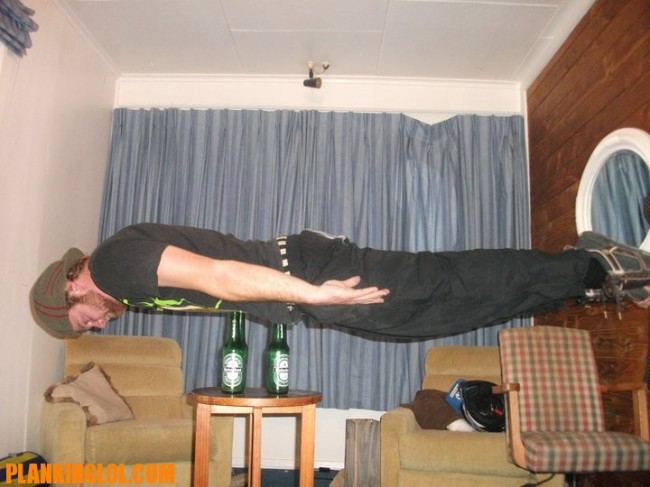
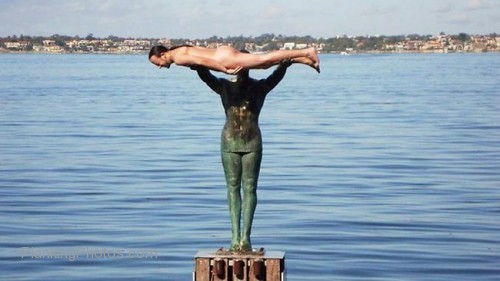
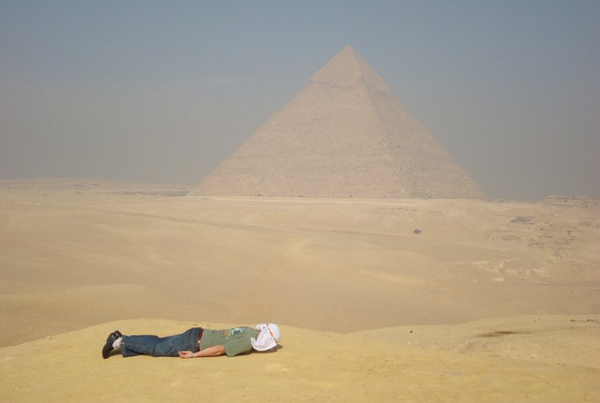
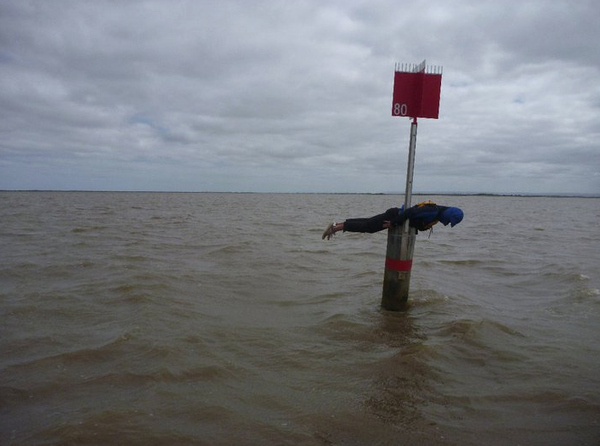
Planking, otherwise known as “The lying down game”, has evidently been around for a while but I just learned about it.  It’s totally absurd (a guaranteed hit with me) and involves lying down on one’s face in random, incongruous, often public places, and then holding a prescribed, rigid position with arms pressed against one’s sides, legs and torso stiff and straight, and fingers and toes pointed.

All very crisp and gymnastic, with just a hint of narcolepsy.

Eventually, players started taking pictures and posting them on Facebook pages, Twitter feeds, and blogs, after which the game evolved into an internet fad.  A competitive element crept in…participants attempting to one-up each other with increasingly creative choices in locale, composition, theme, and scale of danger…which inevitably led to a couple of arrests and at least one tragic death.

Overall though, it’s another splendid example of the new, broad-based, spontaneous organizational power of the internet, a phenomenon that fascinates me.  (Think Arab Spring and flash mobs.)  There’s something about the way this group-mind communication spreads that vaguely reminds me of those huge flocks of birds all flying in unison, or the big schools of fish which turn and flash simultaneously.  I wonder if we humans are wired with a latent gene, too, directing us to coordinate and move together across vast numbers, but it wasn’t until the internet came along that this gene could finally “turn on.”

In any case, the comedy in play with this game is a mix of farce, slapstick, and nonsensism.  (Yes, there really is such a thing.  Look it up.)  And me?  I just call it delightful.

Here are a few of my favorite examples set to “One potato, Two potato…”  Enjoy.

One plank:

Two plank:

Three plank:

Four:


Beer plank:

Wedding plank:

Fast food:

More:

Pole plank:

Fridge plank:

Chopper plank:

Nude:

Sand plank:

Water plank:

Air plank:

Food:

Still haven’t had enough?  Well, just a few more then.  (But after this you’ll have to go to bestplanking.com for satisfaction.)

Here’s the “For godsakes let’s keep a sense of humor men…” plank:

A couple of dead-pan bactrian comedians getting in on the game:

My arch enemy (oh if only…):

And an imaginative, not to mention bath-averse, dog:

Last but not least, here’s something from the country that came up with the fabulous name, Planking. It’s a newscast from Australia with a report on the phenomenon.  Those Aussies…I tell ya.  I really, really love their sense of humor.

(Planking has a Facebook page and a Wikipedia site.  People post their planking photos just about anywhere on the web and then various websites compile “best of’s”.  These particular photos came from Geekosystem’s The 65 Best Planking Pictures From Around the World.) 

copyright Dia Osborn 2011
Accidental Photo II

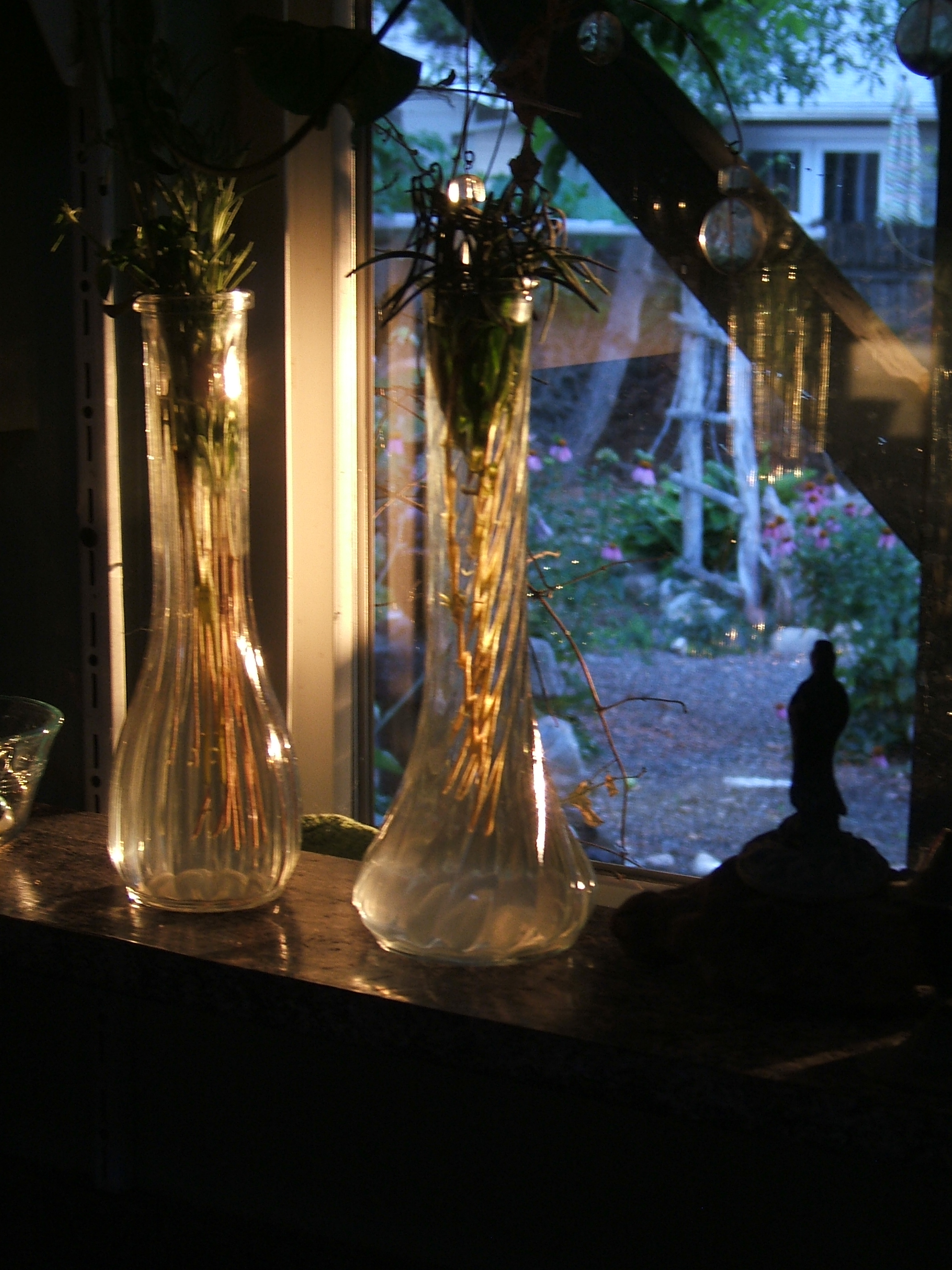
Something happened yesterday around sunset that I hadn’t seen before.  For about one minute:thirty-five, the last rays of the sun peeked out from under tumultuous, massed storm clouds and found a sliver of pathway between the branches of three big trees, around the patio roof, and through a major tangle of wisteria to actually make it in our kitchen window.  The light was golden, dramatic, and lit up two vases sitting in the window like luminaries.  And…in a complete fluke…I had my camera to hand.  I took a dozen shots or so and this was at the peak of the light:

Hardly prize winning but it caught the effect so I was happy.  It also, funnily enough, turned out be another accidental photo.  I was only aiming for the vases but wound up capturing an entire series of worlds that I hadn’t seen when I first snapped the shot.  I mean, look at them all.  There’s…

1) the outside, distant garden,

2) the illuminated, inner world of the vases,

3) the invisible realm of glass separating the two (you can only see it by the ghostly reflections it casts),

4) the world of shadows at the bottom right, where the silhouette person lives, and then

5) the dark abyss just under the shelf.

There are more than five of course, (like the neighbor’s world through those darkened windows in the upper, right hand corner) but you get the gist. Without the camera I only perceived a single world with the vases as its dominant focal point.  All the other unique, fascinating worlds present were reduced to background noise, like visual mall music.  It took the camera to give me the time and mental shift necessary to see the rest.

I realize our brains are designed to take the overwhelming barrage of sensory detail that batters us at every moment, and filter it down to just one or two things that we can actually focus on.  And this ability is a good thing.  I understand that.  Without it we’d all have Asperger’s.

But it also means that this seemingly solid, worthy, dependable world we put so much stock in is actually made up of layers upon layers of different realities, entire alternate worlds in fact, most of which we completely miss, all the time.  Our perception of everything around us isn’t even real.

Or no…it’s real enough taken by itself I guess, but it’s only a teeny tiny sliver of what’s really real.

It’s like what the poor sun had to do to itself to make it all the way inside our kitchen window: Reduce an entire star’s massive energy field–immense enough to warm and light an entire solar system–into a low spectrum sunbeam, roughly 2 foot by 3 foot, that only lasted for a minute and a half. Talk about partial.

Having said all that though, still.  The illuminated vases were very…verycool, and I guess that’s enough.  Sometimes, the slivers alone will knock your socks off.

copyright Dia Osborn 2011
A Huge Life In A Tiny Box

(Sorry for the blur but this is the only picture anyone thought to take.)

A couple weekends ago we drove down to the little town in Nevada from whence my people come and buried a small box in the cemetery there.  It contained a variety of things; a seashell, photos, an old, scribbled note in a silver-plated box with blue velvet lining, a thank you card, a George Washington $1 coin from the U.S. mint presidential series, a Chinese coin, pictures of two Hindu saints, downy feathers, a secret bundle, and a handful of ashes from my mother who died over two years ago.

Some of these things belonged to her and others were things we thought she should have.  The seashell and feathers–because she adored the ocean and migrating birds.  The Hindu saints–because they guided her in life, so how much more important that they be there with her afterward?  The secret bundle–from a secret person for secret reasons known only to them.  And the ashes because they were a last, little part of her that we could come and visit whenever we felt the need.

The old note, I found a couple months after she died.  It was a short list of prayers folded up inside the silver box and stashed with her jewelry, dating from about a year before she died.  The prayers were written in this order:

1)  For an improvement in her health (which clearly didn’t work out so well).

2)  For ten million dollars invested in a trust yielding 8% a year (also a no-go). 

3)  For greater clarity (yes!…she was having amazing breakthroughs and insights during her last months).  And,

4)  A last, loving wish for enlightenment and peace for the whole world. This was the one that made me cry.  It was so like her, my mother, forever toting the world around with her in her bottomless basket of good wishes.

I spent days before leaving for Nevada sifting through the mementos of her life again–through all the deep, swirling emotions they resurrected–looking for the right pieces to place inside the box.  Because my mother believed in reincarnation I carefully tucked in the list…just in case prayers carry over from one life to the next.  The coins went in for murkier reasons even I don’t entirely understand; maybe as a token for the wealth she craved, or as an irrational but oh-so-necessary payment to the Boatman for safe passage, or perhaps just because they were made out of metal and would still be there long after the box itself decomposed.

Six of us came to sit around that small, square hole in the ground, drinking water and wine, soaking up the sun and wind, toasting her memory and telling her stories.  We had a folding chair for each of us and an extra one where we set the box.  We occasionally grew raucous, sprinkling wine over it after a toast, because sometimes remembering in the midst of great loss can just do that to you.

Before we placed the box down in the hole, I opened it one last time so we could have a look inside.  The wind rustled the downy feathers and then blew one out, whisking it over the hillside below us.  It floated above the headstones…more like a butterfly really, than the bird it came from…before finally rising higher, then higher, then higher into the sky.  We all stood transfixed and staring, following its lovely escape in surprised silence, but the same thought was in each of our minds.

Look!  Look! There she goes!

Afterwards we took handfuls of dirt, one by one, and threw them into the hole to cover the box, and with each handful we cried or laughed or were momentarily still…throwing our prayers down for her, too, along with the love of others who couldn’t be there.  With the first handful, grief overwhelmed me and I sobbed on my knees, unconsciously dragging my dirty hand across my forehead and cheeks.  I had no idea why I was doing it except that the grit across my skin felt welcome and good; raw and sharp enough to match the scraping of the wound inside me.

It was the leading edge of a brief but wild storm, and once it passed I felt calmer and lighter for it.  Cleansed and good.  Eventually we finished and, after replacing the small square of turf over the loose dirt, we packed up our things and traipsed off to the city park to eat a small picnic and finish the wine.

I like to think of that small box now, pressed down by the weight of dark, moist earth and already starting to decay, its cache of love and prayer, life and joy, seeping out into the ground like something with a half-life of ten thousand years.  It never ceases to amaze me, how relentless this great current of Life is that flows through us, spilling down from one generation to the next like a perpetual champagne fountain, as if we were ever-widening tiers of crystal flutes constantly filling and spilling simultaneously.

My mother is gone but the huge gifts of her life are still washing down through the bewildering number of other lives she altered just by existing here for a while.  They’re inside all of us who loved her and passing on into all those we love in our turn–inside everything she touched and every place she passed through.

And as of a couple weekends ago those gifts are now inside that tiny box, too, buried up in the high desert mountains where they will be leaking their grace for generations to come.

copyright Dia Osborn 2011
The Danger of Blowholes

This photo was taken moments before the man behind the water spray was sucked down a blowhole on Maui last week:

Photo from the article in the Daily Mail.

Sadly, he only came back up to the surface once before being dragged under again and disappearing for good.  At the time the article was written, his body had still not been found.

It’s an odd way to go, death by blowhole, but that’s not what grabbed me.  My eldest brother was also sucked down a blowhole, decades ago now, also in Hawaii only on Oahu, not Maui.  It was during a high surf alert generated by an earthquake on the Asian side of the Pacific rim and, as soon as they heard about it, Bro (an occasionally professional surfer), his girlfriend, and another surfer friend drove up to Waimea Bay to check out the waves.

They weren’t going there to surf.  The waves were coming in around thirty feet and big wave surfing wasn’t yet as popular as it is today.  No. They were just heading up to watch, because waves that big are a rare phenomenon and, like solar eclipses, tornadoes, and eagles mating, sightings are a privilege and opportunities shouldn’t be wasted.

The three were standing up on the cliffs overlooking the bay, admiring the monster surf, when they first noticed it.  Huge spray coming out of a blowhole none of them had ever seen before.  It clearly had a long tunnel, starting down in the bay and running all the way up through the rock to its exit farther out on the point, and no one had noticed it before because it was inactive in smaller water.  It took seismically generated waves to finally send water all the way up and out the top, and Bro and company were understandably excited by the discovery.  They wandered out to take a closer look.

Now understand, these were experienced island people.  They knew about blowholes.  They understood how strong and deadly water that only reaches up to your ankles can be.  But somehow, in spite of keeping what they thought was a safe distance, the wash coming out of the hole suddenly snaked across the cliff, wrapped around Bro’s feet, whipped them out from under him, and sucked him struggling and clawing back to the mouth of the hole, over the edge, and down inside it.  Just like that.  Blink of an eye.

The Hawaiian Akua are known to be mischievous.

He had just enough time before going under to grab a lungful of air and, because he was a surfer and accustomed to spending long periods of time held under by powerful waves, his lungs could hold a lot.  He began the descent and traveled deeper and deeper down the wormhole, with no idea where it would come out or even if it would remain large enough to allow his passage all the way through.  What he did know was a long, narrow, hurtling slide down through water, rock, and darkness, with a steadily growing pressure in his chest as his air started to run out.

Finally, as he was beginning to think he might not make it, he felt himself whoosh out the bottom of the tunnel into open water. He immediately struck for the surface and when he broke into open air, found he was so far out in the bay he was actually past the surf line.

Needless to say, Bro’s girlfriend and friend were freaking out back on the cliff, and they failed to spot him where he came up because they were looking closer to shore.  But eventually someone sighted him and called the Coast Guard who quickly launched a rescue.  I’m delighted to tell you that my brother survived to tell the tale.  Because he was a strong swimmer, and because he didn’t lose his head, and because our Aumakua were protecting him, and because…well…it just wasn’t his day to die.

Working with hospice is about working with those who die slowly, navigating the process as it gradually unfolds, step by step, over a period of time.  Sudden death is different.  When a person dies abruptly the laws that govern the dying process are moving so fast that it becomes impossible to see the underlying physiological sequence in action.  It’s still taking place mind you.  Every physical body has to go through a shutting down process on it’s way to death.  But while a wasting disease takes us through those stages one at a time, sudden death strikes every point along the sequence simultaneously.

Why is this important?  Because even though these stages of the dying process are the only part we have any control over, we leverage this control into an illusion that we actually have some power over death itself. (We can save lives!  We can!!)  But when a sudden death comes along and collapses the various stages into a singular, catastrophic event which is beyond our ability to influence, then our illusion of control over death is instantly vaporized.

Poof.

The shock of this is absolutely terrifying.  As a people we are very, very, committed to both our denial of death and our illusion of power over it. Pretending like we can somehow conquer it by throwing billions and trillions of dollars into ever-escalating research, treatment, surgeries, medical insurance, regulations, legislation, screenings, hospitals, and drugs has become one of…if not the…central tenet of our modern society.  The pursuit of this illusion has actually now taken over the bulk of our economy.  It’s consuming more and more of the healthy parts of our individual lives.  It’s really, truly massive.

Which is, of course, what makes those moments when the illusion shatters so horrifying.

While medical/technological advances are granting us a greater level of confidence and control than we’ve ever known before, that control is not…and never has been…over death.  It’s over time.  Yet we constantly forget this.

What I’m trying to say here is that dying is negotiable, but death is destiny.  When it’s time to die, it’s just time, whether it’s at the end of a long illness or on the lip of a blowhole.  I realize that saying something like this sounds superstitious in a society that prizes rational thinking, analysis, and control as much as ours does, but only as long as we’re speaking in today’s relatively young scientific language.  In other, older languages this understanding of death as destiny is common.

Try talking to soldiers who’ve seen active duty on the battlefield, or emergency room personnel working long shifts in busy, urban hospitals, or 8,000 meter mountain climbers who’ve seen a lot of companions die climbing, or morticians, or clergy who work with the bereaved, or anyone else who’s been around it a lot and gained an intimate knowledge of the mechanics of sudden death.  They’ll say pretty much the same thing I am; while devastating to watch, the experience also grants one an expanded perspective of reality, an aching grasp of the limits of life, and a deeper understanding of mystery, than all the long, hallowed hallways of science strung together will ever be able to deliver.

To close, here’s an outrageous video from Neptune Surfing.  It was evidently taken at Waimea Bay in 2009 during a storm surge that was creating more monster waves.  Yeah, baby.

copyright Dia Osborn 2011

Potential For-Profit Hospice Abuses

I just found this article on Bloomberg: Preparing Americans for Death Lets For-Profit Hospices Neglect End of Life

It talks about a disturbing possibility of abuse by some for-profit national hospice chains in their attempts to maximize profits at the expense of dying patients.  I don’t have time to comment on this right now (since I just finished my last post) but suffice it to say I’m glad this is being investigated.  Big Money realized there was a profit bonanza coming in end-of-life care back in the early 2000’s and positioned themselves by snapping up all the small hospices they could buy.  I felt deeply uneasy at the time because I worried they might start “streamlining” in order to maximize profits.

While things are never as simple as they appear, this seems to bear out at least some of my fears.  I hope this doesn’t turn anyone away from seeking hospice care.

One possible answer to the problem is a move to “concurrent care” where a person can receive both curative treatment and end-of-life care simultaneously.  I realize that might seem contradictory, but in two studies done by Aetna insurance where terminally ill patients were allowed both ongoing treatment and palliative and hospice care, it turned out access to both programs actually cut emergency room visits by half, and hospital and ICU visits by two thirds.  Overall costs dropped by almost 25%.  And most importantly, the people in the studies reported much higher levels of satisfaction with their care.

copyright Dia Osborn 2011

Hospice in Louisiana Prison is Decreasing Levels of Violence

Photo from the award-winning photographic documentary Grace Before Dying

What transformed the Louisiana State Penitentiary at Angola, one of the most violent prisons in the South, into “…one of the least violent maximum security institutions in the United States”?

A hospice program.

If you get a chance, check out this website that Linda over at What Comes Next? turned me onto.  It’s called Grace Before Dying and is inspiring (which is saying a lot with all the turbulence in the world right now) and is about the photographic documentary by Lori Waselchuk that chronicles the prisoner-run hospice program at Angola State Penitentiary, Louisiana’s maximum-security prison.  Evidently, a life sentence in Angola means both life and death.  85% of the roughly 5100 inmates die there and, up until the hospice program was started in 1998, that meant dying alone in the prison hospital.  But now they have a hospice ward where the terminally ill inmates are transferred, and once there the dying are tended almost entirely by inmate volunteers who are serving life sentences themselves.

It seems to be this most basic act of simple humanity that’s transforming the prison population…which comes as no surprise to me.  Tending the dying in hospice transformed me, too.  It transforms everyone who does it.  From the website:

“The hospice volunteers’ efforts to create a tone of reverence for the dying and the dead have touched the entire prison population.”

Frankly, the prison system we’ve set up in this country has always puzzled me.  I’ve never been able to figure out just what, exactly, we’re trying to accomplish.  The focus on isolation and torture (because really, I don’t think you can call what happens in these hell-holes simple punishment) and then release for godsakes, strikes me as short-sighted.  It’s like capturing a dog doing damage near a downtown cafe, locking it up in a small cage, systematically brutalizing it for five years, then taking it back to the same sidewalk cafe, telling it to behave, and turning it loose again.

What do we expect?  Lassie?

In this country, we’ve coupled justice with revenge and their offspring have been multiplying for years now.  Our prison populations have swelled to the point where they’re wreaking havoc with both our public safety and economic stability, (look at what California’s currently dealing with.)  Doesn’t it seem like now might be a good time to consider trying something different?

Well, some prisons are.  There’s a growing trend to team with animal shelters, allowing inmates to help care for and train abandoned and/or abused dogs.  Another program in Mississippi called PACT partners inmates with abused horses.  Like hospices in Angola and other prisons, these programs structure relationships for the inmates that cultivate bonding, vulnerability, kindness, responsibility, and empathy, all qualities that naturally deepen our innate humanity.

Like tends to beget like.  Cruelty begets cruelty and inhumanity begets inhumanity.  If we really want to create a better, safer, kinder world, then we should probably be trying to foster everyone’s humanity, not destroy it.  By instituting a hospice program, the prisoners at Angola have been given the opportunity to foster theirs.

Dying is generally regarded as the ultimate destructive force…and it is.  I would never argue with that.  But what most people don’t understand (yet) is that it also has a profound ability to heal.  Everyone acknowledges that a “good death” is important for the person who’s actually dying but it goes much farther than that; a good death is also critical for the well-being of those left behind.  A bad death creates scars, the tentacles of which usually spread far and deep through the lives of survivors, and it embeds a terror of the future that eventually infects everything.  Everything.

A good death, on the other hand, tends to nourish our compassion, deepen our humanity, expand our understanding of life, and lift us out of that underlying sense of loneliness and individual isolation that defines so much of modern life; all things that ultimately serve to ease this fear of the future rather than aggravate it.

To close I’d like to leave you with this last quote from the website:

“The hospice volunteers must go through a difficult process to bury their own regrets and fears, and unearth their capacity to love. Grace Before Dying looks at how, through hospice, inmates assert and affirm their humanity in an environment designed to isolate and punish.”

copyright Dia Osborn 2011

Where the Natural and Human Worlds Meet

Okay.  As a wild thing myself, I’m an unreserved, unabashed lover of the natural world.  Always have been.  Since my earliest memories (and even before that according to my mother) I’ve gone to the trees, the rocks, and the waters…the storms and the stars…whenever I was confused or unraveling.  I’m not sure why exactly.  It’s just where I felt better.

My relationship with the human world, however, has been more complicated.  Initially, I was pretty enthusiastic about us.  But then hard things happened and I went through a middle phase, struggling with some disillusionment and bitterness before finally, during the hospice years, finding my way back to a vision of people that’s good.

Again…I have so much to be grateful for, to the dying who let me be with them.

Then this morning, I watched a trailer for BBC One Human Planet (I know, it’s been out forever and you’ve probably seen it already but still, wow.  I mean really, wow…) and visually it seemed to pull together the love I now hold for both worlds in one beautiful, jaw-dropping, mosaic of cinematography.

Which is a powerful…not to mention valuable…thing to do.  I don’t think I’m the only one that views the human and natural worlds as distinct.  First, the industrial age and next, the technological/information one have been terrific for shielding us from the cosmic brunt of natural forces, but in the process they’ve separated us from them, too.

Modern homes are now designed to cut us off as much as possible from fluctuations in just about everything–temperature, wind, light, smells, noise, wildlife, microbes, radiation, crime, neighbors–while our cars strive to prevent us from feeling like we’re even touching the ground.  Somewhere along the line we all agreed on what was the safest, most comfortable environment, and then we built it into everywhere we were likely to spend time; homes, office buildings, vehicles, planes, ships, hotels, malls, banks, airports, restaurants so that, if we wanted to, we could now live sans contact with most of the natural world, most of the time.  And some people do.  Did you know that roughly 80% of people in the U.S. have never seen the Milky Way?

We’ve come so far and so much of its good.  But even so, sometimes I feel like I’m living in a pillow.  It’s wonderful and amazing and safe, for sure, but it also feels like I can’t get quite enough air.

This trailer captures glimpses of some of the non-pillow people all over the world–wild people still living in wild places.  The ones who haven’t been separated into our modern, second world yet.  They’re still creating a lot of their miracles without technology…and I forgot how inspiring and amazing those kinds of miracles are, too.  With as hard as their lives must be in some ways, I’ll bet at least they have plenty of air to breathe, every day.  I wish there was some way to weave these two worlds together again.  It’s hard always feeling like I have to make a choice.

The video is 3:20 minutes long but you’d never know it.  And please…you have to watch it full screen.  (In the name of all that’s good and right, you have to.)  For those who don’t know what that means, look down in the bottom right hand corner of the video box below and click the four arrows pointing in different directions.   The video box will expand to fill your entire computer screen.  Then just buckle your seat belt, click play, and you’re good to go.  Oh…and if you want to see the actual series, I found the DVDs on Netflix.  I imagine they might be available other places as well.

copyright Dia Osborn 2011