Going To Jail For Growing Veggies? What next?

Update 8/13/11:  Evidently, media attention and public opinion does have influence on a city’s prosecutorial discretion.  Following the international outcry stirred up by Ms. Bass’s blog and Facebook page, “Last month, City Prosecutor Eugene Lumberg dismissed the garden charges.”  Article from the Detroit News.  Good for the city of Oak Park.  I’m happy to see they could be reasonable. 

Bureaucracies are hardly famous for their flexibility and here’s a glowing example straight from the annals of the absurd:

Oak Park, Michigan Resident Julie Bass Faces 93 Days In Jail For Vegetable Garden

Evidently, Ms. Bass is being actively prosecuted for the crime of growing a vegetable patch in her front yard.  Not pot, mind you.  Not opium.  Not noxious weeds.  Her house isn’t sporting a dead lawn that she can’t afford to water.  She hasn’t piled up a rusting heap of garbage and she’s not parking her car in some rutted, dried mud just over the curb.  The woman is growing food, in attractive raised beds no less, but officials are digging in because veggies don’t conform to the city ordinance.  From The Huffington Post article;

“According to a local ABC affiliate, city code states that “all unpaved portions of the site shall be planted with grass or ground cover or shrubbery or other suitable live plant material.”

Now clearly, there’s a lot of wiggle room here.  “Suitable live plant material” is about as ambiguous as it gets but officials have nevertheless decided to take a hard line.  They want Ms. Bass’s yard to look like how other yards “commonly” (read traditionally) look.  They want grass, they want shrubs, and they want flowers.  Not this:

Julie Bass has taken her battle online, and now news outlets are picking up the story.  I’ve nosed around a little and am pretty sure that, with the widespread outrage brewing over the incident, the city of Oak Park has a PR nightmare on its hands.

Shall we count all the ways that pressing charges in this case is stupid, if not outright offensive?

1)  With food costs soaring, home vegetable gardens are now very common.

2)  With a growing concern about food safety, home vegetable gardens are now very common.

3)  With the growing obesity epidemic, growing a home vegetable garden is being encouraged at the highest levels of government.

4)  The White House has a vegetable patch in the middle of it’s lawn for godsakes.

5)  At a time when cities, counties, states, and federal governments are shutting down essential services and affected citizens are experiencing genuine suffering, wasting taxpayer money on a frivolous prosecution like this is repugnant.

6)  This prosecution diverts desperately needed resources away from real criminal activity.

7)  It limits the amount of land a family hit by the recession can utilize for growing food.

8)  With food stamp use at it’s highest rate in history, (think escalating budget deficit) being willing to prosecute someone for growing their own food actually creates a skewed incentive favoring food stamps over food production.

9)  Fill in the blank with your own favorite: ___________________________________

Oak Park officials?  Please.  Cultivate a little openess here.  Home gardens as a national activity have returned, and you need to incorporate that reality into your system of governance.  I suspect the city code you’re working off of was originally intended to protect the property values of your homeowners and that’s certainly a worthy goal.  Nobody wants to drive around their city and have it look like shit.  But if you think outside the box, I’m sure you can find a way to adapt your ordinance that would ensure any home garden sited in a front yard still meets required aesthetic standards.  That would preserve the original purpose of the code while allowing for the changing needs of a community struggling through difficult and changing times.

In the meantime, if anyone is interested in helping Ms. Bass out with her mounting legal fees, you can make a donation here: https://bitly.com/pPsDbe

copyright Dia Osborn 2011

Crisis in Paris: How Modern Telecommunication Technologies Saved The Day

Remember this?  Anyone?  Anyone?

(image by Stromcarlson)

Our daughter is in Europe as part of her post-college graduation celebration.  Should be wonderful, no?  Well, we all thought so during the six months of planning involved, but unfortunately the trip hit the rocks on the three-stage plane ride to Spain.

Beautiful Child of our Hearts planned all along to travel with a good friend who has a mild anxiety disorder.  This didn’t seem to pose a problem because, up until boarding the plane, Friend had always managed it successfully with meds.  However, all that changed with the prospect of hurtling approximately 12,000 miles through the sky in a giant toothpaste tube.  In spite of everything her pharmaceutical interventions had to offer, Friend still collapsed and wound up crying for the almost seventeen hours it took to get to Madrid.  Things were somewhat better on land, but by the time the two of them limped into Paris, Friend was experiencing a full-blown meltdown.  It was at this point we received the phone call alerting us to the fact that we now had a mental health/medical crisis on our hands.

Enter:  The godsend of modern telecommunication technologies.

I don’t remember now the exact sequence involved, but at the crescendo of the next three hours of crisis management we had myself in Boise, my sister in Seville, my wife-in-law in southern California, my nephew in southern France, Friend’s (frantic) father somewhere else here in Idaho, an airline phone representative who was God only knows where in the world, and of course our two, inexperienced travelers in a tiny, internet cafe/closet in Paris, all tied together by an intricate web of technology, working on the common goal of getting this fragile, at-risk, woman-child safely home.

Even in the midst of the major stress involved I was struck by how amazing it was; the bewildering complexity of communication taking place.  This was so not the world I grew up in.

We utilized telecommunications capabilities provided by Skype, Sprint, AT&T, Verizon, Telefónica, France Telecom, a couple of land-line phone providers, and whoever the telecommunications company is in Estonia.  There was a staggering array of computer and hand-held device makers involved as we all furiously worked online; talking to the girls, researching various train schedules and flight options, and firing notes and links off to one another through email and instant messaging capabilities.

Now, I’ve seen all the commercials.  I know that what we were doing barely scratched the surface of the mind-boggling communication possibilities available in today’s world.  But it was still amazing and miraculous and wonder-filled to me.  Twenty-seven years ago when I made my first trip to Europe, the only way to communicate en-route was with collect calls on an ancient system of randomly placed pay phones. Today’s situation would have been far more difficult (and terrifying) to negotiate back then.

My father-in-law regularly bemoans the way technology is taking over the world.  He feels that it’s gobbling up increasingly large chunks of our lives, smothering so many of the old pleasures that used to nourish our hearts and minds.  He thinks people should spend less time in front of a screen and instead get out in nature more, talk to each other more, read and attend lectures and go dancing more.  And he’s not wrong.  One of the modern disciplines we all need to develop is getting up out of the chair and walking away of our own volition.

That said, my daughter and her friend would have been in a lot more trouble than they were without all the advantages that have also come to us through technological developments.  There’s an old proverb that says something like Everything is both a blessing and a curse.  I think it’s always our job to reap the blessings while keeping an eagle eye out for the curses.

Long story short, together we found a way to get Friend onto a plane, out of Paris and…a mere twenty hours or so later…safely back home again.  Beautiful Child stayed behind in Paris, a little scared but stubbornly determined to see the city of her dreams anyway.  But finally, a bad case of bed bugs drove her out of the hostel in France and down to her aunt’s house in Seville for help with the infestation.  (A whole ‘nother episode of fiasco that deserves it’s own post.)  C’est la vie, no?

copyright Dia Osborn 2011

Their Body: It’s Not Them Anymore But It Still Deserves Our Thanks

(This is the conclusion of the previous post, It’s OK To Still Love Their Bodies Once They’re Gone.)

The hubster and I returned to Mr. B’s house the following day and, not having been around a dead body this far after the fact before, I wondered if it would smell.  The answer, happily, was no, even though the house was quite warm.  I’m not sure what the usual rate of decomposition is, but in Mr. B’s case, twenty-four hours hadn’t been long enough to pose a problem. In addition, not only had Mrs. B and I carefully bathed his body shortly before I left the day before, she and Cousin A had bathed it again in the evening.  I admit that even though I was prepared to accept whatever state his body was currently passing through, finding it clean, cared for, and odor-free was definitely better.

After greeting the family and catching up on events of the night, I finally walked over to the bed to see him. The difference a day makes is profound.  Mr. B no longer looked even remotely lifelike–on the contrary, he looked unearthly.  His skin was white and flawless, like fine porcelain.  As though an artist had slipped in during the night and shaped an exquisite replica of Mr. B’s face down to the tiniest, loving detail, kissed it, and then left it there against the pillow before slipping away again.

He was resting beneath a lovely, homemade quilt a friend had given him during the fruitless months in rehab and, being the tactile person I am, reached down and laid my hand on his chest.  I knew, of course, he would have hardened by now.  I was expecting that.  It was the cold that surprised me.  Strangely, he felt even colder than the room, but that may have just been a mistake of expectation.  He might have seemed colder because some deep, unquestioned instinct in me–the one that has to believe my loved ones will always, always be warm–was inexperienced.

I stood there for a minute, waiting for another wave of some emotion to hit me…loss, repugnance, regret, relief…but there was nothing really.  Just peace.  He was still and I was still.  The storm and wild ride had come to an end and now all I felt was finished.  It was as though Mr. B had retired the day before with great fanfare, gratitude, and good wishes, and now I’d returned to work in the morning to stand gazing for a minute at his empty cubicle.

Although, no.  Not a cubicle.  His body wasn’t like that at all.  A cubicle is just some sterile, temporary workspace that we work in for eight hours before we get to go home at night.  His body was so, so much more than that.  It was everything that had been solid and warm and real, the part of him we got to touch and dance with and talk to.  His body was the strong and loving arms that reached out and held us when we were small or lonely or afraid.  The voice that whispered to us, and laughed out loud, and trembled sometimes with the strength of emotions he could barely contain.  It was the seeds that brought children, and their children, and their children into this world.  And it was the lips that shaped a lifetime of slow, thoughtful words and then kissed us, warm and reassuring, against our cheeks or foreheads or lips.

No.  Mr. B’s body was nothing like a cubicle.  It wasn’t him either, but it was still something amazing and beautiful and longed for…something we were so grateful to know and touch while we had the chance, and that we’ll ache for now that it’s gone.  I think when someone dies like this, it’s actually a double loss; we lose THEM…that vibrant, animated, unique pulse of Life that was their miracle and gift to this world…as well as the intimacy, comfort, and warmth of their physical self.

It’s so much, this loss..so huge.

And yet, easier to bear somehow because this time at least, our good-byes were lingering.  Because he stayed with us for just that little while longer…giving him the time he needed to unwind from his body and us the time we needed to unwind from him.

copyright 2011 Dia Osborn

It’s OK To Still Love Their Bodies Once They’re Gone

Before Mr. B died, he made sure his body would be left lying for twenty-four peaceful hours–at home–before going to the crematorium.  How sure?  Sure as in he sat down with his lawyer and wrote it into his will sure, making his wish legally binding in Idaho.

His request may sound strange to a lot of people–it certainly does to the average person around here–but the practice is customary among Buddhists who believe that the bond between personality and body takes time to unwind after death.  (I’m not Buddhist but I think the following link is a fairly good explanation of Buddhist beliefs about death and dying for those curious to learn more.)  Of course, the Buddhist belief is different from the prevalent one held in our culture which says our personality/essence/soul/consciousness/whatever one calls it…our us-ness…separates from the body completely at the moment of death.  Even Christians and scientists are aligned on this point–they don’t seem to diverge until the question of what-happens-afterward crops up.

Mr. B’s family was totally on board with his choice and perfectly willing to keep him around.  And me?  I was all for it, too.  I had a personal stake in finding out what effect this choice would have on the loved ones Mr. B was leaving behind. Two years later and I’m still grappling with the distress I felt at abandoning my mother’s body in the hospice house where she died.  I looked at this opportunity with Mr. B as my chance…a gift!…to see what it’s like for a willing, loving, respectful family to keep the body of their dead beloved with them for a little longer–to discover if it helps ease their grieving afterwards.

The hubster and I lingered for an hour or two after Mr. B died, drifting along on the tender current of hugs, tears, laughter, phone calls, rehashing, and story-telling that always follow a good death.  But finally I needed to head home.  I hadn’t gotten much sleep during the night and required a shower and a nap.  Just before leaving, I returned to the bed, leaned over, and laid my cheek against Mr. B’s, whispering I sure do love you, sir.  Have a safe journey.  Knowing you was an honor and a gift.  Then, unexpectedly, I started to cry.

Mr. B’s face was still soft and life-like and, for whatever reason, in that moment it felt like like he was still there.  Not necessarily inhabiting his body per se, but just present somehow.  Around.  It seemed like he was smiling and relieved.  Like everything was okay.  No…better than okay…good.  It felt like he’d suddenly gotten a lot bigger, too, in some insubstantial but still oddly tactile kind of way.  Hard to describe.  (This experience of a sense of presence is actually common among the bereaved, with some studies putting the rate of occurrence at well above 50%.)

That momentary sense of his presence pierced the numbness of fatigue creeping over me and sent me plunging back down into my heart again.  The tears felt painful, bewildering, and sweet, all at the same time.  It reminded me of the day I discovered the stuffed animals my daughter abandoned the day she left home, still sprawling against the pillows in her bedroom.  It was unexpected, walking in and finding them like that–an innocent reminder of her childhood life with us–and I curled up on her bed, gathered them in my arms, and lay there in the ache of remembering for the longest time.

We shared a bond, these toys and I.  They’d been left behind, like I’d been left behind. She loved them, like she loved me.  And lying there clinging to their soft bodies and fake fur, I was awash in all the nourishing, enduring love she’d left behind for us.  I could feel her again, all across the bed, and I realized we’re all born magical like that–with a mysterious ability to place a tangible, lasting kernel of ourselves inside the people we love so that no matter where we go, no matter how big the hole our departure creates, at least we never leave those behind us completely alone.

(This post is turning out to be longer than I originally anticipated so I’m going to spare you all and spread it out over a couple posts.  Next time: Their Body: It’s Not Them Anymore But It Still Deserves Our Thanks)

copyright Dia Osborn 2011 

Pictorial Display of The Garden Before It Started Turning Into A Farm

Over the last few years I’ve been transforming our small suburban lot from the relaxing, tranquil garden area (that I spent years of back-breaking labor developing) into a food-producing space.  I’ve torn out quite a bit during the conversion and have no regrets…it’s still beautiful, just in a different way…but some old photos recently turned up and I thought I’d throw them up here as a kind of memorial to the past.

I give you:  The Ghosts of Garden Past

Below: Rustic trellis built from old fence posts hauled down from the cabin in Stanley, and pruned water sprouts from a vining maple tree.  Today it supports an espaliered pear tree while the hosta bed behind is a vegetable patch.

Below:  Another trellis (at the end of the walkway) built from old fence posts.  This one now supports a grape vine which isn’t doing very well because the black elderberry shrub just to the left of it morphed into a black elderberry tree, shading said grape vine into a powdery mildew, non-producing, struggling state of sub-survival.  I love it anyway god help me and can’t bring myself to put it out of its misery.  I don’t know why.

And again, below (I think you probably get it by now):  Mint and oregano bed in the lower left hand corner. (I know, I know…they shouldn’t be together.  But I never told them so they’re not prejudiced or anything.)  Daylilies just beyond them removed to make room for more herbs.  Same hosta bed-now-vegetable patch to the right.  Same trellis.  (It’ll show up a few more times because a suburban lot is just that small, no matter how tricky your photographic angles.)

Pathway with trial of assorted ground covers…I planted three different kinds then waited to see which would grow most successfully in this spot.  In a contest between corsican mint, elfin thyme, and speedwell, the weeds eventually won (as any non-anal grower of ground covers…i.e. none…could have told me.)  Pathway is now pea gravel.

Let’s play “where’s that trellis?”  Daylilies on the far side also removed to make room for rhubarb and currants.  Garden shed to the right.

Herb bed with lemon balm and yarrow.  (I’ve never had to sow seed for either of these herbs again.  Quite the opposite in fact.  I now have an enjoyable spring/summer/fall pastime called weeding the f—–g lemon balm and yarrow sprouts that come up everywhere, every year.)  This bed now contains zucchini and tomato.

Garden shed again and twin compost pins tucked away in the back.  There are two big, furtive locust trees–out of the picture to the left, on the other side of the fence just behind the compost–who think that we’re just the greatest neighbors since sliced bread.  They are to the compost what the squirrels are to the fruit trees.  It’s a relentless battle to keep their sneaky roots from completely taking over inside the bins.

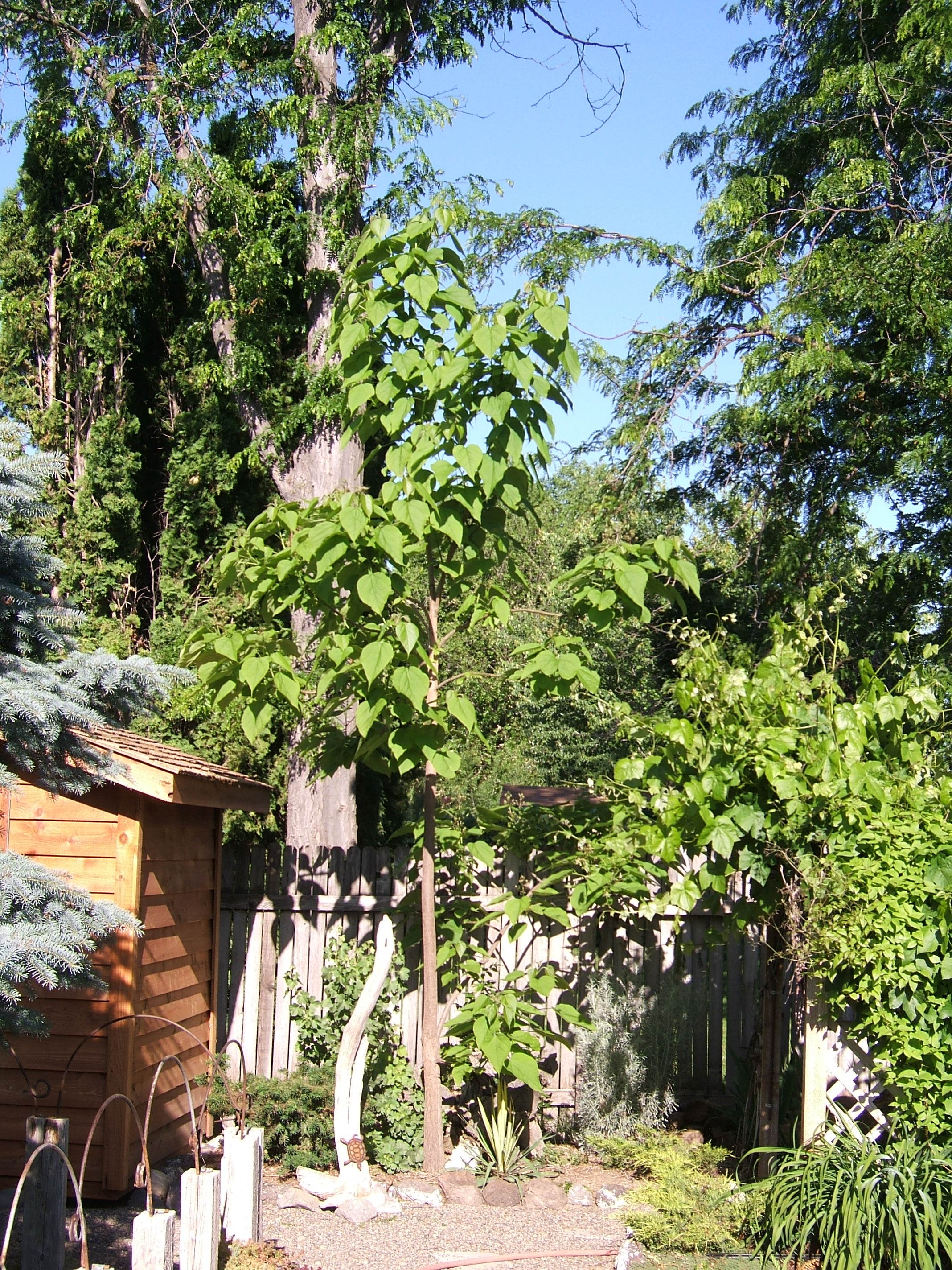
A young, slender trunk-ed, western catalpa tree (the one in the middle with the big elephant-ear type leaves) planted from seed that I stole from a tree in the downtown arboretum.  Why?  Because nurseries around here don’t sell these young trees anymore.  In spite of the fact that they were immensely popular with the Victorian set at the turn of the last century because of their dramatic leaves, stunning early-summer display of unbelievably fragrant white blossoms, and fascinating, rattling, foot-long seed pods, nowadays they’re considered messy.  God forbid a tree should ever drop anything on the ground.   (BTW, did you notice one of the aforementioned big locust trees trying to hide just behind it?  They’re always doing that.)

The lamb’s ears in the container (bottom left) is now lemon thyme, the golden juniper just above it is now a lavender shrub.  But somehow I can’t bring myself to cut out the bigger golden juniper on the right, even though it currently occupies some of the best growing real estate on the property.  It’s like an old, quiet, pleasant, low-maintenance tenant that’s been there forever in a rent-controlled apartment building.  I don’t have the heart to kick it out…so will just have to wait until it dies before I can move somebody else in.  Sigh.

And one last time, “where’s the trellis?”

 This spot next to the front door hasn’t actually changed but I love it so much I’m sticking the photo in here anyway.

One of the two patches of grass left on the property that the hubster has somehow managed to protect from me.  (So far.  It’s still on the endangered list.) 

 And lastly a perennial flower bed next to the driveway, which is slated for mowing so I can slap up a bean trellis instead.

Thanks for joining me on this walk down memory lane!

copyright Dia Osborn 2011

A Blogging Topic That Repels Spammers

In the eternal, unwanted, ebb and flow reality that is spamming-on-the-blog, I’ve noticed something intriguing.  Posts on my main topic of interest…Dying…repel spammers.  (These posts also, unfortunately, repel readers, but let us leave that topic for a brighter day.  Sigh.)

It is oh-so curious, no?

The pattern has just recently become clear to me.  Roughly eighty-five percent of my posts involve something I’ve learned from the dying and the longer I stay on topic, the likelier the flow of spam will trickle off and die. (No pun intended.)  But when I drift off-topic and broach subjects like Arab spring, or annoying Google advertising, or Stihl gas powered pole tree pruners, the velocity of spam immediately increases at a spanking pace.

Spanking, I tell you.

Then I return to my main focus and voila!  All I have to do is write three or more dying-related posts in a row and it crushes the burgeoning torrent of spam as efficiently as Raid on roaches.  Seriously.  It’s just that good.

Even I never dreamed the taboo on speaking about dying was this powerful; that spammers respond to it (in a second hand, traffic sniffing kind of way.)  Who would have thought anything was that strong?  A fascinating and, for once, entirely happy consequence of breaking said taboo.

(Image from Wikipedia)

copyright Dia Osborn 2011

Surprise Worms On The Trash Can…a.m.

I walked into the kitchen this morning to discover a batch of small, white, maggoty-looking worms crawling across the stainless steel lid of the trash can and rolling their plump, fleshy, little way down the sides and across the kitchen floor.  It was disturbing.  Especially coming straight out of a deep sleep.  From my initial fog, I wildly wondered how the stripped carcass of a cooked chicken I’d thrown away last night could possibly decompose that fast.

However, upon reluctantly opening the lid with my latex-glove-protected-hands, instead of the fetid stench I feared my quivering nostrils met an almost minty fresh aroma.  I realized with dawning relief that these were not maggots after all, but a type of garden pest that is usually invisible, hidden within the cell walls of a leaf.  I’ve been battling an infestation of these tiny creatures among my spinach and swiss chard crops, and these ones must have hatched off a bunch of infected leaves I threw in the trash a couple of days ago.

My friends, I give you a rare (low-video quality…sorry!…) glimpse of the leaf miner adult worm stage.

We All Have To Face Our Own Kobayashi Maru

USS Enterprise (NCC-1701)

Trekkies will probably know where I’m going with this.

For everyone else, the Kobayashi Maru comes from the original Star Trek movie series, and is a Star Fleet cadet training exercise that first showed up in the movie The Wrath of KhanIt involves a computer simulation where any Star Fleet cadet aspiring to command a starship winds up confronting the ultimate no-win scenario; a confrontation with an enemy that culminates in the destruction of the ship they’re commanding as well as the death of everyone on board, including the cadet.

In one of my favorite plot twists, a determined James Kirk (image from Wikipedia) manages to sneak in and rewrite the computer program before he takes the test as a way to win the confrontation, but the program was designed as a battle to be lost.  That was the whole point; to determine the true character of a cadet by seeing how they responded to certain death.  After all, as Kirk himself later said when defending the test to a disgruntled cadet, how one deals with death is as important as how one deals with life.

Personally, I don’t think you can separate the two because, for the most part people tend to die the same way they live.  Fighters go out fighting, those with a good sense of humor find something to laugh at, controllers try to control the whole process, co-dependents worry about everybody else, and graceful people surrender with a level of dignity that humbles and awes the rest of us.  Trust me on this one…ALL of the virtues and flaws we cultivate in ourselves through our years of living are going to show up in spades when the dying time arrives.

Working with hospice was like watching people take the Kobayashi Maru, only in real life.  I found myself in the extraordinary position of watching person after person confront the certainty of their own death, and it was…well…it was a thousand things.  It was amazing, curious, humbling, horrible, surprising, heartbreaking, staggering, frightening, illuminating, and inspiring.

Getting the chance to witness and learn from so many different people facing this last and greatest test was a rare, rare! and priceless opportunity.  (…a fact that somehow, almost nobody seems to grasp.  So strange…)  And while everything I learned will unquestionably help me face my own death with greater equanimity, courage, and grace when the time comes, far more importantly it’s helping me to also LIVE MY LIFE with much greater equanimity, courage, and grace until then.

Next to giving birth, working with the dying was…hands down…the most life-affirming, life-nourishing, and life-celebrating thing I’ve ever done.  I could never thank or speak highly enough of the people who allowed me to be with them, there at the end.  It was truly an honor, a privilege, and a gift.

copyright Dia Osborn 2011

How to live the best life? Look back from the future.

Linda, a (clearly) wise and percipient fellow blogger, had this to say in her comment about my last post on writing an obituary:

“…it dawned on me one day, that all the guidance I needed for making choices in life would be to live my life the way I’d like to see it written in an obit.”

Amen.

Now I guess I just need to write an obituary for myself to figure out what, exactly, I’d like it to say.

Thanks Linda!

I Highly Recommend Writing An Obituary Sometime

Mr. B’s wife asked me to write an obituary for the newspaper a couple of days after he died and, seeing as how I would have done anything to help her at that point, I said yes.

Of course I had absolutely no experience with writing obituaries but, having read a few of them over the years, I didn’t think it could be that hard.  The ones I’d seen were mainly a list of pertinent facts laced with a couple of life highlights such as career path, a significant achievement, and maybe a favorite hobby or two.  But then Mrs. B told me that she’d like something non-traditional, to go with Mr. B’s mostly non-traditional life, and I fell off the edge into deep water.

So what did I do?  Why, research of course.  I turned to the world-wide web (what-oh-what did we do before the internet delivered it’s wealth of knowledge and resources right to our fingertips?!), googled How to write an obituary, and found ObituaryGuide.com, a veritable smorgasbord of tips and insights.

I soon discovered that an obituary can be so, so, SO much more than just a list of facts; that at its best it should not only capture the deep essence of a life, it should uplift and inspire anyone who reads it to carry the best of that life forward in their own.  I also discovered that trying to capture the essence of something as vast, complex, paradoxical, sacred, and miraculous as a human life is totally impossible…which meant I was doomed before I started.

But here’s the thing.  Trying to do it anyway thrust me into some strange, bigger kind of place inside myself…a loving  place, a place of sorrow and tremendous joy, a place where maybe I might catch a  glimpse of something as huge as a life essence…and going there made me feel a lot better.  As if I got to borrow a bigger set of eyes for a few hours with which to gaze at the world, at Mr. B’s life, and I had the chance to see how everything looks so much better through eyes that big.  So much more sane, and perfect, and right.

I don’t know if it would work like that for everyone all the time, but I highly recommend giving it a try.  You don’t even have to do for somebody that died.  You could do it for anyone, or for yourself for that matter.  Write it for someone you love or someone you’re pissed at.  Just go for the big eyes, whoever it is, and see what changes.

So anyway, here’s the finished product.  I changed all the names and dates and identifying info to protect the innocent of course.  The “Once upon a time…” at the beginning was removed from the final copy but I’ve put it back in again here because…well, I don’t know why for sure.  Maybe because its the only way I know how to describe the magic and transcendental wonder that was Mr. B’s life.

Bud Skinner

1932-2011

Once upon a time, on July 16, 1932 at Weippe, Idaho, Jesse and “Buzz” Skinner brought a perfect, baby boy into the world.  They named him Matthew Reynold but called him Bud, and he grew up ranging mountainsides, adoring animals, and seeing the world around him as something alive…a neat trick that he never outgrew.  He lost his father at thirteen, then his leg (and almost his life) three years later, but happily chose to survive and afterwards returned to his life with the same generosity, determination, and curiosity that ultimately defined him.

Bud grew up (to 6’8″) and did many intriguing and wonderful things.  He married, had children, and in the 1970’s earned a degree in Computer Science, taking an honored place among the ranks of the earliest computer nerds.  He was a college activist (detained but never charged), an only-child who later found his brothers among the men who were his truest friends, and a man who saw the deepest significance of his life in his relationships with others.

On Friday, after seventy-nine years of grand adventure, learning, setbacks, determination, courage, and grace, Bud died peacefully at home in Boise while gazing into the tender eyes of his wife.  At the last he was cradled in both the laughter and tears of his beloved family.  Everyone should have the opportunity to die so well.

Mr. B. is survived by his wife and devoted basset hound, son and his wife, two daughters and their husbands, and numerous grandchildren and great-grandchildren.

While we’re grateful to many, our special thanks go to Bud’s good friend and doctor, Bill Chris, for helping him keep his health all these years, to “Cuz” Ada Brown for her immeasurable love and care during the last weeks, to Dia for being there with us during Bud’s final hours, and to all his wonderful caregivers too numerous to name.  If he ever called you sweetheart, gave you a hug, or knew your name, then you were a special person to him.

A memorial service will be held at noon on Saturday, at the Memorial Funeral Chapel in Boise.  There will be a reception immediately following.

Rather than flowers, Bud would have preferred donations to any organization dedicated to reducing suffering.  Or better yet, the next time you see anyone struggling with a heavy load, stop, smile, lend them a hand, and then gently suggest that they “pay it forward.”  Bud’s vision was for a world growing in an ever-widening circle of tolerance, compassion, and kindness.  It was a vision he worked toward in his own life.  Continuing that effort in yours would be a very high tribute indeed.

copyright Dia Osborn 2011

Old People Know A LOT

Photo by Diego Grez

Here’s a tiny smattering of things I learned from the elderly hospice patients I worked with…

1. how to run a table saw

2. an effective home remedy for the 1918 bird flu pandemic

3. how to trade options in the stock market

4. how to stay safe in the box car when jumping a train

5. how to celebrate a traditional Bavarian yuletide

6. the absolute necessity of paying off a home mortgage

7. how to stack dead bodies after an attack on home soil

8. how an iron lung works

9. what the bedding was made out of in a concentration camp

10. how much stronger we are than I ever, EVER imagined.

copyright Dia Osborn 2011

A Curious, Amazing Thing That Often Happens Just Before Death

Image by Vlado

Both the hubster and I were there with the family, at the house, when our good friend, Mr. B, died a couple weeks ago, and I wanted to tell you about something amazing that happened right before he passed.  Actually, this type of dying event is common and it frequently (certainly in every case that I’ve been involved with) lifts the spirits of those who are there to witness it.

It was nearing the end and Mr. B had been unconscious for close to a day and a half.  The hubster, driven by the common, but often unspoken, instinct displayed by loved ones to never leave their dying person alone, was taking his turn sitting beside the bed and holding Mr. B.’s hand.  The family was scattered throughout the house, cleaning up from breakfast, while Mrs. B was on the other side of the room discussing something with their son.  She’d just finished and was walking past the bed on her way out to the kitchen when Mr. B. suddenly, the hubster later told me excitedly, squeezed his hand.

Hard.

“Like this!” he said, grabbing my hand and crushing it in a way that sent shooting pains up my arm.

“Ow!”  I snatched my hand away and glared at him.  “That hurts!”

“I know!” the hubster started nodding vigorously, relieved that I got it. “That’s just what it was like!  He did that to me, too!”

And suddenly I did get it, and I was amazed.  My mind flew back to the last hour when Mr. B. lay there helpless and still; pale, shrunken, and almost gone.  He’d grown so weak he fell into a final coma from which he couldn’t seem to climb back out, but then somehow…in that last minute…he powered back up anyway.  He’d grabbed onto the only thing available, the husbster’s hand, and squeezed it so hard that the hubster had to sit up and pay attention.

“He opened his eyes and locked onto mine…and I just panicked,” the hubster admitted.  “I didn’t know what was going on but I sure didn’t feel like I was the last thing he needed to see.  So I called Mrs. B. and she was right behind me.  She sat down and took his hand, spoke to him gently telling him she was there, and then a few seconds later Mr. B died while gazing into her eyes.”

The husbster paused, reflecting for a moment, then looked at me and said, “I feel like that’s what he really wanted, y’know?  That’s why he squeezed my hand.  He knew it was time to go and he wanted me to get Mrs. B. for him.”

Later, Mrs. B told me the same thing.

“It happened just as I was walking past the bed,” she mused.  “I think he knew it.  I think that’s why he made his move right at that moment.  He wanted to tell me good-bye.”

It’s well known within hospice circles that the dying are far more aware of and, in a lot of cases, far more involved in the timing of their actual departure, than most people realize.  Hearing seems to be the last sense to go and the dying often still respond to auditory stimuli…familiar voices, favorite music, sensitive information (which is why it’s so important to exercise caution when speaking within their hearing btw), etc….even from the depths of coma.

I love this…the fact that our relationships with one another don’t just stop because one of us loses consciousness.  The connections we build are so much more complex, beautiful, delicate, and tenacious than that.  It often feels…there in the rooms of the dying…like some vast and luminous web has been spun around us, supporting and binding us at a thousand, twinkling, alternate, junction points so that, even if we can no longer speak or see or touch, our love still travels easily along the other pathways, the ones that haven’t collapsed.

My mother awakened in her last moments, too (even though that was scientifically impossible with all the heavy sedation she was under,) her eyes opening for one last, brief glimpse as my brother read a passage aloud from the Upanishads.  My grandmother was decidedly more active about her’s.  After three days of coma (and six solid hours of heavy labor where she seemed to be stuck in her body and unable to leave) she finally sucked in one last, mighty breath, opened her eyes, and let out a yell on the exhale, as though she’d stripped off her helmet, mounted the sound, and was riding it wildly out of her own mouth in a last, triumphant charge.   I remember how I sat there stunned for a moment…and then burst out laughing.  With relief.  With applause.  With joy.

But my favorite story, the one that always cracks everyone up, involves the last moments of The Feisty One, an elderly German woman whose final words probably best sum up the sheer shock-and-awe effect of the transition from life into death.  She was what we call a colorful character; a regal prima donna who commanded everyone, was disdainful of doctors, dismissed all the symptoms of her decline with contempt, and who kept telling me that really, it was all just a bad case of constipation and she’d be up and around again soon. 

And then, she insisted, I’m going to cook you a real German meal.

I adored this woman.

Her daughter-in-law was the one who told me the story of The Feisty One’s last moments.  How she’d had a burst of energy and talked for something like fifteen hours straight, all through the night and well into the following morning, before falling into a coma.  How she then just lay there, finally quiet, for a day and a half, her breathing growing increasingly labored and shallow.  And then how, right at the end, she drew one last breath and opened her eyes again, staring at them all in complete surprise, before exclaiming, “Shit…SHIT!…SHIT!!!”  After which she collapsed back against the pillows again and promptly died.

I can only imagine how those may very well be my own sentiments exactly some day.

copyright Dia Osborn 2011

Jack Kevorkian: The Elephant Is Still In The Room

Jacob “Jack” Kevorkian

May 26, 1928– June 3, 2011

Jack Kevorkian, the outspoken, determined, abrasive champion of physician-assisted suicide died last Friday in a Detroit area hospital.  He was 83 years old and died of natural causes.  He took on one of the most thankless jobs around…trying to get people to actually talk-and-do something constructive about how we die.  I’d like to sincerely honor him for his efforts in that direction, however controversial his methods, as well as wish him a smoother journey going forward than he had while he was here.

May you rest in peace, Dr. Kavorkian.  Thanks for having the courage to try and do something.  You were braver than most.

The tone of the articles I’ve read so far is all over the map.  A few roundly condemn him,  a few unapologetically celebrate him, most fall somewhere in between.  And I guess that’s appropriate considering the terrifying nature of the subject he tried to force the American public to face and address.  This quote from The New York Times article summed it up best for me:

 But Jack Lessenberry, a prominent Michigan journalist who closely covered Dr. Kevorkian’s one-man campaign, said: “Jack Kevorkian, faults and all, was a major force for good in this society. He forced us to pay attention to one of the biggest elephants in society’s living room: the fact that today vast numbers of people are alive who would rather be dead, who have lives not worth living.”

(Well, I’m not sure about vast numbers, but certainly more than there should be.)

Personally?  I admire the man for his bulldog tenacity in trying to make us look at how we treat those who are dying.  Back in the 90’s the terminally ill were holding the very shortest of straws, and really, somebody had to stand up and fight for them.  Kudos to Jack for being willing to put the target on his back.

But as far as his solution of physician-assisted suicide is concerned, I tend to lean more towards the view of Ira Byock, the Director of Palliative Medicine at Dartmouth–Hitchcock Medical Center and one of the most powerful voices out there calling for more aggressive care of the terminally ill.  In a 1994 paper he said that, while Kevorkian addressed the right problem, he proposed the wrong solution:

The problem is that of unmet suffering – indeed, unaddressed suffering – among many of the terminally ill in this country. Kevorkian deserves credit for loudly calling attention to this situation in a manner that the public – and the medical profession – finally can no longer avoid.

…This regrettable frequency of uncontrolled symptoms exists because of a critical deficiency of medical education as well as a lack of commitment on the part of established medicine to do whatever is necessary to alleviate the distress of the dying. The requisite knowledge, medicines, techniques and technology exist; they are simply not being applied. Physicians who do not aggressively respond to anguish among their dying patients deserve the sternest professional sanctions.

I think that the main thing Dr. Kavorkian was fighting for, access to a humane death, has been accomplished with the advances we’ve seen in hospice and palliative care in the last couple of decades.  In hospice care there are already established protocols in place that allow the possibility of medicating a dying person enough to successfully control their pain and suffering, even if it involves death as a possible outcome.  (That’s a whole other blog post that I’ll tackle soon.) For now, the biggest problem I see is that the majority of people still aren’t using hospice and palliative care services anywhere near enough.

To address this problem I’d like to see more aggressive steps taken to:

1) see that both hospice and palliative care services are made more universally available,

2) get more doctors to recommend their use earlier in the process, and

3) educate the general population on what hospice and palliative care really do so they’ll more readily turn to them when the appropriate time comes.

The conversation about dying in this country has come light years since Jack Kavorkian first forced us to start talking, but overall the topic remains an elephant looming large and untended in the room.

Personally, the idea of legalizing assisted-suicide makes me a little nervous.  It’s not a moral issue for me, it’s a social one.  As David Callahan mentions in The Troubled Dream of Life, we already have three other ways we get to legally kill one another (war, capital punishment, and self-defense) and for all our sakes, I’d rather be shrinking than growing this list.  Social fabrics are fragile under the best of circumstances.  I can’t help but feel it would be wise to proceed with caution and have a much more open, reasonable, and in-depth public conversation before we decide.

copyright Dia Osborn 2011

related articles:

Jack Kavorkian Dies at 83, Slate Magazine

Letting Go, The New Yorker

Telling The Truth Isn’t Just Hard, Sometimes It’s Deadly

La Vérité (“Truth”) by Jules Joseph Lefebvre

This is a must-see for all of us writing to inform or educate.  The Committee to Protect Journalists (CPJ) has just released the 2011 Impunity Index (Getting Away With Murder) and it’s both a disturbing and enlightening read.  Evidently they publish this every year (this is the first year I’ve seen it) and it highlights the countries in the world that are most dangerous for journalists based on how many of their murders remain unsolved.    There’s a world map at the top which you can scroll over to see where the cited nations rank.

We all know that speaking up when others want you to keep your mouth shut is frightening and hard.  You can easily become the target for a whole lot of anger (trust me on this one if you don’t already know yourself) but imagine living in a part of the world where you could actually be gunned down in a parking lot in front of your child for telling the truth, and where the person who murdered you wouldn’t even be prosecuted much less punished.  I was really surprised to learn that Brazil (#12) and India (#13), two of the BRIC countries and rising economic powerhouses wielding a growing amount of political clout, were on the list.  I was pleasantly surprised to see that Russia (#9) is improving, and not surprised to see that  Mexico’s (#8) situation is deteriorating.

Actually, everyone should care a lot about this, not just writers and journalists.  Why?

CPJ research shows that deadly, unpunished violence against journalists often leads to vast self-censorship in the rest of the press corps. From Somalia to Mexico, CPJ has found that journalists avoid sensitive topics, leave the profession, or flee their homeland to escape violent retribution.

Censorship and corruption go hand in hand.  You never have one without the other.  Ever.  He who controls the flow of information, controls everything.  Which is precisely why journalists who report on their activities are now the number one target of drug cartels in Mexico.  And the result is predictable.  The remaining journalists have drastically curtailed their coverage…self-censoring in order to survive…and the cartels have been subsequently strengthened by the expanding cloak of silence.  As things gets worse down there, we’re hearing less and less of the details and it’s already starting to spill over the borders into this country.

Freedom of speech is not just about being able to express ourselves on blogs and Twitter and Facebook, although those things are important, too.  At it’s core it’s about protecting our communities and nations, our fundamental freedoms and human rights, from those who would corrupt them.  Media bashing has been something of a blood sport for the last few years, but that’s probably an attitude we should rethink.  Corruption is popping up everywhere in the world right now, including right here at home, and we need all our journalists and the agencies that support them if we intend to keep our freedoms.

Things to do?  Thank a journalist.  Support CPJ.  But probably the most important thing of all?  Practice speaking up ourselves when it’s hard….challenge a bully or respectfully offer a different point of view in a heated conversation…and then try to listen when others do the same.  The most important truth in the world is utterly useless if we all close our ears and refuse to listen.

copyright Dia Osborn 2011

 

The Laughter and Sorrow of Being There

Luna Moth

I’d forgotten…how much better it is to be there when someone dies, than not.

Our dear friend Mr. B died at home, surrounded by those who loved him, last Sunday morning…which was actually pretty fast.  The doctors said he’d have more time, but then I’ve found that doctors usually overestimate;  partly because they feel it’s kinder and partly because they tend, personally, to be more afraid of death than the rest of us.

But Mr. B was glad it didn’t take as long as they said it would.  After four grueling, futile months of rotating between hospital, rehab center, and wound care center he was more than ready to move on.  He was grateful.

That’s the often overlooked gift of extended suffering.  Horrible as it is, there’s simply nothing like it for helping us let go of this otherwise far too rare and luminous world.  If something didn’t come along to tarnish the glow and loosen our grip, dying could (and sometimes does) drag on forever in this current age of limitless medical intervention.

Mr. B and his beautiful wife, Mrs. B, wanted the hubster and I to come and be there with the family during the passage; to help, to laugh, to cry, to steady, to witness.  I was surprised, deeply touched, and thrilled.  I love “a good death”; the kind that happens when someone dies prepared, surrendered, and surrounded.  There’s something potent and magical that happens when a family assembles to lift and love one of its members through the final transition,  something mystical and disorienting that occurs when a body and the life that inhabited it whisper farewell and break their long embrace.  Standing as witness to these things both shatters and transforms me, every time; actually it shatters and transforms everyone that’s lucky enough to be there.

Strangely enough, this…the good and healing part of dying…is the aspect I somehow forget about in between.  I’m not sure why exactly.  Maybe because, in spite of its potency, the experience is nevertheless fleeting and insubstantial and therefore easily overshadowed once it’s past.  Or maybe I forget because this part has become so invisible in our culture of death aversion that’s its just hard to hang onto.  I don’t know.

What I do know is that there’s an energy, a force generated during a good death that both cuts and cauterizes simultaneously.  It mauls me extensively, each time, but then it lays eggs of some vast and tender love there in the wound itself, as if it was some horrible yet sublime parasite, transforming me against my will into something better.   Someone more courageous, caring, and gentle.  Somebody wiser.

I think that was the gift Mr. B. wanted for me..for all of us.  I think that underneath everything else that was going on, somehow he intuitively understood that giving us all a good death would make the gaping hole after he left easier to survive.  Easier to recover and return from.  He used his own dying to create a final, profoundly generous, and life-affirming act.

copyright Dia Osborn 2011