That’s Just Anthropomorphism

the north wind

(This is actually taken from something I wrote in my journal last summer but it feels current again today.  I figured I’d polish it up and use it as my post for this week.  Dia)

The college I attended taught on the block system.  During the first year, we studied one subject at a time, eight hours a day, all week long, after which we tested on Friday and moved on to the next subject the following Monday.  It was intense.  Especially with a boring teacher.  So sometimes, toward the end of any given week when I couldn’t handle being stuck up in my head anymore (focused! thinking! analyzing!), I’d ditch class, borrow somebody’s car, head off to a state park about an hour away, and spend the next few hours hiking a forest trail around the lake.

And there, in that beautiful, silent place, the magic would inevitably happen.

Initially, I’d still feel disconnected, trapped in my thoughts and bouncing around the inside of my skull.  The chattering voices in there (teacher! students! educate! argue! question!) were so gripping they actually blinded me.  I couldn’t see the trees or hear the forest sounds around me for the first mile or so.  But then they’d start to drop off, those voices, one by one.  They’d get quieter and quieter until finally (miraculously!) they’d shut up completely.  I’d look up and finally see the waving canopy of green, hear the cicadas and wind and bird calls.  And that was the point when I’d feel all of a piece again.  Whole.  Quiet and tired and happy.

That Focused-Controlling-Thinking-Person-Up-In-My-Head would have disappeared and I’d just be myself.

Even back then, before the depression, anxiety, and deterioration that marked so much of my middle years, it felt like something extraordinary was happening.  Something I never really understood but sought out anyway, time after time.  There’s always been an old, cunning thing in my gut that knows where healing is stashed for me.  Out in the woods.  Up in the mountains.  Under the sky.

Nature’s always been the place where I never felt alone.

But my mind doesn’t give up dominance easily (the downside of having been born with a strong intellect that got a lot of encouragement.)  At first it’s fun, thinking about things.  It’s like flying.  Exhilarating and soaring and free.  But eventually, when I get tired or stressed or just spend too much time in front of the computer, they turn on me, these thoughts.  They lure me down from the sky with juicy chunks of rabbit meat and when I land, they slip a hood over my head, turning off my eyes and ears, even my sense of smell and touch.  The thoughts get so loud (so big!) that they cut me off from the beautiful, rich world around me and, no matter where I am or who I’m with, after that I feel alone.  Like I barely have a body anymore and my noisy, escalating brain activity is all there is left.

It would be really horrible except that, when I’m locked up in my head like that, I can’t feel anything.

Yesterday it was like that.  I’d been writing all day and the outside world had disappeared again like it does, swept away by an ever-swelling torrent of words and ideas.  My mind was tired and over-stimulated.  It would not (not!) shut up.  And then, as if it wasn’t bad enough, THAT voice showed up.

THAT voice is the worst voice in my head.  It’s horrible.  Crushing.  Relentless.  It’s ambitious and proud, glittering, intoxicating, and sophisticated.  It puffs itself up like some giant bird trying to make me think it’s important! and official! and true!  It tells me that I’m a writer (a writer!) with important things to say that other people need to hear, need to know, need to learn (from me!) and it tells me to compete and study and work my craft and be more professional and what the hell is wrong with me anyway that I can’t finish a project or get something published like everyone else?  (Everyone I tell you!  Everyone!)

It’s a miserable, fucking voice that sucks the heart and soul right out of me.  It makes the real me, the one who lives down, down in there somewhere deep, the one who believes that words are like pixie dust, who loves walking up in the hills and touching wounds gently (gently!) and is sooooo curious that sometimes it’s hard to even go to sleep—it makes her want to curl up in a ball and cover her head with her arms and tell that horrible, horrible voice to just go away and leave me alone.  It makes me not even want to write anymore, or care about anything, because if I do then THAT voice will come and take it over.  Take all my caring about things and try to turn it into something else—something powerful or profitable or influential.  Something other people will want or envy.  Something it can leverage or dangle or sell.

THAT voice makes me dry up.  Like a leaf that fell off its branch and now just lies there on the ground, shriveling.  I really, really hate it.

It showed up yesterday again so I did what I’ve always done.   I ran away to the hills.  I took Dane, left civilization behind me, parked at the bottom of a hill and started to climb.  I slipped out of the  cage in my head and skittered away, bent double, dodging under mental shrubbery where that miserable, fucking voice couldn’t find me, until I was finally out of range and free.  Then I looked up and suddenly I could see again.  The real world was there around me, with all my friends.  All the wildish life that the cunning thing in my gut knows and trusts and returns to every time.

There was sagebrush and dust puffs and stink bugs aiming their rear ends at the sky.  The ranging hills were there with all their shadows, and the clouds streaked with pink edges from sunset.  There were grasshoppers everywhere, and purple thistle just coming into bloom.  There was yarrow, St. John’s wort, distant mountains, and the peeping of ground squirrels, and as I climbed higher I gradually remembered that all these things are my friends.  They’re not just bushes, bugs, and rodents, great big mineral piles and water vapor reflecting the last rays of sunlight.  They’re my true companions on this journey through life,  the essential, necessary others in my fellowship, the friends without whom none of this is worthwhile or has any meaning.

Without them, there’s no point in writing anything anymore.

I know, scientifically speaking, that this way of looking at the natural world is naive and superstitious and stupid.  THAT voice sniffs and says That’s just anthropomorphism. But I don’t care.  I know I’m not supposed to look at these things as truly alive.  I understand I’m supposed to see them as inferior and less-than.  Brainless.  Non-human.  Stuff to be used or exploited or destroyed for what we want.

But I don’t believe that.  They don’t look that way to me.  They never have.  From my earliest memories the natural world has always been real.  The place where nothing lies to me and I never feel wrong or unwelcome.  Where I can finally (finally!) relax because when I’m there, the odd way I love the world and everything in it…the living and dying and dead…is actually okay and perfect.

It’s where just caring about things, just touching wounds gently, just being forever curious, is enough.

a wood carving we saw at the end of a driveway in the Olympic rainforest

copyright 2011 Dia Osborn

Awards Season

Here’s a tag-you’re-it kind of award that’s a lot of fun.  Bloggers nominate other bloggers, and then anyone who receives the honor has to write a list of seven (eight? ten? it’s all over the map) things about themself that they haven’t disclosed before.

Well, yesterday I was nominated by the ever-so-stylish, great poultry protector, John Gray of Going Gently fame.  So in the spirit of the game, here are ten things about me you probably didn’t know:

1)  Back in the old days, my grandfather was the accountant  for, among a number of other local businesses, three of the brothels in the small, western town where my mother grew up.  One day while he was working on the books at one of these establishments, my grandmother realized she needed him to run an errand for her.  So she called over to the house and, when a woman answered the phone, asked if Gus was there.  The woman said No without missing a beat.  My grandmother got flustered and replied, But…Gus is my husband.  He told me he’d be there. After which the woman on the other end of the line repeated Nope.  Sorry.  No Gus here. It was only then my grandmother realized her mistake and started laughing.  Oh no, she informed the woman, Gus isn’t a customer, he’s your accountant.  He’s working on the books today and I need him to pick up a loaf of bread on the way home. The other woman relaxed and started laughing, too, after which she told my grandmother she’d be happy to deliver the message.

c. 1890

2)  I once went barefoot for four years and could put out cigarettes with the soles of my feet.

3)  I gave birth to both my kids at home.

4)  My mother went to an ashram in India to study with a saint when I was twelve.  Afterwards, she was rumored to be enlightened.  My father was career military and went into special ops after he retired.  He was rumored to be part of a hit squad.

5)  I’ve been to all fifty U.S. states, Canada, and deep into Mexico.  I love this continent and it’s people with all my heart.

6)  I won awards for my sculpting in papier mache and displayed in galleries.  Never sold much though.

7)  I taught trampoline.

8)  I adore the hubster.

9)  I used to type faster than the wind and was always in demand as a secretary.

IBM Selectric

10)  Andy Kaufman once did a private comedy show for me, but it was out of context and I didn’t really get it.  It wasn’t until years later, after Man On The Moon, that I finally realized just how funny he was.  I still think he had the kindest eyes I’ve ever seen.

image from Wikipedia

And now, passing the baton, I’d like to nominate Janet over at her cracking blog My Brother Andrew, where she’s raising money for research into Motor Neuron Disease (MND), and Linda at What Comes Next? who fearlessly and fluently tackles whatever topic comes her way.  Your turn girls.  Good luck!

copyright Dia Osborn 2011

Buoyancy, A Curious Japanese Ritual, and Admitting Confusion

IMDb

Today I hurt.  In pursuit of my timid triathlon quest I lifted weights yesterday, so today it’s harder to lift anything else.  And once I finished the round of weights, I went down to the pool to swim laps for the first time in over a decade and made an awkward discovery.  Most people probably already know this but it turns out fat is really buoyant.  I mean really. There are about sixty pounds or so standing in between me and my old fighting weight and, gauging from the way my body responded to the water yesterday, I think most of it is in my butt.  I may as well have had a life-preserver strapped to it.  Or an inflatable boat.  No matter how deep I dove or how hard I kicked to stay down there, my rear-end inevitably led back up to the surface like a drowning person seeking air.  It was embarrassing.  The self-delusion I’ve clung to over the years took a critical (necessary?) hit and now I’m forced to admit there is nothing, nothing, sleek left about my body.

The poor dear.  I owe her big time.

And now on to what I really wanted to talk about in this post.  There was a powerful insight I had while watching the Japanese  film “Departures” a couple of weeks ago but the problem is, I’m still not exactly sure what it was.  (Actually, I feel kind of like a quote I found once in a whole oats forum: The answers we found only served to raise a whole new set of questions.  We’re as confused as ever, but we believe we’re now confused on a higher level and about more important things.) Please bear with me here while I struggle to explain this.  For starters, there are a few things I do know about the insight.  For instance, it was a big one.  It felt like it might explain a lot of what I’ve been trying to communicate about dying in this blog.  It’s also continued to eat at me because I suspect understanding this one insight could go a long way toward easing the excess terror a lot of people feel about dying these days.

But what is it exactly?  Well, to explain that I need to describe three of the scenes that triggered the insight.  But Spoiler Alert:  If you haven’t seen the movie yet, these scenes will give a major part of the plot away.

Ready to go ahead anyway?  Okay.  Here we go.

The first is a scene where the main character, Daigo (who’s taken employment as someone who reverently prepares the bodies of the dead for cremation) meets an old childhood friend on the street.  The friend has his family with him and Daigo stops to greet them.  But the friend gruffly sends his wife and child on up the street without introducing them, telling Daigo that he knows he’s working with the dead and therefore wants nothing to do with him.  He ends the encounter saying something like  “get yourself a decent job” before walking away.

The second scene involves the death of this old friend’s elderly mother.  Daigo is asked to perform the “encoffining” ceremony for her; an exquisite, formalized, Japanese ritual of bathing and dressing the deceased in front of the watching family.  By the time this scene arrives in the movie, we’ve already witnessed the profound and often healing influence this ceremony has on the families, so we’re expectant that something similar is about to happen to Daigo’s friend.

And we’re not disappointed.  True to form, as he watches Daigo not only restore the dignity to his mother’s body that death stripped from it, but also elevate it to an almost transcendent state of beauty, the friend’s perception of  Daigo’s work transforms.  We all watch as the childhood friend finally “gets it.”  He’s moved.  He weeps, and he thanks Daigo for the gift he’s given his whole family.

Then, in the third scene, Daigo visits the recently deceased body of the father who abandoned him in early childhood.  He stands in a strange room gazing down at a body he doesn’t recognize and with which, other than anger, he feels no emotional ties.  Suddenly, two men hurry into the room hauling a cheap coffin.  They set it down, seize the shoulders and feet of the body, and start to heave it into the box.

We’re all shocked.  This time there is no beautiful, reverent ceremony.   No respect for the family standing in observance.  No restoration of dignity to the body or anything else for that matter.  Quite the opposite.  The actions of the two men only deepen the natural horror that always goes with the violent severance of life.  They treat the body as a “thing.”  As so much trash or waste to be collected, dumped, and burned.  Far from providing healing, this callousness threatens to increase Daigo’s trauma.

Needless to say he’s outraged and this heat transforms his wound.  He stops the men mid-transfer, and drives them away.  Then he kneels down beside the body to perform the ceremony of encoffining, and in so doing finally finds the healing for himself that he’s provided for so many other families.

These scenes were aching, beautiful, and real for me.  I recognized the peculiar transformation of healing that can come through deep pain, because I often saw the same thing in my work with hospice.

And…suddenly…I’m realizing I’ve misunderstood what the source of that healing really is.  All this time, I’ve thought it was caused by the power of the dying process itself, but it’s not.  It’s more than that.

Dying generates an enormous, surging wave of energy that sweeps through the lives of everyone involved.  It’s like a tsunami of upheaval, destruction, and change; physically, mentally, emotionally, spiritually, and socially.  The sheer magnitude of the energy involved inevitably wrenches and devastates to some degree, even with a relatively benign death.  The natural, physical violence involved as a body dies dictates that.  Dying as an energy is a lot like nuclear power or the roiling energy of the sun.  It’s an elemental force of nature.

I’ve mistakenly assumed that the positive transformations portrayed in the movie, the kind I often saw in my hospice work, were built into the dying process itself.  But now I’m thinking not so much.  The energy of dying is neutral.  It doesn’t care how we feel about it.  It doesn’t care whether it traumatizes us or not.  It doesn’t care if we face it with courage and respect, or run away from it horrified and screaming.  Healing us is not its job, anymore than it’s the sun’s job to make sure our houses are warm.  The power dying generates has the potential to heal, of course, but it probably won’t unless we learn how to harness  and direct it.

In Departures, Daigo shows us one way to harness it; with respect, willingness, humility, compassion, and tremendous courage.

The movie puts a concrete face on the beauty, dignity, grace, and healing that can accompany dying and death, something that I’ve been trying to describe in this blog for a while.  (With questionable success.)   And the movie does so without romanticizing or hiding the gruesome, gritty realities that are also involved.  There are a couple of graphic scenes (skillfully deployed with humor) which add something critically important.  The truth is that dying and death are primarily energies of destruction.  Yes, they’re still crucial to the world if there’s going to be enough room and resources left for all the new life yet to come, but that fact doesn’t tend to make the graphic nature of it all easier.  It’s important to learn the tools we can use to manage the graphic elements involved, things like humor, reverence, and building a bigger context.

There’s a deep paradox embedded in our nation’s perspective about dying.  On the one hand, our national eyes look at it through a scientific medical paradigm through which we’ve increasingly grown to see dying as a failure and a waste.  Now, I don’t in any way mean to dismiss the profound gifts that medical advances have brought to our lives or suggest that we should ever return to a world without them.  However, it’s important to understand that the lens of technology we’ve adopted has created a growing distortion in our expectations about death.  In attempting to reduce it from a universal force of nature to the level of a technological glitch, we’ve objectified dying in much the same way that the two men in the third scene objectified the body of Daigo’s father.  These days, in both medical research and public awareness, we increasingly see death as a mess and a waste, and we tend to treat it with a corresponding aggressiveness, disrespect, and callousness as we attempt to conquer and eliminate it.

But something else entirely is taking place on the individual level.  While our societal consciousness reels in a kind of perpetual horror of dying, I’ve met so many individuals whose lives have been touched in a beautiful, dignified way by the death of someone they loved, usually because of the help and guidance they received from a hospice or other agency that (in direct opposition to the scientific medical view) perceived dying as an incredibly valuable time of life.  These people I met had been through hell, no question.  But they’d also learned how to see what was happening through eyes of respect.  During their difficult journeys they were allowed and encouraged to unleash the fullest extent of their love, even in the face of unalterable and permanent separation.  To varying degrees, they had each tasted what it was like to rage, to long, to grieve, to laugh, to tremble, to hope, to ache, to collapse, and then to survive and come through a deep, irreparable loss within a circle of respect and safety, holding the hands of others who didn’t minimize, dismiss, or pull back from their experience.

This paradox between a technological perspective and a reverent one is, on a deep level, tearing us apart.  Our scientific determination to conquer death is engaged in a ferocious battle with our deep human desire to die a peaceful one and, even though we know deep down that we can’t have both, we still throw all our considerable resources at the first goal, and then bitterly fight over what policies to set that can guarantee the second.

It’s made us a little schizophrenic.

I don’t pretend to know what the solution to the conflict will be.  That’s something that only time, growth, and group wisdom can reveal.

But I do know what’s helping me climb out of the clash.  In a lot of ways I felt like my job with hospice was similar to Daigo’s, only I did mine with the living.  I bathed and dressed and prepared them, too, with as much reverence and respect as I could muster, and I did my best, minute by minute, hour by hour, and day by day, to restore the people who were dying and the people who loved them to a sense of their own dignity, courage, and strength.   I know it was something I never would have learned how to do without the help of my mentors…the experienced hospice staff who taught me…and I also know that I really want to figure out some way to pass their gift to me downstream.

Which is why I recommend this movie so highly.  Because I think it can help.  If you ever get a chance, give it a look.  Departures.

copyright 2011 Dia Osborn

Surprise Raptor Visits

Here’s odd.

Yesterday, I was sitting, temporarily distracted, at my desk, gazing out the sliding glass door into the garden while chatting with the hubster on the phone.  All of a sudden the finches and Oregon Juncos scattered wildly off the hanging bird feeder as a red-tailed hawk swooped down and landed on top of it.

Now, just so you know, this kind of thing doesn’t usually happen around here.  We live in a tract home near the center of a small town.  We have a ‘burban back yard that, yes, has lots of trees but, no, doesn’t qualify by any stretch of the imagination as raptor habitat.  So having a big ole’ hawk fly in, land, and pose a scant ten feet away was rare and momentous.  For me, oh great adorer of all things wild, it was akin to an angel sighting.  I was struck.  Moved.  Awed.

And then it flew away again.  The warp in the time/space continuum righted itself, and the world returned to normal.

But then this morning I got an email from some friends who live outside the next small town over:

“…We’re inside out of the cold and I hear a scratching sound that sounds like a cat scratching on the wall….I turn around looking behind me and at that time Nola say’s “oh my god It’s an Eagle” We look through the glass door and sure enough it’s a huge Golden Eagle standing on the railing working it’s claws…..It turns it’s upper body takes a real good look at us and like slow motion bends it’s legs straight down and just launches straight up expands it’s massive wings catching some air and glides away..Didn’t even flap it’s wings…it was incredible.  Pure deep golden brown.. Looked extremely healthy…..we are still smiling…”

And now I’m struck, moved, and awed all over again.  (And a little jealous.  THEY got an eagle.)  I wonder what’s going on?  We’re having some strange weather right now, way too warm with lots of rain that’s melting all the mountain snow prematurely.  Low areas are flooding and I’ve seen numerous hawks flying over the hills where I walk Dane the Mangy Rescue Mutt every day.   Usually, they don’t return until spring.  Has the unseasonal warmth tricked them?  The scientific part of my mind is intrigued.

But there’s this older thing down inside me, too, perhaps in my brain stem (involuntary body control) or amygdala (emotions and memory) that greets these wild creatures as messengers.  When this old thing stirs and rises, it often feels like something uncoiling in my stomach.  There are certain kinds of stimuli that tend do activate it, like hearing a hawk cry echo off the hills, or when a dry puff of wind brushes loose hair across my neck, or when something rustles in the dark, or when I sense a potential pattern  in the smattering of random events that populate my day.  It’s an involuntary, physiological response that I’ve had since I was a child, one that I’ve always just accepted and carried around with me in my pocket like a knife or a compass.  It’s a valued tool and  I like it.  I listen because it tells me things about the world that I need to know, things my busy conscious mind doesn’t usually notice.  It whispers stories about big things and old ways, warns me when I’m in danger, tells me when I need to pay attention because something important is happening.

It uncoiled yesterday when the hawk came, then again this morning when I heard about the eagle, whispering something about wild things calling.  It filled me with a deep sense of longing.  I think I’ll take Dane and head back up into the hills now, climb the ridge to the top of Widowmaker where I’m finally alone with nothing but mountain ranges stretching across the horizons.  I need to climb today, up into the wind and sage brush and sun and silence, where I can shake off the world, take my mind, and throw it far away up into the sky.  Let it soar for a while.

The red-tailed hawk told me so.

image from Wikipedia

copyright Dia Osborn 2011

I have a secret.

I think I may want to do a triathlon.

There.  It’s not a secret anymore. (How scary.)  I haven’t gotten to the point where I’m firmly committed though.  Don’t go getting all supportive.  I can’t just come out and boldly state I’M GOING TO DO A TRIATHLON yet, because the only-slightly-open-to-the-idea part of me who’s standing there perusing the brochure would startle, slide to the back of the crowd, and head straight home.  No.  I have to sneak up on her.  I have to peek over her shoulder and nonchalantly say Hey, a triathlon eh?  Interesting idea.  Think you’ll do it? No pressure.  No energy on it.  Just detached interest and vague agreement.  I have to enroll her in this and it may not be easy.

To be honest, even just thinking about it as a remote possibility is surprisingly emotional.  It’s strange.  It’s like how I imagine a woman might feel who long since gave up trying to have a baby, but then suddenly considered trying to conceive again.  The idea is fraught with the possibility of a lot of renewed pain, so I have to approach it carefully.

I’ve been pretty lost where my body is concerned for about a decade now.  Long, long ago and far, far away, in a mythic land of youth and pre-depression, I was a finely-tuned athlete.  At various times in my life I swam competitively, played tennis and championship field hockey, and as a gymnast was once invited to a training camp for the Olympics.  (I chickened out.  I’m athletic but not terribly competitive which was always hard on my coaches.)  I used to run for miles every morning for the joy of it, do twelve hour day-hikes through mountainous terrain alone, and if the tiny college I attended had only had a dance department I would have graduated with a useless degree in Tap and Modern instead of the useless degree in Literature I have today.

But then the depression came along, and for the next nineteen years or so it relentlessly ate away at my natural energy and drive.  Then perimenopause jumped onto the pile, too.  For a while I still had the advantage of strength and sheer momentum to keep me staggering ahead but, with the other two double-teaming me, eventually my body gave in and collapsed to the mat.  The weight kept increasing, the fatigue took over, my joints started to hurt, and it finally just seemed easier to give up and put it all behind me.  The old activities became distant memories.  All that remained were my daily jaunts back in the hills with our gradual succession of dogs.

(I think anyone who’s ever been willing to quit on themselves completely, but didn’t for the simple reason that their dog…leash in mouth…wouldn’t take no for an answer, will understand when I say just how much I owe them and why I loved them all so deeply.)

Over the years I’ve tried to school myself to forget the natural athlete I was, (like I schooled myself to forget so many of the other things that I lost through the worst of the depression,) and I thought I was doing okay.  But now, all of a sudden, out of the blue, I’m thinking Hey, maybe I can do a triathlon and it’s stirring up a whole lot of buried stuff.

For instance, I mentioned it to the woman at the YMCA (I just joined) who was showing me how to use the weight machines and, as soon as the words came out of my mouth, to my horror I started crying and couldn’t stop.  I was aghast.  At first I tried to explain but it was too hard to talk coherently with my face beet red and my heart pounding and my stomach sinking the way they were.  She seemed to understand anyway.  She waited until I pulled myself back together again, then offered to help me create a beginning training schedule, which we did.

It calmed me.  It was a step.

So here I am today, ready to openly admit that I’m secretly contemplating trying to consider to see if maybe I might want to try and train for a triathlon, just in case I actually decide to do one at some point in the undetermined future.  We’ll see if it happens.  Frankly, right now it feels like declaring for the summit of Mt. Everest.  But then again, you never know.

This kind of secret, insidious desire…the type that comes out of nowhere and challenges all the low expectations one has settled for over time…can sometimes surprise to the upside.  I just need to be careful not to crush it.  It’s like a teeny tiny flicker of flame.  I can’t just drop a log on it, that would snuff it out.  I need to feed this little, precarious dream with tinder and twigs in small handfuls first, until it gets big enough to put on a branch or two.  Who knows?  Maybe I’ll wind up with a full blown bonfire at some point.  Stranger things have happened.

In the meantime, I now have to go buy a pair of tennis shoes.  And then tomorrow I have to go back to the Y to work on the weights and swim laps for half an hour.  I seem to be able to commit to that much.  The rest…well…the rest will just take as long as it takes.  And that’s okay.  Whoever the tenacious, secret person is down inside me wanting this, she seems to be nothing if not patient.

image from Wikipedia

copyright 2011 Dia Osborn

When Something More Important Than The Parachute Failed

image from Wikipedia

While I was browsing around yesterday researching skydiving and back-up parachutes, I came across a news story from February 2009.

It told the tale of a skydiving instructor, George Steele, who died of a heart attack mid-jump. Now, that piece of information alone would have made me sit up and keep reading because, even though I naturally link skydiving and the possibility of death in my mind, I don’t usually think of it as happening due to a heart attack.  But the story actually gets far more interesting from there.

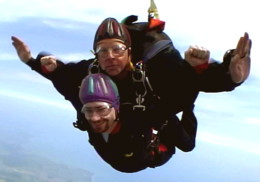
It turns out this skydiving instructor was not alone when he died.  He was doing a tandem jump and had a novice strapped to his chest.  Now this piece of information electrified me.  Like a lot people out there, I’ve considered doing a tandem jump (someday) as a bucket list kind of thing.  But of all the risks I ever thought might be involved, the instructor strapped to my back having a heart attack was never one of them.

By now I’m on the edge of my seat.  I want to know more.  I have to know more.

Turns out the newbie, Daniel Pharr, was a 25-year old soldier trained how to respond in a life-threatening situation.  His instincts proved up to the task.

The two were the last of the group to jump out of the plane.  After a minute or so of free fall Steele pulled the chute.  Everything became very quiet, which Pharr commented on, and Steele replied to.  And it was shortly after this that Steele’s heart quietly failed.  Pharr soon realized Steele had become non-responsive so, going off of what he’d seen on TV (and our mother’s told us TV would just rot our brains) he grabbed the right steering toggle and guided them safely to the ground about a third of a mile away from the designated landing site.

This was turning into such great story!  Double surprise twist with a happy ending.  Dia, I told myself.  It doesn’t get much better than this.

But wait! she answered.  It does!

Turns out Daniel Pharr’s first thought, when he recognized the danger he was in, was , “So at that point I realized I was just going to have to do what I had to do to get down to the ground and try to help him.”

The article had been great up to that point but this part totally knocked my socks off.  I was inspired.  I was in awe.  I couldn’t help but compare what my own response would have been because…well…it just wouldn’t have been as good.  I’m self aware.  I know my own mettle.  I’ve been in enough emergency situations to realize that I’m primarily driven by self-interest.  Oh sure.  If my kids were involved I’d be a little more noble (as long as they hurried) but otherwise I’d be swelling the herd stampeding for the door.  I probably would have been cursing the poor guy for having a heart attack.  But not Daniel.  Oh no.   Daniel was thinking just as much, if not more, of his partner than he was of himself.

Pharr’s evolution from victim to survivor to hero was like food for the secret, emaciated Better Person languishing inside of me.  He gave me hope, a guiding star.  I fell in love with Daniel Pharr on the spot and wished him, wherever he was and whatever he was doing, continued good fortune and everything blessed and best in life.

But having spent all this time telling you the rest of this stuff, here’s the aspect of the whole story that I really wanted to highlight:

It looks to me like, as deaths go, George Steele got to die a really good one.  Yes, he was only 49-years old and sure, he probably didn’t want to die and most likely wasn’t prepared for it.  But having said all that, clearly he got to do it doing something he loved.  In his relatively short life he’d already done over 8000 jumps.  He’s already taken numerous people out for tandem jumps, sharing in the thrill, exuberance, joy, and rush of all those he introduced to his passion for the first time.  And even though at the end he was doing a tandem jump, he was lucky enough to be doing it with someone experienced and savvy enough to survive the dangers his sudden death created.

But even with as great as all that is, this is what really got me: George Steele didn’t die alone.  When he took his last breath, he got to do it with another warm, pulsing, vibrant, strong, caring, enthusiastic companion strapped to his chest, someone sharing in the same sense of wonder, excitement, and joy that he was feeling himself.  Here’s how Pharr describes what turned out to be Steele’s last moments, floating up there in the sky:

“He pulled the chute,” Pharr said. “It got super quiet. It’s eerily quiet up there. I made the comment to him, ‘It’s surprising how quiet it is.’ And he’s like: ‘Welcome to my world.'”

Welcome to my world. Those were the last words he ever spoke.  I only hope mine will be so great.

I’m not happy for George Steele that he died.  At all.  But I am very happy for him that when he did, he died well.

copyright 2011 Dia Osborn

P.S.  By the way, when asked Daniel Pharr mentioned he’d be willing to jump again himself, but his family put the kabosh on it.  What a guy.


“Love For No Reason” Book Launch Today

The book my wife-in-law, Carol Kline, just spent the last two years of her life writing with Marci Shimoff is finally launching today!  It’s after 11:00 and even though I’m sneezing, coughing, blowing all kinds of disgusting stuff out of my nose, and should be dragging my suffering carcass off to bed, I HAD to write a quick CONGRATULATIONS CAROL!!!!!!  You totally rock, girl!

(BTW, yes.  She’s the wife of my ex-husband.  She’s also the co-mother of our children and…after all the years of blood, sweat and tears it took to raise the Wild Things…a dear, DEAR friend.)

I just got an email from her and Love For No Reason is currently sitting at #9 on the Amazon best seller list and #3 on the New York Times!!  (Marci worked her butt off on the marketing end of things and she’s a powerhouse.  NOT to be denied!  Wow.)  Carol gave me an advanced copy for Christmas a few weeks ago, so when I say that the book is a great and worthwhile read, I speak from first hand experience. It’s all about cultivating a state of unconditional love in oneself that can stand against virtually anything the world throws at you.  It’s simple but incredibly profound, and just reading it gave me a badly needed lift. 

I can’t believe how far away I’ve gotten away from even thinking about trying to live with some degree of unconditional love.  I used to strive for it regularly through meditation and all kinds of spiritual practice but over the last five years have fallen off the wagon into some lazy habits.  It was something of a shock when I did the initial exercise in the book and discovered I am now almost nil for “love for no reason,” living mostly in “love for good reasons”, but still harboring a (very difficult to look at) amount of “love for bad reasons” too.  It was kind of a wake up call.

It feels great to immerse in some knowledge again that’s cultivating the highest.

Anyway, if you’re interested in reading more about it, go here:  http://www.TheLoveBook.com.  It has links to both Amazon and Barnes and Noble there if you’re seized by an urge that just can’t be denied.

And just one more time for the road: GOOD ON YOU CAROL!  We’re all so proud of you for pulling yet another one out of your hat.  Great job!


Update:  I forgot.  Here’s Carol’s biography.  I’m just SO proud of her!

Carol Kline is the co-author with Marci Shimoff of Love for No Reason: 7 Steps to Creating a Life of Unconditional Love and Happy for No Reason: 7 Steps to Being Happy from the Inside Out. She also co-authored five books–with over 5 million sold–in the best-selling Chicken Soup for the Soul® series, including Chicken Soup for the Dog Lover’s Soul and Chicken Soup for the Cat Lover’s Soul, and the #1 New York Times best-selling Chicken Soup for the Mother’s Soul 2. She is also the coauthor of The Ultimate Dog Lover and The Ultimate Cat Lover. In 2006, she co-wrote You’ve Got to Read this Book: 55 People Tell the Story of the Book that Changed Their Life with Jack Canfield and Gay Hendricks.

A freelance writer/editor for over thirty years, Carol, who has a B.A. in literature, specializes in narrative non-fiction and self-help. Carol is also a speaker, self-esteem facilitator, and animal welfare advocate. In addition, she has taught stress-management systems to the general public since 1975. At present, she is at work on several writing projects on a variety of topics.

The Film: Departures

I finally watched the Japanese film Departures last night and was astonished and blown away, both.  The 2009 Oscar winner for Best Foreign Language Film also captured thirty-four other international film awards and, in my humble opinion, deservedly so.  It took the difficult subject of “encoffining”, the ceremonial (and totally fascinating) bathing and dressing of the recently deceased which is performed in front of the family, and treated it with a lightness of touch and reverence that made it both moving and accessible.  Add in a stunning soundtrack and cinematography and no wonder it was such a hit.

I’ve caught a rabid cold from the hubster so, much as I’d love to go on and on about it, I don’t have the energy.  It’s hard to juggle a parade of soggy tissues and tea cups while trying to type so I thought I’d just leave you with the trailer for the movie.  That way you can get a flavor of it for yourself.

The one thing I will say is that this movie captured the beautiful, uplifting experience I had over and over again with the dying and their families.  It somehow managed to portray a little of everything that’s involved; the grief and joy, anger and humor, the awkwardness that so often arises in circumstances of profound intimacy, the need for forgiveness, the graphic elements involved, the enduring love, and the ultimate affirmation of life that comes when death is received with dignity and grace.  It also captures how the gifts of those who die can pass outward in a spiral, swirling back into the lives of those left behind to aid in healing their wounds, both new and old.

I give this movie two thumbs up needless to say.  Here’s the trailer:

copyright Dia Osborn 2011

Christmas Trees and Death Panels: How Fear Sets A Snare (Republished)

As the Advanced Care  Planning Consultation legislation goes down in flames for the second time, I thought I’d revisit this post from August where I wrote about one of the biggest reasons it went down the first time.  It seemed like it was still pertinent so I’m posting it again.   

(This post was originally published on August 20, 2010.)

Like many people, the Christmas tree scene in the original 1972 Poseidon Adventure movie made a deep impression on me.  I was only fourteen when the movie was first released so I was impressionable.  Given.  But even so the scene is a classic.

It’s Christmas (New Years?) Eve on a luxury ocean liner out in the middle of the ocean and the crew and passengers are celebrating in the ballroom under the branches of a towering and heavily decorated Christmas tree.  As per disaster movie formulae, a tsunami formed by an earthquake off the coast of Crete comes rolling across the ocean and hits the ship broadside, capsizing it and tossing the above mentioned assemblage all over the slowly inverting ballroom.  Once the Poseidon settles in it’s new, upside down position, the Christmas tree is lying on it’s side on the ceiling-turned-floor.

Enter: Gene Hackman, a renegade missionary.  He swiftly marshals a group of men to raise the tree again for use as a ladder to access a service door at the bottom-now-top of the room.

We’ve seen a lot of random chaos and horror up to this point but Fear as a saboteur has been suspiciously quiet.  That changes once the Christmas tree option is presented.  Fear immediately recognizes a golden opportunity and steps in to set the first, big snare of the movie:

The survivors each have to make a choice.

Reverend Gene, on the one hand, tells everyone to climb the Christmas tree and head for the hull of the ship, because that’s the only logical place where rescuers could ever access survivors.  Reverend Gene represents original thinking and a challenge to the status quo.

But the ship’s purser disagrees and tells them no, no, no, they must all stay put in the ballroom and wait for someone to find and rescue them there because the ballroom is where rescuers will search.  The purser (read official man in a uniform) represents standard thinking and the status quo, something fatally attractive to anyone with a strong herd mentality.

It was painfully clear to all of us in the theater that the Rev was right and everyone needed to climb.  Fast.  We knew that those who couldn’t rise above convention and think outside the box were gonna die, die, die, horribly and soon.  We knew this because the whole scene was built around a basic rule of human behavior; terror tends to drive thinking out of the cerebral cortex (rational, logical, problem solving) and into the amygdala (instincts, habit, and fear).  Anytime we’re confronted with a new and terrifying situation, if we can’t master our emotions and analyze circumstances objectively then we revert to old mental ruts and knee jerk reactions.

We follow the herd because by god there’s safety in numbers.  Right?

In this case, not so much.  Fear springs the snare, paralyzing just about everyone there.  The majority of people listen to the purser and decide to stay put.  Only a handful climb the tree and, once the chosen few are safely ensconced up in the only possible escape route, explosions sound in the belly of the ship, windows and skylights shatter in the ballroom, the Christmas tree topples back down to the floor, and deep, ocean waters surge in, drowning every last screaming, thrashing person who made the mistake of defaulting to what felt, instinctively, like the safest bet.

Working in the hospice field, one grows familiar with fear and its many, (many, many, many, many, many) snares.  A fear of dying can often drive us to make unwise care and treatment decisions.  From what I can tell, a lot of this comes from the profound lack of education and understanding that exists in this country around the dying process.  The fierce denial we’ve embraced as a society doesn’t leave much room for the cerebral cortex to think about the subject at all, which means that most of the default choices people make at the end remain firmly embedded in the instinctual part of the brain.  How could it be any different?  There are few instincts more powerful than the one to survive and, if we don’t have some extraordinary and compelling reasons not to, we’ll naturally choose to continue treatments beyond (sometimes far beyond) the point where our doctors, or even we ourselves, think we should.

Yet at the same time, most of us don’t want to die wrapped up in tubing and drugged into a stupor, or with flash paddles sending electric jolts into our heart while our family looks on in traumatized shock.  But it happens all the time anyway.  Why?

There are a host of complex factors that contribute to the problem but ultimately one underlying cause rules them all:

We persistently and adamantly refuse to talk about dying.

We play right into one of Fear’s greatest snares.  Fear loves the fact that we won’t talk about dying because that prevents the cerebral cortex from getting anywhere near our decision making.  How can we possibly evaluate what’s been going wrong, learn anything new, or change anything for the better, without some calm, compassionate, respectful, thoughtful discussion about what’s going on?  We can’t.  Our fearful silence gives the old habits and instincts free rein and we default, over and over again, to the same flawed choices.  That’s how, even if it’s the last thing we ever wanted, we still so often wind up cocooned in IV lines without so much as a spare patch of skin for our loved ones to kiss or hold.

This reluctance and failure to talk about dying is the norm in individual cases.  But it happens on the national level as well, and a prime example of it  just played out during the recent health care reform debate.

Remember the small provision in the health care bill (section 1233 of HR 3200) entitled Advanced Care  Planning Consultation? (Otherwise dubbed, in a bewildering but imaginative twist, as  Death Panels.) Amazingly, it constituted only three pages out of roughly 2000, yet it wound up hijacking the debate.  Why?  Because it asked us to start talking about the dying process.  More specifically, our own dying process.  It boldly and openly addressed the current, gaping need that exists for each of us to have a conversation with the doctor who’s treating us about how we want that treatment to look.

But in so doing this tiny provision struck a major taboo.

Let me reiterate here.  The provision didn’t try to address how we’re treated, it just wanted us to start talking about how we’re treated, but it’s authors may as well have suggested we all drink poison Kool-aid.  They failed to understand how profound the fear of talking about dying is in our society, and that failure is a big part of the reason why the whole thing blew up.   

Personally, I think legislation of some sort is a good idea, but this version was doomed to fail.  I mean, come on.  Any politician planning to link death, law, and government is going to have to make a serious effort to engage the general citizenry in a calm, compassionate, respectful, informative, and thoughtful discussion about the whole thing first.  They need to institute a massive educational outreach to explain why a conversation about end of life care is so essential.

They need to do a much better job of explaining its gift.

There are stories out there that we all need to hear.  Stories about how drastically a simple end of life care discussion can improve outcomes for individuals, families, and entire communities.  For instance, we needed to hear about the two studies done by Aetna insurance.  The ones where the terminally ill who had access to both ongoing treatment and palliative and hospice care, cut their emergency room visits by half and their hospital and ICU visits by two thirds.  Costs dropped by almost 25%.  And most importantly, these people reported much higher levels of satisfaction with their care.

We needed to hear about the compelling evidence emerging from the Coping with Cancer study that suggests end of life care discussions not only decrease suffering and costs, but also increase both quality of life and even life expectancy.  As Dr. Atul Gawande explains in his article Letting Go: What should medicine do when it can’t save your life?, “These patients suffered less, were physically more capable, and were better able, for a longer period, to interact with others. Moreover, six months after the patients died their family members were much less likely to experience persistent major depression.”

And then there is the interesting case of La Crosse, Wisconsin, where life expectancy is actually one year longer and end of life costs about half the national average.  This is because  some far sighted medical leaders in the community got together back in 1991 and started a campaign to get physicians and patients to discuss end of life wishes.  Again from Dr. Gawande:

“By 1996, eighty-five per cent of La Crosse residents who died had written advanced directives, up from fifteen per cent, and doctors almost always knew of and followed the instructions…Answers to the list of questions change as patients go from entering the hospital for the delivery of a child to entering for complications of Alzheimer’s disease.  But, in La Crosse, the system means that people are far more likely to have talked about what they want and what they don’t want before they and their relatives find themselves in the throes of crisis and fear…The discussion, not the list, was what mattered most.” (Emphasis mine.)

These amazing stories and others like them are currently opening a lot of eyes to the wide ranging gifts that come from having a simple discussion about dying.

It would have been helpful if we heard these stories before the legislation was introduced.  A few realized their error and tried to get the news out, but it was too late.  Fear had already seized another golden opportunity (politics!) and set its snare.  The term Death Panels rose from the depths, Fear immediately latched onto it like a monster from a nightmare, and our group, instinctual  brain responded with a great big Hell no!! Explosions sounded from the belly of the debate, windows and skylights shattered, and Provision 1233, like the Christmas tree, slowly toppled to the floor, destroying any hope for mutual, constructive discussion during this round.

Which leaves the majority of those who are currently dying in much the same position as the unlucky Poseidon passengers who decided to sit and wait.  They’re still not having that conversation about end of life care choices, so they’re still missing out on the help, relief, grace, and extra time which are its gifts.

But there’s good news.  We don’t need legislation to talk about dying.  We can talk about it any time we want.  We can figure out, right now, who it is we’d like to choose for us if a time comes when we can no longer choose for ourselves.  Then we can talk with them, right now, as long or as often as we need to.  We can tell them about what’s important to us and what scares us.  What we’re hoping for and how hard it is to trust with something this big.  And they can talk with us, too, about how badly they need to know what we want and how scared they are of making a wrong decision.  About how much they love us and how afraid they are of the loss.

Then we can go in and sit down with our doctors and tell them, too, about these frightening, tender, sacred things we’ve discovered about each other and ourselves.  We can give them the vital information they need to have, so they can care for us in the way we want most.

If we can do all that then the legislation that follows will be far more informed, compassionate, and respectful…the kind of legislation that everyone can trust…because we’re finally talking.

If you’d like to start talking about dying and end of life care but aren’t quite sure how to start, here are a handful of reading resources that might help jump start a conversation:

1) Dr. Atul Gawande, Letting go: What should medicine do when it can’t save your life? (13 pages long but more than worth the time required to read it.)

2) Final Gifts (This book is a huge favorite with the hospice crowd…curious, beautifully written, and uplifting.  Good for easing fear.)

3)  Palliative Care Blog (Fantastic resource for everything end of life and palliative.  Contains a wealth of links to other resources as well.)

4)  Talking About Death Won’t Kill You (The title of this book pretty much says it all.)

copyright 2010 Dia Osborn

Update 8/25/10: Here’s some news. Last week New York state passed a bill (The New York Palliative Care Information Act) requiring doctors to offer terminally ill patients information about different end of life options.  It’s essentially Provision 1233 resurrected in state form.  Behold!  The Christmas tree rises again.  What I found most interesting was that the bill was passed over the objections of New York State’s medical society.  The doctors opposed it saying ‘the new law would intrude “unnecessarily upon the physician-patient relationship” and mandate “a legislatively designed standard of care.”’  Truth be told, there are studies showing medicine tends to attract people with the highest levels of anxiety about dying. Doctors as a group tend to be more reluctant to talk about it than the average person, yet they’re now the ones who are legally responsible in New York to initiate the conversation?  Hmmmmm…  What does this bode for the future?  Hopefully, now medical schools and other sources of medical education will provide more training for how to talk about dying.  As Dr. Gawande stated in Letting Go, it’s a skill that needs to be developed just as much as surgical skills.  We’ll see.  In any case I hope this will stir up more constructive discussion!

And The Death Panel Two-Step Takes Another Turn Around The Room. Damn.

This image from Wikipedia is so great I had to use it again.


Well dear readers, I just read the bombshell.  Last week, in The Death Panel Two-Step, I wrote about The New York Times revelation that, in a political style stealth-move, regulation approving Medicare reimbursement for doctors to discuss end-of-life care wishes with their patients was going to be included in the new health care reform policy after all.

When I first read the news I was happy about the policy, but dismayed and uneasy about the secrecy.

Now, my fears are confirmed.  Barely a week later there’s been a complete turn around.  The New York Times is now reporting that, since the news broke, minds have changed and the regulation was re-removed from the policy that went into effect on January 1.  The suspected reason?  The administration needs to reserve political capital for the bigger upcoming battle over the health care reform bill as a whole.

And so the dance around Advanced Care Planning Consultations continues.  For those who may not have been watching closely, the steps so far have looked something like this:

Last year: The original legislation mandating reimbursement for doctors’ time  is included as part of the overall health care reform bill.  Result:  The death panels outcry.  The legislative language is subsequently removed from the bill. 

Then last week: The story surfaces in the NYT that the bit about consultations has reappeared in the bill under the invisible cloak of regulatory language, and it will become law as of January 1.  Inevitable result:  The invisible cloak is ripped aside and the death panels outcry is renewed. 

Today: The New York Times announces that the Obama administration has reversed course yet again.  Result:  Any doctor who takes the considerable time required to educate a patient about preparing for the dying process is going to have to pay for it out of his/her own pocket.  That discussion will now only happen as an act of charity because Medicare won’t pay for it, nor will most insurance companies, nor will most patients (who can be reluctant to have that conversation in the first place, free or not.)

So for the time being it looks like politics will continue to dominate the debate about end-of-life care conversations.  The Left and the Right will continue their wheeling and reeling around the dance floor, locked in an increasingly hostile embrace, both sides far more committed to fighting for the lead than actually listening to one another (or, far more importantly, trying to communicate effectively with us.)

I’m so saddened by this.  I can’t help but think of all the suffering, frightened people this year who will be sliding backwards into the dying process, flailing and totally unprepared, with a very good chance they won’t even be able to turn to their doctor for adequate answers or guidance when it comes.

There’s a lot of blame for this mess flying around right now, and its all directed at the politics that came into play.  But I think that’s all just smoke and mirrors.  Blaming the politicians and holding them responsible for the quality of our dying is a most excellent way to avoid facing a deeper and far scarier truth; the majority of us are subconsciously grateful  for the gridlock because now we still won’t have to talk about the fact that we’re going to die.

Most people are terrified to talk about dying in general and their own dying process in particular.  Deep down, we don’t really want to have that conversation with our doctor to begin with.  We don’t want to even think about, much less fill in, a living will.  We don’t want to discuss with our spouse or children or friends what it’s going to be like as we die.  And we certainly don’t want to look close enough at the gory details involved to make effective, useful plans.

The deeper reason this legislation didn’t pass is not because Democrats and Republicans couldn’t cooperate, but because most of us don’t want them to.  Not on this one.  Who in their right mind goes to the doctor to talk about dying anyway?  Nobody?  That’s the last thing we want to pay good money to hear.  We can die for free.  No. The reason we usually go to a doctor is to find out about all the new, better, and increasingly expensive ways there are to stay alive.   And if one doctor can’t deliver a possible escape route then we’ll just keep on looking for another one who can.

Talking about dying in our culture is still a big taboo and it’s all about fear.  Deep, irrational, primal fear lurking just below the surface, waiting to sabotage any and all attempts to deal with dying directly.  It’s hard to imagine any good legislation being passed until this fear is both better understood and respectfully addressed.

With that in mind I thought I’d re-post something I wrote back in August about just this topic.  The name of the post was Christmas Trees and Death Panels: How Fear Sets a Snare and (if I can figure out the technical details of how to do it) it should be coming up next.

copyright 2011 Dia Osborn

Elders and Technology: An Awkward Pairing

This morning I received an email with an attachment from my out-of-town brother-in-law (BIL) that was actually for my mother-in-law (MIL). 

So if it’s an email for MIL, you ask, why did BIL send it to you

Why you silly twit, I answer.  Because MIL is elderly of course.  She doesn’t know how to email.

MIL has a computer.  In fact she has three; two desktops she bought for herself and a laptop gifted from her son.  But none of them are presently hooked up because, even though she really wants to learn how to email, every time she’s tried so far she hit a wall.  She got overwhelmed and quit, turned off the service again, because computers and technology are just not coming easy for her.

As pretty much everyone knows by now, there’s a huge generational divide where technology is concerned.  My kids, on the one hand, use electronic devices like prosthetics.  They’re physically attached to their laptops, cellphones (with bluetooth, GPS, browsing, cameras, youtube, and wifi capability plus downloaded ringtones and extensive music libraries),  gaming systems, and complex entertainment systems with blue ray and live streaming (and accompanying battery of remotes.)  They communicate via texting, email, IM, Facebook, Twitter, et al, and…once every ten thousand years when the planets all align…they’ll even make a phone call.   They also both have dedicated closets for the graveyard of outdated devices they’ve abandoned over the years.

MIL also has a dedicated closet but she’s abandoned her devices for a completely different reason; she couldn’t figure out how to make them work.  She’s not unusual in this way.  My father and father-in-law (FIL) can’t use most modern technological devices either.  I also ran into this problem a lot when I was working with hospice.  Most of the elderly people I cared for not only couldn’t use a computer, they often struggled just to navigate a simple telephone voice mail system.  Sometimes, at their age, it was because hearing had become a problem.  But even those who could hear perfectly well seemed to have trouble.  They resented the fact that they couldn’t just talk to a person.

This morning it occurred to me that, where the new, modern world of technology and electronics are concerned, most of our elders are like first generation immigrants from the old world.  They come from a different set of customs, a slower pace, a different, simpler world view.  The new language is proving to be sophisticated and difficult for them, and they often get lost trying to navigate a landscape that can seem foreign and incomprehensible.

MIL (almost eighty) is from the old country so emailing, as part of the new language, has been hard for her to learn.  Still, I admire her tremendously because at least she wants to learn.  She tries.  She’s frustrated and overwhelmed by it all, but even so, she’s still tickled by the prospect of laptops, and camera phones, and digital picture frames, and thin, sexy, LCD TVs.  She takes risks and buys gadgets she doesn’t know how to use, hoping she’ll be able to figure them out and sometimes she even does.  Little by little, she really is making progress.

So BIL and I, and all of her children, continue to try and be patient and supportive.  We’re the second, bridge generation, straddling the divide between our parents’ world and that of our children.  Hopefully, in helping our elders, we’ll be able to sort out and harvest the best of their world, then preserve it, adapt it, and pass it down to our kids to be folded into the new one.

That’s what I’m hoping for anyway, because I think an evolving world with deep roots is the strongest, most nourishing kind.

The Favorite, by Georgios Iakovidis (1890)

(Image from Wikipedia)

copyright 2011 Dia Osborn

The Death Panel Two-Step

image from Wikipedia

Remember all the hue and cry about “Death Panels” last year?  Recall how powerful the fear was that it invoked, and how the outcry wound up blocking legislation aimed at reimbursing doctors for the time required to provide patients with information regarding end-of-life care?

Well, where legislation failed, it looks like regulation will prevail.  The New York Times carried a front page article a couple days ago leaking news that under new Medicare regulation, starting on January 1, 2011, doctors will now be reimbursed for the time required to provide patients with adequate counseling for end-of-life care planning.

“The final version of the health care legislation, signed into law by President Obama in March, authorized Medicare coverage of yearly physical examinations, or wellness visits. The new rule says Medicare will cover “voluntary advance care planning,” to discuss end-of-life treatment, as part of the annual visit.

Under the rule, doctors can provide information to patients on how to prepare an “advance directive,” stating how aggressively they wish to be treated if they are so sick that they cannot make health care decisions for themselves.”

As some of you may remember, I wrote about this subject a while ago in Christmas Trees and Death Panels:  How Fear Sets A Snare.   Back then, I was disappointed but not terribly surprised that this legislation failed because it’s nigh-on impossible to legislate something that no one will even discuss.  As someone who worked for six years with hospice and who strongly advocates for end-of-life care conversations, I’m certainly glad it finally passed.

But my reaction is hardly all leaping  joy and ribbon waving.

On the one hand, I’m profoundly relieved that one of the major roadblocks to physician/patient discussions about end-of-life care is now removed.  Even though this policy doesn’t address the real elephant in the room…the fact that most doctors are clueless about how to have that particular discussion with a patient…it at least now provides a financial incentive for them to face into all their deepest fears about death and dying and try to learn how to talk about it.

And I believe that’s a good policy.  To explain why, I’ll refer once again to the decades long experiment in La Crosse, Wisconsin where doctors have been having regular end-of-life care conversations with their patients since the mid-1980’s.  I’m not exaggerating when I say that this one, simple  practice has made the quality of dying in La Crosse  among the most benign, respectful, compassionate, comfortable, and enlightened in the nation.

Having said all that however, I’m still bummed at the stealth used to get this policy instated.

“While we are very happy with the result, we won’t be shouting it from the rooftops because we aren’t out of the woods yet,” Mr. Blumenauer’s office said in an e-mail in early November to people working with him on the issue. “This regulation could be modified or reversed, especially if Republican leaders try to use this small provision to perpetuate the ‘death panel’ myth.”…

The e-mail continued: “Thus far, it seems that no press or blogs have discovered it, but we will be keeping a close watch and may be calling on you if we need a rapid, targeted response. The longer this goes unnoticed, the better our chances of keeping it.

So why does this kind of behind-the-scenes maneuvering dismay me?  Because it’s going to make having an open, constructive, educational, illuminating, respectful, national conversation about dying even harder than it already was.  (I didn’t know that was even possible.) Far from building any kind of consensus or trust, or making an attempt to listen to or address some of the real fears feeding into the Death Panels uproar, it instead seems to confirm one of the deep fears a lot of people already have about linking how we die with big government: namely, that those in power don’t really care about the concerns or desires of everyone they govern, but are only intent on imposing laws that they believe are best for everyone.

Overall, I rate this new regulation as basically two steps forward for health care policy, and one step back for public discussion and trust.

Sigh.

I foresee, with my magic crystal ball, that setting public policy around dying is going to continue to be a tough dance for everyone to learn.

copyright 2011 Dia Osborn

Update: Snoring Dog Studio expressed some confusion in the comment section as to what part of this regulation I was objecting to.  Great question.  It made me realize I didn’t reference something important that was said later in the article.  I have now included the pertinent quote.  Thanks Snoring Dog!  


A Yuletide Wish

Image from Wikipedia

THOUGHTS FROM THE YULETIDE 2010

Dearest family and friends, old and new;

Greetings from the slushy, drizzling, overcast, and fog-riddled, slightly-far north town of Eagle, Idaho!  We fervently hope the holiday season is bringing you a lot more sunlight than we’ve seen here over the last month, and that your vitamin D and serotonin levels are correspondingly higher.  I really shouldn’t complain of course.  We need the moisture, and the snow in the mountains is a godsend.  But still. We’ve been buried under low, heavy clouds and dense fog for so long now that it’s starting to feel a lot like Venus.

The family is doing well.  Cal’s had a great year at work and, yes, he’s still traveling back and forth to the Northeast every month and loving the job.  Go figure.  A double life really seems to suit him.  And thanks to both good luck and their stellar work ethics, Lorin and Kit survived the transition and still have jobs after Hewlett Packard bought Palm last year, laying off a lot of the old work force in the merger.  McKenna graduates from Boise State University in a few days with a B.A. in English/writing emphasis and a minor in History and has developed into both a talented academic and a sensible, hard working woman.  We really couldn’t be prouder.  As for me, I was eventually buried under the organizational demands of trying to write a book about dying, so I shelved the project and started a blog about dying instead.  Turns out it’s a lot easier to continue to sound coherent in a few paragraphs than it is throughout hundreds of pages.  Who knew?  I have a deepened respect for anyone who writes an entire book about anything.

*          *          *

Well, right after I wrote the above paragraphs two weeks ago the tsunami hit and I was swept out to sea by the combined demands of holiday preparations, graduation celebrations, blogging schedule, joining a gym (not the best timing on that one…), and cramming a block of dental/medical appointments into the end of the year to try and catch the insurance benefits before they expire.  That’s how I find myself sitting here a day and a half before Christmas, stuffed and tired, pressured by deadlines, sweating and sore, screened and cleaned, just a wee bit stressed out, and still trying to think of something warm, fuzzy, and holiday themed to say in the yuletide letter this year.

Merry Christmas?

Actually, I say that carefully.  A few years ago Cal and I took a walk along the river on Christmas day and ran into an older couple who wished us a Merry Christmas as they passed by.  When we smiled and wished them the same, to our surprise they became agitated and stopped to talk.  Evidently, they’d wished someone else a Merry Christmas earlier in the day and whoever it was had bristled and taken offense at the greeting.  Our older couple had retaliated by taking offense at the fact that offense had been taken and, lo and behold, in direct opposition to the spirit of the season, the cycle of bad feelings was up and running, passing on its merry little way downriver to us.

I’ve thought about that one ever since.  I realize there’s often tension these days around what Christmas…and other traditions for that matter…are supposed to mean, how they’re supposed to be celebrated, and whether or not they should even hold the prominent place they do in a secular society.  It’s understandable.  I think we all tend to get a little territorial about the traditions that are most important to us, and it’s only natural to resist the intrusion of other traditions onto our own.

The urge to protect the unique rituals, values, and celebrations that nourish, strengthen, and guide us in our lives is universal.  I know I certainly don’t want anyone else messing with the way I celebrate my season.  But having said that, please believe me when I say that neither do I have any desire to dictate how you should celebrate yours.

We weren’t a particularly religious family when I was growing up, so my parents took the Santa Claus track and really poured themselves into celebrating the magic of Christmas.  They went to great lengths to create as much joy, wonder, and sense of miracle for us kids as possible and, funny though it might sound, some of the most important, foundational lessons of my life were learned from the way they taught us to celebrate the season.

First of all, they taught me that Santa Claus was real. That there actually existed a jolly, caring, magical being who was so generous–so loving and happy–that he devoted his whole life to flying through the world to try and touch, enrich, or bring love to every last, living person in it.  Naturally, this understanding evolved quite a bit as I grew up.  (You’ll be relieved to know I no longer believe in Santa.) However, it also instilled a couple of lasting and important beliefs in me:

1) There are powerful and benign forces at work in creation that sincerely desire my happiness, and

2) Gifts aren’t always given because they’re earned or deserved.  Sometimes generosity is just for its own sake.

Secondly, my parents taught me that sometimes miracles come in the night, and I can’t begin to tell you how much courage and hope I’ve drawn from that lesson over the years.  Throughout my childhood and on into adulthood, it’s helped me to be less afraid of the shadows, to trust that along with the monsters, darkness also harbors miraculous, luminous gifts.  And I honestly think the odd faith I developed from that early lesson helped me more during the lean, dark years of my battle with depression than anything else.

Third, my mom and dad required us, from the time we were small, to think about, select, wrap, and give gifts to each other.  And when we finally got to open them all on Christmas morning, we always did it one at a time, each of us taking turns opening a present while everyone else watched and shared in our excitement.  We circled around and around this way, as many times as it took, until everyone was done and it was this ritual, more than any other in my life, that taught me how the giving and receiving of gifts is really a banquet for everyone to sit down and enjoy.  I learned that whether I’m giving or receiving, ripples of happiness can be created either way, and the truer the spirit with which I do both, the wider the ripples become.

There were a thousand other lessons of course, opportunities to develop qualities like patience and self-control, as well as learning how to manage things like disappointment, envy, and greed.  I’ve continued to build on these early lessons all my life, and I feel like the Christmas traditions practiced by my family were actually fundamental and essential to the development of my deepest sense of humanity.  I’ve always known that my family’s way of celebrating Christmas was neither the “right” way nor the only one, but it was our way and that made it beautiful, nourishing, and perfect for us.  It created magical ties of love, faith, strength, and generosity that bound us closer together, and gave us a way to reaffirm each year the things that my family cherished most.  And I’ve done my level best to pass the same gifts and lessons down to my own children.

I guess this is all just a long way of trying to explain that, if Cal and I wish you a Merry Christmas or Happy Holidays or Peace of the Season or any other kind of holiday wish, it’s not because we’re trying to impose our childhoods, or beliefs, or values, or culture on you.  We’re not.  We don’t believe in that.  We love the fact that everyone gets to find and draw meaning for their life in the way that feels right and true and most nourishing to them.  And we love even more that we all have the freedom to do just that.  No.  All we’re really trying to do with the greeting is make a deep, sincere, and heartfelt wish for you from the language of our childhood joy:

For us Merry Christmas means that, no matter what holiday you do or don’t observe, and no matter how you do or don’t observe it, from the depths of our hearts and with the greatest good will, we wish for you all that is best in your world, from all that is best in ours.

With great love and even greater hope,

Cal and Dia

Wikipedia again

copyright Dia Osborn 2010

Life Is Like A Trust Fund

In “Dying” Is Still Alive I talked about the cost of focusing so much on trying to cure a life threatening illness that we risk going straight from being sick to being dead, with no time left for the opportunities that dying offers in between those things.  In the comment section afterwards, Linda of What Comes Next? posed an important question:  When fighting a life threatening illness, is it possible to embrace dying too soon…to forfeit the opportunity to rise above it and live longer? This is a great question and one that a lot of people ask.

What I’d like to do is break it down into two parts.

Part # 1)  Is it possible to embrace dying too soon?

My answer, which probably won’t surprise anyone, is absolutely not.

Personally, I think we should all start embracing dying (i.e. looking at it, accepting it, and using the daily awareness to live as wisely and fully as possible) early on, ideally in childhood.  The opportunities for exposure are rife.  Like the first time we see our father crush a bug, or our mother put a cooked leg of something on our dinner plate, or have a family pet die, or hear about our little friend Emily losing her grandpa.  As I’ve mentioned before, it’s never hard to find dead bodies scattered along the side of pretty much any road in America and, if all else fails, there are the innumerable references to, and reports of, dying and dead on the news twenty-four hours a day.

However, since children learn how to embrace dying from their parents, and since most parents don’t know how to teach it, most of us wind up as adults lacking the skill.  In fact, most parents not only fail to teach how to embrace it, they treat it as something unspeakable and do their best to hide it.  The most common metaphor for dying used in our culture is The Enemy, a horrible, looming foe to fight against tooth and nail, both bitterly and indefinitely.

As a result, most of us don’t learn to embrace dying as the last, natural, grueling-but-luminous stage where, if we’re lucky and blessed, we have the time necessary to successfully wrap up our life.   Instead, we deny it as long as possible which can drastically shorten or, sometimes, even eliminate the opportunity to fulfill our end-of-life tasks.   Most people don’t seem to realize that it takes time, sometimes a lot of it, to wind up our affairs, make our bequests, and absolve and be absolved by those we care about.  To link trembling hands one last, aching, transcendent time and say I love you.  I’ve always loved you.  I will always love you.

As a death averse society, we haven’t fully grasped yet that dying at peace, with no regrets, and with our loved ones prepared for a life without us afterwards, is a necessary and worthy goal.

Instead, most us learn to look at dying as the gruesome, terrifying end of everything.  To run.  Run! Hard and fast, for as long as possible toward escalating medical intervention; drugs, surgeries, and treatment regimes that can not only consume most of the time we have left and create more layers of suffering, but actually shorten our lives as well.

In La Crosse, Wisconsin, where end-of-life discussions are the established, accepted norm, life expectancy is actually one year longer than for the average American population.  And a 2006 study by the NHPCO found that the mean survival rate for patients on hospice was 29 days longer than it was for patients who were not on hospice.

For a person who’s spent their entire life regarding dying as something horrific, it’s a real challenge to switch gears, turn around, and embrace it when it finally comes.  Not impossible mind you, but definitely harder.

Helping people make this switch was one of the major goals we always worked toward in our hospice.  We fought hard to help people make the difficult transition from fighting for life to accepting dying because we saw, consistently, what a profound and healing difference it makes.  There’s more trauma involved when the state of dying is embraced late, or never embraced at all.  There just is.  Sometimes this is unavoidable, as in the case of a swift or sudden death.  But more often in today’s medical system, it happens as a result of focusing entirely on finding a cure without also preparing for dying.

Which brings me to the second part of Linda’s question.

2)  Is it possible to forfeit the opportunity to rise above it and live longer?

While this question initially seems to reduce the situation to its simplest elements, I think it’s actually creating a trap.  To explain, I’d like to use a teaching story.

Imagine you were born with a trust fund, and in this trust fund was a billion dollars. All your life you’ve been able to draw from this fund whenever you wanted, using the money for any old thing your heart desired.  While you learned early on that the trust would eventually wind down and close, everyone was kind of fuzzy about the dates on that part.  So in the end you just kind of forgot about it and started spending.

Then one day your lawyer calls to tell you that the termination clause has been activated.  He’s learned that you’re going to lose access to the funds in about six months.  He knows there’s no way to break the clause entirely, but he thinks that if you fight it, you might be able to win a temporary stay.  Buy some extra time.  The tricky thing is, you have to draw down the money in the trust fund to mount the court battle.

You now have three forces at work:

First, there’s the hope:  You might win extra time and still have some money left in the fund afterward.

Second, there’s the real and measurable cost:  You’ll be diverting money to the fight and depleting the funds you need for everything else in your life.

And third, there’s the risk:  Court costs these days can easily eat up most of the trust.  Even if you eventually win more time, the funds might already be exhausted.

Considering these three things, you really, REALLY need to ask yourself some important questions before you decide on a strategy.  The trick is what are the best questions to ask?  Naturally, you want the ones that will give you the most insight and wisdom, the ones that will be most helpful in guiding you in your choices during the time you have left.  So what are those questions?

Linda’s question, adapted to our metaphor, is one possibility.  If I just accept the clause and forgo taking it to court, will I miss the opportunity to use the trust fund longer? The answer?  Well…yeah. Of course you would.  The answer to that one, just from the standpoint of pure logic, is obvious.  Which initially makes the right choice seem like a no-brainer.  Of course you should fight.  Anything else would be giving up.

However, this way of looking at it is actually misleading.  It makes it sound like, universally, there’s only one possible option that everyone should always make.  But that’s not true.  Why?  Because every person is different; with different needs, different dreams, different circumstances, different ages, different strengths, different fears, and different prospects.  All these things need to figure into the choices that each person makes, so the questions we ask need to include them.  Ideally, they’d run more along these lines:

Okay.  Exactly how much extra time are we talking about fighting for here?  Rough guess, what are the odds of my winning this fight?  Am I really interested in betting the farm on longer, riskier odds?  Just how much money is left in the fund to fight for at this point anyway?  Is there something other than legal fees I really want or need to spend that money on?  What will I lose by mounting a fight?  What’s more important to me; having the funds available to spend in the future, or spending them today on what I love?

And what is perhaps the most important question of all:  How much of the fund should I reserve for what I love, value, and cherish the most, to ensure I have no regrets–that my loved ones will still be okay–when the trust eventually closes?

The metaphor of a trust fund is apt because, in reality, life isn’t something that belongs to us. It’s not like our mothers gave birth and then picked up a receipt at the front desk.  Life has never been ours, something we’re entitled to own and control.  On the contrary, it’s only ever been a miraculous, incomprehensible, immeasurable resource controlled by something else too big to understand.  Life is something that we didn’t earn and don’t even necessarily deserve, but that we nevertheless get to use however we want, for free.

To me, life is exactly like a trust fund…only times a gazillion. It’s our fortune.  Our treasure.  A limitless, jaw-dropping, sphincter-releasing wealth beyond our wildest, freaking dreams.  I’m talking real-life fairy tale here, a winning-the-biggest-lottery-of-all-time kind of luck.  A staggering, incalculable store of riches that’s set up in trust for us when we’re born and that we get to draw on and use for as long as we’re here.

But of course, as with all fairy tales, there is that one small catch:  We only have access for a limited time.  And while the question how much time? is certainly a compelling one, it’s unanswerable.  For me it’s more valuable to ask instead, What is the best and brightest use of whatever time I do have?

The medical mindset at work today tends to glorify the fight to live, and skim over the deep human costs involved in such a fight.  This often leads people to continue fighting in the face of increasingly long odds, instead of devoting their remaining energy to fully living whatever time they have left.  It’s surprisingly easy for the fight itself to take over and become the goal.  That’ why it’s so important to remember that the fight is only worthwhile in so far as the life it seeks to preserve is worth living.  When it begins to consume and destroy that life instead, then it’s time to stop.

We’re living in a transitional age where developing technologies have granted us miraculous gifts.  We’ve gone from having little to no choice at all about how we die to an overwhelming explosion of options and, even though we don’t have any more power to prevent death today than we ever did, we’ve developed an extraordinary, mind-blowing capacity to manage its timing.

However, there’s still a gaping hole that exists between these developing powers and our understanding of how best to apply them.  Subconsciously, we’re wrestling with a lot of confusion.  All the old instincts about dying are alive and well and active, lurking just below the surface.  We’re still firmly in the grip of old memes, superstitions, beliefs, and attitudes about it, only now we’ve added layers of wild (and often unrealistic) expectations born of a new, more sophisticated world.  Our collective understanding and response to dying, developed through tens of thousands of years of helplessness, hasn’t evolved as quickly as our intellectual, technological knowledge, creating turmoil and chaos.  But it’s also opened the door for some amazing exploration and new possibilities in how we want to ultimately embrace and manage the way we die.

We’re living in an exciting, intoxicating age where we’re all medical pioneers, where we all get to explore and experiment in our own lives with how best to apply this new wave of knowledge.  I suspect, as we evolve and mature in our understanding of what dying and death mean in today’s world, we’ll become more skilled in balancing our profound desire to live with a deepened, more authentic acceptance of dying.   We’ll discover new and wonderful ways to navigate, treat, live…and still dance…with chronic and terminal illness.  Ways that, today, we can’t even begin to imagine.

I think the current, explosive growth in medical possibilities offers us a parallel opportunity, both as individuals and societies, to grow and develop at a pace that simply wasn’t possible before.  We now have  the chance for our deepest humanity–our collective courage, generosity, insight, humility, and wisdom–to grow at the same exponential pace as our technology.

Personally, I love it.

copyright 2010 Dia Osborn

There’s A Yorkshire Saying

I’m at the Commencement ceremonies for my daughter’s college graduation this morning and will be busy celebrating this great, great, GREAT event for most of the day.  It’s been a wild week with very limited writing time.  Therefore, the post I had scheduled for today will have to wait.  In the meantime, I give you this fantastic saying from Yorkshire:

“YOU ARE A LONG TIME DEAD.”

John of Going Gently told me about this one.  He said people in Yorkshire use it to remind themselves of how important it is to live life fully while we still have the chance, because once the chance is gone, it’s gone for a long, long time.

Needless to say, I love it.   I figured, in the holiday spirit of giving, I’d pass it along.

copyright Dia Osborn 2010

(Image is from Wikpedia and is of Whitby Abbey, Yorkshire)