What’s going on with out of body experiences? Those hanging around the outside would like to know.

414px-GoldFlwr3

The Secret of the Golden Flower from Chinese book of alchemy and meditation.

I’ve been hearing the last few months about a neurosurgeon, Eban Alexander, who had a near death experience that should have been impossible if NDE’s are really caused by lingering subtle brain activity as most skeptics believe.  Evidently, the part of his brain necessary to support such lingering brain activity was destroyed by a raging bacterial meningitis infection so that explanation, in his case anyway, is out.

It’s a fascinating case and gives some of the most compelling evidence I’ve heard to date that our consciousness might actually arise from something other than just the physical brain (which has some broad and controversial ramifications.) In addition, the story of what he experienced internally while “dead” is strange and beautiful and filled with a lot of hope…which makes for a very good listen indeed.

BTW, if his conclusions about what he experienced wind up holding true for a broader swathe of the rest of us, it’s good news. I like it anyway. He recently published a book documenting the whole thing if you’re interested.  I haven’t read it myself but it’s available on Amazon here.

I track this type of development because I basically have two conflicting minds when it comes to this kind of esoteric stuff.  On the one hand my scientific mind tenses up and rolls her eyes, even though she knows there’s no evidence-based proof either way.  Traditionally, something like NDEs isn’t a topic that science is supposed to weigh in on because it’s not measurable, so I know she shouldn’t even have an opinion which makes me squirm.

On the other hand, the rest of my mind swivels around in her chair to stare at the scientific side in disgust and says What the hell are you rolling your eyes about?  You’ve been experiencing this kind of shit since you were three.  Don’t be a hypocrite.  And because that’s true, again, I squirm.

From what I can tell, most people seem to experience something that’s scientifically unexplainable at some point during their lives, NDEs are just one example. The list covers everything from deja vu, to knowing who’s on the other end of the phone before it’s answered, to seeing or sensing deceased loved ones, to so-called hauntings, to the feeling of being watched, to psychokinesis, etc. etc. etc.

And, while none of us are usually encouraged to talk about it afterwards still, these experiences often leave long impressions, for better or worse.  And in such cases we remember and stash their memories away in safe and secret places where we can finger them again in private moments when no one’s looking.  Because even though sometimes these experiences are just small and curious and insignificant, sometimes they’re life changing.  And, at the extreme ends of the spectrum, they can wield some extreme influence, either destroying lives or saving them.

One of mine happened when I was eight or nine years old and riding in the family station wagon when we lived in Hawaii.  We were outside Honolulu on our way to one of my gymnastics meets and there was a van full of people driving along parallel to us in the next lane.  I was studying the driver, a man, wondering very intensely what it would be like to be him, driving wherever he was going, in his completely different world.

Suddenly, my physical viewpoint radically changed and I found myself looking back at our station wagon from the driver’s seat of the van.  I was stunned and looked wildly around for a moment…at the mountains beyond the station wagon and the highway just ahead of the van…and then felt a wave of panic as I realized that I knew absolutely nothing about this man’s life and certainly didn’t want to be in it.  At that point my viewpoint radically shifted again and I found myself once again sitting in my own body in my own car with my own family in my own life, and my terror quickly faded.

Being eight or nine years old I didn’t really care about explaining what happened, I was just glad it was over.  But ever afterwards I was a little more cautious about wondering that intensely about other people’s lives.  (Even so, the same thing happened a couple other times over the years and was, again, quite scary.)

I also go in and out of periods where I have intense and vivid dreams about people or events that turn out to be true.  Like the time when I dreamed that an old high school friend I hadn’t seen for ten years was happy and pregnant.  The dream made me want to reconnect and when I finally tracked her down and explained what prompted me to call, we were both amazed when she told me that she was indeed pregnant with her first child.  It happened again with a dream about another woman I’d once known in Los Angeles whom the entire community had always looked up to as having the strongest marriage around. In the dream I saw she was having severe marital problems but didn’t think much of it after I woke up.  Six months later though, I heard she had just decided to divorce her husband and everyone was surprised and shocked.  I, on the other hand, remembered the dream and thought, hmm.

To be honest, I don’t really like this particular type of experience when it happens because I don’t know what to do with it. I’d prefer to stick with my own body and life, not roam around peering into somebody else’s like some kind of creepy voyeur.  There’s so very much that I’d rather just not know.

Anyway, I guess part of why Eban Alexander’s account is so intriguing to me is because, for a variety of reasons, staying in my body has always felt a little hit and miss.  My consciousness seems to be more jellyfish than oak with a tendency to drift rather than root.

For instance, due to some early trauma I developed the trick of leaving my body whenever things got too scary or painful (which I know sounds really strange to people who aren’t familiar with it but it’s actually a common coping mechanism called dissociation.)  Then there’s a sweeter, friendlier way to float up and out that happens sometimes in deep meditation or prayer.  And I occasionally experience the vivid physical sensation of sliding back into my body again just as I’m waking up from sleep.

Then there’s this other related experience where I’m both inside and outside my body at the same time, experiencing both simultaneously, which can be either beautiful or disruptive depending on what’s immediately around me.  (Nature is wonderful, people are pretty disorienting.)

And I’ve just never dared do heavy drugs.

For all these reasons and more, the question about whether the seat of consciousness is strictly brain-based or something else feels kind of personal to me.  For the sake of my mental health I’d dearly love to have more consensus about what’s really going on.  I’ve always wished it was safer to talk about more openly…to probe and explore and have intelligent, non-biased discussions in a search for explanations and possible constructive uses.  But up till now that’s been tricky.  One runs the risk of being turned on by either a pack of rabid scientists or a pack of rabid spiritualists.  Maybe Mr. Alexander’s experience will open the door to some common ground.  I hope so.

I suppose I should probably start the calmer conversation with the two conflicting parties in my own head.  I mean if I can’t be more respectful of my own experiences and doubts and questions, then how likely is it I’ll be able to listen respectfully to anybody else?

Anyway, anyone else want to weigh in?  I’m very curious to know what others are thinking and/or experiencing out there.  Leave a comment if you’re feeling brave.


Weddings and Funerals and Hospice, Oh My!

Required: Emotional Flexibility to handle wide swings.

There’s a lot going on these days.  First: A news headline.

Beloved daughter and longtime boyfriend get engaged on Valentine’s Day, set date for June.  Mother surprises herself and approves.

Why the surprise? Well, partly because I’m not a big fan of weddings.  In my teens, I used to have nightmares about being a bride trapped in a church ceremony from which there was no escape and I’d wake up every time with my heart pounding, scared to go back to sleep.  These dreams left an impression.  In waking life, I actually ran away during my wedding to the hubster and he had to head me off before I made it into the woods, then carry me back.  (He’s both quick and strategic, thank God.  But that’s a story for another post.)

And then, of course, there are all the other things to worry about where the post-wedding marriage is concerned, especially when entered into by a couple of novices who are all dazed and happy and oblivious to that circle of glowing eyes waiting just beyond the twinkle-lit garden.

But in spite of my entrenched dread of weddings and general worrying nature, when Beloved Daughter and Soon To Be Son-In-Law (SIL) sat us down and told us the news, my first response was enthusiastic and joyful and even…god help me but it’s true…optimistic.  You could have knocked me over with a feather.  I was actually happy for them which, I should mention, is an excellent sign since my initial, gut level reaction to things is usually pretty accurate.

So, reality #1: I’m in happy wedding mode.

Then there’s the other thing happening.

The hubster’s whole family is still in hospice mode, circling the wagons around Mon Pere as he cheerfully and busily packs as much as possible into the shining, beloved life that still remains to him.  I haven’t posted any updates in a while but he continues to amaze in his approach to the whole thing.

He’s slowed down considerably and is sleeping more and more, but even so he still goes out to attend classes at the local university, voraciously reads and replenishes a stack of books that would choke a pig, gets together with family and friends for every occasion possible, and has thrown himself into a cause that would be of enormous benefit to the safety of our entire community.

He’s extraordinary.  Really.  When I think of how much earlier we probably would have lost him if he hadn’t gone on hospice and started receiving good palliative care, I shudder.  There are too many lives being worsened or cut short these days because of overly aggressive treatment or uncoordinated care late in life, and I’m profoundly grateful…every single day…that Mon Pere managed to steer clear of those treacherous shoals.

He’s a wily old fish, that one.

So, reality #2: I’m also in emotional, unpredictable hospice mode.

Then there was this third thing that happened last week.

The hubster’s oldest and best friend lost his 90+ year old mother a week and a half ago and the family held the funeral Thursday evening.  The hubster and I attended, as did Mon Pere since he’s also close to Best Friend.

In fact, Best Friend asked Mon Pere (who is an excellent public speaker) to stand up for him and read a brief vignette he’d written about his mother during the funeral, since he knew he’d break down and sob uncontrollably if he tried to read it himself.  Mon Pere was happy to help out in any way he could.

What happened next was moving and astonishing to me.

In a curious turn of events, the hospice that cared for Best Friend’s mother is the same hospice currently caring for Mon Pere, and since the chaplain presiding over the funeral proceedings was the chaplain for this hospice, Mon Pere knew her quite well.

So before he started reading the vignette, he took a moment to express his appreciation for the chaplain specifically and the kind of work that hospice people do in general, and then things became startlingly poignant when he shared that the reason he knew her was because he was currently in hospice himself with prostate cancer.

I heard the woman sitting behind us gasp when he said it, and there was a brief, electric rustle that went through the room before things settled back down again.  It was only a few sentences spoken simply and sincerely, as though he was sharing that he and the deceased had an old school friend in common, and then he bent his head to read Best Friend’s story.  And that was that.

It was a brief moment, startling and fragile and honest and moving, but everything afterwards was made a little bit more beautiful and real and immediate for it. It was like he’d taken a needle and innocently woven an additional, luminous thread into the tapestry of all of us assembled there, and suddenly life was no longer just a two-dimensional kind of us and them thing anymore—those who are alive and those who are dead.

For a heartbeat he stood there, simple and shining, as a reminder that life isn’t so much a table that we fall off and disappear from as it is a perpetually flowing river, something that’s sweeping us all from upstream to downstream to a final spill out into a big ocean that was always waiting there to receive us.  Best Friend’s mother washed into that sea a week and a half ago while Mon Pere’s pace is picking up in a final, quickening rush to get there, but that doesn’t mean either of them will ever be gone.  They can’t be gone because no matter how far ahead they and their peers get, it’s still the same water carrying us all.

So.  In my third and final reality these days I am:

Wedding-happy, hospice-reeling, funeral-touched, and bobbing somewhere along the length of a winding, luminous river filled from headwaters to ocean with dearly beloved companions.

Which makes today another very, very good day.  Shakespeare (as usual) says it best:

Image

copyright Dia Osborn 2013

Hope: Options In A World Of Growing Antibiotic Resistance

Hope_in_a_Prison_of_Despair

Hope in a Prison of Despair by Evelyn De Morgan

I’ve been following the rise of antibiotic resistant diseases (along with viral outbreaks and world touring parasites) since about 2005.

I don’t know why I do this exactly, other than being insatiably curious about these tiny, adaptively brilliant, nearly invisible little companions that outnumber us by magnitudes of trillions and wield a level of power that takes my breath away.

BTW, it’s a power for both ill AND good as we’ll see in a bit, so don’t panic yet.

You may or may not have noticed some of the headlines lately, but first the director of the U.S. Centers for Disease Control and now the U.K.’s Chief Medical Officer have come out publicly to announce that we’re heading over the predicted cliff where antibiotic resistant diseases are concerned.

Antibiotics are losing their effectiveness against a disconcerting array of infections now.  Some of those tiny bacterial companions I mentioned earlier?  Well, they’ve been very, very industrious and mutated to the point where antibiotics just aren’t slowing them down like they used to.  A couple have actually become bullet proof where no antibiotic can touch them.

The language in these bureaucratic announcements is eyebrow raising.  There were unusually dramatic words employed like catastrophic and nightmare which, if you don’t follow these things, is kind of the governmental equivalent of tearing hair and screaming from rooftops.

So what does all this mean?  Well, if you’re a bacteria, it means the future’s looking very rosy.  But if you’re human?  Not quite so much.

Picture the world as it looked before the development of penicillin and you start to get an idea of how much our lives have changed since the terror of infections ceased to rule them.  Forget about syphilis, tuberculosis, and pneumonia.  Once upon a time a splinter or scraped knee could turn fatal if they became badly infected.

Of course things won’t return to exactly the way they were back then.  On the good side, antibiotics will continue working to some extent, and on the bad side, we’ve made some of our little bacterial companions a thousand times stronger.  But in any case it’s safe to say that infections are going to be a far bigger issue than they have been for the last seventy years.

Such is the nature of shifts in power.

Naturally, the $64,000,000 question on everyone’s lips is What comes next?  What do we do about all this?  How are we going to treat infections that have achieved semi or complete immunity to antibiotics?

Well, it’s really going to have to be a multi-pronged approach.  Just like there’s no one energy source capable of completely replacing oil, there’s unlikely to be one miracle treatment that can replace antibiotics.

(Although bacteriophages…wonderful little viruses that eat bacteria…may finally get a chance to come into their own. But more on that in a minute.)

First, a couple of other possible prongs off the top of my head:

CIRCLING THE WAGONS

Trying to prolong effectiveness for the antibiotics that do still work.

This seems to be the main focus of our beloved bureaucracies.  It’s kind of a close-the-barn-doors-after-the-horses-are-gone approach but still vitally important and necessary to buy time.  It involves taking dramatic action to try and slow the spread of antibiotic resistant diseases, curb widespread antibiotic abuses, and encourage new antibiotic research.  Of course here in the U.S., any such policy that’s actually been approved hasn’t been funded, (ahem…cough, cough)  but I guess we deserve that. Our politicians’ divide simply reflects our own.

In any case, we’re effectively leaderless for the time being which is why We The People need to start harnessing some of our famed independence and creativity.  Now would be a good time to energetically explore other alternatives in individual, grassroots, and entrepreneurial ways, the leader of which has to be:

PREVENTION

I would like to stick my neck out here and make a few predictions.

1)  We’ll see a renewed love affair with stricter hygiene in clinical settings.

Remember when nuns ran the hospitals, how squeaky clean everything was?  The metal was shiny, floors were knee-scrubbed, sheets were bleached and ironed, and anyone who didn’t wash their hands had them struck hard and repeatedly with rulers?  I predict our tolerance for rulers will return.

2)  We’ll all learn the correct way to wash our hands.

Soap will once more be king.  We’ll not only start using it every time, we’ll use it liberally and scrub up to the wrists.  No more just swiping one’s fingertips under the dribble and then touching every last contaminated surface on our way out the door.  (Or worse, not washing one’s hands at all. I predict that people who don’t wash their hands thoroughly will be the future equivalent of 17th century lepers.)

3)  We’ll start rethinking just how necessary any surgery or procedure really is.

Without antibiotics to back it up, reluctance to cut ourselves open and stick foreign medical objects inside will skyrocket.  I predict fewer boob jobs and face lifts, cesarean sections and knee replacements, as well as a lot more soul searching and research before patients agree to things like stents, bypass surgeries, spinal fusions, etc.  It’s estimated that 30% of American healthcare costs are spent on overtreatment. I imagine the risk of fatal bacterial infections could cut into that.

And then there should also come a rising openness to:

OTHER ALTERNATIVE TREATMENT POSSIBILITIES LIKE:

1)  Maggot debridement therapy.

Living, disinfected maggots eat mostly dead tissue and, wisely employed, can help clean up a chronic or infected wound in the niftiest of ways.  This method fell out of widespread medical use with the advent of penicillin in the 1940’s but it’s recently been making a comeback.  It’s currently only used on a limited scale because most people think maggots are gross, but I predict that dying from an infected wound will eventually be viewed as even grosser.

2) Fecal implants. (The use of bacterial white hats against bacterial black hats.)

With success rates reportedly as high as 60-80% against drug resistant C. difficile the use of fecal transplants is already swiftly rising.  (The good bacteria in the transplanted healthy feces repopulates the compromised intestinal tract driving out bad bacteria.)  There are also early indications that fecal implants may be of benefit for a variety of other serious gastrointestinal complaints and, if so, their value will explode.  I predict that Big Pharma will double down on trying to develop and patent some kind of poop pill.

3)  Bacteriophage therapy.  (The little viruses that could.)

Every bacteria has a hungry little virus or bacteriophage…phage to their friends…that will gobble that specific bacteria right up.  (These little guys are viral white hats to be distinguished from viral black hats like flu and cold viruses, etc.)

Bacteriophage therapy is the science of matching the right virus to the right bacterial infection and then turning a bunch of them loose to have their way.  Pioneered mostly in Georgia before the fall of the U.S.S.R. the therapy was gaining momentum before the advent of penicillin.  (See a trend?  Penicillin accidentally killed more than just bacteria.)  A handful of dedicated Georgian doctors kept the therapy alive through the decades (a great story btw…these guys are fucking heroes) and currently have the most impressive stockpile of therapeutic viruses around, including a happy little phage for MRSA. As I write this some of our own venture capitalists are working furiously to get the therapy through regulatory hurdles right here in the States.

I predict that professional and public interest will continue to rise in other alternative therapies like these that were previously viewed as too weird or gross or complicated to consider.

And on the individual level there’s already a lot of enthusiasm and interest in possible infection control alternatives coming from:

4) Old home remedies and

5) Traditional medicine from other cultures

But those are a whole other blog post and I’ve already gone on for way too long here.

I guess what I’m mainly trying to say is that, while the dwindling power of antibiotics signals the end of an admittedly halcyon age in medicine, it’s by no means the end of the world.  We’ve been battling infections since the dawn of humanity so of course there are other options (a couple of which look like they may be superior to antibiotics for specific infections as in the case of fecal implants for C. diff.)  And there are plenty more options still to be explored.

The transition between medical ages won’t be easy of course.  We’ve become dependent on antibiotics in a way that makes us pretty vulnerable to their loss. I’m not trying to minimize the real and looming threat to public health that we face.

But neither do I want to climb up on the rooftop to join in screaming and tearing my hair.  While grave warnings are absolutely necessary in the current situation, there are other people far better equipped than I am who are already covering that job.

What I’d like to do is try and introduce some hope to the conversation to keep things grounded.  I remember my initial response to all this when I first learned about it some years back was that of a deer frozen in the headlight of an approaching train. It took me a while to calm down and figure out that I didn’t have to just stand there and get hit.

That’s when I started my research and, over time, the more I’ve learned the more hope for the future I’ve felt, so I thought I’d share a couple tidbits here in case it might do something like that for you.  A little hope can works wonders with a bad case of paralysis.

copyright Dia Osborn 2013

p.s. These are all articles hyperlinked in the above text.  Just thought I’m stick them here again for easier reference.

The Rise of Antibiotic-Resistant Infections

‘We Have a Limited Window of Opportunity’: CDC Warns of Resistance ‘Nightmare’

‘Catastrophic Threat’: UK Government Calls Antibiotic Resistance a ‘Ticking Time Bomb’

Are you ready for a world without antibiotics?

How to wash our hands

Phage Biology and Phage Therapy

Morningful

image

Early morning isn’t usually my time of day but I couldn’t sleep. My god it’s beautiful. I feel like I just went on vacation to some unexpected paradise with slanting fresh light and brave song birds and a sweet kind of stillness that’s so different from the deep silence of night. I think I love this, too.

Good morning world!

Hospice Patients Declared Business Assets By National Hospice Chain

A national, for-profit hospice chain has just sent its lawyers into court to fight over who gets the patients of a non-profit hospice that’s going bankrupt.

In their filing, Gentiva Health Services Inc. objects to the plans the failing San Diego Hospice has made to transition all willing patients to another local provider in a way that can keep patients, some existing employees, and hospice facilities together as much as possible, thereby causing the least disruption for those dying in their care.

Instead, they want the bankruptcy judge to break up the parts and, in essence, sell off the patients (referred to as the “business” in legalese) separately from the real estate. They’ve made a $1 million bid for the “business” and their filing language basically reduces these 450 rare, luminous, and achingly vulnerable human beings to the status of “valuable assets.”

This is a hospice.  Referring coldly and deliberately to dying people as so much business property. You’d think that was bad enough. It’s not.

They did it in open court.  A public forum with media coverage.  They either didn’t realize or didn’t care how these patients might feel to read a news article and hear themselves described in such demeaning and dehumanizing terms.

From the article Creditors decry Scripps hospice deal:

Gentiva Health Services Inc., the Atlanta-based company that made the $1 million offer, objects…saying that doing so amounts to handing over the hospice’s business for free, a move that would not maximize value for creditors who want to get paid.

In court papers, Gentiva states that San Diego Hospice’s “relationship with its 450 patients”** is a “valuable asset” of its estate.

(**see note below)

“Gentiva is ready, willing and able to pay Debtor the sum of $1 million for an orderly transition of the hospice business,” the filing states.

How in the world can people who run a hospice talk about dying people like that?

Look, I think we all understand that there’s a business dimension to hospice care.  Nobody can keep the doors open for long if they’re not financially responsible enough to obey the laws and pay their bills.

But that should never be construed to mean that profit can be shamelessly embraced as the bottom line like this. The mission of the hospice movement has always been to serve the dying, not monetize them. Whoever doesn’t understand that difference really shouldn’t be working in the field.

** Obviously, no one can legally buy, sell, or award patients themselves to any hospice company.  Theoretically, patients are always free to choose whomever they want, including the freedom to change hospices at any time, for any reason.  Any of these 450 people, if they so chose, could go back to the drawing board, start the process all over again, and interview as many hospices as they wanted.

Theoretically.

In reality though, that almost never happens.  The vast majority of patients never interview hospices at all.  Neither do they themselves choose one.  They’re almost always referred to the specific hospice favored by their personal doctor or the hospital they’re using and then they stay with that hospice for the duration of their life.  

Furthermore, as a patient’s condition deteriorates and they get closer to death, the risks of disruption of care associated with a change in hospice provider rise geometrically and it usually becomes unwise to change, even if they still had the energy to do so.  

So even though theoretically these 450 patients get to choose whichever hospice they’d like next, realistically speaking almost all of them will go to whichever one their records are legally transferred to.  They’ll probably be informed in some obscure way that they don’t HAVE to go with that hospice, but they either won’t understand or they won’t care.  They’ll be far too overwhelmed with the daily tasks of dying to deal with it and they’ll just want to know who’s going to take care of them next.

When Gentiva says it wants to buy “San Diego Hospice’s relationship with it’s 450 patients”, what they’re saying is they want to buy access to patient records, contact information, and most importantly, patients’ expectations that Gentiva will be the hospice assuming their care going forward.

So even though theoretically dying people can’t actually be bought and sold, for all practical purposes they most certainly can.

copyright Dia Osborn 2013

“They just let her die!!!” Or maybe not? Nursing homes and CPR.

672px-CPR_training-04

CPR Training

BEST UPDATE OF ALL:  Here’s an article in Forbes with all the facts.  FINALLY!!  Most important one?  The elderly woman who died didn’t have a Do Not Resuscitate Order but she was very clear (and had made it clear to her family) that she did NOT want life sustaining measures taken to keep her alive.  In the end her wishes were observed.  No tragedy.  No horror.  No fault.

UPDATE:  Some side effects and statistics:  If CPR is done properly (i.e. hard enough to move the blood) the three biggest immediate risks to the recipient are broken ribs and possibly the sternum, vomiting with aspiration of the vomit into the lung and subsequent pneumonia, and brain injury due to prolonged absence of oxygen to the brain. Then there the subsequent dangers faced in a long stay in intensive care including infections (with a rapidly growing list of drug resistant viruses and bacteria), all the side effects (and possible errors) of complex drug regimens, inadequate pain management and/or opiate side effects such as increased difficulty breathing and eliminating, rapid muscle loss leading to loss of ability to perform activities of daily living, and…well, more.  All of these can easily lead to even further complications in the case of an elder.

One study in Michigan put the chances of a person in their 80′s being discharged from the hospital alive after CPR at under 4%. Another one in Washington State put the odds slightly higher with about 9.4% of those in their 80′s being discharged and 4.4% of those in their 90′s. Neither one really defined what quality of life they were living when they were discharged though, other than “alive.”  The hidden numbers would be fascinating.

As I write this there are twenty-three headlines trending on the Google news feed about the breaking case of a nurse who refused to administer CPR to an eighty-seven year old woman who collapsed in a nursing home. The elderly woman subsequently died.  All of the headlines are worded something like this:

Elderly woman dies after nurse refuses CPR.

Punchy, no?  These headlines are factual but, far more important, they’re attention grabbing.  They’re designed to outrage you because, as every editor worth their salt knows, outraged readers are far more likely to read the following article than un-outraged ones are.

But they’re also totally lacking in nuance.  They reduce the entire situation to a couple of sensational facts and then conveniently ignore everything else, which make the reports ultimately misleading…and I say that with 100% conviction even though I don’t know the particular details of the case.

This is what I do know:

1)  How incredibly violent and destructive CPR is on a frail, weakened, and aging body, how much intense pain and suffering it inflicts on the elder involved, and how often CPR leads to further complications that then help kill said elder anyway, just in a different, longer, and more painful way.

2)  How often Do Not Resuscitate orders (a legal document specifically citing the wish of the elder NOT to have CPR administered) are ignored by facility staff and emergency medical personnel for legal reasons.

3)  How often unsuspecting families wind up being called to the ER after the fact and presented with an elderly loved one who just wanted to be allowed to die peacefully in their own bed, but who is now stuck in intensive care, cocooned in tubing, medicated into unconsciousness, and off limits to all but a handful of core loved ones now faced with the unimaginable (and mostly incomprehensible) battery of choices concerning what to do next.

4)  How often these same families are then also presented with an unimaginable (and mostly incomprehensible) bill.

5)  How often the medical personnel involved hate to do any of this to a frail elderly person and their loved ones.

6)  How the numbers of these kinds of tragic, confusing situations are escalating as our exploding elder population lives longer, more debilitated, multi-disease prone lives while, at the same time, our medical technology grows ever more adept at keeping them alive and dangling whether they want it or not.

Let me be clear here: I don’t know what happened in this specific case.  I don’t know whether this particular elderly lady had specific wishes about CPR or, if she did, whether she’d ever expressed them to anyone.  I have no way of knowing how sick and/or frail she was, how she felt about the quality of her life, or how her family felt about losing her.  I don’t know the legal reasons why the nursing home she was in had a No CPR policy in place, or whether the nurse involved was following facility protocol willingly or totally against her conscience.

But I do know this: everyone involved in this incident was, in one way or another, influenced by the extraordinary stresses listed above…we all are, even if we’re not elderly yet or know anyone who is…and it doesn’t do any good to try and reduce it to sensational black and white headlines that outrage and/or scare the shit out of everybody.

In fact, it’s doing a great deal of harm by impeding calm, rational discussion.

I’m hopeful though that as time goes on, this incident will help promote a better conversation about CPR and the elderly, a wider conversation that’s badly needed.

UPDATE:  Here’s a link to another article that starts to address more of the nuances involved.  Evidently, the woman’s daughter “said she has no problem with the care her mother received at Glenwood Gardens.”  The conversation begins?

UPDATE 2:  According to a local news station the elderly woman did not have a Do Not Resuscitate order.  The woman’s daughter is a nurse and still says she’s satisfied with the care her mother received which suggests there may be specific medical details pertinent to the situation which have not been released.  

copyright Dia Osborn 2013

The Myth Of “Saving” Lives

491px-Rembrandt_Harmensz._van_Rijn_015

The Raising of Lazarus by Rembrandt

This post has been sitting in my drafts folder (i.e. the tomb) for months because I worked on it too long the first day, evening caught me unawares, and the basic idea suddenly turned stupid.  (My posts are like vampire victims.  Sunset frees my inner critic to suck the blood out of ’em.)

But then a few days ago I came across the following article, Faulty Rhetoric: ‘Save a Life’, written by a real doctor and voila!  My idea sat up in its coffin.  The blood is back, my friends.

Let’s see if I can finish before nightfall this time.  EDITOR

The myth that modern medicine can “save” lives is a primal myth, an archetypal one.

If there was ever a contest to pick the One Medical Myth To Rule Them All, I’d put my money on this puppy because its seductive, prolific, tenacious little tentacles reach into almost every corner of medicine.  The belief that we can save lives is arguably the basis of our entire modern health care system and therefore the majority share of our economy, too.

And yet it’s not true.  (Hence, the myth part.)  It’s based on…well, denial of course.  But also a verbal trick so simple that you’ll laugh when you hear it…or cry, or dismiss it as stupid and irrelevant…but here’s the gig:

To create this myth all you have to do is substitute the phrase “we can save lives” for the phrase “we can extend lives” and poof!  Instant, just-add-water myth. One tiny word change and we humans now wield power over death itself instead of just (some, a little, not very much) power over time.  We don our godhood.

Pretty nifty, no?

The truth is, of course, that nobody can save any life from death.  No one survives permanently.  All we can ever do is…maybe, hopefully…buy ourselves some extra time.

(And I am NOT knocking time here.  If you have something meaningful to do with it every second is sweet, not to mention that occasionally the amount of time purchased is substantial, like years or decades or even, in the case of children, an entire life’s worth.  No.  All I’m saying is that, in the end, a “saved” life dies just like an unsaved one does.  Death is never defeated, just delayed.)

Well…so fucking what? you may be asking and thank you if you are.  That’s a very important question.

The problem doesn’t lie on the individual level.  It’s not inherently bad for a person to hope for delivery from death.  In fact, in the short-term it can help.  Denial is a powerful and effective coping mechanism applied wisely.  It really, truly is.

The harm comes in when our collective, societal focus (and the lion’s share of our national resources) shift en masse from managing time wisely to trying to “save lives” and defeat death completely.  Chaos and tragedy are bound to ensue.  It’s like a bunch of people flying in a plane who yell screw the landing strip, Henry! and cheer the pilot on as he tries to stay aloft indefinitely.

Get where I’m going?  Anyone else having visions of an airliner full of screaming people plunging out of the sky to explode in a gigantic ball of fire when it hits?  Anyone else worried about what it might fall on?  (Anyone see parallels with our current healthcare system?)

In life, as in flight, it’s absolutely critical to always keep one’s final destination in mind because ultimately, most people don’t want to live just for the sake of being alive anymore than they want to fly just for the sake of being up in the air.  They want to use both to experience something more…companionship, family, travel, learning, laughing, growing, adventuring, building, loving one another…something.

So what is most likely to provide the highest quality time (rather than escape from death)?

Would it be to walk into a doctor’s office and beg, Save me Doc!  Save me!  I don’t want to die!

Or would it be to sit down and calmly, realistically say, Okay Doc. Before we talk treatments, you need to know a couple things.  1) How I’d like to live whatever time I have left and, 2) how I’d ultimately like to die…peaceful, complete, surrounded, and loved.  Not strapped to a gurney, blue, and bankrupt with my loved ones traumatized for life.  Now.  Is there a treatment ticket I can purchase that will buy me some meaningful time but still eventually wind up on THAT landing strip?

Of course for conversation that to happen, we each have to first figure out how we’d most like to live and die, because that’s something no doctor…however good, however wise…can tell us.  But figuring that out is also how we finally start to grow up in this new medical paradigm we’ve all created together.   And it’s the only way any of us will ever learn to navigate its labyrinth successfully, harnessing the miraculous benefits it offers while avoiding the substantial harms it can inflict.

And (looks at the watch quick) I’m…done!  With five hours of light still left.  Well done, me.

copyright Dia Osborn 2013


Women’s purses are better protected than their bodies.

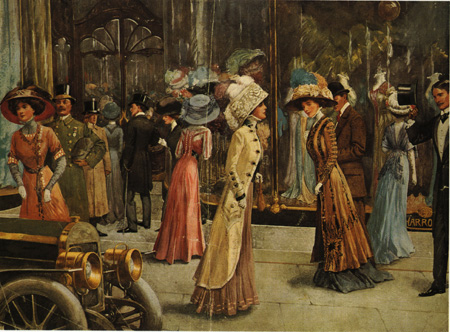
Harrods_1909

Imagine a woman walks into a car dealership.  She’s approached by a salesman who spends the next hour showing her cars and he eventually takes her out to test drive a favorite model.  The woman is not only wildly enthusiastic but states her intent to actually purchase the car.

So they return to his sales office where he patiently walks her through car options and loan details and, as she remains happy and willing, he finally draws up the paperwork.  At this point the salesman is beside himself, convinced he’s about to make a commission that will finally pay for the sports fishing trip to Alaska he’s been dreaming about for the last three years.

But as he places the pen in front of her to sign on the dotted line, everything falls apart.  She hesitates, starts expressing doubt, and then tells him she’s changed her mind and doesn’t want to buy the car after all.  She refuses to sign, picks up her purse, and heads for the door.  The salesman sees his dream of wind and waves, halibut and ocean salmon, heading out the door with her and he gets angry.

He feels cheated.  He feels like she’s led him on.  He tells himself that her earlier desire to buy the car is what she really wants, that her unexpected change of heart doesn’t count because she already assured him that she did, indeed, want it.

So he leaps out from behind the desk, grabs her, and throws her to the floor.  He rips her purse from her hands and pulls out her checkbook, after which he drags her back to the desk and violently sticks a pen in her hand.  He forces her to sign the purchase agreement, as well as a check for the downpayment, and only after he has those securely in hand does he allow her to finally leave the room.

Sounds ridiculous, right?  What salesman in his right mind would do that knowing that the odds of the contract being upheld (or even pursued) in a court of law are virtually nil?

Far from honoring such a transaction, every business interest involved would not only regard it as invalid, they’d be appalled and even frightened by it.  The dealership, fearing the nightmare of negative publicity it generated, would move swiftly to fire the salesman and make public apologies.  The police would arrest him on charges of, among other things, assault and battery, while the leasing company would refuse to honor the purchase agreement and the bank would refuse to cash the check.

Why?  Because in a merchant society, violent assault as a sales tool is considered bad for business.  Women wield enormous purchasing power, so naturally even our male retailers, police, bankers, leasing companies, courts, and chambers of commerce have a vested interest in preserving easy and continued access to their purses.

Frightened and/or battered women do not good shoppers make.  They’re wary and harder to coax into the store if they suspect they’ll be beaten once inside, so simple economics demands they be aggressively protected from out of control, violent salesmen like our shining example above.

And they are.

Men instinctually understand that if they start screwing up the business opportunities for other men, the consequences will be swift and severe, which is why incidents of this type are basically unheard of.  Men (and the keyword is men here) have established a zero tolerance for it.

But that’s a woman’s purse.  Unfortunately, we have a different situation entirely when it comes to clear cut legal protections for a woman’s body.  Sadly, there is still no established solidarity among men…no absolute and unquestioned zero tolerance policy…for sexual assault and rape.  While most men easily and intuitively understand why they’re not allowed to force a woman to sign financial documents, their understanding of why they can’t under any circumstance force a woman to grant them sexual access remains far more confused.

The fact that so much confusion still exists is a nightmare for women.  Clearly.  And since it’s rooted in long standing, deeply entrenched societal attitudes about not only sex and violence, but the basic identity of women and men, it won’t be easy to change.

But speaking as a woman myself?  I absolutely vote for the attempt.  Sexual violence against women is currently on the rise domestically and abroad and, while I understand (and even sympathize with to a degree) the reasons why so many men, including some very influential male politicians, are afraid of supporting and crafting stronger laws which could make them more vulnerable to wrongful prosecution for rape, I can’t help but resent just how easy they find it to sell off our safety to purchase their own.

There’s a very dangerous message going out these days to sexual predators that a certain cadre of male lawmakers are willing to turn a blind eye to their activities in order to afford themselves and men in general a greater protection from prosecution.

And there are already predators taking advantage of it in Northern Minnesota. There are signs that Native American women living on reservations in the north (one in three already report being raped and 80% of the assaults are perpetrated by non-natives) are also becoming fair game for rape by transient hunters during hunting season.  And yet politicians like Eric Cantor are working furiously to water down The Violence Against Women Act to make sure that stronger protections for Native American women (as well as LGBT and undocumented immigrant women) are not put in place.

From CNN Politics:

The Republican proposal deleted provisions from the Senate measure giving tribal authorities jurisdiction to prosecute cases on Indian reservations, specifically against discrimination of LGBT victims, and allowing undocumented immigrant survivors of domestic violence to seek legal status.

Native American women are hardly the only ones.  What’s happening to women in the U.S. military is another nightmare.  From The Guilfordian:

In an anonymous survey of women who served in Iraq or Afghanistan conducted by the Department of Veterans Affairs, 22.8 percent reported being victims of sexual assault or rape while in a war zone.

The Pentagon’s annual report on sexual harassment released in December showed a 23 percent increase in sexual assaults reported by students at its military academies, making 2012 the third consecutive year of increase.

And women in prisons fare far worse.  Frankly, some of the prison reports read like coverage of the rape protocols practiced by soldiers against women over in The Congo.  And it’s no secret that it’s happening. How in the world can this be willingly tolerated in a developed nation like the U.S.?

And then there’s the high incidence of date rape on college campuses, the rise in domestic violence, the revelations of child sexual abuse allowed in some of our largest and most powerful institutions, to name only a few.  The list is depressing and very, very long.

Men, I’m sorry to have to say this but really, the overwhelming majority of sexual predators are coming from among your ranks, as are the majority of politicians crafting the policy and law we women so desperately need for our protection.  Our sons and our grandsons are instinctively imprinting on your attitudes and your treatment of women. You guys are the ones who wield most of the power on this issue but, as a group, so far you’re failing us.  The statistics tell the horrific story.  Please, please, make our bodies at least as important to you as our purses are, and preferably more so.

Here are some sobering statistics from The Center on Women and Families. (And this is their toll-free, 24/7 emergency hotline for anyone out there who needs help: 203-333-2233.)

Statistics on Sexual Violence

The following statistics are based on national average.

Statistics on Females

  • Every 2 minutes, someone in the U.S. is sexually assaulted.(U.S. Department of Justice’s National Crime Victimization Survey)
  • 1 out of 6 women have been victims of rape or attempted rape in their lifetime. (National Institute of Justice & Centers for Disease Control & Prevention.)
  • 38% of women who have been raped were ages 14-17. (PSU)
  • 60% of rapes/sexual assaults are not reported to the police. (U.S. Department of Justice)
  • 73% of sexual assaults were committed by a non-stranger. (U.S. Department of Justice)
  • 38% of rapists are a friend of acquaintance to the victim. (U.S. Department of Justice)
  • 92% of homeless women have experienced severe physical and or/sexual violence in their lifetime. (PCAR)
  • Up to 38% of women identify sexual abuse as a reason for leaving their home. (PCAR)

Statistics on Males

  • An estimated 92,700 men are forcibly raped each year in the United States. (Tjadn & Thoemmes, 1998)
  • 3% of American men have experienced an attempted or completed rape in their lifetime. (National Institute of Justice & Centers for Disease Control & Prevention.)
  • In 2003, 1 in every 10 rape victims was male. (U.S. Department of Justice)

Statistics on Children

  • 1 out of 4 girls and 1 in 6 boys will be sexually assaulted by the time they are 18 years old. (Darkness to Light)
  • 15% of sexual assault and rape victims are under age 12 and 44% are under age 18. (U.S. Department of Justice)
  • 93% of juvenile sexual assault victims know their attacker. (U.S. Bureau of Justice Statistics)
  • Girls ages 16-19 are 4 times more likely than the general population to be victims of rape, attempted rape, or sexual assault. (RAINN)

UPDATE:  The Violence Against Women Act just passed in the House with protections for Native American, LGBT, and undocumented worker women left intact!  Thanks from the bottom of my heart to every man who stepped up to the plate and voted for it.  You’re sending a powerful message to all the sexual predators out there busily trying to figure out which women will be easiest to rape.   You have my undying gratitude (and the gratitude of the legions of other women who’ve either been sexually assaulted or are in chronic danger of being so.)  Today is a very, very good day.

copyright Dia Osborn 2013

How Trees Treat Their Dead (Among Other Things)

Tree anthropologists everywhere have wet dreams about this kind of luck.  Last weekend I received a coveted invitation to visit a little known tree community in the White Clouds mountain range of central Idaho and, needless to say, jumped at the chance.  The day was a perfect storm of ideal conditions…calm weather, crystal clear skies, total solitude, and unprecedented access.  The following is the photo/documentary report I’ve submitted to The Boston Journal Of Arborealogy.

My primary focus as a tree anthropologist has been the study of funereal practices among high altitude trees of the North American mountain west and while, admittedly, most of the tall timber rites I’ve observed wouldn’t translate well for human adoption, there are a few elements that might help inform our primarily human-centric views on death and dying.

ARBOREAL RESPECT FOR THE DEAD

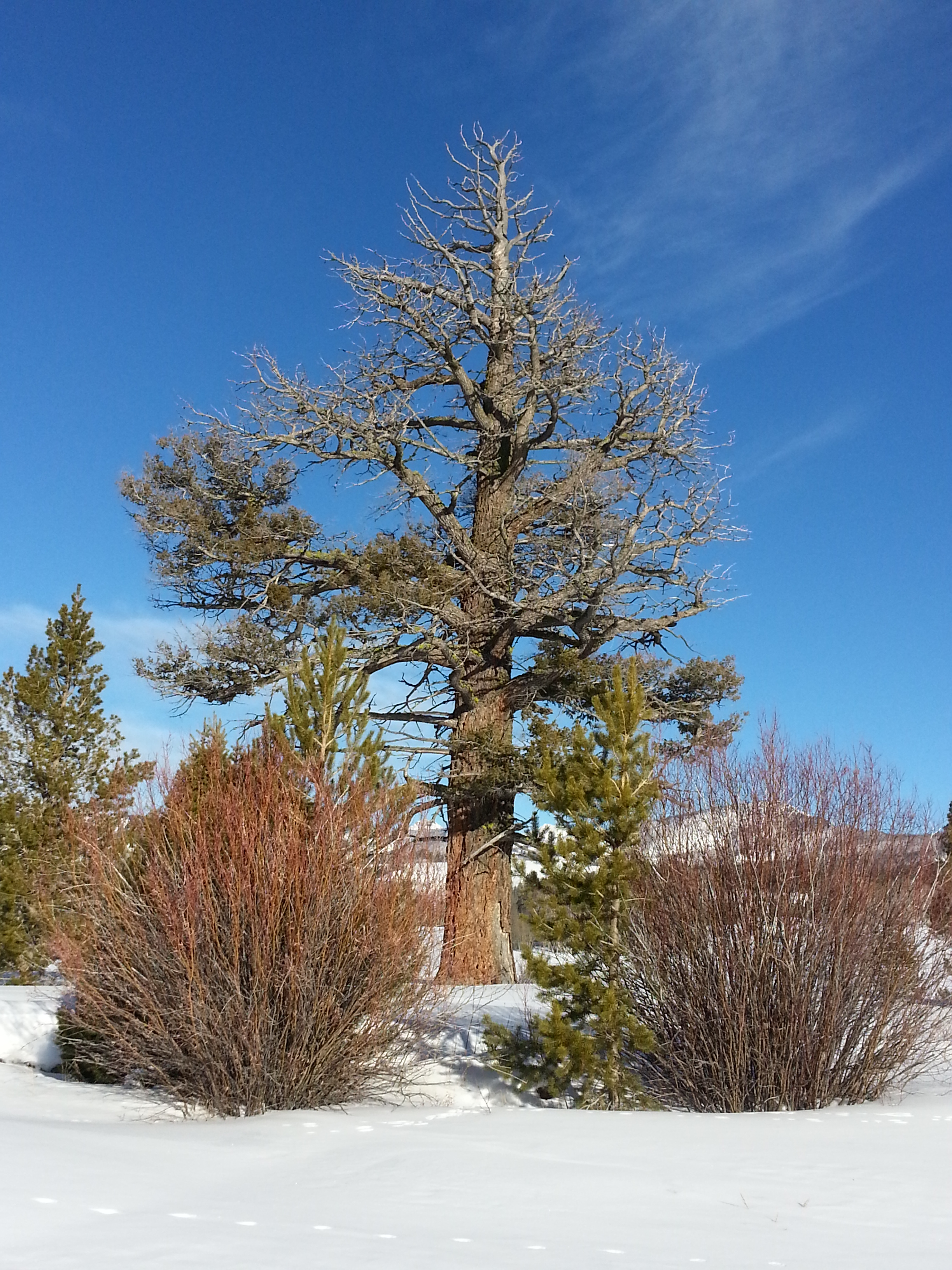
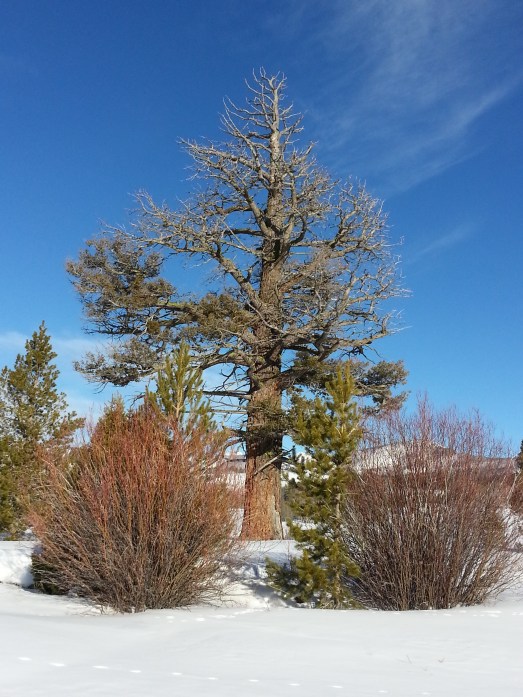
The first and most obvious difference between tree and human treatment of the dead is that trees make no effort whatsoever to hide theirs.  It’s truly striking.  For instance take a look at this photo of a recently deceased elder who clearly held great stature among the local community.
20130203_153626

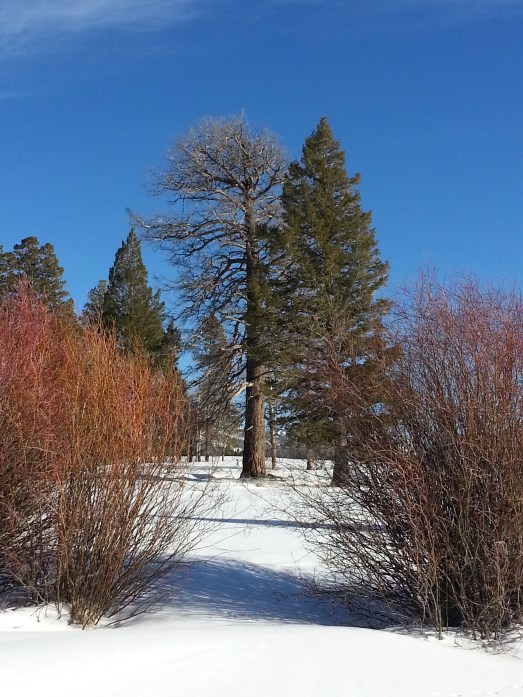
Even more surprising is the fact that, during the rapid years of its pine beetle fueled decline, this giant was apparently not only allowed but encouraged to display that, too, for the entire community.  (Note the willow shrubs and young Ponderosa pines posted to stand guard in the foreground…one of the many indicators that this tree was highly regarded in life and remains so in death.  Immediately below is a photo of another highly regarded dead tree with posted willow shrub guards.  Note the surviving spouse standing alongside in this example.)
20130203_154131

INTERMARRIAGE

Next, I was given a brief introduction to the following “Jack Spratt could eat no fat, His wife could eat no lean” looking couple but was not allowed to ask questions.  I believe the loss was still fresh.  Jack’s wife seemed to be fairly distraught, entangling her lower branches with his now bare and drooping ones.

20130203_153515

Evidently, there’s some sensitivity surrounding the fact that this was an interspecies marriage but I couldn’t put my finger on exactly why.  While intermarriage between a variety of evergreen species is widely accepted, intermarriage between evergreens and deciduous species is less so.  (Obviously this places Aspen, as the only deciduous trees in the area, at a decided disadvantage.)  I couldn’t discern whether this taboo arises from the lack of any possibility for cross pollination or from the wide difference in life expectancies.  Individual Aspen don’t live nearly as long as, for instance, Douglas Fir or Lodgepole Pine, so the tragic outcome displayed above is inevitable.

ARBOREAL PLAY

Moving on.  As an interesting and little known aside, I wanted to mention that trees can also be surprisingly playful.  When the ones in the picture below saw me angling for a photograph of the mountain range behind them, they began mischievously crowding together to block the shot in a well-known tree version of the game “Peek-a-boo.”

20130203_155636

At first it was just irritating, but that was before I noticed the unconscious, aesthetic instinct that appears to be common among high altitude trees.  I was amazed to discover that no matter how they blocked the view, this little gang o’ green left just enough of the mountain range exposed behind them to reveal a scene of subtle but unmistakable beauty and, once I let go of my preconceived notions of the shot, we had a lot of fun.  Trees are natural hams and will usually hold a pose for as long as you need.  Here’s another group of adolescents playing the same game:
20130203_154752

It’s a strange fact that even dead trees sometimes enjoy a good game of “Peek-a-boo”, only their ability to effectively block whatever’s behind them is understandably compromised.  I’m happy to announce however, that their innate aesthetic sense is not.  Please note the two examples below:

20130203_153736

20130203_154552

I was amused to find some of the native shrubs in the area attempting to mimic the game, but of course they lack the necessary height for effective play.  Thus, I finally managed to capture the original mountain photograph I was after here:
20130203_154923

ARBOREAL PARENTING AND PROGENY

High altitude trees of the mountain west are widely recognized as devoted parents and the ones in this region are no different.  Here’s a photo of one of their young taken while visiting a community daycare center.

20130203_163539

Tree youth are granted considerably more freedom than their human counterparts, largely because saplings are more sedentary.  Not that the dangers they face are any less, but at least they can’t wander off looking for trouble.

Tree seeds, on the other hand, are wildly mobile.  Seedhood is well known as the most unpredictable phase of all tree life, with the popular-but-dangerous game “Grow Where You Fall” observed worldwide and across most tree species.  Every mature, seed-bearing tree in this region has grisly stories to tell of tiny seeds leaping from their branches to be swept away by wind gusts, and indeed the infant mortality rate among emerging seedlings is upwards of 99%.

Staggering, I know.  How tree parents bear those kinds of losses is beyond me.  Perhaps it’s their longer perspective, the same thing that anchors and steadies them through the cyclic punishment of winter storms and icy nights.  I often wonder if their epic suffering is what ultimately helps them exude the sense of serenity that mountain trees are so famous for.  There’s no way to know of course, but I myself have learned a great deal about endurance by hanging around under their branches.

THE “SHORT DEATH”

Unlike humans, trees experience both what is known as a “short” death and a “long death.”  Short death is actually just a hibernation of sorts and can be triggered by failing light, winter cold, or drought.  It’s most familiar display happens among deciduous trees whom, at the first sign of winter, drop all their leaves and fall asleep where they stand in a kind of narcoleptic response to the stress.

Needless to say leaves everywhere hate the practice and in some regions have attempted to unionize to prevent it, but so far without success.  The unfortunate little fellow pictured below managed to cling to his twig longer than most but I’m afraid February finally claimed even him.

20130203_162813

ASPEN

Now…throwing all scientific objectivity aside for a moment…I must say I found the Aspen in the area to be a delight beyond anything even I had hoped for.  As a succession species their position in the larger community is not enviable, and yet somehow, despite widespread marginalization, they still maintain a childlike openness.  Like everyone else, I was raised on charming tales of the mysterious attraction Aspen trees so often display for humans but still, the actual experience of having a circle of these white-barked beauties gather to peer down at me in unabashed curiosity was a thrill I will never forget.

20130203_162455

20130203_162628

ASPEN “PEEK-A-BOO”

Of course Aspen love to play “Peek-a-boo” as much as other species, but they’ve learned how to model a unique, winter “slow death” style that’s become quite a draw for photographers.  I’ve included two of my own modest examples below:
20130203_162402

20130203_162213

But if you want to see a couple of spectacular photographs that draw from the lesser known but even more beautiful “Block the Peek Completely” style, try here and here.

A RARE LACK OF INHIBITION

While Aspen are universally friendly, individually they’re quite shy preferring to cluster in groups.  This is due in large part to the fact that each copse, however large, shares a single root system.  However, you can still occasionally find a rare exhibitionist such as the nubile example below:

20130203_163453

Breathtaking.

SOME PHENOMENA RARELY CAPTURED ON FILM

The existence of animales non evidens (or Invisible Ones) is a subject hotly debated among arborealogists and not likely to be settled anytime soon.  Much like Big Foot and the Spanish chupacabra, most reports originate from sightings of their tracks, but unlike their larger counterparts, animales non evidens themselves are truly indiscernible to the naked eye.  In addition, their tracks can only be seen in winter as their body mass is apparently too insubstantial to imprint on anything heavier than snow, making them that much harder to detect.

High altitude tree communities universally report a close and symbiotic relationship with non evidens and in fact assign them an almost revered status.  Indeed, Invisible Ones are said to play an important role in all arboreal funeral rites as they are essential to the slow decomposition process that breaks down a dead tree to its original elements…a final state that is the closest approximation trees have to an afterlife.  I was assured by several of the Aspen I spoke with that the tiny tracks in the photograph below were indeed left by non evidens.  I submit them here for review and discussion.

20130203_161914

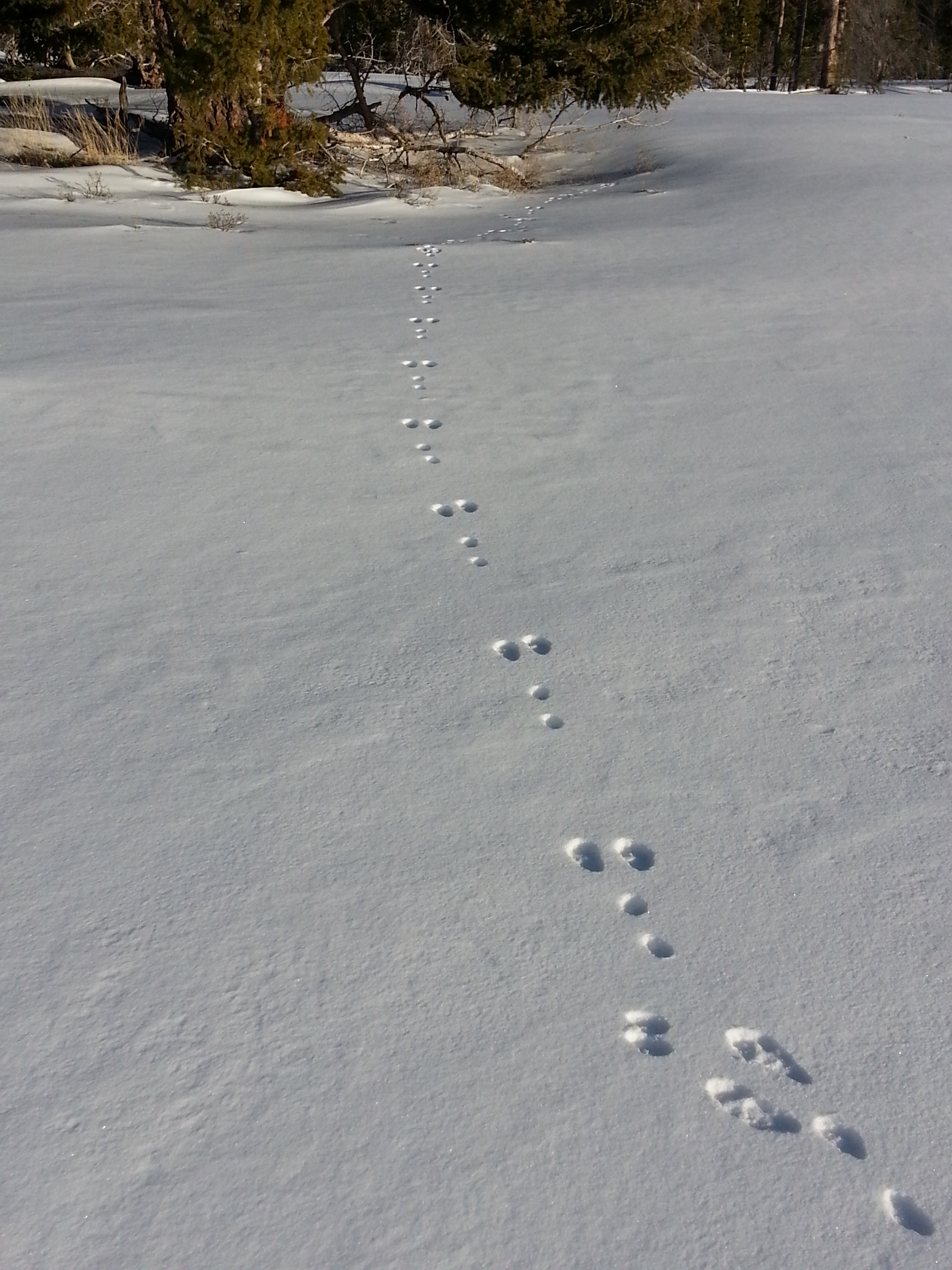
I was understandably excited by the find and immediately commenced a search for more tracks.  At first I thought I’d hit the jackpot when I discovered those shown below, but the Aspen just chuckled and told me they were from a rabbit.
20130203_164633

Unlike human grieving, the stage of arboreal death where loss is experienced most keenly is not when a tree initially dies, but when its desiccated trunk finally falls to the ground.  In a forest situation it’s not uncommon for surrounding trees to actually catch a swaying companion in their branches and hold them there for months…sometimes years…before allowing their final collapse.

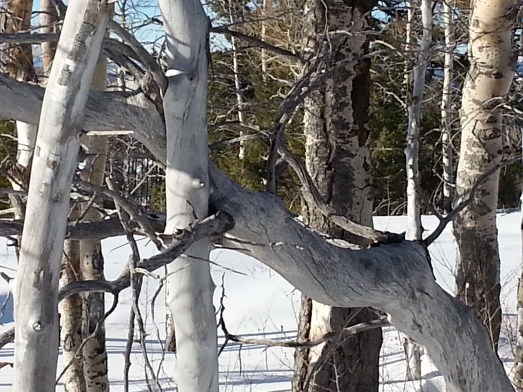
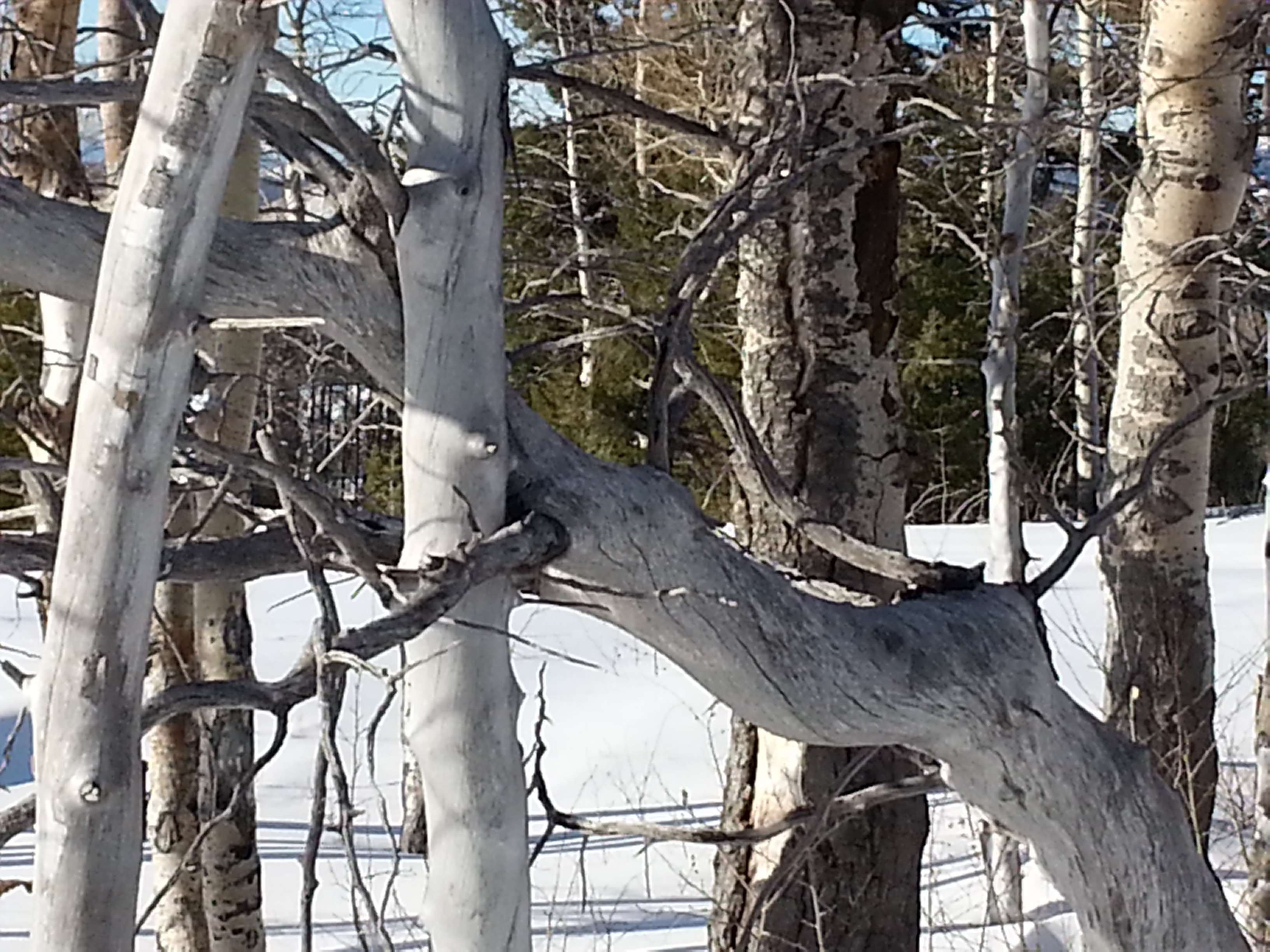
This practice is called suspension and is particularly important to high altitude Aspen since 1) they invariably grow in close copses and 2) they’re subject to such a brief lifespan.  There’s an esoteric but widely held belief in this region that suspension somehow extends an Aspen’s life and indeed, it’s considered a “bad death” if any tree makes its final fall without the lingering support of community.  One copse of Aspen allowed me to take the photo below and I cannot overstate the generosity of their permission.  As you can see, these trees were devastated by grief, the two on the left even going so far as to experience a “sympathy death.”
20130203_162105

ARBOREAL BELIEF SYSTEMS

The spiritual meaning that high altitude trees assign to dying and death are notoriously difficult to translate but perhaps the easiest explanation is that death is regarded more in the light of an act of generosity than in the human sense of tragic loss.  I suspect much of this comes from the paucity of local resources and the corresponding limit to the number of trees the region can support.

Seen in this context the death of a tree holds a double gift: Not only does it free up the resources it would otherwise consume, but it also eventually contributes the nutrients contained in its own structure back to the surrounding community through slow composting.  For this reason dying is considered to be an honored…even sacred…act, which is perhaps why they make no effort to disguise or hide it.

All the trees I spoke with seemed confused by the human concepts of “God” and “heaven,” primarily because they can’t seem to distinguish between “this” and “other” worlds.   However, there is a transcendental element to their beliefs.  They actually have three words for “life” (all of which are lovely, melodious sounds made by wind moving through leaves or needles.)

1) The first word roughly translates to mean biological life.

2) The second is closer to the human idea of energy, while

3) The third simply has no equivalent.  Trees describe it as a sound they can all make…even dead trees…in response to a feeling of supreme content.  It’s inaudible to the human ear but is often felt on a tactile level, like the rumbling of a distant waterfall, or the ground vibration of a running herd, or the distant growl of an airliner flying at 30,000 feet.  Predictably, the larger the tree, the stronger the sound/vibration they emit.

When humans do report an experience of this arboreal call, it’s usually described in terms of beauty rather than sound.  Who hasn’t seen a person standing and staring, bemused and mouth agape, at some spreading tree specimen the beauty of which temporarily incapacitates them?  Indeed, I’ve occasionally seen entire groups held spellbound by the same effect. (Nature photographers seem to be particularly susceptible.)

Older reports all indicate that the sound deepens when emanating from a dead tree…magnified a hundred fold in fact…but, while I’ve often longed to hear it myself, the opportunity to do so is almost nonexistent in areas where human and tree communities overlap.  This is due to the human custom of immediately cutting down any tree that appears to be dying or dead.

However, I’m delighted to announce I finally heard it on this trip.  Twice no less.

It was nearing sunset and I was preparing to take my leave, offering the many slow and formal farewells that are such an integral part of arboreal etiquette.  It was during the last round of “boughing” (a kind of upper limb waving that frankly, looks ridiculous on a human being, but is pure ballet when performed by a tree) that I felt the first sound begin to resonate in my chest.  It happened while “boughing” to the cluster pictured below:

20130203_164134(0)

I have to say, I now understand on a visceral level why trees regard the sound with the reverence they do.  It’s moving, heartbreaking, and deeply disorienting…suggestive of something ancient and vast…and in a strange way it really does evoke an unusually strong impression of life itself, even though it’s emanating from something that has died.  Indeed, the overall effect was one of sensory awareness heightened to an almost ecstatic degree, like the best imaginable blend of heartfelt prayer, smooth opiates, and skinny dipping.

I finally managed to reorient myself with some effort and took my leave, retracing my tracks on the long trudge home.
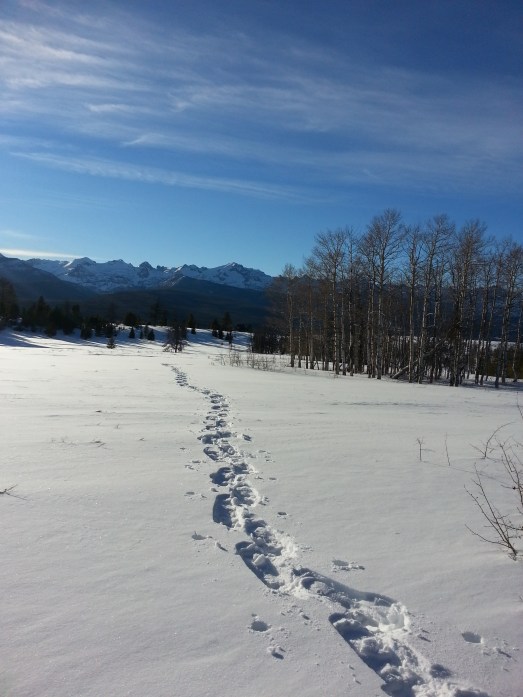
20130203_163302

The second sound came as I was nearing the top of a ridge and looked up to find this magnificent dead elder standing sentinel there:

20130203_171410

There followed an undetermined lapse of time where I was held, frozen and slack jawed, by the unearthly sound it generated (evidently in response to the coming sunset.  Trees and sunsets share a long, almost legendary history widely chronicled in their mythologies.)  Fortunately, I was finally recalled to myself by the increasing cold and I managed to salvage enough presence of mind to get this one, rare shot before the sun disappeared and the light was entirely lost.

The whole experience was extraordinary, even more so because the vibration continued resonating in my chest for a long time after the original sound itself had faded.  It lasted the entire time it took me to retrace my steps back to the cabin and only ended completely once I stepped inside and closed the door.

The next event I’m scheduled to attend is The Rocky Mountain Clonal Conference (hosted jointly by the Utah Quaking Aspens and Snake River Shrub Sumacs) followed by The Prometheus Scholarship Awards (named for the famous 5,000 year old Bristlecone Pine cut down by a U.S. Forest Service Service graduate in 1964.)  These scholarships are given out every hundred years or so to the most promising crop of young saplings collecting folklore and songs from our oldest surviving trees.  I will of course only be able to attend the opening ceremony as the entire conference lasts about seventeen years.

And lastly, for any readers who actually made it all the way to the end of this silly, fantastical report…you, too, are hereby awarded an honorary Prometheus Award for your extravagant disregard as to the value of human time.  Bravo.  (You have permission to download the following logo and display it prominently on any blog, website, or letterhead you choose.)

20130213_112350

copyright (especially the award) Dia Osborn 2013


Spiritual Monogamy?

I, personally, am not wired for it.  Not.

That said, unlike a lot of people these days, I love religions.  All of them.  Present and past.  I think religions are important and valuable and necessary and that they do a lot of good.

(Harm, too, of course, but my inner purist is pretty battered at this point.  The wild ride from shining eyes to growling cynic to the mysteries of a hospice bedside was a bitch, but it did leave me with this one kernel of truth: Throwing stones is hard on my hope.)

I don’t currently belong to a religion, although I used to convert a lot back in the day.  In my troubled teens and twenties I was something of a spiritual nomad crossing the vast desert of life and let me just say…when you’re exiled and wandering through the dunes and darkness like that, you can’t afford to be picky about who’s well you will or will not drink out of.  A ladleful of grace is a ladleful of grace and I was glad for every offer.

I found the same kind of life-saving grace at the heart of each religion I fell in with.  Even though the words they used were often different…not to mention their customs, costumes, stories, and songs (and sometimes even their Gods)…still, that rippling, silver grace lying pooled in the bottom of each ladle was the same.

Maybe that’s why I’ve never been able to choose between them…commit to just one and forsake all the others.  Because how could I turn my back on any of these friends who once took me in from the night, bathed and bandaged my feet, and let me rest till I was stronger?  I can’t shake the feeling that that would betray the very grace they once shared with me.  I may not be a Christian or Buddhist or Hindu or Jew or Shinto or Muslim or Taoist or Pagan…or any of the other beautiful, twinkling, mysterious faiths that offer the shelter of tents where we can kneel in safety and drink with both hands…but I still love and believe in them all, in their value, imperfection, and gifts.  In the grace lying veiled and tender at their cores.

Y’know, the thought just occurred to me…maybe I am spiritually monogamous, just not to a religion or a God.  What if it’s that grace I keep finding everywhere that won me over time?

Although not even over time really.  It was love at first contact.  I fell for it hook, line, and sinker the first time I ever experienced it as a small child, long before I entered a church, had any words to describe it, or even knew that grace was a thing.  Honestly?  I have no idea in the grand scheme what that feeling of being enfolded and cradled is all about, where it comes from, or if it comes from anywhere. Whether it’s a sign of something divine, a neurological by-product, or something generated by an as-yet-to-be-discovered energy field like electro-magnetism or gravity.

What I do know is that without its influence over the years, the odds of my surviving to write this blog post were pretty bad and I can hardly bear to think about everything I would have missed.  So yeah, maybe I’m wired to be spiritually monogamous after all.  Who knew?

il_570xN.272868770

(This piece of beauty is called Night Sky Over Desert Dunes and is an acrylic on canvas by artist Kathryn Beals.  8×10 prints are available here for $14.00 USD.  Something of a steal really.)

copyright Dia Osborn 2013

Faecal Transplants Finally Get Some Respect

CBS News reports that a study has just been published in The New England Journal of Medicine which finally confirms what many already knew:

Faecal implants work far better than antibiotics when treating the highly contagious (and rapidly spreading) gastrointestinal infection called C. difficile.  

Hopefully, now that it’s official, it’ll be easier for those who want to have the procedure done to find a doctor willing to do it somewhere near them.  This is great news.  Very great news.

Other posts on faecal transplants:

Fecal Implants? Seriously? (Yup.)

Could Fecal Implants Be A Cure All?

Immortality or Purgatory? What Will Happen To Our Online-Selves When We Die?

copyright Dia Osborn 2012

Immortality or Purgatory: What Will Happen To Our Online-Selves When We Die?

gravestone

Photo by R Neil Marshman

I received a comment Sunday morning that shook me up in a way that surprised me.  It was on a post about fecal transplants I wrote a couple of years ago that has continued to get a lot of hits over time, mainly, it seems, from people suffering with the C. difficile epidemic now sweeping the globe.

Some of these people left comments on the post and one was from a man named Jay who shared his battle with C. diff. in some detail.  He’d finally found a doctor willing to do the fecal transplant procedure for him and he promised to come back afterwards and share the results.  That was in May of 2012.

He never returned and, honestly, I never thought about him after that.  Over the years this blog has developed a handful of regular followers with a few more who pop in and out for occasional visits, but mostly I get one time visitors.  I didn’t realize how inured I’d become to this fleeting contact, or how much I’d fallen into thinking about most of my visitors as clicks rather than real people living their fragile and luminous lives out there.

But then I woke up Sunday morning, groped through the usual morning fog for my phone while the coffee was brewing, and saw the fecal transplant post had received another comment.  When I clicked through to read it I discovered it was from one of Jay’s surviving loved ones, Cindy.  She wanted to let me know that Jay never came back to post his results because, even though his transplant procedure had been a brilliant success, he died of complications from another procedure a little while later.

Her comment startled and instantly sobered me.  It knocked me out of my safe, cozy, Sunday morning cocoon into a place with a much larger perspective.  There I sat, looking down at the careful, gracious words of a flesh and blood woman who was actually sitting out there somewhere in the world, bending over her keyboard in great loss and pain, and suddenly, through her, Jay ceased to be just a flat, old blog comment I’d mostly forgotten about.  In that moment his online-self merged with his solid, physical self and made him very real for me.

I’ve run across a few blogs over the years that just stopped with no explanation of why.  I always assumed these bloggers grew bored or busy and just abandoned it, but now I wonder how many of them might have physically died leaving their blog-selves in some weird, digital purgatory.  If there isn’t a surviving loved one like Cindy who’s willing, able, and given all the right passwords and permissions to update our blogs and social media sites after we die, then instead of basking in an honored, online immortality of sorts, our digital selves will probably just be cast into limbo…unfinished, unremarked, and unmourned.

But (to me anyway) what’s even more important is that if we don’t take time to make some kind of plan for our sites before we die, then it could potentially cause a lot of confusion and pain for our surviving loved ones.  A person’s Facebook wall can evidently turn into something of a free-for-all when they die and the internet as a whole is still the wild, wild west where digital afterlife is concerned.  It’s something that bears thinking about.

The truth is if Cindy hadn’t found me and let me know, it wouldn’t have taken anything away from my life.  The sum total of contact between Jay and I consisted of one comment and one reply.  It was at most a mild and civil encounter, like a pleasant exchange with someone at an information desk.

But because she had the grace to follow-up for this man that she loved, my life was unexpectedly enriched.  She and, through her, Jay gave me the opportunity to have a Whoa! moment that knocked me out of my busy, triviality-consumed head for a few moments back into my heart and deeper humanity.  I want that kind of interruption in my life.  I want to be reminded that life is priceless and delicate and brief.  And a comment like Cindy’s also inspires me to strive for the same kind of thoughtfulness and grace so I, too, can pass it forward.  You just never know how that kind of thing might touch or help someone else.

Thank you Jay and Cindy.  Please accept my loving thoughts and deepest condolences in your time of sorrow.

I looked around and found a few links to different articles and online resources that I found insightful and/or helpful.  They all shed light on some of the developing ethics of, and how to prepare for and manage, our digital afterlives.  Like wills and advanced directives, it’s something worth thinking about for those we’ll be leaving behind.

Articles:

Online Life After Death Faces Legal Uncertainty

Death on Facebook Now Common as “Dead Profiles” Create Vast Virtual Cemetery

Guides:

How To Prepare For Your Online Afterlife  A 12-step guide to getting your virtual affairs in order.

The Digital Beyond  A resource for online services designed to help plan for the digital afterlife.

Online Memorials

On Decoration Day

copyright Dia Osborn 2013
When Instincts Lag Behind

800px-Henri_Rousseau_-_Il_sogno

Henri Rousseau The Dream

Our collective, societal instincts about dying haven’t really kept pace with our evolving medical technology.  Which makes sense.  How could they?  Group instinct develops over long periods of time…decades, centuries…while medical technology is changing so fast that even the medical technologists changing it can’t keep up with it all.

Instinctually, the typical knee jerk response is still to cling to life as long as possible and our  group choices…the ones offered by our medical industry…mostly reflect that.  The majority of people don’t understand on a visceral, gut level yet how blindly clinging to life can now take us far past what we want into nightmare territory.  It’s like overshooting a remote landing strip and crashing deep in the jungle on the other side.  You may live a little longer that way but you now face new and different ways to die that you probably won’t like.

I usually find there’s a big divide in understanding between people who have hands-on experience around dying and people who don’t. Experience seems to update one’s instincts to the 21st century.  In a hurry.

I suspect better education about dying would, too.  And it also might help people avoid some of the most popular mistakes being made today.

For anyone interested in the educational option, here’s a link to one of my favorite articles about navigating the dying process in today’s world.  It’s called Letting Go by Atul Gawande and is pretty long.  But it’s also compassionate, wise, and insightful…things that can help when wading into a topic as scary as this one.

copyright Dia Osborn 2013
Sparkles and Shadows

20121230_101918

Happy New Year!

First, an update.  My blog is falling apart.  I upgraded last summer to a level way beyond my expertise and now less and less is working with each successive update.  I finally gave up this morning and stuffed an S.O.S. in a bottle for WordPress support staff in the desperate hope they can help me return to my old blog domain.

Please Wizards…I want to go home.   I just want to go home.  (Click heels together three times and repeat.)

Hopefully things will improve soon and I’ll be able to comment on other people’s blogs again!  In the meantime, please keep your toes, eyes, and fingers crossed for me.

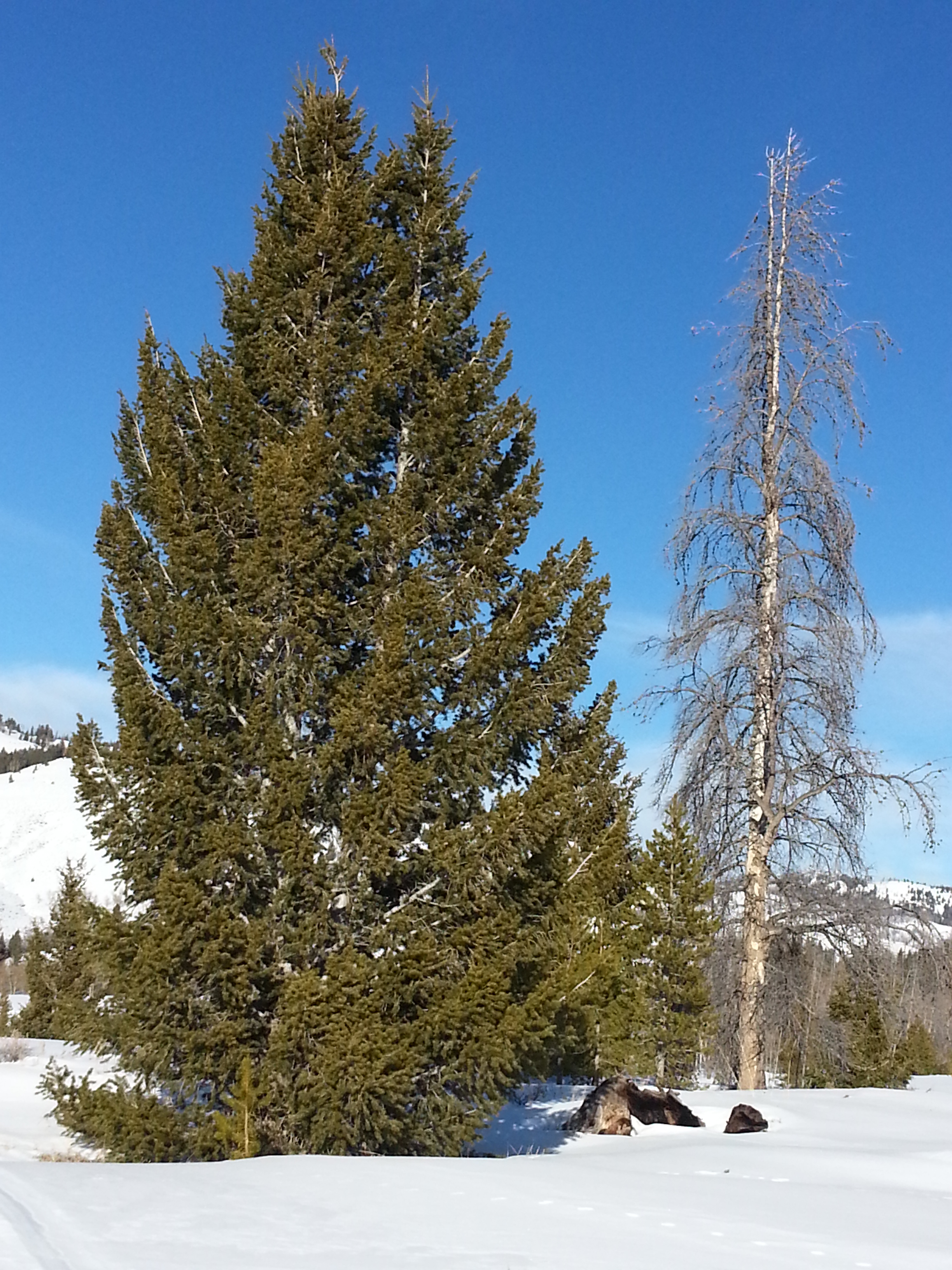
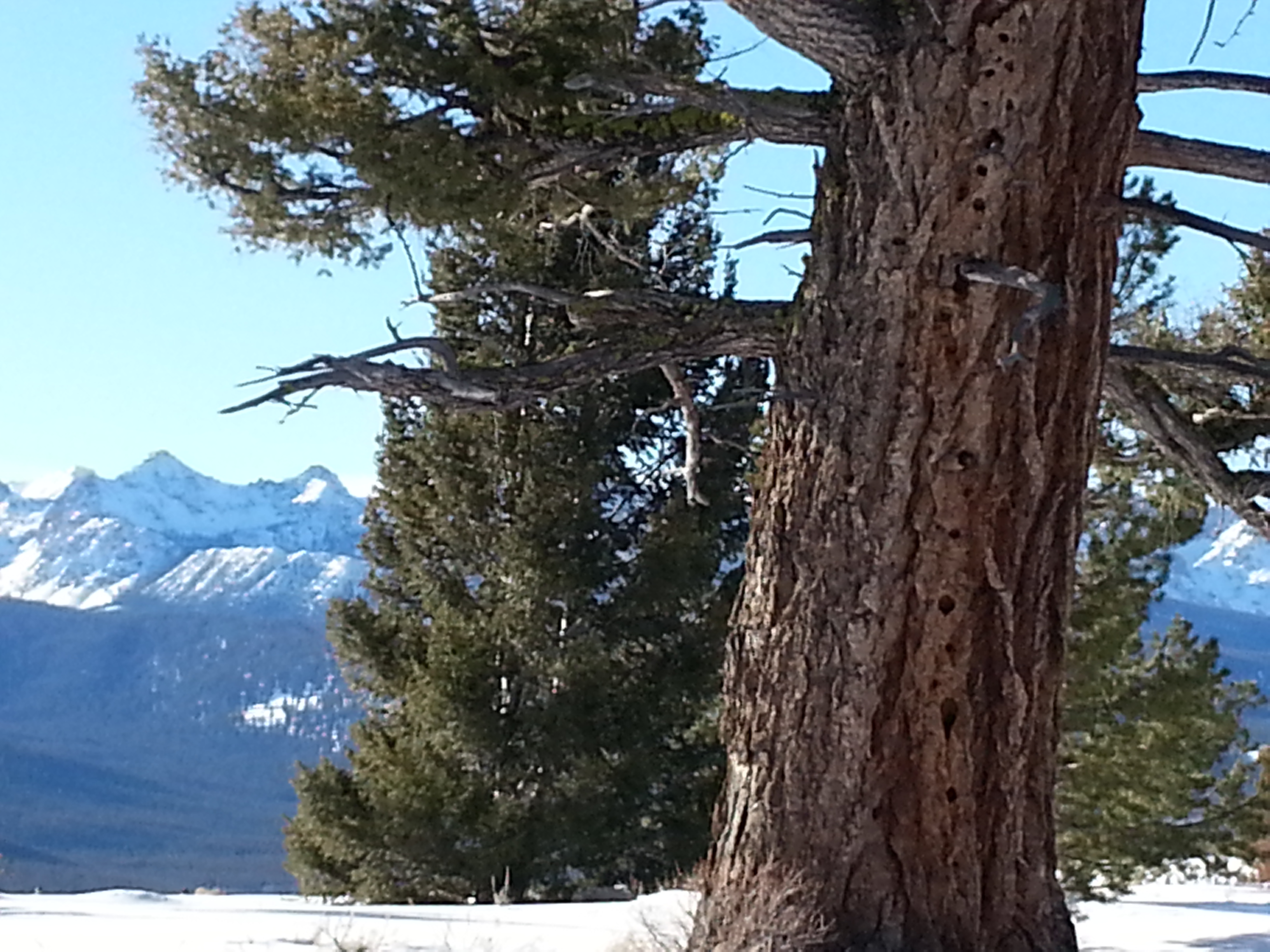
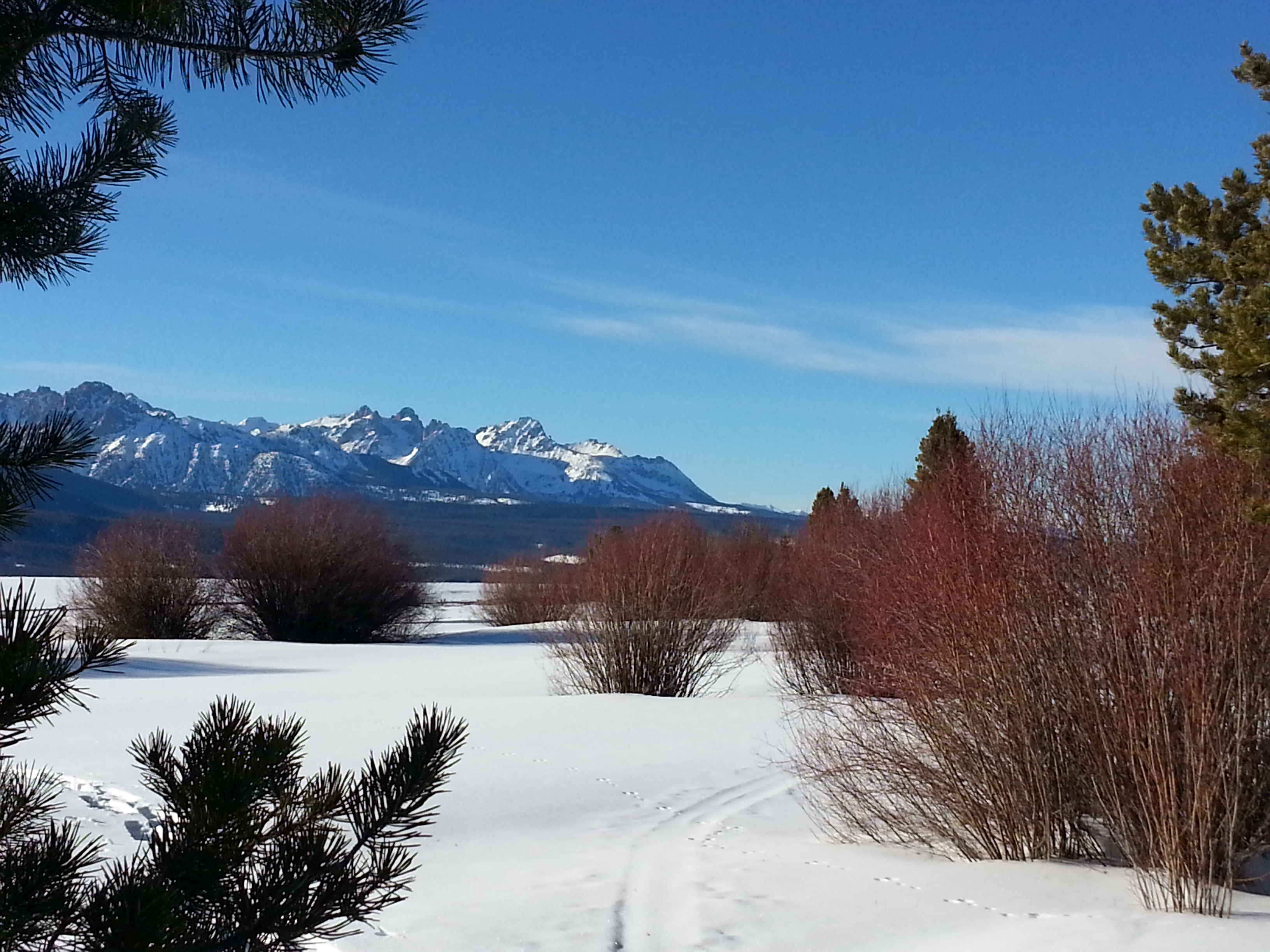
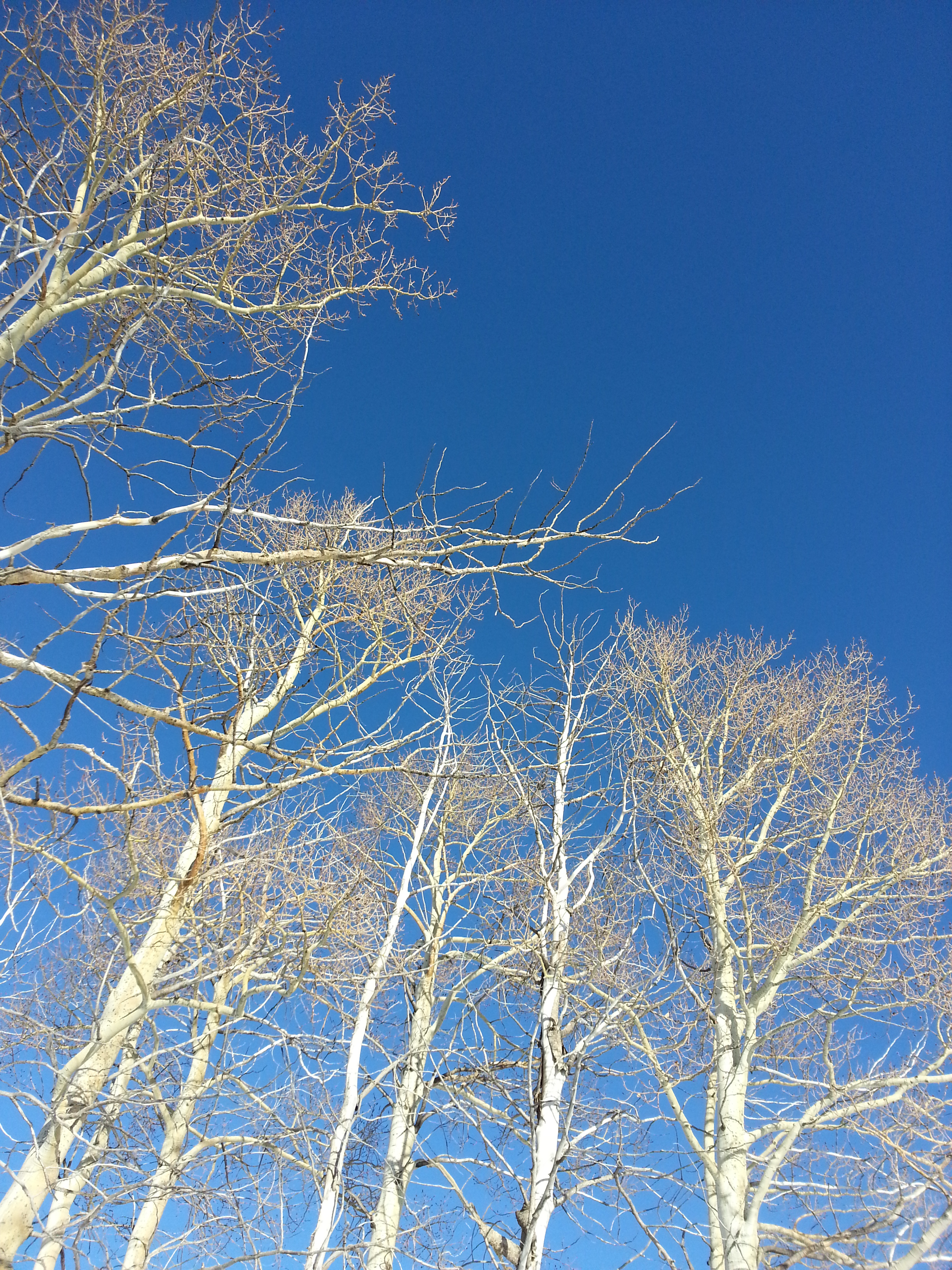
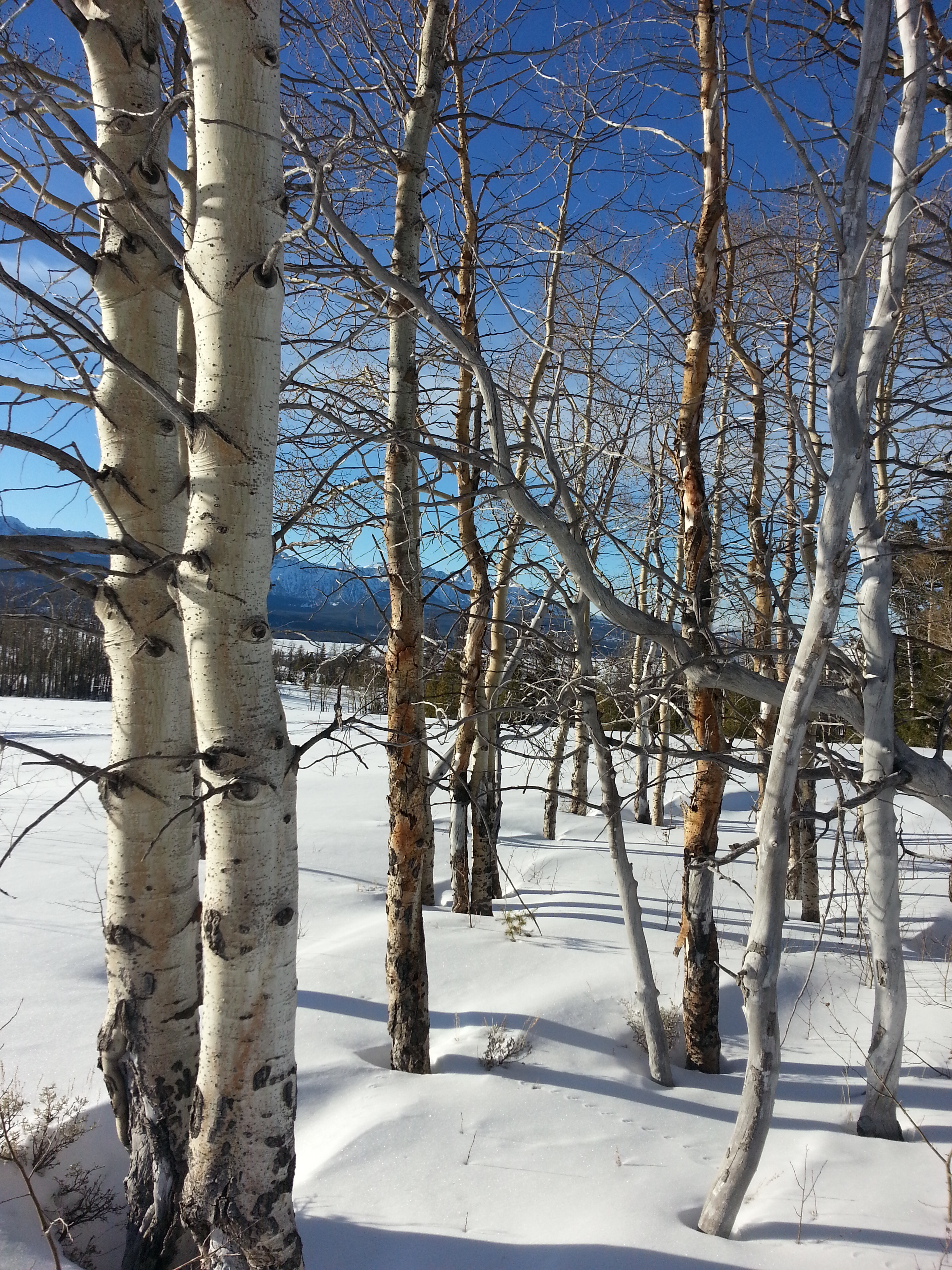
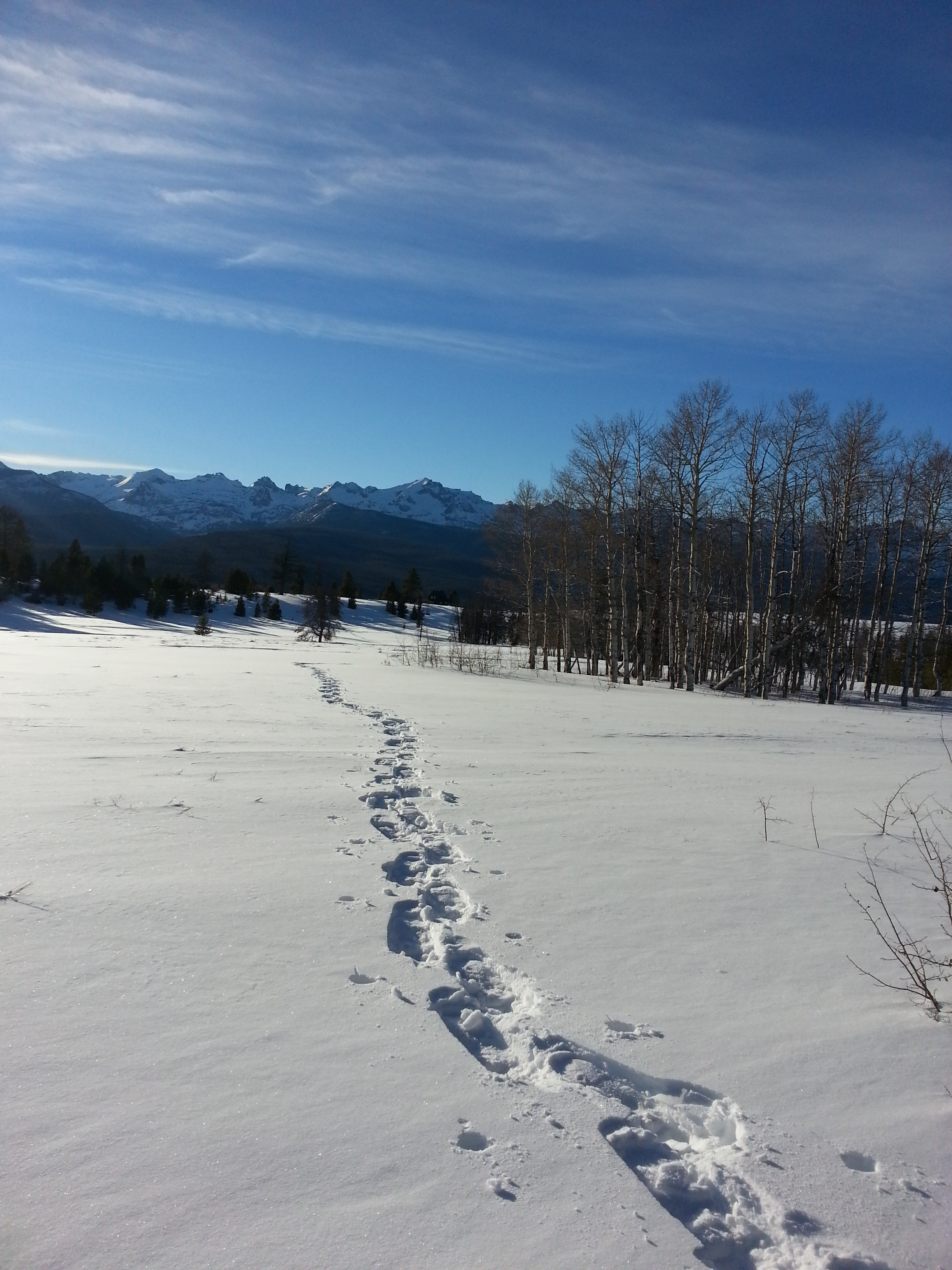
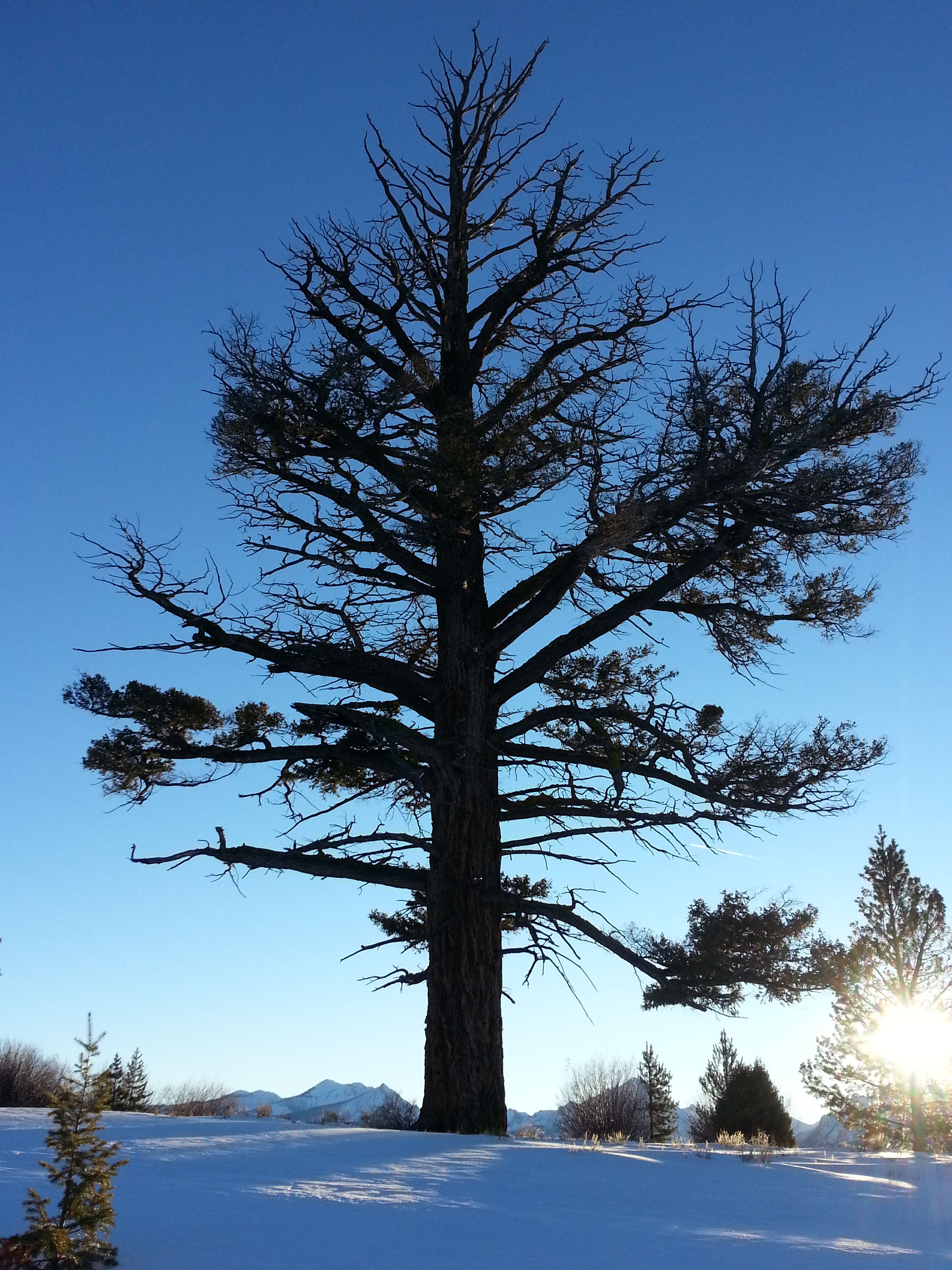
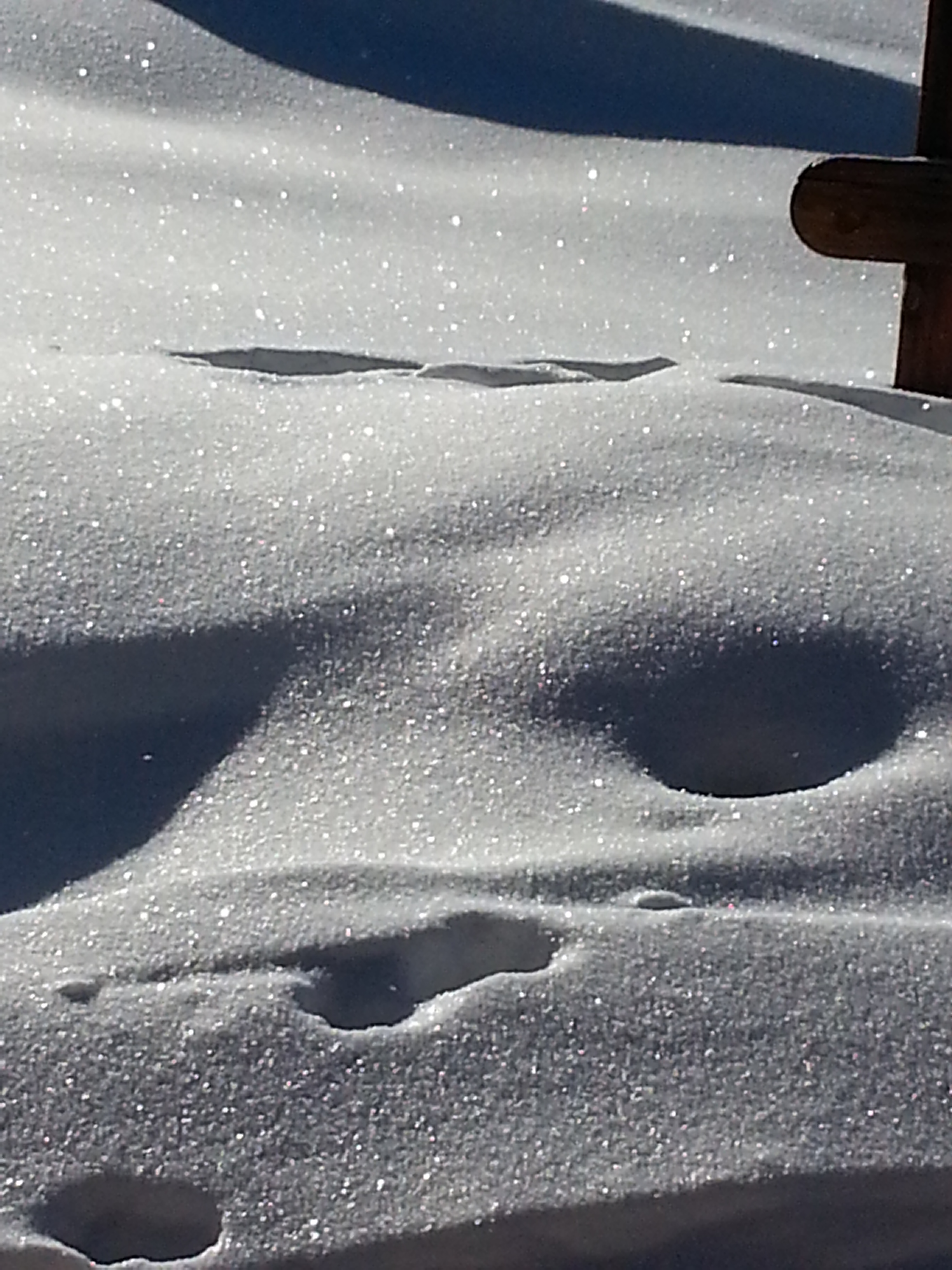
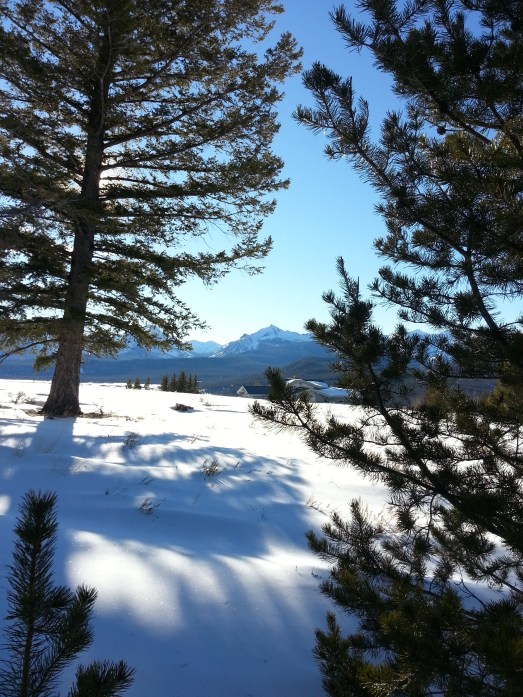
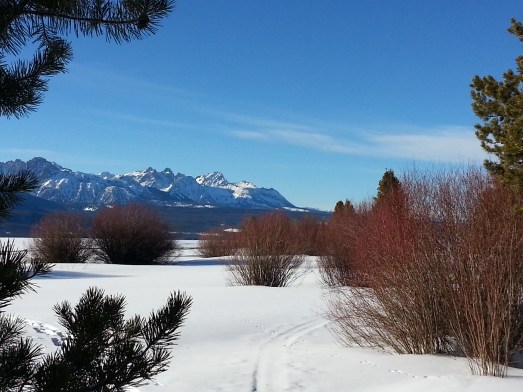
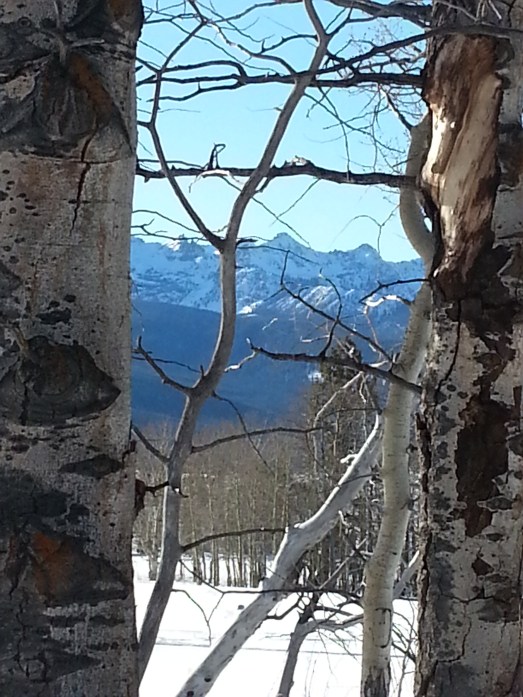
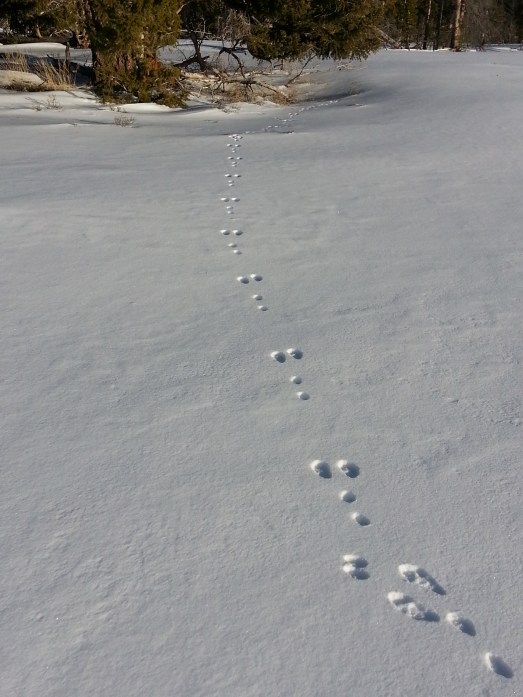
On another topic, the hubster and I ran away to the mountains again for the week between Christmas and New Years and spent our afternoons briskly snowshoeing.  I brought my trusty camera phone with me to take pictures but soon abandoned the attempt because it was such a pain to stop, sink my poles, remove my gloves, unzip my jacket and then my pocket, take out the phone with frozen, clumsy fingers, find the camera app, take a picture, then do all the above again in reverse.  Every time.  We were getting nowhere really fast.

Here are the ones I did get.  Nothing that truly captures the beauty of the place (I’m no photographer) but enough to hint.  A high settled in while we were up there so conditions were crystal clear and brutally cold…great for sparkles and shadows.

20121231_150453

20121231_151835

20121231_145644_4_bestshot

And, as always, the view out the front door of the cabin.  (Sorry, but I just never get tired of this shot.)

20121230_102012

Here’s to the challenges and adventures of the coming year!  Good luck to us all.

copyright Dia Osborn 2013

To marvel or run?

Would this excite or terrify you?

(I found this video on a great blog called 2BAware.  The whale breaches 26 seconds into the video.  The other half a minute records the response of the woman on board.)

A number of commenters on the video’s Youtube page sound unsympathetic to the woman’s distress.  They were apparently left by people who don’t yet know that breaching whales can and do sometimes land on boats.  Case in point:  An incident off Cape Town earlier this year.  (Amazing video. The whale and the couple on board were evidently okay but the yacht wasn’t.)

Moby-Dick-terrorises-sail-004

(This photo is part of a slideshow at ABC News.)

The hubster and I are big fans of extreme survival literature and it was during the reading of  some of these books that I first discovered that collisions between boats and whales really do occur.  There’s also the Large Whale Ship Strike Database compiled by the National Marine Fisheries Service that makes for some fun/disturbing reading if you’re into that kind of thing.

Maybe that’s why I felt a wave of compassion for the woman in the video, because I knew her fears weren’t entirely unjustified.

I couldn’t help but wonder what MY response would be in that kind of situation.  Would my awe at the spectacle outweigh my flight response?  Maybe a little of both?  Hard to know unless it happens I suppose.

I’m pretty sure of one thing though…if fear DID win out, I wouldn’t sound nearly as nice as this poor woman does.  I’d be swearing like a sailor and that camcorder would be in serious danger of going overboard.  (My flight and fight responses tend to get all mixed up in a crisis.)

copyright Dia Osborn 2012