Their Body: It’s Not Them Anymore But It Still Deserves Our Thanks

(This is the conclusion of the previous post, It’s OK To Still Love Their Bodies Once They’re Gone.)

The hubster and I returned to Mr. B’s house the following day and, not having been around a dead body this far after the fact before, I wondered if it would smell.  The answer, happily, was no, even though the house was quite warm.  I’m not sure what the usual rate of decomposition is, but in Mr. B’s case, twenty-four hours hadn’t been long enough to pose a problem. In addition, not only had Mrs. B and I carefully bathed his body shortly before I left the day before, she and Cousin A had bathed it again in the evening.  I admit that even though I was prepared to accept whatever state his body was currently passing through, finding it clean, cared for, and odor-free was definitely better.

After greeting the family and catching up on events of the night, I finally walked over to the bed to see him. The difference a day makes is profound.  Mr. B no longer looked even remotely lifelike–on the contrary, he looked unearthly.  His skin was white and flawless, like fine porcelain.  As though an artist had slipped in during the night and shaped an exquisite replica of Mr. B’s face down to the tiniest, loving detail, kissed it, and then left it there against the pillow before slipping away again.

He was resting beneath a lovely, homemade quilt a friend had given him during the fruitless months in rehab and, being the tactile person I am, reached down and laid my hand on his chest.  I knew, of course, he would have hardened by now.  I was expecting that.  It was the cold that surprised me.  Strangely, he felt even colder than the room, but that may have just been a mistake of expectation.  He might have seemed colder because some deep, unquestioned instinct in me–the one that has to believe my loved ones will always, always be warm–was inexperienced.

I stood there for a minute, waiting for another wave of some emotion to hit me…loss, repugnance, regret, relief…but there was nothing really.  Just peace.  He was still and I was still.  The storm and wild ride had come to an end and now all I felt was finished.  It was as though Mr. B had retired the day before with great fanfare, gratitude, and good wishes, and now I’d returned to work in the morning to stand gazing for a minute at his empty cubicle.

Although, no.  Not a cubicle.  His body wasn’t like that at all.  A cubicle is just some sterile, temporary workspace that we work in for eight hours before we get to go home at night.  His body was so, so much more than that.  It was everything that had been solid and warm and real, the part of him we got to touch and dance with and talk to.  His body was the strong and loving arms that reached out and held us when we were small or lonely or afraid.  The voice that whispered to us, and laughed out loud, and trembled sometimes with the strength of emotions he could barely contain.  It was the seeds that brought children, and their children, and their children into this world.  And it was the lips that shaped a lifetime of slow, thoughtful words and then kissed us, warm and reassuring, against our cheeks or foreheads or lips.

No.  Mr. B’s body was nothing like a cubicle.  It wasn’t him either, but it was still something amazing and beautiful and longed for…something we were so grateful to know and touch while we had the chance, and that we’ll ache for now that it’s gone.  I think when someone dies like this, it’s actually a double loss; we lose THEM…that vibrant, animated, unique pulse of Life that was their miracle and gift to this world…as well as the intimacy, comfort, and warmth of their physical self.

It’s so much, this loss..so huge.

And yet, easier to bear somehow because this time at least, our good-byes were lingering.  Because he stayed with us for just that little while longer…giving him the time he needed to unwind from his body and us the time we needed to unwind from him.

copyright 2011 Dia Osborn

It’s OK To Still Love Their Bodies Once They’re Gone

Before Mr. B died, he made sure his body would be left lying for twenty-four peaceful hours–at home–before going to the crematorium.  How sure?  Sure as in he sat down with his lawyer and wrote it into his will sure, making his wish legally binding in Idaho.

His request may sound strange to a lot of people–it certainly does to the average person around here–but the practice is customary among Buddhists who believe that the bond between personality and body takes time to unwind after death.  (I’m not Buddhist but I think the following link is a fairly good explanation of Buddhist beliefs about death and dying for those curious to learn more.)  Of course, the Buddhist belief is different from the prevalent one held in our culture which says our personality/essence/soul/consciousness/whatever one calls it…our us-ness…separates from the body completely at the moment of death.  Even Christians and scientists are aligned on this point–they don’t seem to diverge until the question of what-happens-afterward crops up.

Mr. B’s family was totally on board with his choice and perfectly willing to keep him around.  And me?  I was all for it, too.  I had a personal stake in finding out what effect this choice would have on the loved ones Mr. B was leaving behind. Two years later and I’m still grappling with the distress I felt at abandoning my mother’s body in the hospice house where she died.  I looked at this opportunity with Mr. B as my chance…a gift!…to see what it’s like for a willing, loving, respectful family to keep the body of their dead beloved with them for a little longer–to discover if it helps ease their grieving afterwards.

The hubster and I lingered for an hour or two after Mr. B died, drifting along on the tender current of hugs, tears, laughter, phone calls, rehashing, and story-telling that always follow a good death.  But finally I needed to head home.  I hadn’t gotten much sleep during the night and required a shower and a nap.  Just before leaving, I returned to the bed, leaned over, and laid my cheek against Mr. B’s, whispering I sure do love you, sir.  Have a safe journey.  Knowing you was an honor and a gift.  Then, unexpectedly, I started to cry.

Mr. B’s face was still soft and life-like and, for whatever reason, in that moment it felt like like he was still there.  Not necessarily inhabiting his body per se, but just present somehow.  Around.  It seemed like he was smiling and relieved.  Like everything was okay.  No…better than okay…good.  It felt like he’d suddenly gotten a lot bigger, too, in some insubstantial but still oddly tactile kind of way.  Hard to describe.  (This experience of a sense of presence is actually common among the bereaved, with some studies putting the rate of occurrence at well above 50%.)

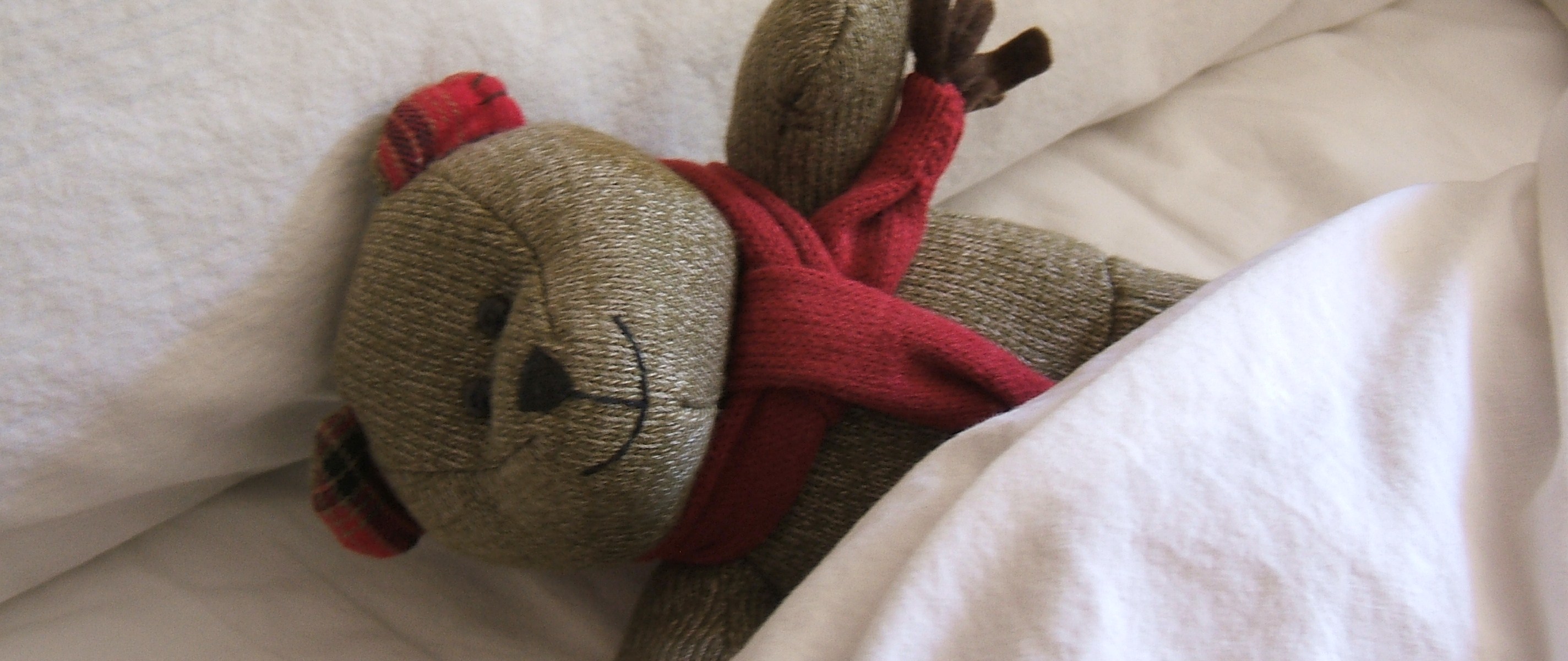
That momentary sense of his presence pierced the numbness of fatigue creeping over me and sent me plunging back down into my heart again.  The tears felt painful, bewildering, and sweet, all at the same time.  It reminded me of the day I discovered the stuffed animals my daughter abandoned the day she left home, still sprawling against the pillows in her bedroom.  It was unexpected, walking in and finding them like that–an innocent reminder of her childhood life with us–and I curled up on her bed, gathered them in my arms, and lay there in the ache of remembering for the longest time.

We shared a bond, these toys and I.  They’d been left behind, like I’d been left behind. She loved them, like she loved me.  And lying there clinging to their soft bodies and fake fur, I was awash in all the nourishing, enduring love she’d left behind for us.  I could feel her again, all across the bed, and I realized we’re all born magical like that–with a mysterious ability to place a tangible, lasting kernel of ourselves inside the people we love so that no matter where we go, no matter how big the hole our departure creates, at least we never leave those behind us completely alone.

(This post is turning out to be longer than I originally anticipated so I’m going to spare you all and spread it out over a couple posts.  Next time: Their Body: It’s Not Them Anymore But It Still Deserves Our Thanks)

copyright Dia Osborn 2011 

A Blogging Topic That Repels Spammers

In the eternal, unwanted, ebb and flow reality that is spamming-on-the-blog, I’ve noticed something intriguing.  Posts on my main topic of interest…Dying…repel spammers.  (These posts also, unfortunately, repel readers, but let us leave that topic for a brighter day.  Sigh.)

It is oh-so curious, no?

The pattern has just recently become clear to me.  Roughly eighty-five percent of my posts involve something I’ve learned from the dying and the longer I stay on topic, the likelier the flow of spam will trickle off and die. (No pun intended.)  But when I drift off-topic and broach subjects like Arab spring, or annoying Google advertising, or Stihl gas powered pole tree pruners, the velocity of spam immediately increases at a spanking pace.

Spanking, I tell you.

Then I return to my main focus and voila!  All I have to do is write three or more dying-related posts in a row and it crushes the burgeoning torrent of spam as efficiently as Raid on roaches.  Seriously.  It’s just that good.

Even I never dreamed the taboo on speaking about dying was this powerful; that spammers respond to it (in a second hand, traffic sniffing kind of way.)  Who would have thought anything was that strong?  A fascinating and, for once, entirely happy consequence of breaking said taboo.

(Image from Wikipedia)

copyright Dia Osborn 2011

Surprise Worms On The Trash Can…a.m.

I walked into the kitchen this morning to discover a batch of small, white, maggoty-looking worms crawling across the stainless steel lid of the trash can and rolling their plump, fleshy, little way down the sides and across the kitchen floor.  It was disturbing.  Especially coming straight out of a deep sleep.  From my initial fog, I wildly wondered how the stripped carcass of a cooked chicken I’d thrown away last night could possibly decompose that fast.

However, upon reluctantly opening the lid with my latex-glove-protected-hands, instead of the fetid stench I feared my quivering nostrils met an almost minty fresh aroma.  I realized with dawning relief that these were not maggots after all, but a type of garden pest that is usually invisible, hidden within the cell walls of a leaf.  I’ve been battling an infestation of these tiny creatures among my spinach and swiss chard crops, and these ones must have hatched off a bunch of infected leaves I threw in the trash a couple of days ago.

My friends, I give you a rare (low-video quality…sorry!…) glimpse of the leaf miner adult worm stage.

We All Have To Face Our Own Kobayashi Maru

USS Enterprise (NCC-1701)

Trekkies will probably know where I’m going with this.

For everyone else, the Kobayashi Maru comes from the original Star Trek movie series, and is a Star Fleet cadet training exercise that first showed up in the movie The Wrath of KhanIt involves a computer simulation where any Star Fleet cadet aspiring to command a starship winds up confronting the ultimate no-win scenario; a confrontation with an enemy that culminates in the destruction of the ship they’re commanding as well as the death of everyone on board, including the cadet.

In one of my favorite plot twists, a determined James Kirk (image from Wikipedia) manages to sneak in and rewrite the computer program before he takes the test as a way to win the confrontation, but the program was designed as a battle to be lost.  That was the whole point; to determine the true character of a cadet by seeing how they responded to certain death.  After all, as Kirk himself later said when defending the test to a disgruntled cadet, how one deals with death is as important as how one deals with life.

Personally, I don’t think you can separate the two because, for the most part people tend to die the same way they live.  Fighters go out fighting, those with a good sense of humor find something to laugh at, controllers try to control the whole process, co-dependents worry about everybody else, and graceful people surrender with a level of dignity that humbles and awes the rest of us.  Trust me on this one…ALL of the virtues and flaws we cultivate in ourselves through our years of living are going to show up in spades when the dying time arrives.

Working with hospice was like watching people take the Kobayashi Maru, only in real life.  I found myself in the extraordinary position of watching person after person confront the certainty of their own death, and it was…well…it was a thousand things.  It was amazing, curious, humbling, horrible, surprising, heartbreaking, staggering, frightening, illuminating, and inspiring.

Getting the chance to witness and learn from so many different people facing this last and greatest test was a rare, rare! and priceless opportunity.  (…a fact that somehow, almost nobody seems to grasp.  So strange…)  And while everything I learned will unquestionably help me face my own death with greater equanimity, courage, and grace when the time comes, far more importantly it’s helping me to also LIVE MY LIFE with much greater equanimity, courage, and grace until then.

Next to giving birth, working with the dying was…hands down…the most life-affirming, life-nourishing, and life-celebrating thing I’ve ever done.  I could never thank or speak highly enough of the people who allowed me to be with them, there at the end.  It was truly an honor, a privilege, and a gift.

copyright Dia Osborn 2011

How to live the best life? Look back from the future.

Linda, a (clearly) wise and percipient fellow blogger, had this to say in her comment about my last post on writing an obituary:

“…it dawned on me one day, that all the guidance I needed for making choices in life would be to live my life the way I’d like to see it written in an obit.”

Amen.

Now I guess I just need to write an obituary for myself to figure out what, exactly, I’d like it to say.

Thanks Linda!

Old People Know A LOT

Photo by Diego Grez

Here’s a tiny smattering of things I learned from the elderly hospice patients I worked with…

1. how to run a table saw

2. an effective home remedy for the 1918 bird flu pandemic

3. how to trade options in the stock market

4. how to stay safe in the box car when jumping a train

5. how to celebrate a traditional Bavarian yuletide

6. the absolute necessity of paying off a home mortgage

7. how to stack dead bodies after an attack on home soil

8. how an iron lung works

9. what the bedding was made out of in a concentration camp

10. how much stronger we are than I ever, EVER imagined.

copyright Dia Osborn 2011

A Curious, Amazing Thing That Often Happens Just Before Death

Image by Vlado

Both the hubster and I were there with the family, at the house, when our good friend, Mr. B, died a couple weeks ago, and I wanted to tell you about something amazing that happened right before he passed.  Actually, this type of dying event is common and it frequently (certainly in every case that I’ve been involved with) lifts the spirits of those who are there to witness it.

It was nearing the end and Mr. B had been unconscious for close to a day and a half.  The hubster, driven by the common, but often unspoken, instinct displayed by loved ones to never leave their dying person alone, was taking his turn sitting beside the bed and holding Mr. B.’s hand.  The family was scattered throughout the house, cleaning up from breakfast, while Mrs. B was on the other side of the room discussing something with their son.  She’d just finished and was walking past the bed on her way out to the kitchen when Mr. B. suddenly, the hubster later told me excitedly, squeezed his hand.

Hard.

“Like this!” he said, grabbing my hand and crushing it in a way that sent shooting pains up my arm.

“Ow!”  I snatched my hand away and glared at him.  “That hurts!”

“I know!” the hubster started nodding vigorously, relieved that I got it. “That’s just what it was like!  He did that to me, too!”

And suddenly I did get it, and I was amazed.  My mind flew back to the last hour when Mr. B. lay there helpless and still; pale, shrunken, and almost gone.  He’d grown so weak he fell into a final coma from which he couldn’t seem to climb back out, but then somehow…in that last minute…he powered back up anyway.  He’d grabbed onto the only thing available, the husbster’s hand, and squeezed it so hard that the hubster had to sit up and pay attention.

“He opened his eyes and locked onto mine…and I just panicked,” the hubster admitted.  “I didn’t know what was going on but I sure didn’t feel like I was the last thing he needed to see.  So I called Mrs. B. and she was right behind me.  She sat down and took his hand, spoke to him gently telling him she was there, and then a few seconds later Mr. B died while gazing into her eyes.”

The husbster paused, reflecting for a moment, then looked at me and said, “I feel like that’s what he really wanted, y’know?  That’s why he squeezed my hand.  He knew it was time to go and he wanted me to get Mrs. B. for him.”

Later, Mrs. B told me the same thing.

“It happened just as I was walking past the bed,” she mused.  “I think he knew it.  I think that’s why he made his move right at that moment.  He wanted to tell me good-bye.”

It’s well known within hospice circles that the dying are far more aware of and, in a lot of cases, far more involved in the timing of their actual departure, than most people realize.  Hearing seems to be the last sense to go and the dying often still respond to auditory stimuli…familiar voices, favorite music, sensitive information (which is why it’s so important to exercise caution when speaking within their hearing btw), etc….even from the depths of coma.

I love this…the fact that our relationships with one another don’t just stop because one of us loses consciousness.  The connections we build are so much more complex, beautiful, delicate, and tenacious than that.  It often feels…there in the rooms of the dying…like some vast and luminous web has been spun around us, supporting and binding us at a thousand, twinkling, alternate, junction points so that, even if we can no longer speak or see or touch, our love still travels easily along the other pathways, the ones that haven’t collapsed.

My mother awakened in her last moments, too (even though that was scientifically impossible with all the heavy sedation she was under,) her eyes opening for one last, brief glimpse as my brother read a passage aloud from the Upanishads.  My grandmother was decidedly more active about her’s.  After three days of coma (and six solid hours of heavy labor where she seemed to be stuck in her body and unable to leave) she finally sucked in one last, mighty breath, opened her eyes, and let out a yell on the exhale, as though she’d stripped off her helmet, mounted the sound, and was riding it wildly out of her own mouth in a last, triumphant charge.   I remember how I sat there stunned for a moment…and then burst out laughing.  With relief.  With applause.  With joy.

But my favorite story, the one that always cracks everyone up, involves the last moments of The Feisty One, an elderly German woman whose final words probably best sum up the sheer shock-and-awe effect of the transition from life into death.  She was what we call a colorful character; a regal prima donna who commanded everyone, was disdainful of doctors, dismissed all the symptoms of her decline with contempt, and who kept telling me that really, it was all just a bad case of constipation and she’d be up and around again soon. 

And then, she insisted, I’m going to cook you a real German meal.

I adored this woman.

Her daughter-in-law was the one who told me the story of The Feisty One’s last moments.  How she’d had a burst of energy and talked for something like fifteen hours straight, all through the night and well into the following morning, before falling into a coma.  How she then just lay there, finally quiet, for a day and a half, her breathing growing increasingly labored and shallow.  And then how, right at the end, she drew one last breath and opened her eyes again, staring at them all in complete surprise, before exclaiming, “Shit…SHIT!…SHIT!!!”  After which she collapsed back against the pillows again and promptly died.

I can only imagine how those may very well be my own sentiments exactly some day.

copyright Dia Osborn 2011

The Laughter and Sorrow of Being There

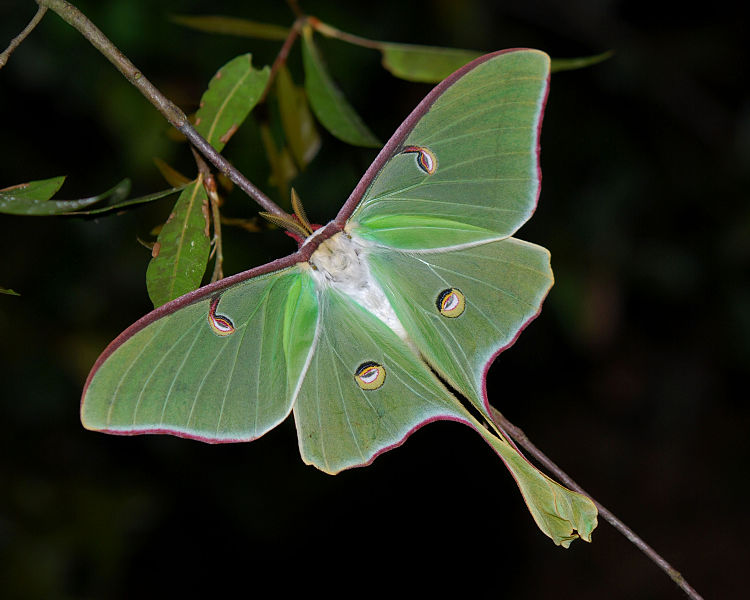
Luna Moth

I’d forgotten…how much better it is to be there when someone dies, than not.

Our dear friend Mr. B died at home, surrounded by those who loved him, last Sunday morning…which was actually pretty fast.  The doctors said he’d have more time, but then I’ve found that doctors usually overestimate;  partly because they feel it’s kinder and partly because they tend, personally, to be more afraid of death than the rest of us.

But Mr. B was glad it didn’t take as long as they said it would.  After four grueling, futile months of rotating between hospital, rehab center, and wound care center he was more than ready to move on.  He was grateful.

That’s the often overlooked gift of extended suffering.  Horrible as it is, there’s simply nothing like it for helping us let go of this otherwise far too rare and luminous world.  If something didn’t come along to tarnish the glow and loosen our grip, dying could (and sometimes does) drag on forever in this current age of limitless medical intervention.

Mr. B and his beautiful wife, Mrs. B, wanted the hubster and I to come and be there with the family during the passage; to help, to laugh, to cry, to steady, to witness.  I was surprised, deeply touched, and thrilled.  I love “a good death”; the kind that happens when someone dies prepared, surrendered, and surrounded.  There’s something potent and magical that happens when a family assembles to lift and love one of its members through the final transition,  something mystical and disorienting that occurs when a body and the life that inhabited it whisper farewell and break their long embrace.  Standing as witness to these things both shatters and transforms me, every time; actually it shatters and transforms everyone that’s lucky enough to be there.

Strangely enough, this…the good and healing part of dying…is the aspect I somehow forget about in between.  I’m not sure why exactly.  Maybe because, in spite of its potency, the experience is nevertheless fleeting and insubstantial and therefore easily overshadowed once it’s past.  Or maybe I forget because this part has become so invisible in our culture of death aversion that’s its just hard to hang onto.  I don’t know.

What I do know is that there’s an energy, a force generated during a good death that both cuts and cauterizes simultaneously.  It mauls me extensively, each time, but then it lays eggs of some vast and tender love there in the wound itself, as if it was some horrible yet sublime parasite, transforming me against my will into something better.   Someone more courageous, caring, and gentle.  Somebody wiser.

I think that was the gift Mr. B. wanted for me..for all of us.  I think that underneath everything else that was going on, somehow he intuitively understood that giving us all a good death would make the gaping hole after he left easier to survive.  Easier to recover and return from.  He used his own dying to create a final, profoundly generous, and life-affirming act.

copyright Dia Osborn 2011

Amazing and Strangely Beautiful: A Train Moving Through A Crowded, Urban, Vegetable Market.

This week has been crazy what with dueling colonoscopies for the hubster and I (including those ever-fun and entertaining cleansing preps beforehand), a mysteriously injured leg for Dane the Mangy Rescue Mutt, and visits to a dear, dear friend who has just entered hospice and is–bravely, calmly, and gracefully–readying himself for final departure.

It’s been a lot.

So this week I thought I’d just post a fascinating, 44 second, Youtube video of a train passing through a densely crowded, urban, vegetable market.  This thing just blows my mind.  See what it does to yours.

Living in the western U.S. as we do here, wide open space is a given.  The expectation of being able to see long distances, lots of sky, and relatively few people is actually structured into our physical, brain circuitry and the hubster and I have frequently noticed how, after a while, we start to feel constricted when traveling in areas that are heavily forested or otherwise “closed in”.  I imagine it involves some form of imprinting.

Anyway, this video beautifully illustrates how these people (possibly in Thailand?  I haven’t been able to discover for certain…) have imprinted on a heavily populated, urban environment.  Adapted.  In some strange way they’ve elevated these difficult living conditions into something fascinating and dynamic, disturbing and deeply moving.  The precision and coordination between so many diverse, moving parts looks like choreography, doesn’t it?  Or possibly an undersea scene.  The awnings coming back down after the train passes looks like the way sea anemones eventually, gracefully, unfurl again, after being disturbed.

copyright Dia Osborn 2011

Maybe I’m Just Dreaming Here…

In ordinary, everyday life, things look ordinary and everyday.  They just do.  Days tend to go the way we expect them to which makes life comfortable, predictable and…let’s face it…easy to take for granted.  Abundance is one of the things that breeds this kind of carelessness.  When it looks like we still have an unlimited supply of tomorrows it can make what we do with today seem unimportant.  Less urgent.

Which isn’t true of course.  Every last thing we ever do from taking a breath, to grumbling about chores, to graduating from college, to losing a job, to giving birth, to getting old, to dying, is an irreplaceable, priceless gift of life on a long chain of irreplaceable, priceless gifts.

But the illusion that any given moment doesn’t matter can be powerful and, when I think about it, perhaps not altogether unnecessary.  After all, it could be hard to get stuff done if we were face down on the floor all the time, incapacitated with the kind of wonder, longing, and gratitude for life that often comes to a person when they learn it’s their time to die.  I mean Big Awe can be fabulous, for sure, but it’s not terribly practical when you’re tackling a to-do list.

And yet, I do so love that feeling of dawning wonder.  Those moments when I look at my life and realize (for a mind-blowing, gut-wrenching moment) just how fragile, miraculous, and brief all this is.  Oh sure.  Those moments tend to wreak havoc with my daily routine because after a glimpse like that I want to slow down and savor everything.  Even things like taking the trash out and wiping under the rim of the toilet bowl take longer because crappy though they are, they’re suddenly glowing, like everything is glowing, and it’s really distracting.

But this spike in inefficiency is worth it to me because, for however long those moments last, I’m not afraid anymore.  Of anything.

Look.  I realize that dying is generally held to be a morbid subject and I know it’s odd for me to want to talk about it as much as I do.  But I can’t shake the hope that if I could just capture a couple of those brief and luminous moments in words, that maybe somehow it might help ease some of the deep, unconscious fear somebody else has, too.  That maybe if some of the general, widespread terror could be alleviated, our lives and relationships with one another might be transformed today, long before we ever have to face dying ourselves and embark on our own journeys.

Of course this is probably just a pipe dream.  Most likely, everything is perfect just the way it is and I should just be quiet and garden instead.  Dying is probably a reality too big to cope with in everyday life, too vast and searing to look at until we’re right on the brink of falling in.  Maybe we’re supposed to just forget, fall asleep and live in the dream of small, safe things until the yawning maw opens wide to swallow us at the end.

But then again…maybe not.  What if there’s no law ordaining that we have to wait until we’re actually dying to glimpse the strange, revealing light it offers?  What if the rules are more flexible than that?  What if it’s perfectly okay, even good, to look around us sometimes with transformed eyes while we’re still healthy, happy and whole, so we can see once again, however briefly, just how huge, beautiful, terrifying, priceless, miraculous and brief this life really is?

What if, however impractical or inefficient they might be, moments of heartbreaking wonder were actually good for us?

copyright Dia Osborn 2011

When extraordinary forces act upon mere humans beings (even if we don’t want them to.)


NASA photo: Solar particles interacting with Earth’s magnetosphere.

Nine times out of ten when a person found out that I worked with hospice they’d stare at me wide-eyed and say I could never do that. But I was never fooled by this.  Of course they could.  Anybody can.  Bathing, dressing, and toileting are not rocket science.  They don’t require rare tools or four hands.

I always knew what people really meant was I never WANT to do that…a sentiment which, while perfectly normal and near-universally shared, is irrelevant.

Life is full of things we don’t want to do but at some point wind up doing anyway.  And sometimes, much to our surprise, when the time comes we wind up doing them gladly.  It’s important to remember that, no matter how skillfully we hide, sooner or later we’re probably going to be dragged back out of our hole and plumped down beside the death bed of someone we love anyway.  And once we’re there, yes, of course we’ll be as rumpled, wild-haired, and sleep-deprived as everyone else who ever sat by a death bed before us.

But here’s the thing.  With as hard and devastating as it’s likely to be, we’ll also probably experience that same unexpected, fierce moment when we completely forget about how we never wanted to be there, because all we now feel is a throbbing, shattering gratitude that we are. That we get to hang on for dear life to their hand one last time and whisper how deeply, how much, we will always, always love them.

Y’know, there’s nothing wrong with the profound and irreparable wounding that comes to us through our great love for one another.  Far from it.  This wounding is essential and deeply human.  We’re supposed to be dragged under and scarred sometimes.  It’s a big part of what helps save us from the aching emptiness of a shallow life.  I’m not trying to mislead anyone here—all beauty aside, dying and its accompanying losses tend to be brutal for everyone involved.

But I’m telling you, somehow every single person I worked with went right ahead and navigated the journey anyway…and I can’t begin to tell you how much that one, simple fact floored me.  At first I couldn’t quite believe it.  Then later, as I watched each one of those ordinary, average, regular, everyday people negotiate an event with a destructive power equal to any earthquake or solar flare, I experienced a growing sense of both wonder and indignation.

Wonder at how infinitely much stronger we are than I’d previously understood.  And indignation that somehow, somewhere along the line, I’d been lead to believe we weren’t.

copyright Dia Osborn 2011

Death With Dignity? (…and they all burst out laughing.)

Not to crack any eggs here but somebody needs to say it:  dying is not, and never will be, a dignified process.  I have the deepest respect for all those good people who are espousing our “right” to die with dignity but, really, they’re tilting at windmills.

The physical act of dying is so like childbirth.  Both can be described in a lot of ways; primal, humbling, graphic, awe-filled, raw, ridiculous, deeply human, and often very, very embarrassing.  But not dignified.  Definitely not dignified.  However, this is not to say that the people who are dying can’t be dignified, because they can.  Without question.  Even in the midst of such an undignified process.  But frankly, the only people I ever saw die with dignity were the ones who were already living with it beforehand.

This is where I think the Death With Dignity movement errs.  With all the good will in the world, dignity is simply not something we get to grant one another.  No matter how good the medicine is, or the standard of care, or the advance directive, or the insurance, or the canopy of whatever legislation we drape over it all, true dignity is only generated from within.  It has to be built by each person, brick by brick, over time, from the inside out, using tools like courage, strength, respect, humility, truth, and grace under fire.  Not an easy task by any standard.

But on the flip side of this effort, once its firmly in place, once a person has anchored into a deep sense of their own dignity as a human being, it’s not something that can be easily dismantled either.  Especially not by things as shallow as whether or not a person can drive or feed or wipe themselves, or smile with both sides of their mouth, or even remember their own name.  I’ve seen people curled up and muscle locked from multiple sclerosis who were still happy, people suffocating from pulmonary edema who were still grateful to be alive, and people with advanced dementia who were still tender and loving to everyone around them.  I’ve also seen those who eventually decided to stop fighting their disease and surrender, not because they no longer wanted to live but because the battle to do so was threatening to consume and destroy the loved ones they were leaving behind.  Our ability to control our environment, our medical care, our bodies, or even our brains is not what ultimately defines us, and it seems like the biggest difference between a person who is living (and dying) with genuine dignity and everyone else is that they’ve figured that out.

I say this with the deepest conviction:

The most dignified people I helped care for weren’t the ones with the best medical care, or the clearest minds, or those who displayed the most control over how they were going to die.  But they were staggeringly wealthy in terms of love and endurance, generosity and strength.  They were the people who accepted their final vulnerability with a grace that humbled those of us who stood there and witnessed it.

And they were also, interestingly enough, rare.  Says something about us, no?

While I’m a passionate advocate for universal access to good medical and home care for the dying, it’s not because I think it’ll grant them some measure of dignity they don’t already have.  It’s because in doing our best to protect and care for the vulnerable among us, and by stepping up and helping to shoulder their last burden in all the ways that we can and should, it gives the rest of us a chance to work on deepening our own innate human dignity..

copyright Dia Osborn 2011

Refugee Spiders Helping To Protect Pakistanis From Malaria

Here’s an odd and wonderful story.

Wired UK posted an article today about one of the stranger consequences of the major flooding that took place in Pakistan in 2010.  Evidently, there are submerged areas of the country where the threatened spider population took to the trees and spun draping canopies of webbing which completely cover them.  If you love great photography go take a look at the eerie, beautiful pictures included with the article.

But the most amazing part of the story is the report from Britain’s Department for International Development who is currently working there in Pakistan.  They say there are far fewer malaria carrying mosquitoes in the vicinity of these trees, in spite of the standing, stagnant water surrounding them.

The concentrated spider populations are helping to control the burgeoning mosquito population.  How’s that for a lovely side effect?  This strange partnership between trees and spiders is creating living, arboreal shields against disease for the people living nearby.

I love this; how tragedy can transform a creature we usually regard as a danger and/or a household pest into a profound gift of protection.   I’ll remember this the next time I pick up a shoe to crush one, and instead catch it in a jar and place it carefully outside…in honor of its little, eight-footed Pakistani brethren who are (however unintentionally) protecting my own devastated and suffering brethren across the world.

One small way of gratefully participating in the web of life.  (No pun intended.)

Photo UK Department for International Development

copyright Dia Osborn 2011

The Worst Kind of Natural Disaster

With Japan’s ongoing crisis very much on my mind right now, I’ve been thinking a lot about natural disasters in general.  Most regions are vulnerable to some kind of disaster and, usually depending on how recent the last one was, the people who live in them wind up developing both a deep-seated fear about theirs and an emergency plan to help them survive it when it comes.

When I lived in Iowa I always had an ear cocked for the wailing of tornado sirens at the onset of a violent storm.  In Southern California I dutifully bolted bookcases and water heaters to the wall in case of a possible earthquake.  In Hawaii as a youngster I learned all the warning signs and action steps for surviving a tsunami, and living in Idaho today the hubster and I have supplies and an evacuation plan set up in case a catastrophic fire ever sweeps through our neighborhood (as one nearly did last summer.)

This basic disaster reality is everywhere.  The Gulf coast has hurricanes, the communities along the Mississippi river are prone to floods, Boonville, New York gets buried under record snowfall every year…
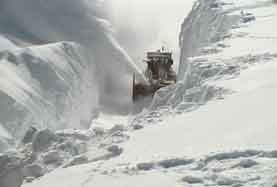
a bad year

and North Dakota see wind chills in winter that can equal the flanks of Mt. Everest.

But in Quinault, Washington, where we just spent a week at the southern end of Olympic National Park, I witnessed the residents living with a niche type of natural disaster that’s particularly unique.  These people live with the ever present danger of falling trees.

No.  Wait.  Let me rephrase.  Falling big trees.  Huge.

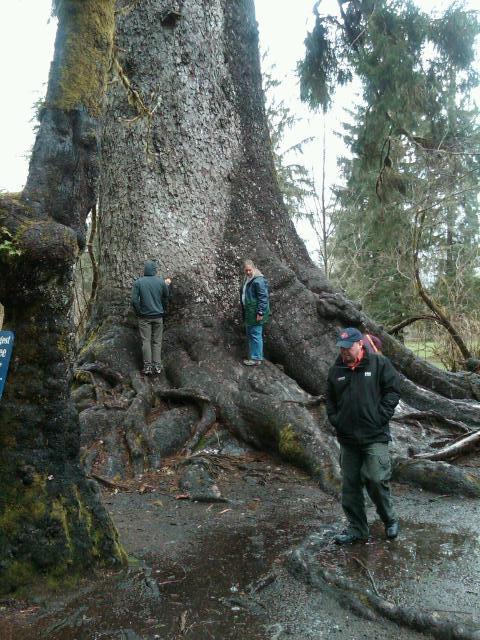
The tiny community is nestled in the Valley of the Giants, so named for the towering Douglas firs, western hemlocks, western red cedars and sitka spruces that fill the valley.  These behemoths are spawned by the twelve to fifteen feet of precipitation the area gets each year.  (That’s right.  I said feet.)  In fact, the Quinault Valley is home to six of the largest living trees of their species on record.  Short of the sequoias and redwoods farther south, trees just don’t get a lot bigger than this.

Me in the middle, standing on the root of a Sitka spruce that’s over 1,000 years old.

In other, dryer places trees are considered large if they reach a hundred feet.  But around Quinault, a hundred feet is just the point where branches start on the older Douglas Firs.

What it felt like in there.

It was like time traveling, walking around under a fern-laced, moss-draped canopy like that.  The light is filtered, soft, green, and primeval.  If you ever doubted that water is indeed life I highly recommend a visit to this place because wandering around the area was like watching the life cycle in hyper-drive—bursting, spurting, reckless growth delicately balanced with every conceivable form of sagging, creeping, bulbous decay.  It was heady stuff, and fascinating.  A wee bit unnerving at times but utterly breathtaking, too.

It changes one, being underneath it for a while.  I’m not quite sure how, it just does.

Anyway, apart from their staggering beauty these giant trees have a lesser known, scarier quality.  Because most of the ground water in the rain forest is contained in the top three feet of the land, that’s as deep as their root systems grow.  Horizontally, they spread out over mind boggling distances, but vertically, they don’t bother because there isn’t anything they need down there.

But wait, you might think.  What about stability?  Don’t they need deeper roots to keep them from falling over? Well, that seems logical enough if you’re thinking like a human.  Our species lives by the belief that surviving to the oldest possible age is a valuable goal.  But the rainforest trees of the Quinault Valley have a completely different agenda which includes eventually toppling over while they’re still alive and relatively resource rich.  Because if they don’t, new, baby trees won’t be able to grow down on the forest floor.

You see, the reason most of the ground water is held at the top is because there’s a three-foot thick layer of moss and fungus lying between the air and the earth.  This layer serves as a sponge and can hold a tremendous amount of water (which, trust me, is necessary in a place that gets twelve plus feet of it a year.) But there isn’t as much in the way of dirt and nutrients available in this layer so seeds falling to the ground have little chance of putting on significant growth without some kind of additional support.

This is where the falling trees come in.  Not only do they provide an elevated surface, but as they settle and begin to decompose all the nutrients and other resources stored in their wood become available, so seeds falling on their trunks and branches have everything they need to get a good start in life.  These fallen trees are called nurse logs because they literally become giant nurseries for the future generations of forest life.
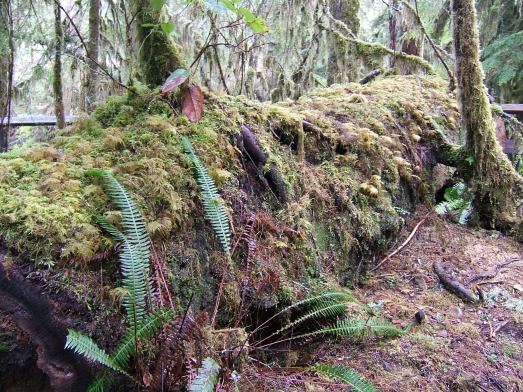
A fairly new mom.

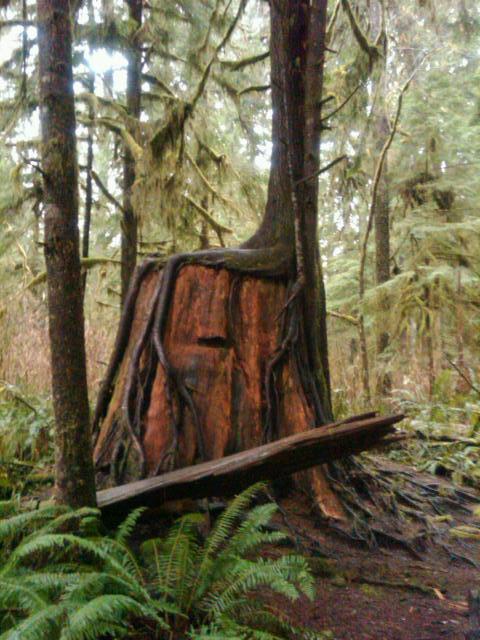
Below is a picture of what the middle stage of a tree’s growth looks like.  This is an initially successful Douglas fir with roots working down the sides (of a nurse stump in this case) to establish themselves permanently in the forest floor.  I’m not sure why all the moss and other growth was stripped off here…kind of disturbing actually…but it reveals the process.   Sorry the photo’s a little fuzzy but this was taken with a camera phone.
And finally, here’s a photo of the bottom of an older tree after the original nurse log has completely disintegrated.  It was fascinating to see how all the big trees had multiple “legs” at the bottom like this.  This is what those skinny, snaking little roots grow to look like years later.
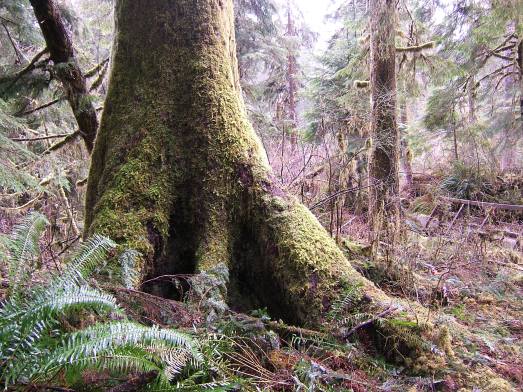
I admit, the generosity built into this kind of life cycle takes my breath away.  I love the idea of elders giving back everything they’ve managed to collect and contain over the years to nourish the younger life just getting started.  It makes more sense to me than the way it’s so often done in the human world, where increasingly our resources are directed toward the aging and children are left to bear the brunt of the resulting scarcity.

So, getting back to the original narrative of a falling-trees-natural-disaster, what is it that eventually knocks these gigantic puppies over?  Well, there are hurricanes that come in off the Pacific ocean periodically and the winds they generate knock down trees.  Small hurricanes take out smaller trees.  Medium hurricanes take out medium ones.  Big hurricanes knock over some of the big ones.  And then every hundred years or so you get a monster hurricane, and that’s when the giants can start coming down.

The last monster hurricane hit in December of 2007 and it just so happened that the hubster and I showed up in Quinault a scant three months later for our first-ever visit to the rain forest.  Driving into the area we had no idea what had just happened.  Strangely, there was almost no mention of the local impact of the gale in regional news coverage at the time, which seemed really strange considering the extent of the devastation both to the forests and the human communities along this stretch of coast.  (I imagine that, because it’s a rural area, there weren’t enough people impacted to be considered newsworthy.)

We couldn’t figure it out at first.  Driving up the coast from Oregon on our way to Quinault we noticed that a significant number of houses and buildings in every coastal town we drove through had extensive roof damage.  Blue tarps covering big holes were everywhere.  Then, as we turned inland, we drove past entire hillsides that looked like some kind of huge buzz saw had gone through.  In these places, literally all the trees were snapped off midway, like matchsticks, every single one, but we just figured the timber industry had come through and done a really shitty job of clear cutting.  (Sorry guys.) It wasn’t until we checked in at the Lake Quinault Lodge and started chatting up the locals that we learned about the real nightmare.

Evidently they’d had no warning in Quinault.  The local Forest Service had mistakenly forecast 50 mph winds for their area so everyone assumed they were looking at an ordinary storm.  They made no additional efforts to prepare for what was actually coming.  When the strongest winds hit, (sustained 100+ winds for about twenty minutes or so) some said it sounded like a fleet of jet airliners were all coming in to land simultaneously.  Others just described the sound as deafening. They all remembered that you could hear the trees crashing down through the forest like explosions, and that there wasn’t a house in the area that escaped unscathed.

Before the winds had gotten really bad, when the locals still believed they were dealing with an ordinary storm, there was a small crew of men who set off in a truck with chainsaws to clear the two mile stretch of road out to the main highway.  Six trees had fallen across the road early in the storm and the locals hopped in the truck thinking it was road-clearing business as usual.  But once they finally cleared the road all the way to the highway, they turned around to discover eight more big trees had fallen behind them that they had to clear to get home again.  They made it back safely, but with more trees falling behind them the whole way.

On that trip we talked a lot with the brand new owners of the little local mercantile (built back in the 1920’s) across the street who told us their story.  They said that once they realized how dangerous the storm had become, they decided to evacuate  over to the Lodge for more protection.  The wife had run upstairs to their apartment over the store to grab a few things when the 200 foot Sitka Spruce on the hillside behind them gave way, crashing down right on top of her.  The only thing that saved her life was the old, stone chimney running up the back of the building.  The tree hit it dead center, miraculously stopping it from completely crushing the store, but a large branch broke through the roof striking her in the head and knocking her out temporarily.  When she came to she discovered she was trapped and had to wait for her panicked husband and a few other men to cut her out.

During that first visit we stayed for two weeks and the hubster and I had ample time to wander around and soak in the aftermath.  A lot of the trails were either partially or completely closed.  Indeed, sometimes the forest had just collapsed on top of them.

There was one section in particular where a microburst had ripped about a mile long path of devastation through the trees.  Here’s what one section looked like in 2007.  A few months earlier this was dense, lush rain forest.

And here’s what another part of the area looked like last week:
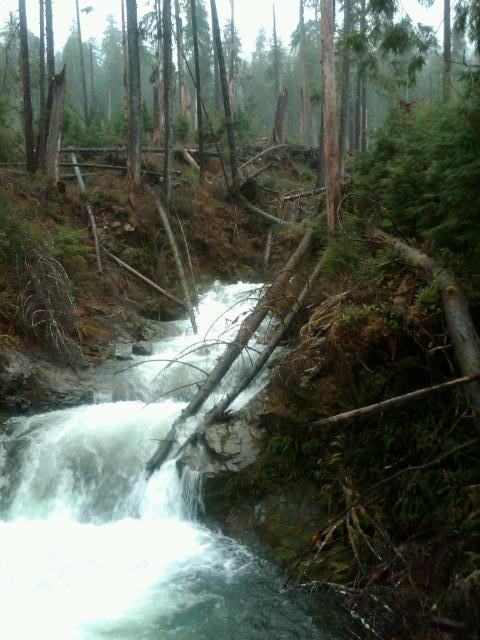
A lot of the debris that originally buried the creek was washed away by successive spring run-offs in this spot, but there were other areas where we still couldn’t see the creek for all the fallen trees.  We could hear it though, and then watch where it reemerged later downstream.

And here’s a picture from 2008 of what it looks like when one of the big trees gets snapped off near the base.

Fast forward to 2011 and it was fascinating to return and see all the ways the forest has been healing itself from the carnage.  We took the same trails we’d taken before and there is now a layer of moss, algae, fungi and ferns softening all the ragged, shattered edges that were so fresh on our last visit.  There are new trees sprouting out of the many fallen trunks, and all the giant root systems that were ripped out of the ground and left exposed (some of them fifteen feet tall) are slowly transforming into beautiful, vertical walls of moss, trapped stones, and epiphytes.

I’m happy to say there’s also some healing taking place among the human population, but it’s gradual.  The wife trapped by the falling Sitka Spruce was the only person to sustain any physical injuries during the hurricane, but the deep mental and emotional scarring that took place was distributed more evenly.  Everybody who went through it has PTSD.   Everyone.  You can see it in their eyes whenever they hear a strong gust of wind, the uneasy way they turn to look out a window or peer up into the swaying tree tops.  The man who was supposed to lead a group of us on a guided tour around the lake canceled it an hour beforehand because the forecast was calling for possible high winds and nobody there likes to take chances anymore.  Honestly, by the end of this trip I was starting to feel a little nervous myself as a big storm rolled in off the ocean the day before we left.  I caught myself glancing up into the canopy to gauge the strength of the wind as my pace picked up on the way to the car.

I think we’re designed to learn from one another like that.  I think it’s hard-wired into our brains to listen and observe the people we meet when we travel, especially in new, unfamiliar zones that lie outside our ordinary range of experience.  A couple days after the Japanese tsunami struck I heard a professor being interviewed on the news about everyone’s horrified fascination with all the images being broadcast.  He said we do it, at least in part, because there’s an enormous amount of information encoded in those kinds of images.  Biologically we’re all deeply wired to survive and that’s why, unconsciously, we’re always scanning the horizon for possible threats and any information we can glean about how to survive them.

There have been a few times since we returned home, as I’ve watched the tsunami coverage, that my mind has gone back to the two days we spent strolling along the beaches of the Washington coastline.  We’d discovered rare pathways down the cliffs and then walked along the shoreline for hours, enjoying the sand and rocks, playing in the swell of water as it rushed up to our feet and then retreated again.  Even though there are signs along every coastal highway indicating tsunami evacuation routes, we never once seriously considered that such a monster wave might come while we were there ourselves.  That it might catch us unaware, rolling up while we were lost in our long, relaxing reverie of salt spray and sea gull cries, sweeping us right off the narrow, exposed stretch of beach we were exploring between water and cliff.

I’ve considered it since though, as I’ve watched the footage from Japan, and that professor is right.  I’ve gleaned enough information from the images to realize that if a 9.0 earthquake had happened off the coast of Washington instead, a few days earlier while we were there, the resulting tsunami would have swept us away.  The hubster and I would have vanished and no one would ever have known for sure what happened to us.

Looking into the face of that kind of stark reality is sobering.  I’ve had the wild, frightened thought a couple of times that, on our next trip, I won’t return to the beaches at all.  Just in case.  It’s in those moments that I have to make myself remember.  Make myself step back and say, Wait a second, Dia.  How much are you willing to sacrifice  here to be safe? Am I really going to give up the ocean, or hiking through rain forests, just to be safe from tsunamis and falling trees?  And if I’m willing to give those up, where else won’t I go?  Anywhere where there might be an earthquake?  A hurricane?  A typhoon?  Anywhere where I might fall or freeze or burn or be eaten by wild animals?  Anywhere where I could possibly be mugged or raped or otherwise terrorized?  Just how small am I willing to allow my world to get before the ensuing suffocation makes my life not worth living anymore?

Again.

And that, my friends, is the real kicker.  I’ve already been to that place.  I’ve already lived in the weird, terrifying world of phobia and creeping paralysis and, between you and me, I think falling into that abyss is the worst kind of natural disaster that can happen to somebody.  The fact that it’s internal doesn’t make it any less real or devastating, and the fact that nobody else can see the destruction doesn’t make the struggle to recover from it easier or less necessary.

The Great Gale of 2007 is long over but even so, during each subsequent storm, those who survived it are experiencing another sliver of it again.  For them, that storm is still real and, inside them, aftershocks are still happening.  Its ghost is alive and well.  The great tsunami that just devastated northern Japan is now over, too, but the ghost wave it left in its wake will be alive and haunting that land for a long time to come.   That’s just the way an internal disaster works.  They’re longer and slower and more ephemeral.  They can also be trickier to rebuild from, than the ones that happen on the outside.

But it can be done.  For me, over time as the fears have receded and I’ve started to recover, I’ve discovered a lot of nurse log-type activity going on inside.  The years of depression and agoraphobia were unquestionably destructive, and a lot of my old life was toppled over and swept away during the worst of that illness.  But even so, these days there’s some fascinating new growth coming up out of the hopeless, twisted, tangle of what my world used to be.  I’m considering things, experiencing little sprouts of hope and ingenuity that, during the worst, I believed would never be possible again.  Maybe these little sprouts will someday grow up to be big trees of their own or maybe they won’t.  I know that another wave of depression could always come along and sweep me out to sea again because that’s the risk of the region I live in now, but deep down inside me I’m not sure that would really matter anyway.  I’m beginning to suspect what’s most important is the fact that I’ve been able to endure, survive, and live at all.  For however long it lasts.

Because isn’t that just the thing about life?  Whatever winds up happening with me, with any of us individually for that matter, Life itself will never stop because it has an endless capacity to reroute.   Sure, accepting the details of that rerouting sometimes involves my having to step back and expand my view a lot, having to accept that life is something far bigger than just my life.  Life is actually our life, something we all get to participate in for a little while together, and something we all still continue contributing to after we’re gone.

It’s like how the pattern of old growth tree roots reveal the place where the nurse log that gave them life once lay.  In a thousand, million different ways, large and small, we all wind up as nurse logs for this world and for each other; each of us profoundly effecting and altering what’s around us during the brief but blazing time we’re here.  I think the magnitude of our impact is far, far greater than we’ll probably ever understand, and that our gifts to this world will never be wiped away because they’re far too necessary to ever waste like that.  On the contrary they’re transformed; reabsorbed and used to nourish all the generations of life that follow, life that wouldn’t have been possible if we hadn’t existed here for a little while ourselves.

My prayers go out for everyone who died–everyone who is still dying–in Japan, and I send my wishes for deepening strength, resilience, and healing for all those who ultimately survive them.

copyright 2010 Dia Osborn