False Positives Are The Tenth Circle of Hell

image from Dante’s Inferno by Giovanni Stradano

Four months of hell are officially over and I guess the news is good:  the hubster does NOT have prostate cancer.  Hooray.  Of course he never had it to begin with.  This whole, horrible journey has just been one big, fat, fake-out from the word go.   He didn’t have prostate cancer when December’s PSA number came back elevated, he didn’t have it through the roller coaster of doctor appointments, advanced testing, and useless treatments to rule-out-other-causes that followed, and he didn’t have it when they did the biopsy last week.

Nope.  The news is just great.  And it only cost us a horrible first week of initial shock and icy paralysis, four more months of chronic, low grade anxiety and fear, an early nuclear blast of antibiotics that temporarily wiped out his entire immune system whereupon a subsequent cold turned into a bad chest infection with a resulting week missed from work, a painful biopsy with risk of infection accompanied by yet another nuclear blast of antibiotics, additional missed work time for all the appointments and phone calls, a great big round of terror for his parents, a few thousand dollars from our savings, and a medium-grade case of post traumatic stress disorder for me.

(And now the doctor wants him to go on a prostate drug for the rest of his life and we’re looking at a much higher risk for future false positives.  Oh boy.  Maybe, we’ll get to do this every year.)

Honestly?  I’m not sure what to think about everything we just went through.  I feel battered and numb.  I don’t even feel grateful that the news was good because it was never bad to begin with.  Somehow it feels more like we were duped.

Look, I understand the thinking behind preventive screening and yes, certainly, I agree there’s some profound value hidden somewhere in this monster of a system we’ve created.  But I also know there’s something really, really wrong with what just happened to us.  Really wrong.  I’m not clear yet on what that is exactly, and I’m not sure how the hubster and I should change our approach with prevention going forward to decrease the chance that it will happen again.  But I do know this:

1) the U.S. has the highest rate of medical over-treatment in the world,

2) there’s broad concern about the kind of detrimental side effects from false positives like we just experienced (here’s another example affecting newborns), and

3) the science on the actual effectiveness of various screenings is still evolving which means, to a certain extent, we’re all playing the role of guinea pigs.

My instincts are screaming that the system is laced with way too much fear…far more than the situation warrants…and this fear is interfering with our group common sense.  It’s not that cancer and heart disease aren’t real threats, but this frantic, escalating fight to avoid them is eating up ever-increasing amounts of the perfectly-healthy-and-okay part of our lives.

You know what this whole thing reminds me of?  The ever-fabulous Robert Preston playing a slick, handsome, traveling salesman in  The Music Man.  Harold Hill, the con man, rolls into town one day convincing everyone they have a serious problem and he has the only solution.  He seizes on a common, reasonable parental fear and blows it up into a looming monster threatening to engulf the entire town until, predictably, everyone buys whatever it is he’s selling.

I’m not sure who exactly is playing the role of Music Man in this whole prevention/screening/false positives/over-treatment monster we’ve created, but I sure do feel like the hubster and I bit the hook.

Anyway, on a lighter note here’s a Youtube clip of Bob singing “Ya Got Trouble” in the movie.  (It’s a classic and SO much fun!)  Watch how the townspeople fall for his spiel, hook, line and sinker.  Who can blame them?  Call me a sucker but I’d buy anything from this guy.  My father-in-law (a life-long, very successful salesman for IBM) calls this the best sales training video of all time.   The first nine seconds of the clip are sort of dark but it clears up after that.  Enjoy!        

copyright Dia Osborn 2011

Update:  10/10/11  Looks like I’m not the only questioning  what’s going on.  New recommendations are being prepared.  See following article for details.

PSA Exams Should End in Men Without Cancer Symptoms, Panel Says: 

A draft report, released today by the Health and Human Services Department’s Preventive Services Task Force, recommends against so-called PSA tests for men who don’t have symptoms that are “highly suspicious for prostate cancer.”

Building Immunity: Dying isn’t avoidable, but the horror of it is.

So what drove me to work with hospice in the first place?

Dying encompasses a significant chunk of our total life experience yet, because our society has such an ingrained revulsion and fear of it, we tend to quarantine, hide, then ignore the people who are actually doing it.  And because I grew up in our society, I dutifully learned to wrinkle my nose, too, to try and avoid things like illness, decay, ugliness, aging, abuse, and death.  Poop and throw up.  Sadness and sagging.  Helplessness, wrinkling and loss.

Everything was going along just fine until one day I started to notice that, with aging, more and more of the people and places I loved were passing under the shadow of these things.  This, of course, made avoiding the necessary things more difficult and I started to chafe.  But it wasn’t until it reached the point where avoiding the scary stuff became synonymous with avoiding the people I loved who were experiencing them, that something inside me finally mutinied.

The system clearly wasn’t working the way I’d been told it should.  So, after some thought, I dug my spear out of the closet, painted and crossed myself, then marched off into the heart of darkness to investigate that big, hidden chunk of life for myself.  Go explore it.  Learn my way around.  Find out if it was really as bad as everyone said it was, and discover if I had the stomach for it or not.  I quickly found a hospice where I could volunteer, then approached my first bedside and sat down with a catheter bag knocking against my knee, the fumes of urine wafting steadily up into my nostrils, for the next two hours.

And in direct contradiction to all I’d been led to believe, I survived.

So I continued.  I stepped in and volunteered some more.  Decided to go a little farther and return to school to get certified as a nurse’s assistant.  I gave my first naked, elderly gentleman his bath, wiped fecal matter from the wrinkled genitals of a younger woman whose multiple sclerosis had left her paralyzed, and slipped my arm and strength behind the shoulders of a grandmother who could barely raise her head from the pillow while she heaved up blood into a trashcan.

And, lo and behold, I still survived.

So I relaxed a little and started falling in love with people.  I listened to their stories, sometimes over and over again, and fell deeper into love.  I studied those struggling in the depths of decline and loss; witnessed those who once walked stopped walking, those who once spoke stop speaking, those being left behind look around blindly, their hands reaching out, bewildered and lost, for something they’d never find.

And I started to do more than just survive.  I started to change.

I began to see through the blood and wasting and smells, the crushing overwhelm, occasionally catching glimpses of something shining behind the clammy skin and unfocused eyes.  I occasionally heard something in the way people spoke, something gentle just beneath their words that was so vast it wrenched my heart and stole my breath.  And sometimes—sometimes—I’d feel that thing there in the room, flowing all around us like a current of air or water, an underlying, pulsing love that was so searing and tender it left me sobbing over the steering wheel afterwards, shaken to the core.

Something transforming me, bit by bit by bit.

The concept of immunity fits well with the changes I’ve experienced.  You see, it’s not that the dying process isn’t as hard as I feared.  It most certainly is and, what’s worse, I now have all the details.  No.  I didn’t become magically oblivious to the horrors involved.  What seemed to transform was my ability to witness and contain the dying of others without being devastated by it.  It was a gradual process of course, requiring a gradual exposure, but over time, as I discovered how much stronger people are than I’d previously suspected I felt myself growing freer from my fear for them, and as my fear dissipated it allowed me to see their strength more clearly.  It became a self-perpetuating feedback loop of expanding perception and depth inside me.

This developing immunity involved something inside me growing larger with each passing day.  I’ll say it one more time because I feel it’s so important to understand—it’s not that the suffering I witnessed diminished in any way.  The hardships endured by the people I was serving remained just as real and grueling as ever, and my heart never ceased breaking for them because that’s what a heart is designed to do when confronted with the profound human suffering of others.

But as my immunity to the horror grew, my heart began to break in a different way.  Not in the destructive way that leaves smoking ruins and rubble in its wake, but more like the way an egg cracks open to release a new and different form of life into the world.  That’s what it felt like time and time again; as I watched a frantic daughter stumble into the room at the last minute to collapse by her mother’s bedside, sobbing with relief because she’d reached her just before she died, or a husband, desperately struggling out of a morphine fog for a few moments to take his wife’s hand and tell her how sorry he was for not recognizing her.  That inside, where he still existed, he would always, always love her.  Each time I felt the enormity of their love and loss inside me like a physical blow, felt a sharp pain inside my chest as something smaller and restricted cracked violently open allowing something fragile and dripping, unfolding and new, to spill out and fill me.

It was as though I was dying a little too–each time—and then being reborn again as something clearer, larger, and calmer emerged from the shards.

In a very real sense I felt like I was being vaccinated with the pain and dying of these people, so that my own capacity to bear such things, to understand and contain them, could grow.  I’d always thought of immunity as a physiological response but the capacity seems to exist on the mental, emotional and spiritual levels as well.  It became increasingly clear to me that, while the benign and loving experiences of my life are what nourish and prepare me, it’s the injuries and hardships along the way that force me to harness and deploy that strength.

I’d like to leave you with a quote that best describes this process of immunization for me, as well as its resulting gift of strength.   It’s from Victor Frankl, a Viennese psychiatrist who survived imprisonment at Auschwitz and afterwards authored the book Man’s Search for Meaning, and he captures the insight far more succinctly:

That which is to give light must endure burning.

image

copyright Dia Osborn 2011

Let There Be Light! Easter and The 14′ Stihl Telescoping Gas Powered Pole Tree Pruner

stihlusa.com

In honor of Easter I’m following a Let There Be Light! theme in today’s post.

The first miracle?  Sunlight  now penetrates into areas of the property that haven’t seen it in over a decade (some of which probably still shouldn’t…oops) because last Saturday we rented a tree pruner and got totally carried away.  The loss of restraint may have been due to simple gloom-fatigue, but more likely it was because of the totally bitchen miniature chainsaw (seriously!! a tiny chainsaw!!) strapped to the end of a long pole that could reach anywhere.  Anywhere.

It was heady stuff.  Who knew that even itty bitty chainsaws can grant that level of intoxicating power?  The chore quickly turned into a kind of pruning Bacchanal, except no wine or naked women.  I believe we cut something off pretty much anything taller than four feet.  Redbuds, catalpas, blue spruce, photinias, apple and maple and peach, and then there was the mugo pine.  (God?  Please help the mugo pine.  We didn’t mean to hurt it like that and we’re really, really sorry.)  The little Stihl Beast cut through tree trunks like butter, apple wood like soft pine, and soft pine like a it was a down pillow exploding, only with wood chips instead of feathers.

We just couldn’t seem to stop.

(The mugo pine; going from five trunks down to two)

The bad news is we have to wait for the trees to leaf out to learn who survived and who didn’t.  But the good news is twofold: 1) The sun will shine on our happy home once more so I should be able to get a decent crop of vegetables again;

(Sugar peas and arugula seedlings: note the elegantly arranged chicken wire to keep out the hostiles)

…and 2) the drastic pruning created all kinds of carnage for the squirrel interstate highway system around and over the garden so maybe Dane the mangy rescue mutt will finally be able to catch a couple of them in his powerful, crunching jaws.  (As I mentioned before here, I currently feel no charity towards them.  None.  They declared war on me, so I will despise them and wish every conceivable kind of harm on the twitching rodent horrors until our usual winter’s truce returns.)  

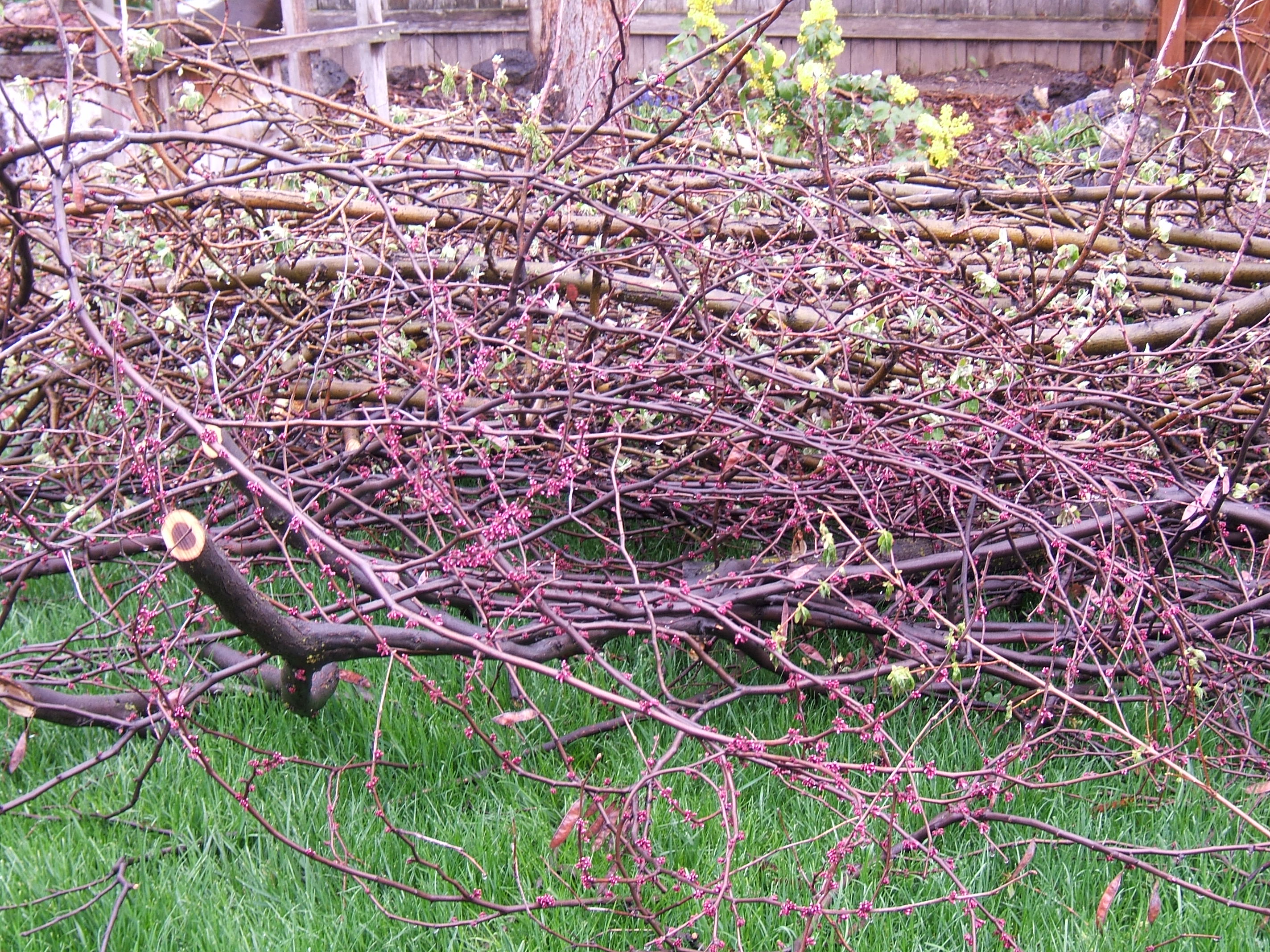
In the meantime I have a lot of debris to clean up.  Because of time constraints and back pain we hauled anything that fell over into neighbors’ yards, to the dump.  Then we piled the rest into three (big!) piles: one on the driveway, one under what’s left of the mugo pine in the corner, and one in the middle of the lawn.  Why?  Because in spite of the fact that the hubster leans toward hauling the rest of it to the landfill as well, I’m hell bent and determined to chop it all up and use it for kindling and firewood in the wood stove next winter.

Why am I hell bent?  I don’t know.  I just have to.  It’s one of those things.

So five days later I’m about two thirds of the way through the first pile on the lawn.  The hubster is twitching a little himself as he worries about the grass slowly dying underneath, but still refrains from pressuring me.  (Saint Hubster: patron saint of obsessive compulsives.)

I’m doing it all with hand pruners and loppers, cutting each individual piece to sixteen inches or less.  (Again…I don’t know why.)  I’m piling everything against the back fence where it can dry out in the hot, summer, high desert sun so as to readily ignite come next November.

(Looks like salad, no?)

But enough of that.  Now, on to the second miracle.  In spite of last weekend’s widespread destruction, we still managed to preserve and protect the perennial gifts of hope, rebirth, and new life (thereby following a loose Easter theme), that Spring has brought back to the garden this year.  Here are a couple things I found blooming around the garden this morning:

(rain drops on bleeding heart)

(miniature iris with a cluster of hens and chicks on the left)

(and some tulips nestled among the up and coming daylilies)

Blessings on all your gardens and families and Happy Easter!

copyright Dia Osborn 2011

When Intelligence Loses Some Of Its Dazzle

The recent spate of tornadoes across the Southeast reminded me of this old Youtube video where a camera mounted on the back of a train engine captured video of a tornado hitting the cars behind it.

It’s a great video, terribly exciting and titillating, until one realizes what exactly is in that tanker plowing into the back of the engine.  From the commentary on the site:

The tornado then moved across the Chicago and Northwestern railroad where it blew 12 railroad freight cars off the track. The train was moving at the time the tornado hit it…so as the main engine stopped…the remaining cars on the track continued along it and slammed into the front part of the train. This caused a few more cars to derail…including one containing hazardous materials that caused the evacuation of the town of Lawrence.

Now, this particular incident by no means equals the destructive force of the Japanese earthquake and tsunami-plus-nuclear disaster of last month (and this month, and probably the next many, many months to come) but it’s still a fascinating example of how some of our less intelligent human choices occasionally magnify the destructive impact of a natural disaster.

I lived in a small town in southeast Iowa for close to twenty years.  The tracks ran right through the center of town and it was known that hazardous materials (including spent nuclear waste for godsakes) were sometimes transported on the trains passing less than thirty feet away from the houses full of sleeping, eating, cooing, gurgling, laughing, fighting, loving, worrying, working, struggling, hoping, dreaming, flesh and blood human beings lining either side.

I’ve never understood the practice.  Frankly, in a nation that worships intelligence the way ours does, it always seemed…well… a trifle slow to me.  However, I’ve no doubt that those who make the decision to do it (over and over again for years and years) and their loved ones live nowhere near any of the tracks involved, and that, while they feel genuinely horrified when these kinds of accidents occur, they simply don’t allow it to get them down for long.  (So at least that’s intelligent and healthy of them, oui?)  

Sometimes I think we could live with a tad less IQ among those who are running the circus, and a bit more in the way of common sense and simple humanity.

copyright Dia Osborn 2011


Maybe I’m Just Dreaming Here…

In ordinary, everyday life, things look ordinary and everyday.  They just do.  Days tend to go the way we expect them to which makes life comfortable, predictable and…let’s face it…easy to take for granted.  Abundance is one of the things that breeds this kind of carelessness.  When it looks like we still have an unlimited supply of tomorrows it can make what we do with today seem unimportant.  Less urgent.

Which isn’t true of course.  Every last thing we ever do from taking a breath, to grumbling about chores, to graduating from college, to losing a job, to giving birth, to getting old, to dying, is an irreplaceable, priceless gift of life on a long chain of irreplaceable, priceless gifts.

But the illusion that any given moment doesn’t matter can be powerful and, when I think about it, perhaps not altogether unnecessary.  After all, it could be hard to get stuff done if we were face down on the floor all the time, incapacitated with the kind of wonder, longing, and gratitude for life that often comes to a person when they learn it’s their time to die.  I mean Big Awe can be fabulous, for sure, but it’s not terribly practical when you’re tackling a to-do list.

And yet, I do so love that feeling of dawning wonder.  Those moments when I look at my life and realize (for a mind-blowing, gut-wrenching moment) just how fragile, miraculous, and brief all this is.  Oh sure.  Those moments tend to wreak havoc with my daily routine because after a glimpse like that I want to slow down and savor everything.  Even things like taking the trash out and wiping under the rim of the toilet bowl take longer because crappy though they are, they’re suddenly glowing, like everything is glowing, and it’s really distracting.

But this spike in inefficiency is worth it to me because, for however long those moments last, I’m not afraid anymore.  Of anything.

Look.  I realize that dying is generally held to be a morbid subject and I know it’s odd for me to want to talk about it as much as I do.  But I can’t shake the hope that if I could just capture a couple of those brief and luminous moments in words, that maybe somehow it might help ease some of the deep, unconscious fear somebody else has, too.  That maybe if some of the general, widespread terror could be alleviated, our lives and relationships with one another might be transformed today, long before we ever have to face dying ourselves and embark on our own journeys.

Of course this is probably just a pipe dream.  Most likely, everything is perfect just the way it is and I should just be quiet and garden instead.  Dying is probably a reality too big to cope with in everyday life, too vast and searing to look at until we’re right on the brink of falling in.  Maybe we’re supposed to just forget, fall asleep and live in the dream of small, safe things until the yawning maw opens wide to swallow us at the end.

But then again…maybe not.  What if there’s no law ordaining that we have to wait until we’re actually dying to glimpse the strange, revealing light it offers?  What if the rules are more flexible than that?  What if it’s perfectly okay, even good, to look around us sometimes with transformed eyes while we’re still healthy, happy and whole, so we can see once again, however briefly, just how huge, beautiful, terrifying, priceless, miraculous and brief this life really is?

What if, however impractical or inefficient they might be, moments of heartbreaking wonder were actually good for us?

copyright Dia Osborn 2011

When extraordinary forces act upon mere humans beings (even if we don’t want them to.)


NASA photo: Solar particles interacting with Earth’s magnetosphere.

Nine times out of ten when a person found out that I worked with hospice they’d stare at me wide-eyed and say I could never do that. But I was never fooled by this.  Of course they could.  Anybody can.  Bathing, dressing, and toileting are not rocket science.  They don’t require rare tools or four hands.

I always knew what people really meant was I never WANT to do that…a sentiment which, while perfectly normal and near-universally shared, is irrelevant.

Life is full of things we don’t want to do but at some point wind up doing anyway.  And sometimes, much to our surprise, when the time comes we wind up doing them gladly.  It’s important to remember that, no matter how skillfully we hide, sooner or later we’re probably going to be dragged back out of our hole and plumped down beside the death bed of someone we love anyway.  And once we’re there, yes, of course we’ll be as rumpled, wild-haired, and sleep-deprived as everyone else who ever sat by a death bed before us.

But here’s the thing.  With as hard and devastating as it’s likely to be, we’ll also probably experience that same unexpected, fierce moment when we completely forget about how we never wanted to be there, because all we now feel is a throbbing, shattering gratitude that we are. That we get to hang on for dear life to their hand one last time and whisper how deeply, how much, we will always, always love them.

Y’know, there’s nothing wrong with the profound and irreparable wounding that comes to us through our great love for one another.  Far from it.  This wounding is essential and deeply human.  We’re supposed to be dragged under and scarred sometimes.  It’s a big part of what helps save us from the aching emptiness of a shallow life.  I’m not trying to mislead anyone here—all beauty aside, dying and its accompanying losses tend to be brutal for everyone involved.

But I’m telling you, somehow every single person I worked with went right ahead and navigated the journey anyway…and I can’t begin to tell you how much that one, simple fact floored me.  At first I couldn’t quite believe it.  Then later, as I watched each one of those ordinary, average, regular, everyday people negotiate an event with a destructive power equal to any earthquake or solar flare, I experienced a growing sense of both wonder and indignation.

Wonder at how infinitely much stronger we are than I’d previously understood.  And indignation that somehow, somewhere along the line, I’d been lead to believe we weren’t.

copyright Dia Osborn 2011

Death With Dignity? (…and they all burst out laughing.)

Not to crack any eggs here but somebody needs to say it:  dying is not, and never will be, a dignified process.  I have the deepest respect for all those good people who are espousing our “right” to die with dignity but, really, they’re tilting at windmills.

The physical act of dying is so like childbirth.  Both can be described in a lot of ways; primal, humbling, graphic, awe-filled, raw, ridiculous, deeply human, and often very, very embarrassing.  But not dignified.  Definitely not dignified.  However, this is not to say that the people who are dying can’t be dignified, because they can.  Without question.  Even in the midst of such an undignified process.  But frankly, the only people I ever saw die with dignity were the ones who were already living with it beforehand.

This is where I think the Death With Dignity movement errs.  With all the good will in the world, dignity is simply not something we get to grant one another.  No matter how good the medicine is, or the standard of care, or the advance directive, or the insurance, or the canopy of whatever legislation we drape over it all, true dignity is only generated from within.  It has to be built by each person, brick by brick, over time, from the inside out, using tools like courage, strength, respect, humility, truth, and grace under fire.  Not an easy task by any standard.

But on the flip side of this effort, once its firmly in place, once a person has anchored into a deep sense of their own dignity as a human being, it’s not something that can be easily dismantled either.  Especially not by things as shallow as whether or not a person can drive or feed or wipe themselves, or smile with both sides of their mouth, or even remember their own name.  I’ve seen people curled up and muscle locked from multiple sclerosis who were still happy, people suffocating from pulmonary edema who were still grateful to be alive, and people with advanced dementia who were still tender and loving to everyone around them.  I’ve also seen those who eventually decided to stop fighting their disease and surrender, not because they no longer wanted to live but because the battle to do so was threatening to consume and destroy the loved ones they were leaving behind.  Our ability to control our environment, our medical care, our bodies, or even our brains is not what ultimately defines us, and it seems like the biggest difference between a person who is living (and dying) with genuine dignity and everyone else is that they’ve figured that out.

I say this with the deepest conviction:

The most dignified people I helped care for weren’t the ones with the best medical care, or the clearest minds, or those who displayed the most control over how they were going to die.  But they were staggeringly wealthy in terms of love and endurance, generosity and strength.  They were the people who accepted their final vulnerability with a grace that humbled those of us who stood there and witnessed it.

And they were also, interestingly enough, rare.  Says something about us, no?

While I’m a passionate advocate for universal access to good medical and home care for the dying, it’s not because I think it’ll grant them some measure of dignity they don’t already have.  It’s because in doing our best to protect and care for the vulnerable among us, and by stepping up and helping to shoulder their last burden in all the ways that we can and should, it gives the rest of us a chance to work on deepening our own innate human dignity..

copyright Dia Osborn 2011

Squirrels and Spring: The War Begins Anew

The Enemy

The little shits.  I just discovered they’ve gone and bitten most of the flower buds off the espaliered apple and pear trees I planted three years ago.  This…the fourth year…would have been my first to actually get some fruit off these trees, but now?  There will be nothing.  Nada.  Zip.  Zilch.

No flowers, no fruit.  I’m beaten before the season even started.

Squirrels.  I hate them again.  I spit to the side after saying their name.  I bite my nails at them, chop my elbow and flick my fingers in the air.    I suddenly remember everything they did to the garden last year (every year!) and abhor them with the same passionate loathing I feel in the beginning of each new spring.  My animosity towards them resurrects like some dark and toxic perennial plant, the longer days and increasing warmth calling it forth from its long, winter dormancy.  I recently received a wondrous book for my birthday, The Synonym Finder by J.I. Rodale, and I turn now to look up hatred because this terrible lust for vengeance I feel requires long and sharpened words on which to impale the little, rodent horrors.

Malevolent, bitter, venomous, antipathy. They are abominations. An execration upon the land. And I hold them, my enemies, in eternal aversion and disaffection.

Take that.

It’s so strange, how this resumption of hostilities takes me by surprise every year.  I’m not sure how it happens but, every winter, I seem to mysteriously forget the previous year’s vandalism and begin to think they’re cute again.  Probably because they are, with their flicking tails and miniature hands and adorable, pointed little faces.  During the season of Long Cold I somehow forget how they laid waste to my peach harvest and bit the heads off every last sunflower and ate my bean sprouts just as they were emerging above ground.  The fact that they gnawed vast patches of bark off our trees and dug up the potted plants and chewed big holes in the tool shed eaves slips my mind and instead, I enjoy watching them hop around the porch, nosing among the fallen bird seed and coming up to peek at me through the sliding glass door.

In winter they’re like a meditation, these tiny gifts of life itself.  A reverie.  A delight.  A lovely, hope-filled reprieve from an otherwise bleak and dreary  garden hibernation.  And then?  Spring comes…poof!…and their true nature reveals itself as they start mindlessly destroying things like the furry, four-footed Jekyll and Hydes they are.  Warm and fuzzy one second, then fanged and slavering the next.

So the battle resumes.  Time to go load up on packages of carpet tack strips to tie along the branches of the peach tree and run some electric wire along anything espaliered.  I need to make more muslin bags to cover the grape clusters as the gray monsters chewed holes through a majority of them last year, but I think I still have enough chicken wire to protect the veggie beds until the seedlings reach a stage where they’re no longer so enticing.

And last but not least, as the most important weapon in my arsenal, I have the squirrel-catapult-is-awful-yet-we-can’t-look-away video.  (Click top video if you, too, need release.) And just so you know, this time of year I make no apology (none!) for laughing oh-so-hysterically when I watch this.  Firstly because, as I mentioned in last year’s squirrel rant, I once saw one fall fifty feet out of a tree in our backyard, stand up, brush its pants off, and light a cigarette.  You can’t injure these things.  C’est impossible. But second and more important, even the squirrels are glad I have an alternate outlet for the violent emotions I feel towards them right now.

copyright 2011 Dia Osborn

Ghosts and Cemetery Babies

The Haunted Lodge built back in the 1920’s

And now for more from our recent trip to the Olympic rainforest.

The hubster and I were surprised to learn that Lake Quinault Lodge, where we were staying, is haunted.  Famously so.  The Lodge has been featured on a couple of supernatural-styled TV shows.

We were surprised because we heard nothing of ghosts during our first stay in 2008, even though we stayed for two whole weeks.  Perhaps the locals were too busy recovering from the recent hurricane at the time, in which case we forgive them.

Evidently, the ghost is named Beverly and she died when one of the original structures on the property (the boathouse which served as a kitchen) caught fire and burned to the ground back in the nineteen-teens.  Beverly was trapped and burned to death and she’s been hanging around the property ever since.  She’s reported to be a nice ghost and is usually detected in two favorite rooms.  (According to a helpful comment from Josh, evidently “the lodge staff call her favorite room, The Beverly Suite.”)  We were thrilled to learn that one of her haunts was the room right next door to ours, where she likes to open windows that overlook the lake.

(Once I found out about her I invited her to come over to our room a few times, but she refused to be lured.  Our windows remained firmly shut.)

The story that really got us excited though, was a personal anecdote from Michael, the activities director of the Lodge.  He once owned and ran the small mercantile/cafe across the street, and in those days guests from the Lodge regularly spilled over into his establishment.  In fact, on our first trip the hubster and I frequently haunted his cafe ourselves as the food and coffee were to die for.

(Intentional pun.)

Michael told us that one day, a woman came into the merc who was clearly agitated and it didn’t take much prompting to get her to tell him what happened.  She said she’d checked into her room earlier that day and, while unpacking her bags, turned around to discover a woman standing across the room behind her.  The guest became angry and demanded to know who she was and what she was doing in her room.  The strange woman explained that her name was Beverly and she worked at the hotel.

The guest immediately went down to complain to management that one of their employees had trespassed in her room, only to be told that they didn’t have an employee named Beverly.  She was further upset when, upon discovering her room number, management explained the trespass with the story that her room was a favorite haunt of a well known ghost named Beverly.  At this point she’d evidently had all she could take and, returning upstairs, repacked her things and left the hotel, stopping only to pick up a few sundries across the street from Michael’s mercantile on the way out of town.

I’m fascinated by these kinds of personal stories.  I always have been.   Partly for the delicious, spooky thrill involved, but even more so because of the peculiar demeanor that comes over a person who’s been involved if you can get them to talk about it in the first place.

Which usually isn’t easy because unless it’s on a hotel tour, around a campfire, or at a slumber party, we all know we’re not supposed to discuss ghosts, unseen things, or any other kind of experience that isn’t scientifically explainable yet.  At least not seriously and not if we want to have any reputation left afterwards.

I don’t understand the reasoning behind this and it bugs me.  As with so many other subjects, I believe that talking about it openly would be healthier.  I’ve always noticed when I can get a person to open up about an odd kind of experience, most of the time they’re eager to talk in a way that feels like a dam bursting.  Having to hide these things seems to build up varying degrees of internal pressure.  In cases where the experience is not particularly significant, the pressure is small and there’s no real damage done to the person keeping the secret.  But if it’s either a traumatizing event (as it clearly was for the woman who left the Lodge in a huff,) or a meaningful experience (as is often the case when the recently bereaved are experiencing a sense of presence of their lost loved one) then this pressure to remain silent can become a burden.  In a worst case scenario, it can even start to interfere with a person’s ability to cope and heal.

This strikes me as pointless and stupid.  I’m by no means opposed to verbal taboos as a general rule.  Some of them are valuable and essential.  Like not talking about sex in front of small children, or not saying cruel things about someone who died in front of someone who loved them, or not talking throughout the movie in a theater full of other people.  I’m totally on board with taboos that serve to nourish and strengthen our communal ties.

But this taboo against discussing strange, spooky, or mystical things doesn’t do that.  In fact it does exactly the opposite.  It takes a significant chunk of common human experience and puts it in the back of a closet where it can no longer be shared, explored, tested, eventually understood, and then utilized.

Poo on that.

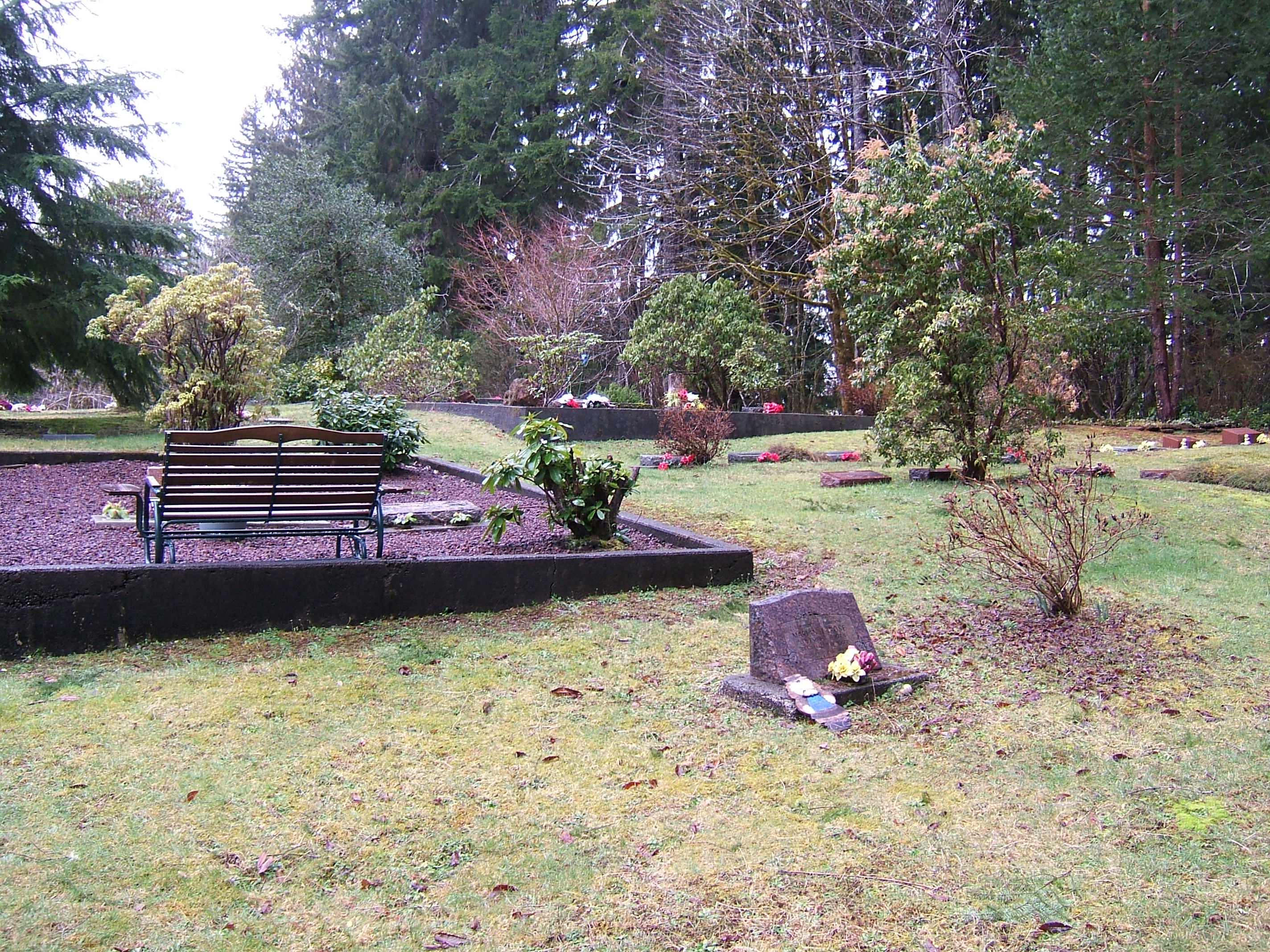
Moving on, Quinault has a tiny, lovely cemetery that I fell in love with on our first trip and returned to take pictures of during this last visit.  Judging from the housekeeping, the ties between living and dead in this place are clearly still vibrant and celebrated.

As you’d expect of an old graveyard full of the original homesteaders and their colorful descendents, it’s fascinating to stroll around listening to the stories the headstones and other grave adornments have to tell.

I loved the patriarch of this family who was clearly a testy, old lumberjack.  Since our first visit the fern has almost completely overgrown the headstones.

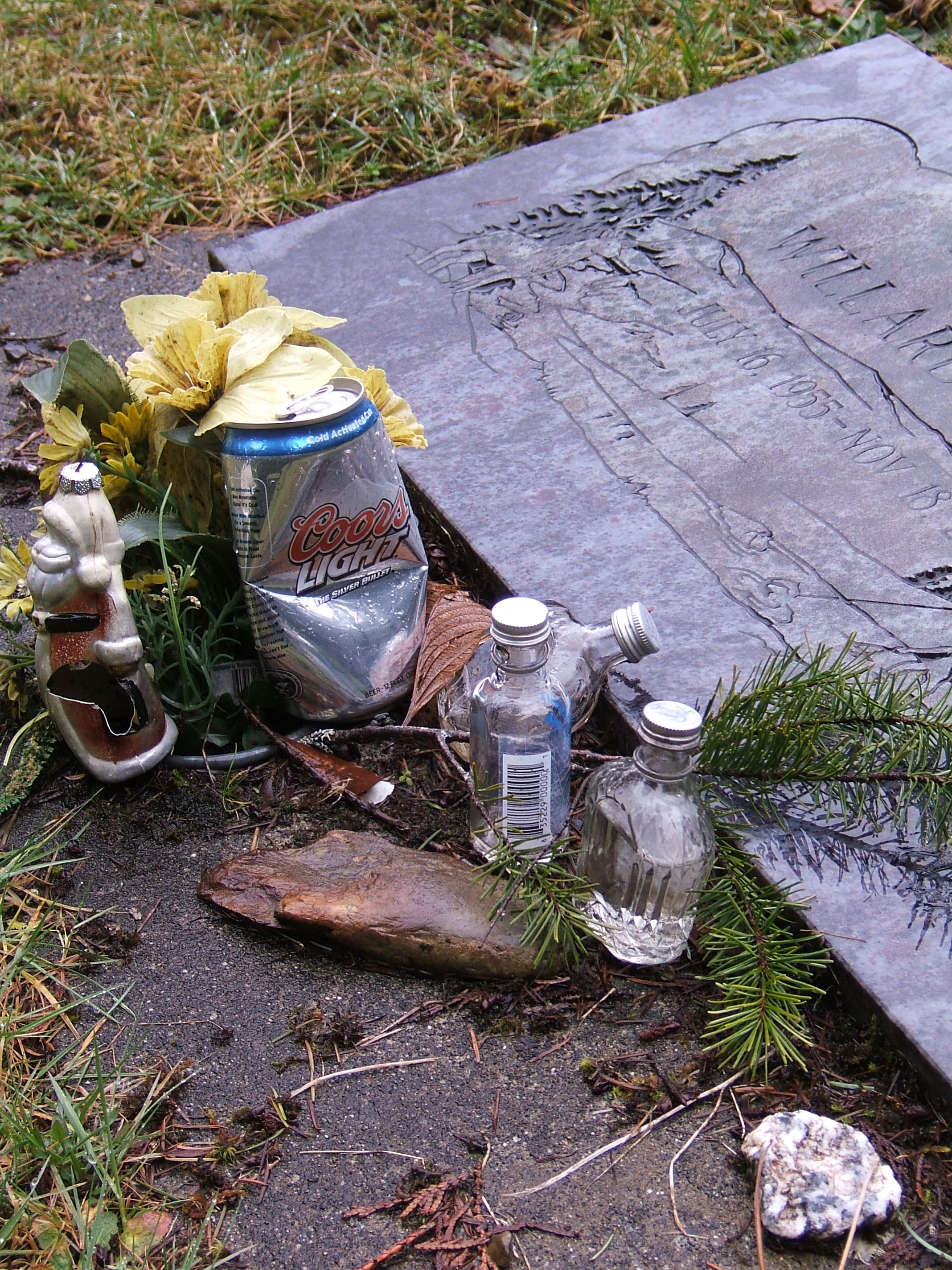
Someone is still coming to sit and drink with Will here, as evidenced by the total lack of rust on the beer can.  Whoever it was left some liquor behind in one of the bottles for him.  There was an ache of memory in the gesture that moved me.

Some of the residents clearly came from money:

While others were remembered in less costly (and less enduring) ways:

Indeed, there were quite a few open areas among the gravesites and I stepped among them gingerly, hoping and praying I wasn’t walking on someone.  In a rainforest environment, anything less hardy than stone disintegrates at a rapid clip and I suspected many of the earliest grave markers were probably lost to the elements.

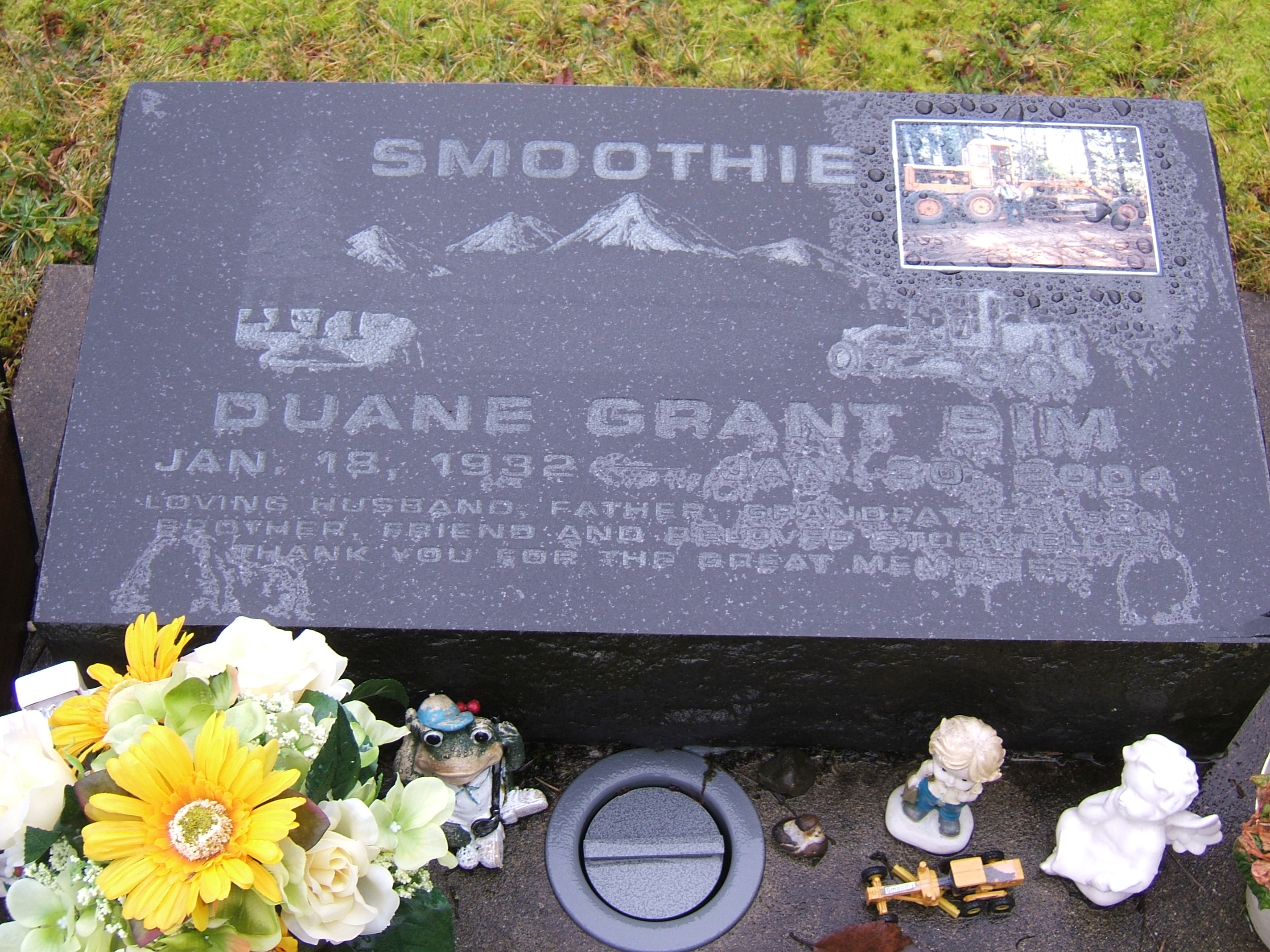
Here was the age-old tale of a couple who couldn’t live without each other.  Duane died in 2004:

And Maxine followed him less than a year later:

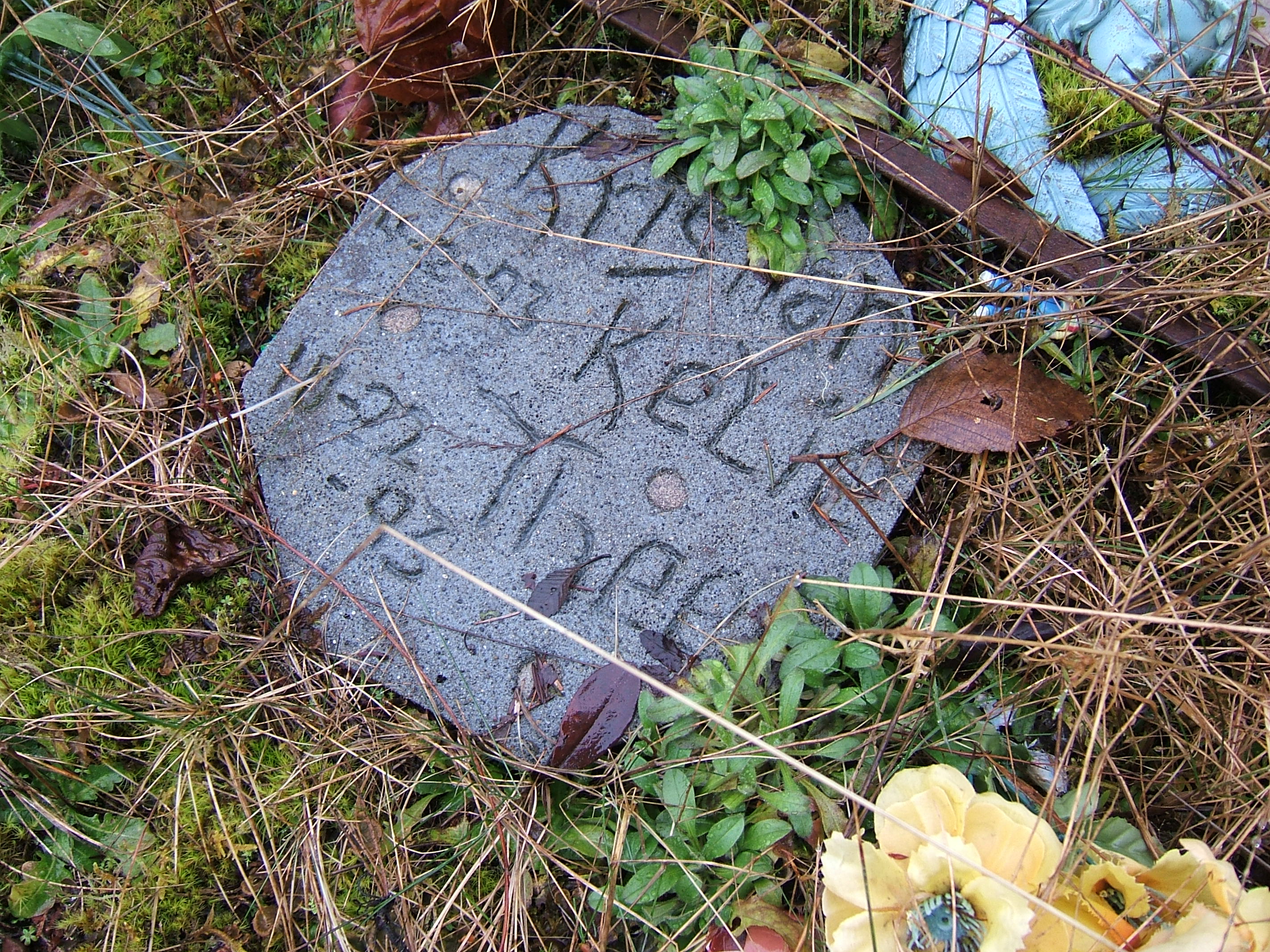
But as always the most poignant graves were those of the children.  In this cemetery there seemed to be an endearing custom of putting them to bed for a final sleep:

From youngest to oldest, here we have baby Kristan:

…little toddler Alexander:

…and six year old Trevor:

I was so glad and grateful that these children were here, in this close-knit, tiny cemetery surrounded by elders who would know who they were, who would be sure to look after them.  I know it would be harder for me, to bury a child in a big, sprawling cemetery somewhere, surrounded by strangers.

copyright 2011 Dia Osborn

The Worst Kind of Natural Disaster

With Japan’s ongoing crisis very much on my mind right now, I’ve been thinking a lot about natural disasters in general.  Most regions are vulnerable to some kind of disaster and, usually depending on how recent the last one was, the people who live in them wind up developing both a deep-seated fear about theirs and an emergency plan to help them survive it when it comes.

When I lived in Iowa I always had an ear cocked for the wailing of tornado sirens at the onset of a violent storm.  In Southern California I dutifully bolted bookcases and water heaters to the wall in case of a possible earthquake.  In Hawaii as a youngster I learned all the warning signs and action steps for surviving a tsunami, and living in Idaho today the hubster and I have supplies and an evacuation plan set up in case a catastrophic fire ever sweeps through our neighborhood (as one nearly did last summer.)

This basic disaster reality is everywhere.  The Gulf coast has hurricanes, the communities along the Mississippi river are prone to floods, Boonville, New York gets buried under record snowfall every year…
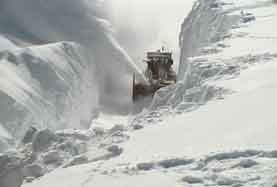
a bad year

and North Dakota see wind chills in winter that can equal the flanks of Mt. Everest.

But in Quinault, Washington, where we just spent a week at the southern end of Olympic National Park, I witnessed the residents living with a niche type of natural disaster that’s particularly unique.  These people live with the ever present danger of falling trees.

No.  Wait.  Let me rephrase.  Falling big trees.  Huge.

The tiny community is nestled in the Valley of the Giants, so named for the towering Douglas firs, western hemlocks, western red cedars and sitka spruces that fill the valley.  These behemoths are spawned by the twelve to fifteen feet of precipitation the area gets each year.  (That’s right.  I said feet.)  In fact, the Quinault Valley is home to six of the largest living trees of their species on record.  Short of the sequoias and redwoods farther south, trees just don’t get a lot bigger than this.

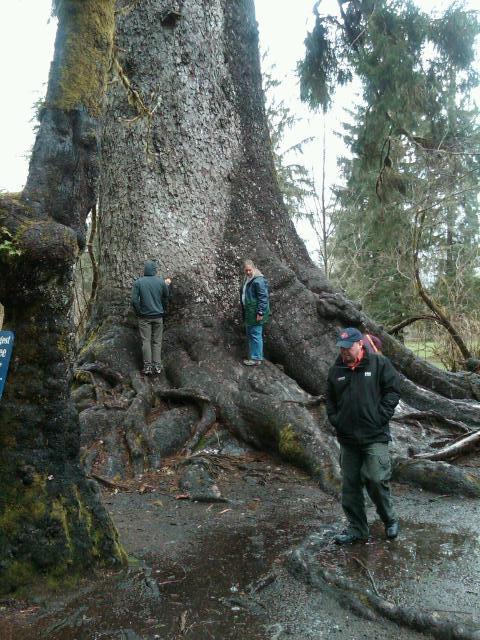
Me in the middle, standing on the root of a Sitka spruce that’s over 1,000 years old.

In other, dryer places trees are considered large if they reach a hundred feet.  But around Quinault, a hundred feet is just the point where branches start on the older Douglas Firs.

What it felt like in there.

It was like time traveling, walking around under a fern-laced, moss-draped canopy like that.  The light is filtered, soft, green, and primeval.  If you ever doubted that water is indeed life I highly recommend a visit to this place because wandering around the area was like watching the life cycle in hyper-drive—bursting, spurting, reckless growth delicately balanced with every conceivable form of sagging, creeping, bulbous decay.  It was heady stuff, and fascinating.  A wee bit unnerving at times but utterly breathtaking, too.

It changes one, being underneath it for a while.  I’m not quite sure how, it just does.

Anyway, apart from their staggering beauty these giant trees have a lesser known, scarier quality.  Because most of the ground water in the rain forest is contained in the top three feet of the land, that’s as deep as their root systems grow.  Horizontally, they spread out over mind boggling distances, but vertically, they don’t bother because there isn’t anything they need down there.

But wait, you might think.  What about stability?  Don’t they need deeper roots to keep them from falling over? Well, that seems logical enough if you’re thinking like a human.  Our species lives by the belief that surviving to the oldest possible age is a valuable goal.  But the rainforest trees of the Quinault Valley have a completely different agenda which includes eventually toppling over while they’re still alive and relatively resource rich.  Because if they don’t, new, baby trees won’t be able to grow down on the forest floor.

You see, the reason most of the ground water is held at the top is because there’s a three-foot thick layer of moss and fungus lying between the air and the earth.  This layer serves as a sponge and can hold a tremendous amount of water (which, trust me, is necessary in a place that gets twelve plus feet of it a year.) But there isn’t as much in the way of dirt and nutrients available in this layer so seeds falling to the ground have little chance of putting on significant growth without some kind of additional support.

This is where the falling trees come in.  Not only do they provide an elevated surface, but as they settle and begin to decompose all the nutrients and other resources stored in their wood become available, so seeds falling on their trunks and branches have everything they need to get a good start in life.  These fallen trees are called nurse logs because they literally become giant nurseries for the future generations of forest life.
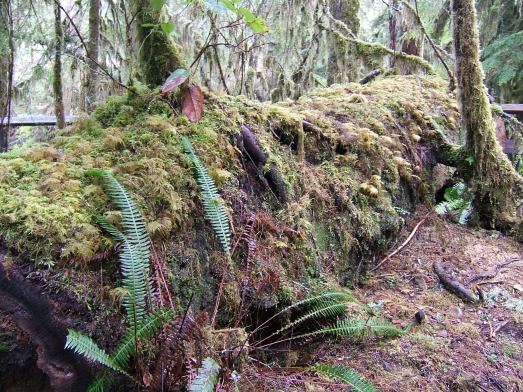
A fairly new mom.

Below is a picture of what the middle stage of a tree’s growth looks like.  This is an initially successful Douglas fir with roots working down the sides (of a nurse stump in this case) to establish themselves permanently in the forest floor.  I’m not sure why all the moss and other growth was stripped off here…kind of disturbing actually…but it reveals the process.   Sorry the photo’s a little fuzzy but this was taken with a camera phone.
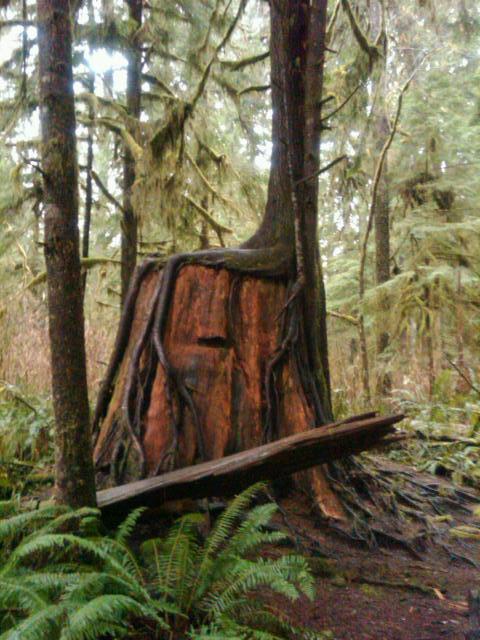
And finally, here’s a photo of the bottom of an older tree after the original nurse log has completely disintegrated.  It was fascinating to see how all the big trees had multiple “legs” at the bottom like this.  This is what those skinny, snaking little roots grow to look like years later.
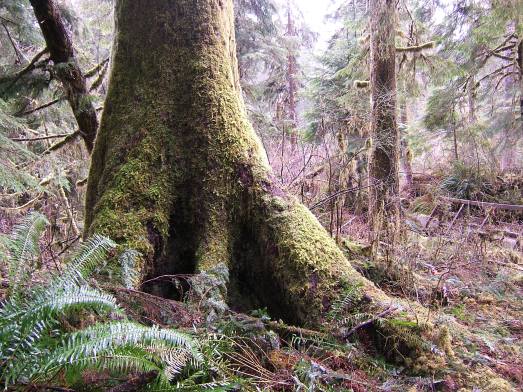
I admit, the generosity built into this kind of life cycle takes my breath away.  I love the idea of elders giving back everything they’ve managed to collect and contain over the years to nourish the younger life just getting started.  It makes more sense to me than the way it’s so often done in the human world, where increasingly our resources are directed toward the aging and children are left to bear the brunt of the resulting scarcity.

So, getting back to the original narrative of a falling-trees-natural-disaster, what is it that eventually knocks these gigantic puppies over?  Well, there are hurricanes that come in off the Pacific ocean periodically and the winds they generate knock down trees.  Small hurricanes take out smaller trees.  Medium hurricanes take out medium ones.  Big hurricanes knock over some of the big ones.  And then every hundred years or so you get a monster hurricane, and that’s when the giants can start coming down.

The last monster hurricane hit in December of 2007 and it just so happened that the hubster and I showed up in Quinault a scant three months later for our first-ever visit to the rain forest.  Driving into the area we had no idea what had just happened.  Strangely, there was almost no mention of the local impact of the gale in regional news coverage at the time, which seemed really strange considering the extent of the devastation both to the forests and the human communities along this stretch of coast.  (I imagine that, because it’s a rural area, there weren’t enough people impacted to be considered newsworthy.)

We couldn’t figure it out at first.  Driving up the coast from Oregon on our way to Quinault we noticed that a significant number of houses and buildings in every coastal town we drove through had extensive roof damage.  Blue tarps covering big holes were everywhere.  Then, as we turned inland, we drove past entire hillsides that looked like some kind of huge buzz saw had gone through.  In these places, literally all the trees were snapped off midway, like matchsticks, every single one, but we just figured the timber industry had come through and done a really shitty job of clear cutting.  (Sorry guys.) It wasn’t until we checked in at the Lake Quinault Lodge and started chatting up the locals that we learned about the real nightmare.

Evidently they’d had no warning in Quinault.  The local Forest Service had mistakenly forecast 50 mph winds for their area so everyone assumed they were looking at an ordinary storm.  They made no additional efforts to prepare for what was actually coming.  When the strongest winds hit, (sustained 100+ winds for about twenty minutes or so) some said it sounded like a fleet of jet airliners were all coming in to land simultaneously.  Others just described the sound as deafening. They all remembered that you could hear the trees crashing down through the forest like explosions, and that there wasn’t a house in the area that escaped unscathed.

Before the winds had gotten really bad, when the locals still believed they were dealing with an ordinary storm, there was a small crew of men who set off in a truck with chainsaws to clear the two mile stretch of road out to the main highway.  Six trees had fallen across the road early in the storm and the locals hopped in the truck thinking it was road-clearing business as usual.  But once they finally cleared the road all the way to the highway, they turned around to discover eight more big trees had fallen behind them that they had to clear to get home again.  They made it back safely, but with more trees falling behind them the whole way.

On that trip we talked a lot with the brand new owners of the little local mercantile (built back in the 1920’s) across the street who told us their story.  They said that once they realized how dangerous the storm had become, they decided to evacuate  over to the Lodge for more protection.  The wife had run upstairs to their apartment over the store to grab a few things when the 200 foot Sitka Spruce on the hillside behind them gave way, crashing down right on top of her.  The only thing that saved her life was the old, stone chimney running up the back of the building.  The tree hit it dead center, miraculously stopping it from completely crushing the store, but a large branch broke through the roof striking her in the head and knocking her out temporarily.  When she came to she discovered she was trapped and had to wait for her panicked husband and a few other men to cut her out.

During that first visit we stayed for two weeks and the hubster and I had ample time to wander around and soak in the aftermath.  A lot of the trails were either partially or completely closed.  Indeed, sometimes the forest had just collapsed on top of them.

There was one section in particular where a microburst had ripped about a mile long path of devastation through the trees.  Here’s what one section looked like in 2007.  A few months earlier this was dense, lush rain forest.

And here’s what another part of the area looked like last week:
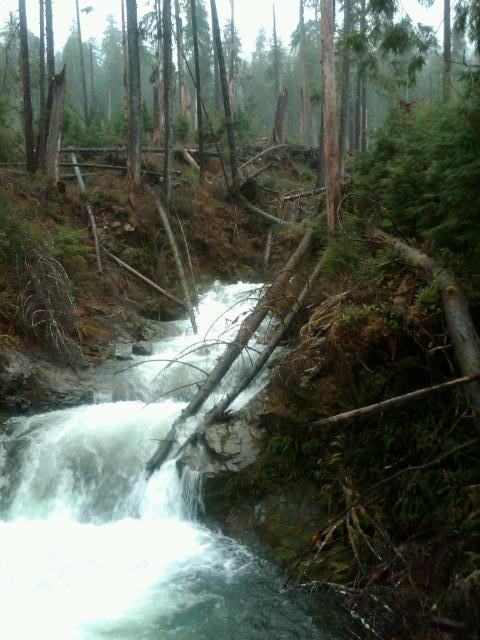
A lot of the debris that originally buried the creek was washed away by successive spring run-offs in this spot, but there were other areas where we still couldn’t see the creek for all the fallen trees.  We could hear it though, and then watch where it reemerged later downstream.

And here’s a picture from 2008 of what it looks like when one of the big trees gets snapped off near the base.

Fast forward to 2011 and it was fascinating to return and see all the ways the forest has been healing itself from the carnage.  We took the same trails we’d taken before and there is now a layer of moss, algae, fungi and ferns softening all the ragged, shattered edges that were so fresh on our last visit.  There are new trees sprouting out of the many fallen trunks, and all the giant root systems that were ripped out of the ground and left exposed (some of them fifteen feet tall) are slowly transforming into beautiful, vertical walls of moss, trapped stones, and epiphytes.

I’m happy to say there’s also some healing taking place among the human population, but it’s gradual.  The wife trapped by the falling Sitka Spruce was the only person to sustain any physical injuries during the hurricane, but the deep mental and emotional scarring that took place was distributed more evenly.  Everybody who went through it has PTSD.   Everyone.  You can see it in their eyes whenever they hear a strong gust of wind, the uneasy way they turn to look out a window or peer up into the swaying tree tops.  The man who was supposed to lead a group of us on a guided tour around the lake canceled it an hour beforehand because the forecast was calling for possible high winds and nobody there likes to take chances anymore.  Honestly, by the end of this trip I was starting to feel a little nervous myself as a big storm rolled in off the ocean the day before we left.  I caught myself glancing up into the canopy to gauge the strength of the wind as my pace picked up on the way to the car.

I think we’re designed to learn from one another like that.  I think it’s hard-wired into our brains to listen and observe the people we meet when we travel, especially in new, unfamiliar zones that lie outside our ordinary range of experience.  A couple days after the Japanese tsunami struck I heard a professor being interviewed on the news about everyone’s horrified fascination with all the images being broadcast.  He said we do it, at least in part, because there’s an enormous amount of information encoded in those kinds of images.  Biologically we’re all deeply wired to survive and that’s why, unconsciously, we’re always scanning the horizon for possible threats and any information we can glean about how to survive them.

There have been a few times since we returned home, as I’ve watched the tsunami coverage, that my mind has gone back to the two days we spent strolling along the beaches of the Washington coastline.  We’d discovered rare pathways down the cliffs and then walked along the shoreline for hours, enjoying the sand and rocks, playing in the swell of water as it rushed up to our feet and then retreated again.  Even though there are signs along every coastal highway indicating tsunami evacuation routes, we never once seriously considered that such a monster wave might come while we were there ourselves.  That it might catch us unaware, rolling up while we were lost in our long, relaxing reverie of salt spray and sea gull cries, sweeping us right off the narrow, exposed stretch of beach we were exploring between water and cliff.

I’ve considered it since though, as I’ve watched the footage from Japan, and that professor is right.  I’ve gleaned enough information from the images to realize that if a 9.0 earthquake had happened off the coast of Washington instead, a few days earlier while we were there, the resulting tsunami would have swept us away.  The hubster and I would have vanished and no one would ever have known for sure what happened to us.

Looking into the face of that kind of stark reality is sobering.  I’ve had the wild, frightened thought a couple of times that, on our next trip, I won’t return to the beaches at all.  Just in case.  It’s in those moments that I have to make myself remember.  Make myself step back and say, Wait a second, Dia.  How much are you willing to sacrifice  here to be safe? Am I really going to give up the ocean, or hiking through rain forests, just to be safe from tsunamis and falling trees?  And if I’m willing to give those up, where else won’t I go?  Anywhere where there might be an earthquake?  A hurricane?  A typhoon?  Anywhere where I might fall or freeze or burn or be eaten by wild animals?  Anywhere where I could possibly be mugged or raped or otherwise terrorized?  Just how small am I willing to allow my world to get before the ensuing suffocation makes my life not worth living anymore?

Again.

And that, my friends, is the real kicker.  I’ve already been to that place.  I’ve already lived in the weird, terrifying world of phobia and creeping paralysis and, between you and me, I think falling into that abyss is the worst kind of natural disaster that can happen to somebody.  The fact that it’s internal doesn’t make it any less real or devastating, and the fact that nobody else can see the destruction doesn’t make the struggle to recover from it easier or less necessary.

The Great Gale of 2007 is long over but even so, during each subsequent storm, those who survived it are experiencing another sliver of it again.  For them, that storm is still real and, inside them, aftershocks are still happening.  Its ghost is alive and well.  The great tsunami that just devastated northern Japan is now over, too, but the ghost wave it left in its wake will be alive and haunting that land for a long time to come.   That’s just the way an internal disaster works.  They’re longer and slower and more ephemeral.  They can also be trickier to rebuild from, than the ones that happen on the outside.

But it can be done.  For me, over time as the fears have receded and I’ve started to recover, I’ve discovered a lot of nurse log-type activity going on inside.  The years of depression and agoraphobia were unquestionably destructive, and a lot of my old life was toppled over and swept away during the worst of that illness.  But even so, these days there’s some fascinating new growth coming up out of the hopeless, twisted, tangle of what my world used to be.  I’m considering things, experiencing little sprouts of hope and ingenuity that, during the worst, I believed would never be possible again.  Maybe these little sprouts will someday grow up to be big trees of their own or maybe they won’t.  I know that another wave of depression could always come along and sweep me out to sea again because that’s the risk of the region I live in now, but deep down inside me I’m not sure that would really matter anyway.  I’m beginning to suspect what’s most important is the fact that I’ve been able to endure, survive, and live at all.  For however long it lasts.

Because isn’t that just the thing about life?  Whatever winds up happening with me, with any of us individually for that matter, Life itself will never stop because it has an endless capacity to reroute.   Sure, accepting the details of that rerouting sometimes involves my having to step back and expand my view a lot, having to accept that life is something far bigger than just my life.  Life is actually our life, something we all get to participate in for a little while together, and something we all still continue contributing to after we’re gone.

It’s like how the pattern of old growth tree roots reveal the place where the nurse log that gave them life once lay.  In a thousand, million different ways, large and small, we all wind up as nurse logs for this world and for each other; each of us profoundly effecting and altering what’s around us during the brief but blazing time we’re here.  I think the magnitude of our impact is far, far greater than we’ll probably ever understand, and that our gifts to this world will never be wiped away because they’re far too necessary to ever waste like that.  On the contrary they’re transformed; reabsorbed and used to nourish all the generations of life that follow, life that wouldn’t have been possible if we hadn’t existed here for a little while ourselves.

My prayers go out for everyone who died–everyone who is still dying–in Japan, and I send my wishes for deepening strength, resilience, and healing for all those who ultimately survive them.

copyright 2010 Dia Osborn

A Quick Note From Mars

We ran away from home because we forgot to celebrate our anniversary last month.  So we decided to tack it on to my birthday this month and do a double blowout celebration to make up for it.  We’ve come to the Olympic rain forest with it’s gigantic, moss draped vining maples, thousand year old cedar trees, 300 foot tall Douglass firs, and 140 – 167 inches of average precipitation a year (much of it in the form of fog drip.)

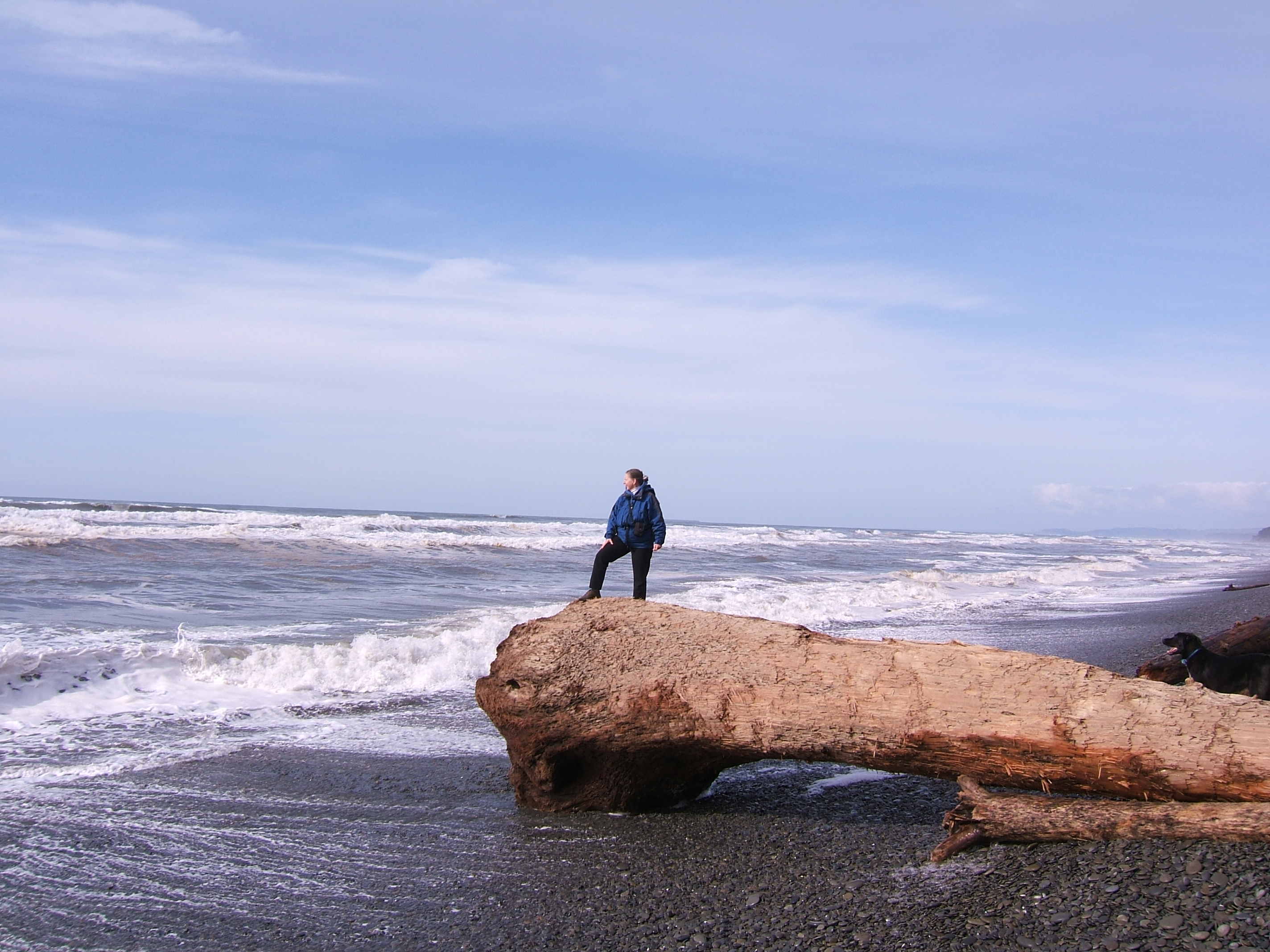
We love it here.  It’s like going to another planet.  Because I don’t have much time to write this week I thought I’d post some photos and videos instead.  The first couple of days we spent on the coast among the miles and miles of driftwood stacks that get piled up there by ocean storms.  The driftwood gets sizeable…

…and goes on forever.

We sat for about an hour and a half waiting for this big one to be washed out to sea.

It never happened.

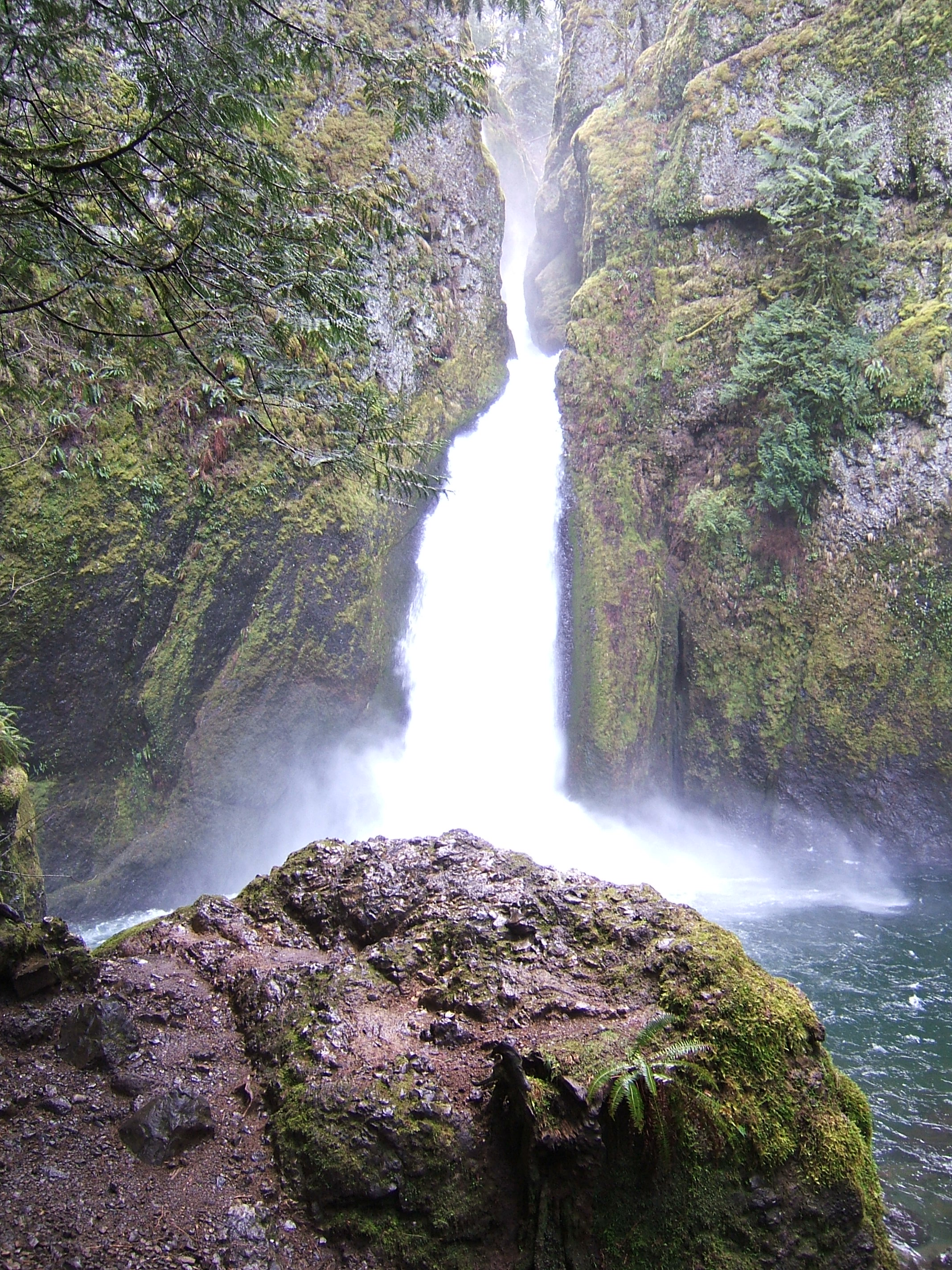
On the drive out through the Columbia River Gorge, we stopped (as we always do) to hike up a side valley full of waterfalls.

This is Wahclella Falls.  ‘Nuff said.  The video speaks for itself.

We’re staying at Lake Quinault Lodge which was built in the 1930’s and made famous by visits from President Roosevelt.

It overlooks (wait for it…wait for it…) Lake Quinault.

And lastly here’s a photo of the traditional painting style of the indigenous peoples.  This was painted on the backside of an overgrown boathouse facing the lake of all places.

One never knows where treasure of this sort will turn up.

That’s it for tonight.  I’ll do a wrap up with more photos once we return home.

copyright 2011 Dia Osborn

Part III: Both The Light And The Darkness Conceal and Reveal

(In Part I and Part II of Chapter 5, I described my quirky attempt to break free of agoraphobia by hiking back into the mountains for three days and three nights alone with my fears.  When I left you last week I’d just come through my greatest terror; that of the sun setting, leaving me alone in the wilderness at night.  Part III is the conclusion.)

The perspective I gained that evening, that darkness delivers a profound gift has, over time, effected a slow yet massive transformation.  Initially, during those three days up in the mountains I clung to the realization primarily as a way to help ease my fear of being alone at night in the wild.  But over the coming years it unfolded in ways I never could have imagined, slowly permeating and changing my understanding of another, more human dimension of darkness; the kind that arises inside us from living with things like pain,  suffering, and death.

It was during this mountain retreat, six years after my grandmother’s death, that I decided to begin my work with hospice and later, by the bedsides of the dying, I wound up experiencing the same sense of revelation and coming home that I’d felt under the evening sky.  All the vulnerable, generous people I worked with were like the stars all over again—shining beings gradually re-emerging as the bodies that had veiled them faded and thinned.  During the hours I spent with them and their loved ones—bathing and turning and wiping and rinsing and listening and laughing and crying—I felt like I’d finagled a seat in their caravan as they journeyed out all together to the farthest edges of life, a beautiful, twilight place that reveals something else, something breathtaking that lies out just beyond.  And as I watched this transformation take place over and over again it slowly dawned on me that the process of dying is not so much about shrinking and expiring as it is about finally growing too big to contain anymore.

A gentleman who’d lost his wife of sixty-plus years once told me that he woke up a couple of times, in the nights immediately following her death, to glimpse her for a moment standing next to his bed looking down at him.  That sometimes, in quiet moments he’d still hear her voice clearly speaking his name.  A woman devastated by the recent loss of her husband told me it was eerie how she kept seeing an eagle overhead–a bird he’d always felt an affinity for–every time she felt like she couldn’t go on.  And still another man confided in a low voice that he’d seen his dead brother the day before, waiting by the graveside as the wife who’d only survived him by eight months was laid to rest.  Over and over I’ve heard similar stories from those who’ve bid a loved one good-bye, and while the events they relate take different forms there’s a common theme between them—a sense that the bond of love itself is not severed even though the loved one has physically disappeared.

Lying there in the mountains I was aware that many of the stars I looked at were actually gone, exploded millions and billions of years ago in supernovas.  What I was gazing at, breathless and awed, was their remaining light, the part that continues to travel through the vast reach of space and time long after the stars themselves die.  I wonder if these stories people told me of sensing the continued presence of a deceased loved one are like that somehow, indicating that sometimes, for those who are aching with injury and loss, there’s another tender, reassuring glimpse available to remind us we don’t have to worry.  We don’t entirely disappear.  No matter how dire things look in the short-term all the light…the love…that we generate over a lifetime continues on.

Here’s an example of something I experienced that falls into the pilot and lightning, lovely-but-not-a-clue category.  Over the years I noticed a phenomenon taking place in the midsections of patients engaged in the late stages of dying.  There was a faint radiance emanating from their solar plexus which increased in intensity as the wasting process accelerated.  I speculated on physical causes, wondering whether there might be a link between the physiological deterioration taking place and an emerging light source.  In physics, unstable atoms emit photons of light when one of their electrons jump from one level to the next and I wondered if perhaps a dying person’s atoms become increasingly unstable as their body shuts down, emitting a cascading increase of light.  I also considered a possible late stage, chemically-induced bioluminescence, like fireflies or the microscopic, sea organisms that light up the wakes of boats.

But most of the time I was just bemused by it.  Those glimpses had the same effect on me as struggling over the last, hot sand dune to gaze across the sparkling expanse of the sea.  The beauty soothed something hunched and shaken inside me.  The radiance in those exhausted, collapsing bodies was so unexpected and lovely that it felt as though the ordinary world was slipping out from beneath my feet and, whatever was happening, whatever was causing it, seeing that light triggered moments that made my heart both break and soar.

But as tantalizing as glimpses of that kind of phenomena were, I have to admit the view that really knocked my socks off was the one looking back towards here; this small, ordinary looking, blue, sky-encased life we live in most of the time.  It’s not that I started seeing unusual things here, too.  It was that, from out there at the edge, everything ordinary taking place back here looked like a miracle.  Changing a shirt, taking a bite out of a sandwich, saying hello, saying good-bye.  Complaining and tears.  Smiles and breath.  People longing and loving, pooping and peeing—nothing looked mundane or small anymore.  Nothing.

I remember all those moments when I turned from a dying person’s bedside and headed back to my life—when I left their homes, climbed into the car, and just sat there staring, gripping the steering wheel with white knuckles like I was about to fall off a cliff.  I’d tremble for a while, looking down the street at the trees, cars, and houses, my heart ripped wide open and bleeding down somewhere near the gas pedal because everything suddenly looked huge and luminous.  And I’d reel from the fact that just a few hours earlier I’d been totally oblivious, taking it all for granted.

Stupid, stupid me.

Knowing that in a few hours time the awareness would fade and I’d be taking it for granted all over again.

Secretly, I like to imagine there’s something mysterious and radiant hidden inside of me, too—a hitherto unsuspected light in my midsection being slowly strengthened and seasoned by all the suffering and love, loss and joy, despair and redemption I’ve managed to endure and survive.  And that when my time comes it won’t be disease or neglect, violence, incompetence, or age, but instead this very light inside that kills me by swelling to an immensity, a brilliance, that finally grows too big for further restraint.

These days I spend a lot less time thinking about how not to die and more of it trying to truly live, to touch and savor everything I can while I’ve still got the chance; the pleasant and crappy, fun and hard, dark and luminous, all of it.  It doesn’t feel so much anymore like my dying will come as the result of a final, catastrophic failure; of my body or my choices or the medical system that cares for me.  Rather it seems like it will simply be the arrival of my own promised twilight, finally coming full circle in a vast and primordial cycle encoded in my body from the start.

copyright Dia Osborn 2010

From THE ONION: “World Death Rate Holding Steady at 100%”

I adore these writers.  For those who haven’t read it before, The Onion is a satirical magazine (originally paper with a now-huge online presence) that makes fun of absolutely everything.  I just came across this tongue-in-cheek article from 1997 that directly addresses the poll I took a few weeks ago, asking about whether or not people believe we’ll eventually find a cure for death.  Here’s a bit:

GENEVA, SWITZERLAND—World Health Organization officials expressed disappointment Monday at the group’s finding that, despite the enormous efforts of doctors, rescue workers and other medical professionals worldwide, the global death rate remains constant at 100 percent.

Death, a metabolic affliction causing total shutdown of all life functions, has long been considered humanity’s number one health concern. Responsible for 100 percent of all recorded fatalities worldwide, the condition has no cure.
“I was really hoping, what with all those new radiology treatments, rescue helicopters, aerobics TV shows and what have you, that we might at least make a dent in it this year,” WHO Director General Dr. Gernst Bladt said. “Unfortunately, it would appear that the death rate remains constant and total, as it has inviolably since the dawn of time.”

A sense of humor about these things is invaluable.  For anyone who hasn’t taken the poll yet, you can still go back and let me know what you think.  I continue tracking it.  Someone dropped by recently who thinks that we will eventually find a cure for death but unfortunately they didn’t leave a comment.  If anyone else with that perspective happens to drop in for a vote, would you mind leaving a comment, too?  In spite of the satirical note of this Onion article, I’d really love to hear your thoughts about it.  I’m fascinated by all different views.

Thanks!

A View From The Edge (Part II)

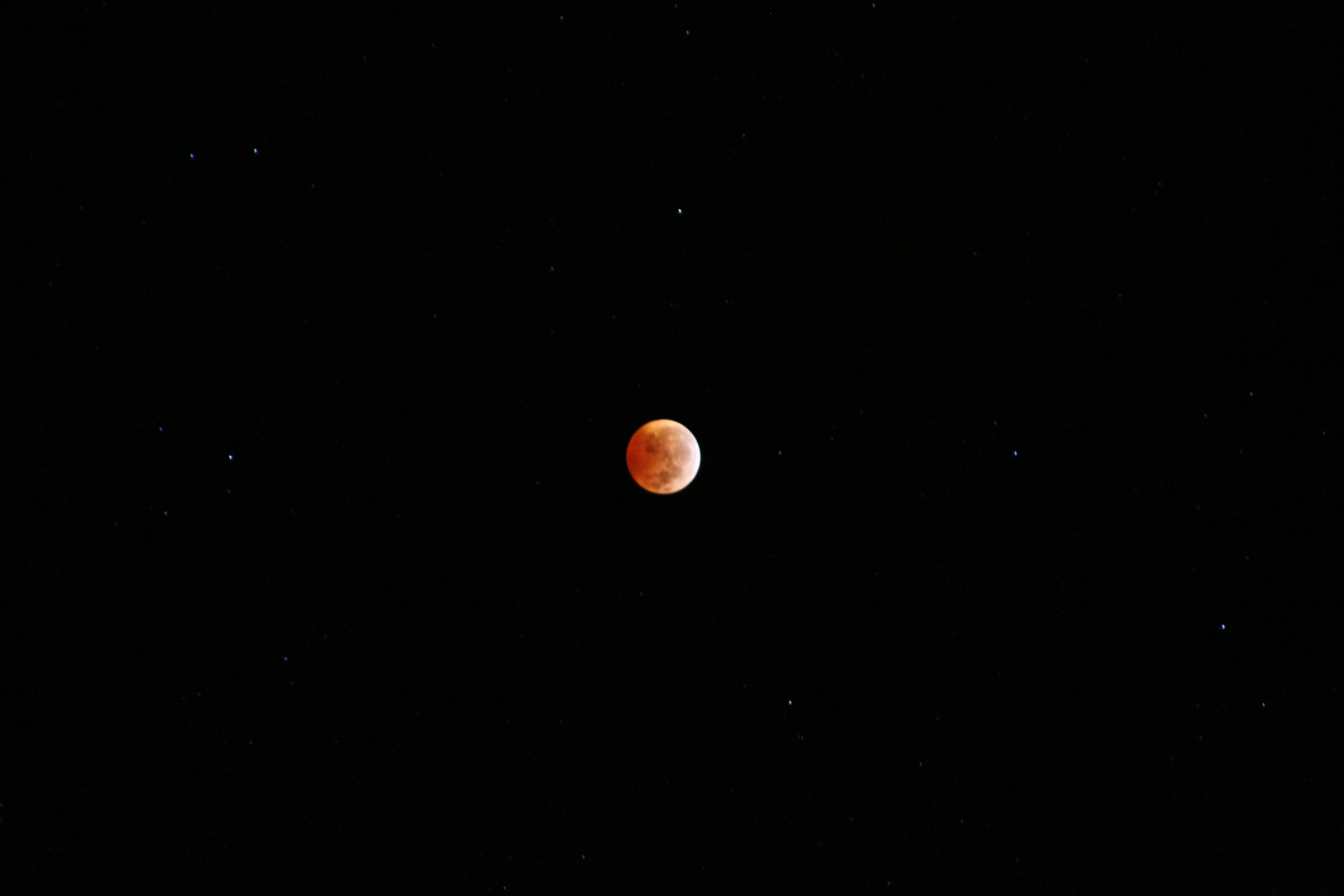
“Lunar Eclipse” by Lorin Kline (my son)

(Last week in Part I I described the forces that drove me high into the mountains for a three-day rendezvous with my deepest fears.  This is the continuing excerpt from the book, Chapter 5.  Dia)

While the list of things scaring me was varied and long, when I arrived at my campsite I discovered one fear in particular standing head and shoulders above the rest.  More than all else, hands down, the prospect of the sun setting terrified me.

There was something so final about it.  I was all alone. Cal had chosen a spot about five miles away and there was no way to communicate with him, no satellite phone or flare or even matches with which to build a signal fire. The trailhead where we’d left the truck was only a two-hour hike away, but without a flashlight I was unable to traverse the steeply forested, snow-slick, north side of the mountain I was on in the dark.  If I panicked I had no weapon to wave wildly at the night, no back door, no safety-net.  Once darkness fell I’d move beyond the reach of any help and for the next eight hours or so, whatever came into my circle I’d have to face.

Which is exactly what I’d intended of course.  Back home it seemed like such a good idea.

Struggling to control the impulse for white-eyed, foaming flight I forced myself to sit down on my sleeping bag facing west.  I called on the desperation that had driven me up there in the first place and made myself watch, eyes unaverted, as the sun dropped towards the peaks, observed as the light around me faded and thinned—and in the process discovered something surprising.

You may not know this but it turns out night doesn’t fall.  It rises.  Shadows start at the bottom, puddling and pooling in the hollows and roots like water and then filling things up from there.  Initially, I was suspicious as I watched the darkness climbing out of the valley towards me, enveloping each boulder, bush and bare spot in its path.  But eventually some subconscious, nightmare expectation in my mind relaxed and I realized there wouldn’t be any eerie wailing or flapping of leathery wings, nothing with foul breath descending on me from above and behind.  The big, bad dark was not coming to get me after all.  On the contrary, as the night shadow rose higher the world grew hushed and peaceful, feeling—rather than a monster—more like some great mother coming to tuck her children into bed.

I watched as she enfolded everything in a calming embrace and when the shadow finally reached my toes I sat stock-still, observing the light that bathed me fade as the sun sank behind the mountains.  Suddenly, I felt excited and couldn’t wait to change into my long underwear, brush my teeth, and climb into my good-to-15 degrees-below-zero sleeping-bag.

I zipped around and still had enough time, after climbing into my bag, to watch as the last rays of light disappeared from the higher ring of mountain peaks that surrounded me.  Everything terrestrial was now encased in the beginning shadows of twilight but it would take a couple more hours for everything to move into full darkness.  I lay there, looking up at the fading blue of the sky and realized that the shadow was still reaching skyward, enfolding even the air, molecule by molecule, and as I watched the darkness deepen in tiny degrees I began to tingle at the thought of seeing the stars.

Back in the Sierra Nevadas during the long nights of my survival training course, while lying there looking up at the brilliant, twinkling worlds spread out above me, I’d slipped into a state of quiet, serene delight.  Feeling like no matter what happened everything would still be all right, that I was safe and cradled in ways that defy explanation.  As the memories of those nights came flooding back I grew excited–couldn’t wait to feel that sense of well being again–but since I knew it would be a while yet, in the meantime I turned to gaze at the deepening shadows on the ground around me.

My enthusiasm swiftly unraveled as I watched the things of this world, the trees and mountain peaks, flitting birds, the carpet of dusty pine needles and stones, the three plastic water jugs and backpack I brought with me, disappearing into the gathering darkness.  The horrified, creeping fear returned as I felt myself being cut off and isolated, stripped of everything familiar, and I began to wonder again if something would come out of that dark unknown to get me during the night–a cougar, a drunken hunter, a wave of bone-chilling cold, a demon.  I frantically reminded myself of the stars that were coming as I turned my eyes back up to the deepening darkness of the sky.

And it was in that moment, as I lay trembling and unexpectedly longing for the darkness of full night to arrive, that I had my revelation.  In a flash I recognized a truth that seems so obvious now but that I’d somehow completely missed.

Both the light and the darkness conceal and reveal.  The light reveals the ordinary world around us.  It gives us one another and makes everything seem smaller and more manageable, wrapping us in a bright and sunny cocoon because as mortals we’re tiny and fragile and need a sense of protection.  But it conceals, too.  It creates the illusion of a blue sky, a ceiling, a world that has limits and is safe and known and predictable.

It isn’t until night arrives that this seductive illusion of containment dispels.  The darkness comes swallowing everything in its shadow,  tugging us away from the usual daylight edges we cling to with white-knuckled fingers until there, in our moment of greatest fear and isolation, it tenderly unveils the larger truth…that we’re cradled, floating in infinity.

The insight was blinding.  Even though it didn’t alter the basic realities of the situation–I was still all by myself out in the middle of nowhere exposed and trapped–it transformed the darkness from a terrifying, alien thing I had to outsmart and survive into a bringer of gifts and grace.  I felt as though I’d reluctantly entered the enemy’s camp only to discover it wasn’t an enemy at all.  It was an ancient, lovely world of starlit depths that had been longing for me, calling me home for years.

A decade of depression slipped away as I fell into an exhausted sleep and, when I woke back up again a few hours later, a twinkling universe stretched out above me.  The soft radiance bathed me as I lay there and quietly wept under the steady, pulsing of starlight.

(Next week, the conclusion.)

copyright Dia Osborn 2010

When Not Quitting Is The Miracle

Thought I’d post a quick update on my mini-triathlon quest.  There’s good news.  Progress is now detectable.  The trainer who adopted me at the YMCA is terrific, enthusiastic, and more importantly has learned to scale back her ambitions where I’m concerned.  Her early training schedule with six days of alternating weights, running, bicycling, swimming, and stretching with a seventh of optional hiking has been revamped to three days of weights and running.

And I’m consistently hitting two of them!  To the outside observer that may not sound like much…and the trained athlete of bygone days in my head would emphatically agree…but to the shell shocked depressive inside who’s spent the last six years floundering between seclusion and creeping paralysis, two days of successful sports training is definitely cause for celebration!

Honestly, I’m a little breathless at my biggest achievement to date…I haven’t quit.  It hasn’t been easy.  This whole thing has felt a lot like sailing along a treacherous coastline littered with underwater rocks.  Each time I start to pick up speed, working out two or three times in a row on schedule, I think Aha!  NOW I’ve got it.  Now I can unfurl the sails and really fly! Then I hear that damn thud and scraping on my internal hull and suddenly, for the rest of the day, I can’t even leave the house.

Which means I have to keep starting all over again and it’s frustrating.  Early on these frequent stumbles really scared me because I thought if they kept up, they’d eventually make me stop.  But two months into the whole thing now and my confidence is starting to build.  I wonder if this is what it’s like for an athlete who suffers a big injury and has to learn how to perform all over again with a new and different body.  Only in my case, the injury was to my mind.  Everything I used to take for granted…simple emotional discipline, mental focus, and freedom from chronic fear and occasional panic…is kaput, so I’m having to learn a whole different set of mental skills and strengths to compensate for it.

It feels good though, even if it’s producing some additional anxiety.  The hardest thing by far is making myself go to the gym.  You may not know this but gyms are very social places.  Lots of active, purposeful, energetic people all striding and pumping and pulling on complicated, noisy, bewildering equipment.  It’s like a ten freeway interchange with heavy traffic flows and well-orchestrated on and off ramps.  Everyone else seems to know exactly what they’re doing and then here I am, an outed hermit dressed in frumpy, old activewear, newly sucked out of my hole and doing my best not to trip and fall off the treadmill (yes…I’ve done it once so far) or hold up the line of nice but impatient people waiting to work on the weight machine I’m currently tangled in.

So much for dignity.  But in spite of everything I’m actually starting to feel individual muscles once in a while instead of the more generalized trembling and collapse I started out with, and the length of time I can run without walking is definitely growing.  I even tried my hand at running on the track yesterday, instead of the treadmill, and I’m happy to report that I didn’t trip, run into anybody, or attract undue attention with all the extraordinary bouncing going on around my chest, hips, and behind.  (The complex physics involved with fat on a jogging person is really something to experience firsthand, let me tell you.) I’m still trying to get a handle on the whole fashion element involved and have yet to figure out how all these women are wearing what amounts to tights with no…I repeat no…visible signs of underwear.  Surreptitious observation in the locker room has only revealed one thong so far, so something else must be going on.  The anthropologist in me is intrigued.

I’ll keep you posted.

In the meantime, if you’ve got an extra ten minutes, here’s an ESPN awards video telling the stories of two, physically-disabled athletes who have been changing the world.  Jim MacLaren, who endured two catastrophic accidents that successively stripped him of his athletic gifts, but who went on to make his miracles anyway, died in August last year.  But his inspiring legacy continues to grow through extraordinary disabled athletes like Emmanuel Ofosu Yeboa of Ghana.  Seriously, if you want something that both puts life in perspective and inspires you to keep hoping, watch this.

Because sometimes just not quitting is the most amazing miracle of all.

copyright Dia Osborn 2011