Could Fecal Implants Be A Cure All?

Fecal bacteria at 10,000x magnification.

(Pretty cool, eh?)

One of the most popular posts on this blog over time has turned out to be, of all things, Fecal Implants? Seriously?! (Yup.)  When I first read about the treatment almost two years ago now, frankly, I thought it was a joke.  But it quickly became apparent that, for a growing number of people suffering or dying from Clostridium difficile colitis…a spreading epidemic in hospitals and nursing homes…fecal implant treatments can often be more of a miracle than a punchline.

Well, buckle your seat belts again folks because it looks like not only do fecal implants provide an effective treatment for C. diff, they may also provide some measure of relief for a host of other gut-related illnesses.  In an Australian article from The Sydney Morning Herald this morningMore Than A Gut Feeling, Sydney gastroenterologist Professor Tom Borody is quoted.

”But there’s also some evidence that other conditions, including ulcerative colitis, chronic severe diarrhoea and IBS (irritable bowel syndrome) can be improved with FMT,” says Borody, who uses the technique in his  practice and believes we need more research to explore its potential.

The article talks about the growing awareness in medical circles that the legions of bacteria living in our guts, when knocked out of balance by things like sanitized environments, bad diets, and antibiotic use “may contribute to hard-to-treat problems such as allergies, autoimmune disease, irritable bowel syndrome, inflammatory bowel disease and even obesity and diabetes.”

(Evidently, a recent study by Dutch scientists shows some promise that transplanting gut flora from a healthy gut to a compromised one may improve insulin resistance.)

The wheels of research are finally starting to roll on this whole idea, which is absolutely fabulous.  I can’t help but wonder though when the far bigger wheels of industry will wake up and start moving in.  How-oh-how will the pharmaceutical companies and hospitals wind up packaging this one?  Poo packets?

Ideas anyone?

Actually, the formal name used for fecal transplant is Fecal (faecalmicrobiota transplantation (FMT) or stool transplant.  Which, when I climb out of my eight-year old self, actually seems more respectful to those who need help but don’t want to wind up as a punchline in someone else’s joke.  So from now on, FMT it is.

copyright Dia Osborn 2012

I Sing An Old English Round

I’m a shower singer these days but once upon a time, back in my college days, I loved playing guitar and singing folk and Celtic music, sometimes even where other people could hear.

One of my favorite things to sing were the old songs from oral traditions that could be sung in rounds.  I always wanted to get enough people together in one place to sing Rose, Our Poor Bird, and Heigh Ho together in eight to twelve rounds but it never happened.  So the dream languished and eventually died.

Then, lo and behold!  Here it is decades later, and I recently discovered software installed on my computer that miraculously enables me to sing all the parts by myself!  No choir assemblage required.  Playing around with it I was delighted and amazed to finally be able to hear all the harmonics involved, and I admit…I briefly returned to a distant dream I once nourished of growing up to be a folk singer some day.  (A dream that died a sad, unnatural death due to paralyzing stage fright, which was just as well since lack of voice training probably would have killed it off anyway.)

The audio tracks got out of sync in the middle for a couple of measures…sorry.  And the photos in the slideshow are from a trip we took to the Olympic rainforest a few years ago.  I thought they captured the same kind haunted feeling as the music.

(It feels a little weird to post this since it’s pretty much solely about me and…let’s face it…who cares?  But what the hell.  I love these songs and after thirty years of wondering what it would sound like, I might as well share, right?)

So anyway, here it is.

copyright Dia Osborn 2012

The Titanic and Something Mysterious Going On in the Dying Rooms

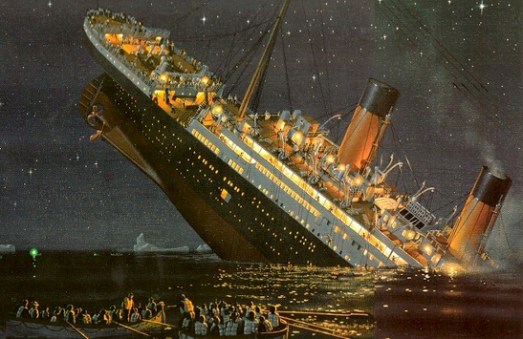
(Image from the blog Corazon’s Corner.)

I indulged in a day of lunch and theatre with an old friend from the hospice I used to work with recently.  Les Miserables.  Music to knock your socks off and blow your hair straight back…especially as we were sitting in the first row directly in front of a two-story speaker.  I couldn’t hear for an hour afterwards but I didn’t want to either, at least not until my body finally stopped vibrating with the memory.

It was a beautiful afternoon spent with a dear friend doing wonderful things.

He used to be the social worker for our small hospice before the owner died and everything fell apart so naturally, over lunch, we spent some of our time reminiscing about the old days.  We got to talking about dying and death in general and, before I had a chance to say anything, Dear Friend blurted out.

“Everyone is SO obsessed with death!”  He seemed excited which, for Dear Friend the Placid…the Even…was startling.  “It’s all you ever hear about!”

He went on to complain about the constant, battering stream of drug commercials, all the news coverage of new medical research that only ever talks about mortality rates and never about quality of life.

The assumption seems to be that if a person is alive, then of course that’s better than being dead…no matter what.  Even though when you actually talk to people on the street, the majority say that after a certain point of escalating suffering and loss (that quality of life thing again) they think they’d really rather just go ahead and die.

It was such a relief to me, to hear somebody else say it.  And it struck me again, how those who have worked around hospice generally wind up coming to the same conclusion.

Dying just isn’t that scary for us anymore.  We’ve seen it.  We’ve been around it a lot.  It’s become our familiar and we’ve made our peace with it.  We know we’ll be doing it and that’s no longer a problem.

Over time we came to see how dying fits into the grand scheme of things and how, more importantly, it can actually top off a life in a way that rights some of the wrongs that were made.  We’ve seen first hand, multiple times, how dying can deepen the beauty of a life, spread that beauty around to others, and even leave that beauty behind as a legacy of good that lasts a very, very long time.

Unlike a lot of people who say they know they’re going to die, we REALLY know it, and the knowledge has largely freed us from the constant, underlying fear that people usually don’t even realize they’re living with all the time.

What IS still scary though, even to us, is all the possible wrong choices around dying that are available in today’s world, choices that we know can make dying a lot harder, make the difficult parts of it even worse than they already are.

They’re choices that are proliferating at a blinding speed, too, that are being pursued, promoted, and paid for by that same deep, unconscious fear of dying that’s basically running everything at this point.  Our medical institutions and research facilities, our public health policies, our hospitals and doctor groups, our politicians, and our insurance companies have all evolved around this one, central terror of dying to the point where mortality rates have become the key measure by which everything else is judged.

Dying…and desperately avoiding it…has long since gobbled up the majority share.

There are a few people scattered around who, like Dear Friend and I, can see this, and some of them are even people in high places with a lot of influence.  Some of them watch the teetering tottering mess with the same dismay that we feel, while others rub their hands together with glee, jump into the chaos, and do what they can to further, then capitalize, on all the fear.

It’s a mess.  It reminds me of that classic scene sequence from the movie Titanic, where the iceberg has been hit, the ship is half sunk, and her decks have finally collapsed into a chaotic, milling scene of abject human terror and despair.

It’s quite grim.  The movie makers did a good job there.

And then…and then.  They do something magical.  The camera abruptly pulls back from the closeup coverage of all the chaos and noise, moving to a more distant, mid-range kind of shot from up in the sky and the noise and chaos are instantly reduced.  We can still hear the screaming but it’s now far away and less disturbing.  The ship, in all it’s eerie, glowing destruction is much smaller now, it doesn’t overwhelm us anymore, framed as it is by a huge sweep of dark, silent ocean that somehow manages to contain and quiet it all.

It’s true.  A larger perspective always helps.

But the magic isn’t over yet.  The camera suddenly pulls back again, to an even farther point up in the sky, a place so high that we can now see not only the vast ocean containing the tiny ship, but the vast night sky containing the vast ocean that contains the tiny ship.

From that height we can’t hear anything anymore.  Not a single visual or auditory detail of the tragedy is left and it’s a relief to be removed from it like that.  To be offered a perspective, a scope of time and place, so vast that it easily contains and cradles even that much suffering.

I think about it a lot, why spending time in the dying world helped to alleviate my own fear of it, and I think it’s because this same kind of thing happened.  Somehow, by being there with them—each rare and beautiful dying person—by laying my own hands on their quivering bodies and fears and dreams, it made the camera inside my eyes magically pull back, too.  Little by little, day after day, mostly to a midrange place where I could still hear and see all the suffering, only surrounded by a great stillness.

But then every once in a while, for some reason that I still don’t understand, (probably love come to think of it…love can do a real number on perception) my eyes would pull back farther than that, out to a place full of twinkling stars and deep time.  And in those moments the people I was looking at, the homes I was working in, would fall away into profound silence while everything started to glow.

The wasting body beneath my hands, the faces around me crumpling in pain or anger or grief, all the dying room litter of soiled wipes and used commodes, of sweaty, wrinkled clothing, ice chips, and pill cups, would transform into something that was simultaneously exquisite and heartbreaking—as if everything, all of us, were turning into a giant constellation of stars that were just hanging there, glowing and guiding, in some other kind of vast but invisible night sky.

Although no.  Not turning into.  It wasn’t so much like we were becoming a constellation of stars.  It was more like that’s what we’d always been but then we forgot, consumed as we are most of the time by the engaging, delightful, overwhelming barrage of all life’s little details.

And for those few luminous moments, I’d stand gazing around me slack-jawed and wide-eyed, my hands frozen in whatever task they’d been doing, my breath suspended with the wonder of what I was seeing.

And then whatever was causing it to happen would change and the camera in my eyes would zoom back into mid-range again, the glowing would disappear, the noise would resume, and I’d be able to move again.

Then later, when I’d leave the dying rooms and walk back into the noisy, chaotic world of regular living, my eyes would zoom back into close range again which, frankly, is where they are most of the time.  I’m usually just as overwhelmed by details as the next person.

But even though those strange, glowing moments were brief I can still remember them vividly.  I can return to them and touch them, over and over again, whenever I need to.  Those seconds of looking at the world from somewhere farther away and higher up, from a place where every ordinary, everyday, stinky, crumpled, decaying thing suddenly looked like a miracle and a gift.

And just remembering it, I’m surprised all over again each time.  Overcome.  It makes me fall head over heels in love with life yet again because somehow I still keep forgetting just how BIG this all is.  Big enough to tenderly hold not only the nubile and lovely, but the terrified and aching as well.

Big enough to contain even dying.  In the end it all really is just a blink.  A beautiful, hard slogging, transcendent, soul crushing, miraculous, grief filled, fascinating, bewildering, breathtaking, fragile, prostrating gift of a blink.

Thank God it eventually ends.  Who could take this kind of fabulous beating forever?

copyright Dia Osborn 2012

Breast Cancer: Pink October’s Long, Dark Shadow

by Raphael

I heard that this was happening before…a few times over the years actually.  But usually the voices of the women talking about it…the ones who are actually dying from breast cancer and therefore barred at the very pink door of Breast Cancer Awareness Month…wind up being drowned out by all the noise and hoopla.

So I thought this year I’d give their voices what little boost I have available.  For whatever it’s worth, this post is written for those of my brave and brilliant sisters (and brothers…men get breast cancer, too…) with Stage 4 or metastatic breast cancer who’ve been unfairly asked to stand behind the building and out of sight for a month while the rest of us gather inside to smile and shop and optimistically wave our pink ribbons in the air.

(About 30% of all breast cancers wind up reaching the metastatic stage by the way…a statistic that often makes the lucky and/or hopeful squirm and sidle away when they encounter anyone already there.)

For those who don’t have a clue what I’m talking about, here it is:

Most of the awareness raising efforts during Breast Cancer Awareness Month aim at benefiting women who are either still perfectly healthy or at least curable.  But for those women (and rare men) who aren’t as fortunate?  Those who’ve already crossed into the next scary…but still oh-so-exquisitely-alive…world of metastatic cancer?  Not so much.

In fact, not only does Breast Cancer Awareness Month NOT raise much awareness about these women and men–their courage, their deep love of life, and their profound need for research dollars– the net effect of the campaign actually winds up excluding them, leaving them feeling abandoned, or worse, unwelcome.

I realize that none of this is intentional…nobody means or wants to pile additional hurt on these women and men already grappling with so much…but it’s still appalling.  We can do better.  I know we can.  Here’s one possibility off the top of my head and it’s a very simple start:

Please…take the time to read this article by Joan Oliver Emmet titled Women with metastatic breast cancer: feeling alienated during Breast Cancer Awareness Month.  Ms. Emmet and the women from her breast cancer support group lay it out more eloquently than I ever could.  Then, if you feel inspired (and have a Facebook account) leave a supportive comment.

Read it because in doing so, you’ll actually be honoring the Awareness part of Breast Cancer Awareness Month as much as you could by running in a footrace (and probably more than buying the pink yogurt or watching Sunday football.)

Or read it because all the women and men with Stage 4 and metastatic breast cancer need to be pulled back into the circle of our arms even more than the rest of us, not less.

Or read it because if we can stop running blindly towards some seductive pink light at the end of an increasingly (let’s face it) corporately constructed tunnel, turning instead to clasp the hands of these women and men with incurable cancer…to stand and face the long shadow of death with them, shoulder to shoulder…our collective terror about the whole thing may actually lessen a little.

Caring and inclusion often have that kind of effect.  They tend to build courage and support clear thinking.

Or just read it because the article isn’t all that long, it’s well written, and it’s moving.

I’d love to see this month move beyond its strictly pink focus and maybe add some depth of color.  If pink ribbons signify a push for cure by early detection and treatment, then maybe we need another color that signifies a push for cure for later stage breast cancers?  Red maybe?  The color of pulsing, dynamic life?   And maybe another color to honor those women and men who can’t be cured at all yet…and those whom we’ve already lost for that matter. Maybe a pink and red ribbon laced with white?

Or then again, maybe we should just take the billions of dollars spent on paraphernalia, marketing, and advertising these days and donate it all straight to the research labs?  (Shooting for the moon, I know.)

But whatever we do, let’s at least pull all the beautiful and beloved women and men currently dying from metastatic breast cancer back into the building this month and hold them in our awareness, too; celebrating their lives, sharing the grief of their losses, and applauding the staggering courage they display every day.

And who knows?  Maybe if we let ourselves actually acknowledge the odds we’re still up against with this dreadful disease, it’ll add even more fuel to our search for cures.

Here’s hoping.

copyright Dia Osborn 2011

I’ll have some judgement with that sandwich, please.

Yum…

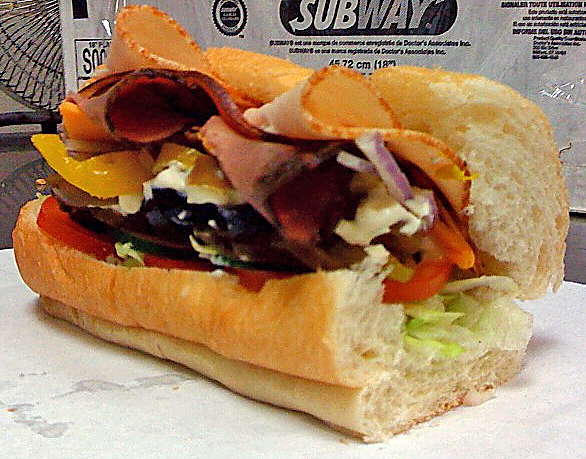
The hubster and I stopped off at Subway on the way home from our Weight Watcher’s meeting last night and, as usual, we ordered our six inch, whole wheat, chicken/turkey breast sandwiches…without the cheese.

The woman serving us did not approve.  Clearly.  She ignored our first request to leave it off, instead focused on cutting and spreading the bread before her.  Then she looked up brightly and asked, “What kind of cheese would you like?”

“No cheese!” we answered in chorus.

She stared at us for a moment, the answer still failing to register.

“You don’t want any cheese?”  Her tone was dubious, as if she hadn’t heard us correctly.

“No.  No cheese,” we reassured her, smiling.

She just stood there staring for another second as the full weight of realization pierced some thick, cheese-adoring cloud in her mind and then, before our wondering eyes, she took a deep breath…eyes widening and rolling back, lips curling a little in contempt…before finally shrugging off the utter stupidity of such a request.  She slid our sandwiches past the cheese tubs in disgust, leaving them to wait their turn in the vegetable queue, then turned to wait on the people behind us without another word.

Ah…the power of cheese.  I’m pretty sure this woman loves it.  A lot.  I’m equally sure that she had no idea what her body language was saying.  Frankly, it was like watching a small child who hasn’t yet learned the intricacies of polite diplomacy; her response was spontaneous, unconscious, full bodied, and 100% honest.

My apologies, ma’am.  Truly, we meant no offense.  We really love cheese, too, it’s just that we’re tired of being fat.

copyright Dia Osborn 2012

“I hope you don’t mind, but I’ve never died before so I have some questions.”

Mon Pere–the unquenchable, the ever entertaining–was out visiting mortuaries and cemeteries the other day and evidently that was one of his ice breakers.

He may have been half-serious…he is Mon Pere and takes his right to have all the information seriously…but I wasn’t there so couldn’t say.  Reports have it that by the time he left each place he had the staff in stitches.

copyright Dia Osborn 2012