Spear Fishing Gone Wrong

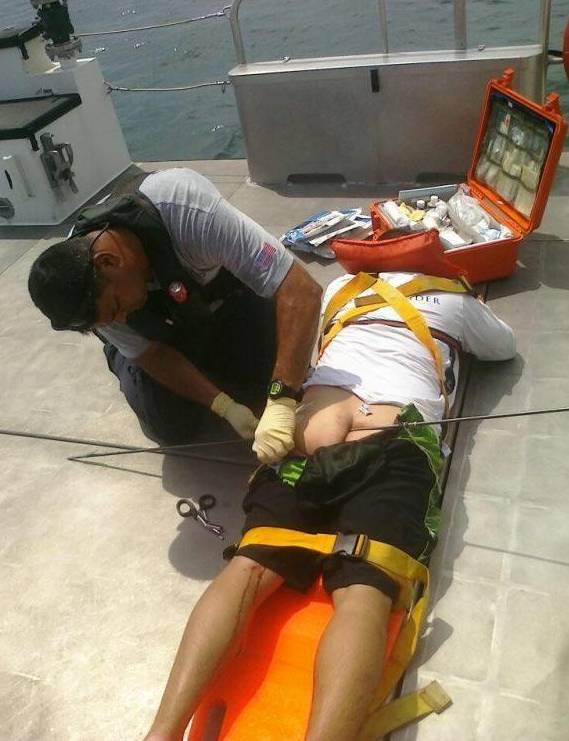
This photograph sent me in about six different directions at once.

1) Horror.  Whoa.  A butt is never, never supposed to look like that.

2)  Fascination.  But…it does.  It does!  I can’t look away.

3)  Curiosity.  Is he unconscious?  What did the spear go through?  What’s in a butt cheek anyway?  Just muscle, right?  No major arteries or veins?  And how will they get it out of there?  Break off one end and pull out the other?  (Owwwwww!!!!!!)  Will they use an anesthetic?  And who is this guy?  I wish I could see his face. And where’s the other guy who shot him?  Or…good god.  Could he possibly have done it to himself?  Why doesn’t he look wet?  Did the accident happen on the boat?  Did they cut his shorts to pull them down like that?  And what’s that logo on his shirt?  Something…DER?  Why is he strapped down?  And is that a fishing boat?  It looks industrial.  Was he commercially fishing?  Is that really even a spear?…

4)  Amorous.  That medic is pretty cute.

5)  Clinical.  What’s with the scissors?  Is he applying gauze?  Like…a band aid?  Seriously?

6)  Empathetic.  Wow.  So that’s what the fish feels like.

copyright Dia Osborn 2012


It’s Still Wilderness Without The Crowds

Okay.  Time to post, no matter what.  I’m being distracted by travel, spring gardening, a writing project, a new hobby, the intense gurgling coming from our dog’s stomach, lint on my pajamas, insecurity…you name it.  I published a post last week, left it up for about four hours, then took it private again because of my old friend, the obsession about Will it offend somebody?  I can handle obsessing about the quality of my writing, I’ve got some protocols in place to keep that one on leash.  But my fear of offending some unsuspecting, trusting reader out there is a lot more savage and last week it leapt out of nowhere and just mauled me.

Which makes it about two weeks without a post, so this…my friends…is gonna be it.  (And probably safe and bland as well.)  Here we go.

We escaped to the Sawtooth mountains again last weekend for some long, gruelling snowshoes through the shitty conditions that always exist up there in April.  It was like seasonal dawn…a transition between stable states.  It wasn’t exactly winter anymore but not full spring yet either.  There was a lot of major snowpack melting down at the rate of a foot a day with all the resulting soft snow and slush, puddles and rivulets, marsh and mud.

This is what it looked like on the first day:

And this is what it looked like two days later:

Who knew snow could melt that fast?  We were amazed.

The great thing about that much mess though, is that nobody else wants to be up there.  The snow is worthless for snowmobiling or cross country skiing, and the area is still too wet and cold for the hikers, backpackers, and river-runners that turn up in droves during summer.  Hunters can’t hunt, ranchers can’t graze their cows yet, and no one can drive off the pavement and not get stuck in the mud, no matter how good their four-wheel drive is.

Actually, I take that back…the Fishing People were already in the valley, which surprised me.  They’re apparently even crazier than we are when it comes to non-deterrence from muddy, boot-sucking conditions and we saw a few of their camping caravans set up in places where the river bends up near the highway.  I wondered at it considering that the Salmon River is swollen, turbulent, and loud with all the snowmelt right now.  I’m not expert but are those really decent fishing conditions?  Or were the Fishing People just fed up with winter and willing to pretend for a while…just to tide them over until the fish really do show up?

Perhaps they were just practicing becoming one with the river.  I’ve heard that’s a big part of fishing, too.

In any case, we had the entire mesa to ourselves, although a neighboring, palatial home owned by a rich doctor from Wisconsin had left a light on again…which drives me absolutely nuts.  I mean, a security light?  Really?  Like…what?  Robbers are going to strap on their snowshoes and trudge two miles uphill to carry off their big screen TV in a backpack?

I really struggle with things like this.

There’s an interesting dynamic going on in the valley where the family cabin has sat for decades.  The Stanley Valley (webcam link) is a relatively poor region mainly populated by ranchers, forest service employees, and a few scrappy souls who eke a living out of the brief but intense summer recreational tourist trade.

It also lies one easy mountain pass away from the extraordinarily wealthy town of Sun Valley, part-time home to Hollywood celebrities, a smattering of billionaires, and an internationally reknowned ski resort.  Over the last decade or so, a lot of that money started pouring over the hill into the Stanley valley, mainly in the form of real estate purchases and second homes/mansions.  This has driven local property values way up creating a serious problem for the less financially-fortunate natives watching their property taxes climb into the rarified air of pretty-much-unaffordable.

With this as our backdrop, now imagine a large mesa perched about halfway down the  valley where the humble family cabin sat in relative isolation for decades.  It served as home base for the hubster’s mother, one of the first nurse practitioners in the state of Idaho who founded and then ran the small, rural medical clinic in Stanley for twenty-five years.  She was a tough old bird even when she was young, on call 24/7, snowmobiling up and down the hill in an area known for some of the most frigid winters in the continental U.S., hiking the two miles up and down in the mud season when neither car nor snowmobile would work, and deeply beloved by those in the region who wouldn’t have had easy access to medical care otherwise.

Fast forward a few years and now multi-million dollar homes have cropped up all around the cabin, making for some interesting neighborhood dynamics.  Don’t get me wrong, everyone who owns up there is united in their deep and abiding love for the entire valley.  We’re all drawn to the place for the beauty of the mountain wilderness, and every neighbor I’ve met is generous, willing to help, and friendly.

But there are natural differences, too, created by the politics of money, the politics of natives versus second-homers, and the politics of environmental concerns versus property and commercial development.

As I’ve watched the building take place over the years it’s gradually sunk in how strange it is…that these days we human beings love our wilderness so much it makes us want to build our homes and communities right in the middle of it, which then, of course, makes it not really wilderness anymore.  We want to be near wild animals so much that we build on the land they need to survive, or we long for the pristine woodland glade so much that we blast a road through the rest of the virgin forest to get there.

It seems so irrational and yet so deeply human, too, to love something so much that we’ll actually harm it to have it.  Like small children hugging a puppy to death, our deep, instinctual need for the beauty, silence, and healing of true wilderness is leading us to damage and even destroy it when that’s the last thing in the world we want to do.

I don’t know what the answer is.  And I have to be careful, too.  Clearly, where the Stanley Valley is concerned, any lofty observations I make about human encroachment are laced with a built-in conflict of interest.  I remember once hearing my eldest brother, a successful real-estate developer around the Pacific Rim, make some acid remarks about how often the first people to move into an area then cite environmental protection as a reason to keep everyone else out.   There’s a lot of truth in that and I feel the sting of it here.  It’s very easy for me, with legacy access, to point fingers at the newbies who only want to do the same thing that we did, only first.

So these days I just try and go up when it still feels most like wilderness to me; i.e. when nobody else is around.  When the silence is still deep enough to catch the faint sound of the river rising up from the valley below, or when the night is still dark enough to see the stars twinkling and shooting outside the window as I lie there in bed for hours staring, unable to go to sleep for the wonder of it all.

That’s why the hubster and I both actually love the shitty April conditions, and why it’s totally worth it for us, hauling a forty pound pack on our backs, uphill, in the dark, through slushy snow and mud to get there.  Just because nobody else is nuts enough to do it.

Except for those Fishing People, but that’s okay.  They’ll never leave the river.

copyright Dia Osborn 2012

Dead Bodies Need Love, Too

…only I think more for our sake than theirs. 

In the last week I had two different friends tell me stories about the death of a close family member and the extraordinary experience they had with the body afterwards.  In both cases the body was handled in a way that’s unusual by American standards, yet both women told me (with deep conviction) that it made all the difference in helping them cope with the loss.

The first is a friend who’s older brother died last year of a sudden heart attack in his early sixties.  He lived and died in a different kind of community in the midwest where a lot of people practice a spiritual discipline with deep roots in the Indian Vedic tradition. Naturally, his cremation was attended with some of the chanting and ritual derived from that part of the world.  It involved an open casket viewing in a small room within the crematorium following the funeral itself.

The ceremony was beautiful, heart wrenching, and mesmerizing to watch.  My friend had a small video that was given to family members, and she shared it with me.

Only the most intimate friends and family members were allowed to attend.  Once everyone was seated a woman, who’d evidently spent a number of years in India learning how to do it, gave a brief explanation of the ceremony and then began singing what had to be one of the most beautiful, soothing, dynamic songs I’ve ever heard.  The words were in Sanskrit so I couldn’t understand any of it, but the melody, repetition, and deep resonance of the woman’s voice was like being cradled in strong arms.

All of the (many, many, many) flowers from the funeral had been brought into the room and two women were busy in a corner stripping all the petals and placing them into a basket near the head of the casket.  As the main woman sang that unearthly song, everyone in the room stood up and began to file past the body in a circle, picking up a handful of petals out of the basket each time they passed and sprinkling them over him as they whispered their final good-byes.  

At first I was just struck by the surprising beauty of the whole idea.  But then, as I watched his white face…his entire body…. vanishing beneath the deepening layers of soft, tender flower petals, I got it.  How much kinder and gentler this was, how much truer to both the profound love and profound loss of the people in that room, to bury him in flowers rather than dirt.  It took my breath away.

His mother nearly collapsed her first time around, under the unbearable weight of her grief.  But it seemed to get easier for her after that.  My friend told me that more than anyone else, the ceremony helped her mother come to grips with the loss.  Neither Friend nor any of her other family members actually lived in that community.  They’d all dropped their lives to travel from across the country, stunned and stricken.  Friend confided that initially she, herself, was reluctant to view his body, to see him like that.  She wanted to remember him as he was.  But then somehow as she watched him disappear beneath the flowers, the pain and shock of his death was transformed into something else.  Something more manageable.  Closure, she said, and her eyes looked unutterably grateful and sad.

Eventually, they all went down to the furnace and, together, rolled his body in.  But by then they were ready to let him go…which I realized was the ceremony’s intended gift.

My other friend’s loss happened at the other extreme.  She lost her elderly mother after a decade of slow, horrendous decline.  In fact, her slide had taken so long that when she finally…finally!…began actively dying it was hard to get her doctor to believe it.  In the end she was only transferred over to hospice care a scant three days before she died and this made my other friend sad.  She would have liked the extra time necessary for everyone to gather and say their good-byes, to turn their familial head downward toward the birthing canal, preparing for their transition into the next world without her.

Then she told me how they didn’t call the funeral home right away, to come and collect her mother’s body afterwards.  Instead they kept her at home for a night so she and her daughter could sleep beside the bed, one on each side, loving it through the first long, dark hours of its new state.  They called in the morning and watched her taken away in the brighter light of day.  My friend shared that, by then, she was ready to let her go and I recognized that closure thing again.  That elusive, emotional line we all have to track down inside ourselves and cross before we get to begin our ascent back up the other side.

In both these stories I was struck by the double loss we experience with the death of a loved one…how we lose both their them-ness AND their body…and how important it can be to separate the two and honor them both.  Not only as a final gesture of respect for our departed, but for our own healing as well.

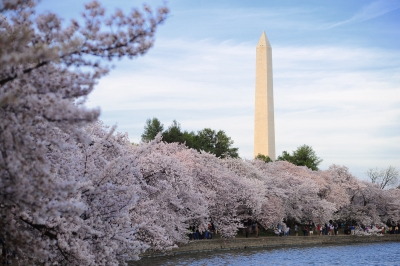
first photograph: Cherry Blossom at Washington Memorial by porbital

second photograph: A Study in Pink by Maggie Smith

copyright Dia Osborn 2012

Poll: Immortality. If you could, would you?

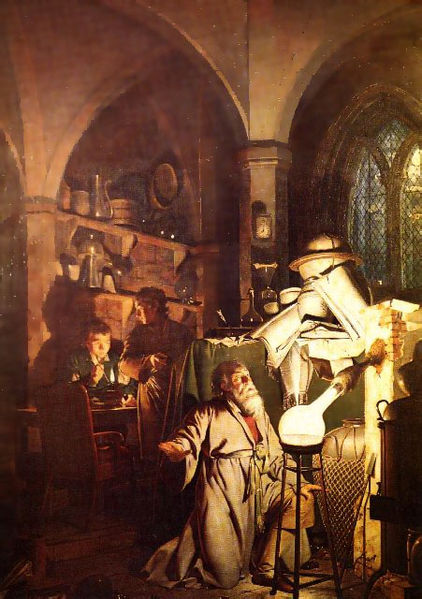
The Alchemist In Search of the Philosopher’s Stone

This past weekend a friend and I had a brief discussion about the pursuit of immortality down through the ages (Fountain of Youth, Holy Grail, alchemy, etc.) at the conclusion of which we both exclaimed that, even if living forever someday became possible, we wouldn’t want it.  Passionately.  In fact, the idea of living forever (or even a lot, LOT longer) was kind of repulsive.

My personal aversion stems from two separate issues.  The first is the fact that life is riddled with tough spots, occasionally becoming harsh to the point of undesirability.  The cumulative injury of those traumas over not just an average lifespan, but an eternity, would have to become unendurable at some point.

Pooh on that.

My second objection is that seizing that much life for myself feels unethical.  We live in a finite universe full of limited resources that can only support so many biologically functioning human beings.  So if I don’t die, then a fair number of future children won’t be born.  I would, for all intents and purposes, be stealing their lives in order to lengthen my own and…well…isn’t that a vampire thing?

Ick.

Although…the question of ethics and immortality gives rise to all kinds of possible plot scenarios for a novel or sic-fi movie.  Which is pretty fun.  Here’s one:

Opening scene: New York City, 150 years in the future.  A mysterious wave of miscarriages has been sweeping across the world for fifteen years and the pace is increasing geometrically, potentially threatening the future of the human race.  A concerned official from the World Health Organization comes knocking at the door of two, world-reknowned, research scientists who specialize in fertility studies.  They’re married and (surprise, surprise) she’s nine weeks pregnant.  The WHO official finds that enrolling them to look for a solution is pretty easy.

Break to next scene:  New York City, present day.  A small group of Swedish scientists reveal a startling anti-aging discovery to a secret committee of the World Economic Forum.  They propose The Methuselah Project, a campaign to lengthen the human life-span by a couple thousand years, and the proposal is instantly and enthusiastically adopted.  (It begins, of course, with the inoculation of power brokers, mega-wealthy, and top government officials.)  Over the next hundred years, trials are run and all of the now-virtually-immortal insiders on the project consolidate their power over just about everything.  Things are finally ready for the second stage where inoculation will be offered to pre-selected people at a hefty price.

Back to the future:  As the two research scientists probe deeper into the growing problem, they uncover a secret network of wealthy, powerful, reclusive people who all seem to be unusually old, although their pasts are cloaked in mystery.  As they start to question individual members of the network, all the usual, life-threatening car, plane, and other accidents quickly begin to happen to them.  The couple survive everything thrown at them and eventually track down one of the original Swedish scientists who now works among the Inuit people in a remote region of the Canadian Northwest Territories.  He reveals that he’s actually 193 years old, and then explains how the original vision of The Methuselah Project was corrupted for the purpose of establishing a two-tier world order; those who live for thousands of years served by those who die by their sixties.  Part of the project involves drastically reducing the world population to a number more easily controlled, and the tool employed is a simple pennyroyal compound leaked into the water supplies of the world (all owned and controlled by Immortals BTW) to induce widespread miscarriages.

Conclusion: This will depend on whether the movie is a feel-gooder or a horror film.

Feel-gooder conclusion: the scientist couple manage to get the word out to the media and expose the scheme to the world, after which all the people rise en-masse to destroy the Immortals and return the world to it’s natural order.

or…

The scientist couple re-engineer the anti-aging serum to bestow not only longevity but wisdom.  The evil Immortals are transformed into kind, benevolent, enlightened teachers who then work to change the world into a better place for everyone.  All are eventually inoculated with the new serum and the scientist couple’s baby grows up to be President of the New World Utopia.  (This ending could be a tough sell.)

or…

The horror film: the scientist-pair are killed before they can expose the plot, but not before their own baby is born and taken away to be raised by an Immortal couple who can’t have children of their own.

or….

The bad Immortals are killed after which the original Methuselah Project is reinstated and everyone in the world is inoculated with the anti-aging serum.  The widespread miscarriages are then replaced by a new set of sterilization, abortion, and lottery-pregnancy laws.  (This movie obviously gives rise to the sequel where desperate women start becoming pregnant illegally only to be hunted down and treated badly when they’re caught.  Or has that movie already been made?  It sounds familiar.)

ANYWAY!!!  This was fun but I really have to get on with my day now.  I’m curious though.  How many of you are intrigued by the idea of immortality (as versus just-not-dying, which is a completely different issue.)  Here’s a quick poll to get an idea of where people stand on the subject and, if you need more room for nuance, by all means feel free to use the comment section.