A Huge Life In A Tiny Box

(Sorry for the blur but this is the only picture anyone thought to take.)

A couple weekends ago we drove down to the little town in Nevada from whence my people come and buried a small box in the cemetery there.  It contained a variety of things; a seashell, photos, an old, scribbled note in a silver-plated box with blue velvet lining, a thank you card, a George Washington $1 coin from the U.S. mint presidential series, a Chinese coin, pictures of two Hindu saints, downy feathers, a secret bundle, and a handful of ashes from my mother who died over two years ago.

Some of these things belonged to her and others were things we thought she should have.  The seashell and feathers–because she adored the ocean and migrating birds.  The Hindu saints–because they guided her in life, so how much more important that they be there with her afterward?  The secret bundle–from a secret person for secret reasons known only to them.  And the ashes because they were a last, little part of her that we could come and visit whenever we felt the need.

The old note, I found a couple months after she died.  It was a short list of prayers folded up inside the silver box and stashed with her jewelry, dating from about a year before she died.  The prayers were written in this order:

1)  For an improvement in her health (which clearly didn’t work out so well).

2)  For ten million dollars invested in a trust yielding 8% a year (also a no-go). 

3)  For greater clarity (yes!…she was having amazing breakthroughs and insights during her last months).  And,

4)  A last, loving wish for enlightenment and peace for the whole world. This was the one that made me cry.  It was so like her, my mother, forever toting the world around with her in her bottomless basket of good wishes.

I spent days before leaving for Nevada sifting through the mementos of her life again–through all the deep, swirling emotions they resurrected–looking for the right pieces to place inside the box.  Because my mother believed in reincarnation I carefully tucked in the list…just in case prayers carry over from one life to the next.  The coins went in for murkier reasons even I don’t entirely understand; maybe as a token for the wealth she craved, or as an irrational but oh-so-necessary payment to the Boatman for safe passage, or perhaps just because they were made out of metal and would still be there long after the box itself decomposed.

Six of us came to sit around that small, square hole in the ground, drinking water and wine, soaking up the sun and wind, toasting her memory and telling her stories.  We had a folding chair for each of us and an extra one where we set the box.  We occasionally grew raucous, sprinkling wine over it after a toast, because sometimes remembering in the midst of great loss can just do that to you.

Before we placed the box down in the hole, I opened it one last time so we could have a look inside.  The wind rustled the downy feathers and then blew one out, whisking it over the hillside below us.  It floated above the headstones…more like a butterfly really, than the bird it came from…before finally rising higher, then higher, then higher into the sky.  We all stood transfixed and staring, following its lovely escape in surprised silence, but the same thought was in each of our minds.

Look!  Look! There she goes!

Afterwards we took handfuls of dirt, one by one, and threw them into the hole to cover the box, and with each handful we cried or laughed or were momentarily still…throwing our prayers down for her, too, along with the love of others who couldn’t be there.  With the first handful, grief overwhelmed me and I sobbed on my knees, unconsciously dragging my dirty hand across my forehead and cheeks.  I had no idea why I was doing it except that the grit across my skin felt welcome and good; raw and sharp enough to match the scraping of the wound inside me.

It was the leading edge of a brief but wild storm, and once it passed I felt calmer and lighter for it.  Cleansed and good.  Eventually we finished and, after replacing the small square of turf over the loose dirt, we packed up our things and traipsed off to the city park to eat a small picnic and finish the wine.

I like to think of that small box now, pressed down by the weight of dark, moist earth and already starting to decay, its cache of love and prayer, life and joy, seeping out into the ground like something with a half-life of ten thousand years.  It never ceases to amaze me, how relentless this great current of Life is that flows through us, spilling down from one generation to the next like a perpetual champagne fountain, as if we were ever-widening tiers of crystal flutes constantly filling and spilling simultaneously.

My mother is gone but the huge gifts of her life are still washing down through the bewildering number of other lives she altered just by existing here for a while.  They’re inside all of us who loved her and passing on into all those we love in our turn–inside everything she touched and every place she passed through.

And as of a couple weekends ago those gifts are now inside that tiny box, too, buried up in the high desert mountains where they will be leaking their grace for generations to come.

copyright Dia Osborn 2011

The Danger of Blowholes

This photo was taken moments before the man behind the water spray was sucked down a blowhole on Maui last week:

Photo from the article in the Daily Mail.

Sadly, he only came back up to the surface once before being dragged under again and disappearing for good.  At the time the article was written, his body had still not been found.

It’s an odd way to go, death by blowhole, but that’s not what grabbed me.  My eldest brother was also sucked down a blowhole, decades ago now, also in Hawaii only on Oahu, not Maui.  It was during a high surf alert generated by an earthquake on the Asian side of the Pacific rim and, as soon as they heard about it, Bro (an occasionally professional surfer), his girlfriend, and another surfer friend drove up to Waimea Bay to check out the waves.

They weren’t going there to surf.  The waves were coming in around thirty feet and big wave surfing wasn’t yet as popular as it is today.  No. They were just heading up to watch, because waves that big are a rare phenomenon and, like solar eclipses, tornadoes, and eagles mating, sightings are a privilege and opportunities shouldn’t be wasted.

The three were standing up on the cliffs overlooking the bay, admiring the monster surf, when they first noticed it.  Huge spray coming out of a blowhole none of them had ever seen before.  It clearly had a long tunnel, starting down in the bay and running all the way up through the rock to its exit farther out on the point, and no one had noticed it before because it was inactive in smaller water.  It took seismically generated waves to finally send water all the way up and out the top, and Bro and company were understandably excited by the discovery.  They wandered out to take a closer look.

Now understand, these were experienced island people.  They knew about blowholes.  They understood how strong and deadly water that only reaches up to your ankles can be.  But somehow, in spite of keeping what they thought was a safe distance, the wash coming out of the hole suddenly snaked across the cliff, wrapped around Bro’s feet, whipped them out from under him, and sucked him struggling and clawing back to the mouth of the hole, over the edge, and down inside it.  Just like that.  Blink of an eye.

The Hawaiian Akua are known to be mischievous.

He had just enough time before going under to grab a lungful of air and, because he was a surfer and accustomed to spending long periods of time held under by powerful waves, his lungs could hold a lot.  He began the descent and traveled deeper and deeper down the wormhole, with no idea where it would come out or even if it would remain large enough to allow his passage all the way through.  What he did know was a long, narrow, hurtling slide down through water, rock, and darkness, with a steadily growing pressure in his chest as his air started to run out.

Finally, as he was beginning to think he might not make it, he felt himself whoosh out the bottom of the tunnel into open water. He immediately struck for the surface and when he broke into open air, found he was so far out in the bay he was actually past the surf line.

Needless to say, Bro’s girlfriend and friend were freaking out back on the cliff, and they failed to spot him where he came up because they were looking closer to shore.  But eventually someone sighted him and called the Coast Guard who quickly launched a rescue.  I’m delighted to tell you that my brother survived to tell the tale.  Because he was a strong swimmer, and because he didn’t lose his head, and because our Aumakua were protecting him, and because…well…it just wasn’t his day to die.

Working with hospice is about working with those who die slowly, navigating the process as it gradually unfolds, step by step, over a period of time.  Sudden death is different.  When a person dies abruptly the laws that govern the dying process are moving so fast that it becomes impossible to see the underlying physiological sequence in action.  It’s still taking place mind you.  Every physical body has to go through a shutting down process on it’s way to death.  But while a wasting disease takes us through those stages one at a time, sudden death strikes every point along the sequence simultaneously.

Why is this important?  Because even though these stages of the dying process are the only part we have any control over, we leverage this control into an illusion that we actually have some power over death itself. (We can save lives!  We can!!)  But when a sudden death comes along and collapses the various stages into a singular, catastrophic event which is beyond our ability to influence, then our illusion of control over death is instantly vaporized.

Poof.

The shock of this is absolutely terrifying.  As a people we are very, very, committed to both our denial of death and our illusion of power over it. Pretending like we can somehow conquer it by throwing billions and trillions of dollars into ever-escalating research, treatment, surgeries, medical insurance, regulations, legislation, screenings, hospitals, and drugs has become one of…if not the…central tenet of our modern society.  The pursuit of this illusion has actually now taken over the bulk of our economy.  It’s consuming more and more of the healthy parts of our individual lives.  It’s really, truly massive.

Which is, of course, what makes those moments when the illusion shatters so horrifying.

While medical/technological advances are granting us a greater level of confidence and control than we’ve ever known before, that control is not…and never has been…over death.  It’s over time.  Yet we constantly forget this.

What I’m trying to say here is that dying is negotiable, but death is destiny.  When it’s time to die, it’s just time, whether it’s at the end of a long illness or on the lip of a blowhole.  I realize that saying something like this sounds superstitious in a society that prizes rational thinking, analysis, and control as much as ours does, but only as long as we’re speaking in today’s relatively young scientific language.  In other, older languages this understanding of death as destiny is common.

Try talking to soldiers who’ve seen active duty on the battlefield, or emergency room personnel working long shifts in busy, urban hospitals, or 8,000 meter mountain climbers who’ve seen a lot of companions die climbing, or morticians, or clergy who work with the bereaved, or anyone else who’s been around it a lot and gained an intimate knowledge of the mechanics of sudden death.  They’ll say pretty much the same thing I am; while devastating to watch, the experience also grants one an expanded perspective of reality, an aching grasp of the limits of life, and a deeper understanding of mystery, than all the long, hallowed hallways of science strung together will ever be able to deliver.

To close, here’s an outrageous video from Neptune Surfing.  It was evidently taken at Waimea Bay in 2009 during a storm surge that was creating more monster waves.  Yeah, baby.

copyright Dia Osborn 2011

Potential For-Profit Hospice Abuses

I just found this article on Bloomberg: Preparing Americans for Death Lets For-Profit Hospices Neglect End of Life

It talks about a disturbing possibility of abuse by some for-profit national hospice chains in their attempts to maximize profits at the expense of dying patients.  I don’t have time to comment on this right now (since I just finished my last post) but suffice it to say I’m glad this is being investigated.  Big Money realized there was a profit bonanza coming in end-of-life care back in the early 2000’s and positioned themselves by snapping up all the small hospices they could buy.  I felt deeply uneasy at the time because I worried they might start “streamlining” in order to maximize profits.

While things are never as simple as they appear, this seems to bear out at least some of my fears.  I hope this doesn’t turn anyone away from seeking hospice care.

One possible answer to the problem is a move to “concurrent care” where a person can receive both curative treatment and end-of-life care simultaneously.  I realize that might seem contradictory, but in two studies done by Aetna insurance where terminally ill patients were allowed both ongoing treatment and palliative and hospice care, it turned out access to both programs actually cut emergency room visits by half, and hospital and ICU visits by two thirds.  Overall costs dropped by almost 25%.  And most importantly, the people in the studies reported much higher levels of satisfaction with their care.

copyright Dia Osborn 2011

Hospice in Louisiana Prison is Decreasing Levels of Violence

Photo from the award-winning photographic documentary Grace Before Dying

What transformed the Louisiana State Penitentiary at Angola, one of the most violent prisons in the South, into “…one of the least violent maximum security institutions in the United States”?

A hospice program.

If you get a chance, check out this website that Linda over at What Comes Next? turned me onto.  It’s called Grace Before Dying and is inspiring (which is saying a lot with all the turbulence in the world right now) and is about the photographic documentary by Lori Waselchuk that chronicles the prisoner-run hospice program at Angola State Penitentiary, Louisiana’s maximum-security prison.  Evidently, a life sentence in Angola means both life and death.  85% of the roughly 5100 inmates die there and, up until the hospice program was started in 1998, that meant dying alone in the prison hospital.  But now they have a hospice ward where the terminally ill inmates are transferred, and once there the dying are tended almost entirely by inmate volunteers who are serving life sentences themselves.

It seems to be this most basic act of simple humanity that’s transforming the prison population…which comes as no surprise to me.  Tending the dying in hospice transformed me, too.  It transforms everyone who does it.  From the website:

“The hospice volunteers’ efforts to create a tone of reverence for the dying and the dead have touched the entire prison population.”

Frankly, the prison system we’ve set up in this country has always puzzled me.  I’ve never been able to figure out just what, exactly, we’re trying to accomplish.  The focus on isolation and torture (because really, I don’t think you can call what happens in these hell-holes simple punishment) and then release for godsakes, strikes me as short-sighted.  It’s like capturing a dog doing damage near a downtown cafe, locking it up in a small cage, systematically brutalizing it for five years, then taking it back to the same sidewalk cafe, telling it to behave, and turning it loose again.

What do we expect?  Lassie?

In this country, we’ve coupled justice with revenge and their offspring have been multiplying for years now.  Our prison populations have swelled to the point where they’re wreaking havoc with both our public safety and economic stability, (look at what California’s currently dealing with.)  Doesn’t it seem like now might be a good time to consider trying something different?

Well, some prisons are.  There’s a growing trend to team with animal shelters, allowing inmates to help care for and train abandoned and/or abused dogs.  Another program in Mississippi called PACT partners inmates with abused horses.  Like hospices in Angola and other prisons, these programs structure relationships for the inmates that cultivate bonding, vulnerability, kindness, responsibility, and empathy, all qualities that naturally deepen our innate humanity.

Like tends to beget like.  Cruelty begets cruelty and inhumanity begets inhumanity.  If we really want to create a better, safer, kinder world, then we should probably be trying to foster everyone’s humanity, not destroy it.  By instituting a hospice program, the prisoners at Angola have been given the opportunity to foster theirs.

Dying is generally regarded as the ultimate destructive force…and it is.  I would never argue with that.  But what most people don’t understand (yet) is that it also has a profound ability to heal.  Everyone acknowledges that a “good death” is important for the person who’s actually dying but it goes much farther than that; a good death is also critical for the well-being of those left behind.  A bad death creates scars, the tentacles of which usually spread far and deep through the lives of survivors, and it embeds a terror of the future that eventually infects everything.  Everything.

A good death, on the other hand, tends to nourish our compassion, deepen our humanity, expand our understanding of life, and lift us out of that underlying sense of loneliness and individual isolation that defines so much of modern life; all things that ultimately serve to ease this fear of the future rather than aggravate it.

To close I’d like to leave you with this last quote from the website:

“The hospice volunteers must go through a difficult process to bury their own regrets and fears, and unearth their capacity to love. Grace Before Dying looks at how, through hospice, inmates assert and affirm their humanity in an environment designed to isolate and punish.”

copyright Dia Osborn 2011

Where the Natural and Human Worlds Meet

Okay.  As a wild thing myself, I’m an unreserved, unabashed lover of the natural world.  Always have been.  Since my earliest memories (and even before that according to my mother) I’ve gone to the trees, the rocks, and the waters…the storms and the stars…whenever I was confused or unraveling.  I’m not sure why exactly.  It’s just where I felt better.

My relationship with the human world, however, has been more complicated.  Initially, I was pretty enthusiastic about us.  But then hard things happened and I went through a middle phase, struggling with some disillusionment and bitterness before finally, during the hospice years, finding my way back to a vision of people that’s good.

Again…I have so much to be grateful for, to the dying who let me be with them.

Then this morning, I watched a trailer for BBC One Human Planet (I know, it’s been out forever and you’ve probably seen it already but still, wow.  I mean really, wow…) and visually it seemed to pull together the love I now hold for both worlds in one beautiful, jaw-dropping, mosaic of cinematography.

Which is a powerful…not to mention valuable…thing to do.  I don’t think I’m the only one that views the human and natural worlds as distinct.  First, the industrial age and next, the technological/information one have been terrific for shielding us from the cosmic brunt of natural forces, but in the process they’ve separated us from them, too.

Modern homes are now designed to cut us off as much as possible from fluctuations in just about everything–temperature, wind, light, smells, noise, wildlife, microbes, radiation, crime, neighbors–while our cars strive to prevent us from feeling like we’re even touching the ground.  Somewhere along the line we all agreed on what was the safest, most comfortable environment, and then we built it into everywhere we were likely to spend time; homes, office buildings, vehicles, planes, ships, hotels, malls, banks, airports, restaurants so that, if we wanted to, we could now live sans contact with most of the natural world, most of the time.  And some people do.  Did you know that roughly 80% of people in the U.S. have never seen the Milky Way?

We’ve come so far and so much of its good.  But even so, sometimes I feel like I’m living in a pillow.  It’s wonderful and amazing and safe, for sure, but it also feels like I can’t get quite enough air.

This trailer captures glimpses of some of the non-pillow people all over the world–wild people still living in wild places.  The ones who haven’t been separated into our modern, second world yet.  They’re still creating a lot of their miracles without technology…and I forgot how inspiring and amazing those kinds of miracles are, too.  With as hard as their lives must be in some ways, I’ll bet at least they have plenty of air to breathe, every day.  I wish there was some way to weave these two worlds together again.  It’s hard always feeling like I have to make a choice.

The video is 3:20 minutes long but you’d never know it.  And please…you have to watch it full screen.  (In the name of all that’s good and right, you have to.)  For those who don’t know what that means, look down in the bottom right hand corner of the video box below and click the four arrows pointing in different directions.   The video box will expand to fill your entire computer screen.  Then just buckle your seat belt, click play, and you’re good to go.  Oh…and if you want to see the actual series, I found the DVDs on Netflix.  I imagine they might be available other places as well.

copyright Dia Osborn 2011

Saving Valentina

And finally…on this blog devoted to talking about dying…here’s a story of something that didn’t die.  This big, beautiful girl came very close but was ultimately saved from drowning by a handful of people (who took a huge risk in doing so I might add.)

On Valentine’s Day earlier this year in the Sea of Cortes down in Mexico, Michael Fishbach was in a small boat with his family and a couple of friends when they came upon a young, humpback whale severely entangled in fisherman’s netting.  At first she appeared to be dead.  But then they saw her exhale and realized she was exhausted and frightened but still alive.  Her tail was weighted down about fifteen feet by all the fishing gear, both pectoral fins were pinned to her sides, and the net went up over her back forward of the dorsal fin.  I can only imagine the thrashing and rolling she must have initially executed in her attempts to get clear of the net that led to so severe an entanglement, or the terror she must have experienced as it tightened around her.

At this point they had to decide whether they were going to watch helplessly as she slowly drowned or try and help her.  Amazingly, as you’ll see in the video, Michael slipped on his snorkel, grabbed the one small knife they had in the boat, and swam slowly over to where she was floating to assess the situation.

At this point in the video I heard a weighty, entangling, and suffocating voice in my own head begin it’s droning about how stupid and dangerous it was for him to even try, but then the girl with wild hair inside me who adores the sea slipped past and ran to the edge of the boat, pumping her hand in the air and cheering Michael on.

Because sometimes safety just isn’t the most important thing.

What follows over the next few hours is a series of courageous attempts and lucky accidents that lead to the saving of a gigantic, and unspeakably precious, young life.  There were so many things that could have gone wrong, things that would have made the situation far more tragic than it already was.  But surprisingly, none of those things happened which confirms yet again what my grey and grizzled father–career warrior, survivor of three major wars, and witness to countless weird and miraculous events on the battlefield–has always told me:

Dia, if it’s your time to die then it’s your time to die, and nothing can save you.  But if it’s not your time to die then it’s just not, and nothing…nothing…can kill you.

Clearly, it wasn’t anybody’s time to die in the Sea of Cortez last Valentine’s Day.

Here’s the video, Saving Valentina, if you get the chance.

copyright Dia Osborn 2011

Going Light

John Grey, a thoughtful and entertaining blogger/smallholder over at Going Gently, mentioned in a recent post that “going light” is a Welsh phrase for the accelerated wasting process that happens during the last days and hours of dying.  During this time it often looks like they’re starting to disappear right before your eyes.

The phrase really struck me, not just because it’s the loveliest way of describing this transition I’ve ever heard, but because it’s also the most accurate.  That’s exactly what the rapid changes look and feel like with both the body and spirit of someone who’s dying.

I’m going light now, Ma.  I’m going light.

Beautiful.

(Image: dan / FreeDigitalPhotos.net)

copyright Dia Osborn 2011

“The Good Short Life”

The New York Times ran a great opinion article by Dudley Clendinen last Sunday called The Good Short Life.  Great title.  It’s about just what it sounds like.

Mr. Clendinen has A.L.S., the best known of the motor neuron diseases which are generally held to be one of the most difficult ways to die.  It involves a gradual shutting down of the involuntary nervous system which, when left to its own devices, leads to a very, very slow suffocation.  The disease takes years to play out and is beyond horrible.

In the article he talks freely, openly, and gracefully about the good and bad involved with dying…and I love him for it.  He’s refusing to disappear into that cloud of gray mist where we so often relegate our dying–that place where we don’t have to see them or deal with them or think about what they’re going through.  Instead he’s speaking up (or writing up in this case), doing his part to maintain a normal, ongoing, comfortable chat about the whole thing.  About dying, that one other universal reality besides being born and drawing breath that we all have in common.

The article is two pages and worth a read.

He broaches a number of controversial topics including the overwhelming costs involved with long term medical care for a condition such as his and the moral question of who’s going to pay for those costs (…the respirator and the staff and support system necessary to maintain me will easily cost half a million dollars a year. Whose half a million, I don’t know…)  He also talks about the choice he’ll have to make about when he’ll die because that’s something those with a motor neuron disease always face; when to fight it, when to manage it, and finally how to either surrender or escape it, whether through the blessing of pneumonia or other infectious disease or a method more proactive.

Of course these are extremely loaded subjects to address, ones which tend to invoke some very strong emotions in people, but that doesn’t mean we don’t still need to talk about them.  Our medical system has advanced to the point where most of us are eventually going to have to face the same kind of choice as Mr. Clendinen.  A lot of people don’t understand this yet but most of us won’t just die anymore.  Medical advances have made it possible to sustain the barest physical functioning for indefinite lengths of time, usually far, far longer than anyone desires.  This means that sooner or later someone has to actively, consciously decide that we’re going to die.  Either we decide to forgo further treatments, our loved ones decide to withdraw life sustaining measures, or somebody else decides they’re not going to pay for it or provide us care anymore.

This is the darker underbelly–the turbulent, terrifying, whitewater rapids–we’ve created with our brilliant, modern, technological capabilities.  For better or worse, these are the kinds of choices that now go with the territory and we are all going to have to learn how to navigate them.  There’s no such thing as a gift–however miraculous, however blessed–that isn’t also accompanied by a burden of responsibility.  In this case we now need to learn how to bear the burden of miraculous choices.

Not everyone will agree with the particular choices Mr. Clarinden eventually makes–which is fine, everyone doesn’t have to–but we can all benefit from studying the way he’s willing to talk about them.  Each of us, when faced with the unique circumstances of our own dying time, is going to have equally difficult choices to make, and simply knowing how to talk about them with our doctors and loved ones will make them far easier for everyone to navigate.

copyright Dia Osborn 2011

Going To Jail For Growing Veggies? What next?

Update 8/13/11:  Evidently, media attention and public opinion does have influence on a city’s prosecutorial discretion.  Following the international outcry stirred up by Ms. Bass’s blog and Facebook page, “Last month, City Prosecutor Eugene Lumberg dismissed the garden charges.”  Article from the Detroit News.  Good for the city of Oak Park.  I’m happy to see they could be reasonable. 

Bureaucracies are hardly famous for their flexibility and here’s a glowing example straight from the annals of the absurd:

Oak Park, Michigan Resident Julie Bass Faces 93 Days In Jail For Vegetable Garden

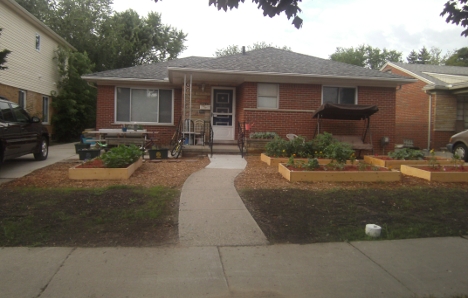
Evidently, Ms. Bass is being actively prosecuted for the crime of growing a vegetable patch in her front yard.  Not pot, mind you.  Not opium.  Not noxious weeds.  Her house isn’t sporting a dead lawn that she can’t afford to water.  She hasn’t piled up a rusting heap of garbage and she’s not parking her car in some rutted, dried mud just over the curb.  The woman is growing food, in attractive raised beds no less, but officials are digging in because veggies don’t conform to the city ordinance.  From The Huffington Post article;

“According to a local ABC affiliate, city code states that “all unpaved portions of the site shall be planted with grass or ground cover or shrubbery or other suitable live plant material.”

Now clearly, there’s a lot of wiggle room here.  “Suitable live plant material” is about as ambiguous as it gets but officials have nevertheless decided to take a hard line.  They want Ms. Bass’s yard to look like how other yards “commonly” (read traditionally) look.  They want grass, they want shrubs, and they want flowers.  Not this:

Julie Bass has taken her battle online, and now news outlets are picking up the story.  I’ve nosed around a little and am pretty sure that, with the widespread outrage brewing over the incident, the city of Oak Park has a PR nightmare on its hands.

Shall we count all the ways that pressing charges in this case is stupid, if not outright offensive?

1)  With food costs soaring, home vegetable gardens are now very common.

2)  With a growing concern about food safety, home vegetable gardens are now very common.

3)  With the growing obesity epidemic, growing a home vegetable garden is being encouraged at the highest levels of government.

4)  The White House has a vegetable patch in the middle of it’s lawn for godsakes.

5)  At a time when cities, counties, states, and federal governments are shutting down essential services and affected citizens are experiencing genuine suffering, wasting taxpayer money on a frivolous prosecution like this is repugnant.

6)  This prosecution diverts desperately needed resources away from real criminal activity.

7)  It limits the amount of land a family hit by the recession can utilize for growing food.

8)  With food stamp use at it’s highest rate in history, (think escalating budget deficit) being willing to prosecute someone for growing their own food actually creates a skewed incentive favoring food stamps over food production.

9)  Fill in the blank with your own favorite: ___________________________________

Oak Park officials?  Please.  Cultivate a little openess here.  Home gardens as a national activity have returned, and you need to incorporate that reality into your system of governance.  I suspect the city code you’re working off of was originally intended to protect the property values of your homeowners and that’s certainly a worthy goal.  Nobody wants to drive around their city and have it look like shit.  But if you think outside the box, I’m sure you can find a way to adapt your ordinance that would ensure any home garden sited in a front yard still meets required aesthetic standards.  That would preserve the original purpose of the code while allowing for the changing needs of a community struggling through difficult and changing times.

In the meantime, if anyone is interested in helping Ms. Bass out with her mounting legal fees, you can make a donation here: https://bitly.com/pPsDbe

copyright Dia Osborn 2011

Crisis in Paris: How Modern Telecommunication Technologies Saved The Day

Remember this?  Anyone?  Anyone?

(image by Stromcarlson)

Our daughter is in Europe as part of her post-college graduation celebration.  Should be wonderful, no?  Well, we all thought so during the six months of planning involved, but unfortunately the trip hit the rocks on the three-stage plane ride to Spain.

Beautiful Child of our Hearts planned all along to travel with a good friend who has a mild anxiety disorder.  This didn’t seem to pose a problem because, up until boarding the plane, Friend had always managed it successfully with meds.  However, all that changed with the prospect of hurtling approximately 12,000 miles through the sky in a giant toothpaste tube.  In spite of everything her pharmaceutical interventions had to offer, Friend still collapsed and wound up crying for the almost seventeen hours it took to get to Madrid.  Things were somewhat better on land, but by the time the two of them limped into Paris, Friend was experiencing a full-blown meltdown.  It was at this point we received the phone call alerting us to the fact that we now had a mental health/medical crisis on our hands.

Enter:  The godsend of modern telecommunication technologies.

I don’t remember now the exact sequence involved, but at the crescendo of the next three hours of crisis management we had myself in Boise, my sister in Seville, my wife-in-law in southern California, my nephew in southern France, Friend’s (frantic) father somewhere else here in Idaho, an airline phone representative who was God only knows where in the world, and of course our two, inexperienced travelers in a tiny, internet cafe/closet in Paris, all tied together by an intricate web of technology, working on the common goal of getting this fragile, at-risk, woman-child safely home.

Even in the midst of the major stress involved I was struck by how amazing it was; the bewildering complexity of communication taking place.  This was so not the world I grew up in.

We utilized telecommunications capabilities provided by Skype, Sprint, AT&T, Verizon, Telefónica, France Telecom, a couple of land-line phone providers, and whoever the telecommunications company is in Estonia.  There was a staggering array of computer and hand-held device makers involved as we all furiously worked online; talking to the girls, researching various train schedules and flight options, and firing notes and links off to one another through email and instant messaging capabilities.

Now, I’ve seen all the commercials.  I know that what we were doing barely scratched the surface of the mind-boggling communication possibilities available in today’s world.  But it was still amazing and miraculous and wonder-filled to me.  Twenty-seven years ago when I made my first trip to Europe, the only way to communicate en-route was with collect calls on an ancient system of randomly placed pay phones. Today’s situation would have been far more difficult (and terrifying) to negotiate back then.

My father-in-law regularly bemoans the way technology is taking over the world.  He feels that it’s gobbling up increasingly large chunks of our lives, smothering so many of the old pleasures that used to nourish our hearts and minds.  He thinks people should spend less time in front of a screen and instead get out in nature more, talk to each other more, read and attend lectures and go dancing more.  And he’s not wrong.  One of the modern disciplines we all need to develop is getting up out of the chair and walking away of our own volition.

That said, my daughter and her friend would have been in a lot more trouble than they were without all the advantages that have also come to us through technological developments.  There’s an old proverb that says something like Everything is both a blessing and a curse.  I think it’s always our job to reap the blessings while keeping an eagle eye out for the curses.

Long story short, together we found a way to get Friend onto a plane, out of Paris and…a mere twenty hours or so later…safely back home again.  Beautiful Child stayed behind in Paris, a little scared but stubbornly determined to see the city of her dreams anyway.  But finally, a bad case of bed bugs drove her out of the hostel in France and down to her aunt’s house in Seville for help with the infestation.  (A whole ‘nother episode of fiasco that deserves it’s own post.)  C’est la vie, no?

copyright Dia Osborn 2011

Their Body: It’s Not Them Anymore But It Still Deserves Our Thanks

(This is the conclusion of the previous post, It’s OK To Still Love Their Bodies Once They’re Gone.)

The hubster and I returned to Mr. B’s house the following day and, not having been around a dead body this far after the fact before, I wondered if it would smell.  The answer, happily, was no, even though the house was quite warm.  I’m not sure what the usual rate of decomposition is, but in Mr. B’s case, twenty-four hours hadn’t been long enough to pose a problem. In addition, not only had Mrs. B and I carefully bathed his body shortly before I left the day before, she and Cousin A had bathed it again in the evening.  I admit that even though I was prepared to accept whatever state his body was currently passing through, finding it clean, cared for, and odor-free was definitely better.

After greeting the family and catching up on events of the night, I finally walked over to the bed to see him. The difference a day makes is profound.  Mr. B no longer looked even remotely lifelike–on the contrary, he looked unearthly.  His skin was white and flawless, like fine porcelain.  As though an artist had slipped in during the night and shaped an exquisite replica of Mr. B’s face down to the tiniest, loving detail, kissed it, and then left it there against the pillow before slipping away again.

He was resting beneath a lovely, homemade quilt a friend had given him during the fruitless months in rehab and, being the tactile person I am, reached down and laid my hand on his chest.  I knew, of course, he would have hardened by now.  I was expecting that.  It was the cold that surprised me.  Strangely, he felt even colder than the room, but that may have just been a mistake of expectation.  He might have seemed colder because some deep, unquestioned instinct in me–the one that has to believe my loved ones will always, always be warm–was inexperienced.

I stood there for a minute, waiting for another wave of some emotion to hit me…loss, repugnance, regret, relief…but there was nothing really.  Just peace.  He was still and I was still.  The storm and wild ride had come to an end and now all I felt was finished.  It was as though Mr. B had retired the day before with great fanfare, gratitude, and good wishes, and now I’d returned to work in the morning to stand gazing for a minute at his empty cubicle.

Although, no.  Not a cubicle.  His body wasn’t like that at all.  A cubicle is just some sterile, temporary workspace that we work in for eight hours before we get to go home at night.  His body was so, so much more than that.  It was everything that had been solid and warm and real, the part of him we got to touch and dance with and talk to.  His body was the strong and loving arms that reached out and held us when we were small or lonely or afraid.  The voice that whispered to us, and laughed out loud, and trembled sometimes with the strength of emotions he could barely contain.  It was the seeds that brought children, and their children, and their children into this world.  And it was the lips that shaped a lifetime of slow, thoughtful words and then kissed us, warm and reassuring, against our cheeks or foreheads or lips.

No.  Mr. B’s body was nothing like a cubicle.  It wasn’t him either, but it was still something amazing and beautiful and longed for…something we were so grateful to know and touch while we had the chance, and that we’ll ache for now that it’s gone.  I think when someone dies like this, it’s actually a double loss; we lose THEM…that vibrant, animated, unique pulse of Life that was their miracle and gift to this world…as well as the intimacy, comfort, and warmth of their physical self.

It’s so much, this loss..so huge.

And yet, easier to bear somehow because this time at least, our good-byes were lingering.  Because he stayed with us for just that little while longer…giving him the time he needed to unwind from his body and us the time we needed to unwind from him.

copyright 2011 Dia Osborn