PARAPROSDOKIANS

I’m a language geek, which is why these kinds of word plays appeal to me so.  My brother forwarded the following to me in an email (my siblings are all language geeks, too) and I loved it so much I thought I’d post it here.

From the email: 

What in the world is a paraprosdokian? you ask.  Well.  It’s “a figure of speech in which the latter part of a sentence or phrase is surprising or unexpected; frequently used in a humorous situation.” 

For instance, “Where there’s a will, I want to be in it,” is a paraprosdokian.

OK, so now enjoy these:

1. Do not argue with an idiot. He will drag you down to his level and beat you with experience.

2. Light travels faster than sound, which is why some people appear bright until you hear them speak.

3. War does not determine who is right – only who is left.

4. Knowledge is knowing a tomato is a fruit. Wisdom is not putting it in a fruit salad.

5. You do not need a parachute to skydive. You only need a parachute to skydive twice.

6. There’s a fine line between cuddling and holding someone down so they can’t get away.

7. Hospitality is making your guests feel at home even when you wish they were.

8. When tempted to fight fire with fire, remember most people use water.

And then, because eight is simply not enough, I found some additional paraprosdokians in a Wikipedia article.  Here are some of those:

  • “If I am reading this graph correctly — I’d be very surprised.” —Stephen Colbert
  • “If all the girls who attended the Yale prom were laid end to end, I wouldn’t be a bit surprised.” —Dorothy Parker
  • “I’ve had a perfectly wonderful evening, but this wasn’t it.” —Groucho Marx
  • “I like going to the park and watching the children run around because they don’t know I’m using blanks.” —Emo Philips
  • “If I could just say a few words…I’d be a better public speaker.” —Homer Simpson
  • “I haven’t slept for ten days, because that would be too long.” —Mitch Hedberg

And here are two more I just found here:

  • “I don’t mean to sound bitter, cold, or cruel, but I am, so that’s how it comes out.” — Bill Hicks
  • “It’s too bad that whole families have to be torn apart by something as simple as wild dogs.” — Jack Handey

Enough!!  I dare you to Google paraprosdokians yourself…I just dare you.

copyright Dia Osborn 2011

A Blip From The Book and A Love Story That Feeds The Earth

I’m participating in a tele-writing workshop which runs through the middle of January so I’m transferring most of my writing attention over to the book for the next six weeks.  (A badly needed redirection I might add.  As most of you probably know, blogging can get a little addictive.)

What I thought I’d do to keep up here is post bits and pieces of whatever I’m currently working on for the book as well as (of course) any other odd and unrelated beauties I stumble over during one of my inevitable distracted periods.  Today, I have one of each:

Here’s a passage from the book that talks about what I went through after the first time I told someone they were dying:

“But even though that’s what I would have preferred, there was no time left for it.  To question slowly requires time, but what if Elsa wanted to know before it was too late?  What if she wanted me to tell her?  What if she said that to me because she saw me as a person who would be straight with her and deliver the news, bad as it was?  Someone who would help her understand what was happening and alleviate her growing confusion?  Help her back to the core and strength of who she was; a woman who preferred the truth.  Who preferred straight dealing.  Who didn’t want anyone to protect or pity her.  A woman who needed someone to respect her strength and treat her like a competent human being rather than an invalid.

There were other times, other days, when I offered slow questions.  Like the day I asked her if she knew that I worked for hospice, or the day I asked if she believed in an afterlife.  Those questions were my bait, asked with the hope of luring her into a conversation about what was happening to her, but on those days she clearly didn’t want to know.  She shrugged them off and changed the subject, letting me know she wasn’t willing to discuss it. 

And I respected that.  I wasn’t attached to her believing that she was dying.  I had no problem with her passing away in the midst of denial if that’s what she preferred.  I was a little uncomfortable when she talked about all the things she’d do when she got better, uncomfortable pretending…but not much.  If that’s what she felt like she needed then I was O.K. with it. 

After all, it was about her.  Not me.

But then that moment came and it blindsided me, when she finally wondered.  When she looked at her belly and stroked her long-fingered hands softly along the sides and said in that small, bewildered voice, “I don’t know why I’m not getting better this time.”  And for one brief, fraught moment she was clearly lost.  Vulnerable.  As if she’d thought she was traveling through familiar terrain and suddenly looked up to find herself in strange surroundings.  Pausing. Suddenly uncertain.  Puzzling softly.

“It’s never lasted this long before.”

It was a fork in the road.  A split second when she could have gone either way, back into denial or forward into truth.  For a heartbeat, a blink, a breath she was open.  Lined up.  In range.  Positioned to receive a message should one happen to come and in that brief moment the responsibility for making a choice of whether to send that message or not fell on my shoulders.

Fuck.

In the moment it seemed so simple…because I would have wanted the truth if it was me, because she had just told me how she preferred straight dealing, because that was how we had been with each other all along…I chose to tell her that it looked like it was her time to go.  That she was dying.  And because it was my choice, my responsibility, and my burden, I was required to look into her eyes and see what it means to strike a mortal blow.  To snuff out hope.  To feel her hand suddenly slip from mine and watch her fall silently away into a dark abyss, her eyes stricken, locked on mine as she grew smaller and smaller.

Is that my penance here?  Is that the asking price for dabbling around the brink of infinity?  Is it a stern reminder that I need to tread more carefully?  That grace is love, yes, but also incomprehensibly vast and unknown and terrifying?  Somewhere in the back of Elsa’s eyes I saw something looking back out at me and warning:  Be careful, Dia.  Always be careful with one another.

Was I wrong to say anything?  Should I have withheld the information and kept my mouth shut?  I don’t know.  I don’t know.

I don’t know.”

Breathe…don’t forget to breathe.

And then here is an oddly beautiful thing I found and just had to share.  It’s a video by Louis Schwartzberg called Wings of Life that “is inspired by the vanishing of one of nature’s primary pollinators, the honeybee.”  It’s absolutely breathtaking…slow motion cinematography of brief and tiny lives…and I highly recommend watching it if you’re feeling any heaviness after reading the above blip.  It’s really just all part of the same Life, y’know?

copyright Dia Osborn 2011

The Gratefulness Exercise

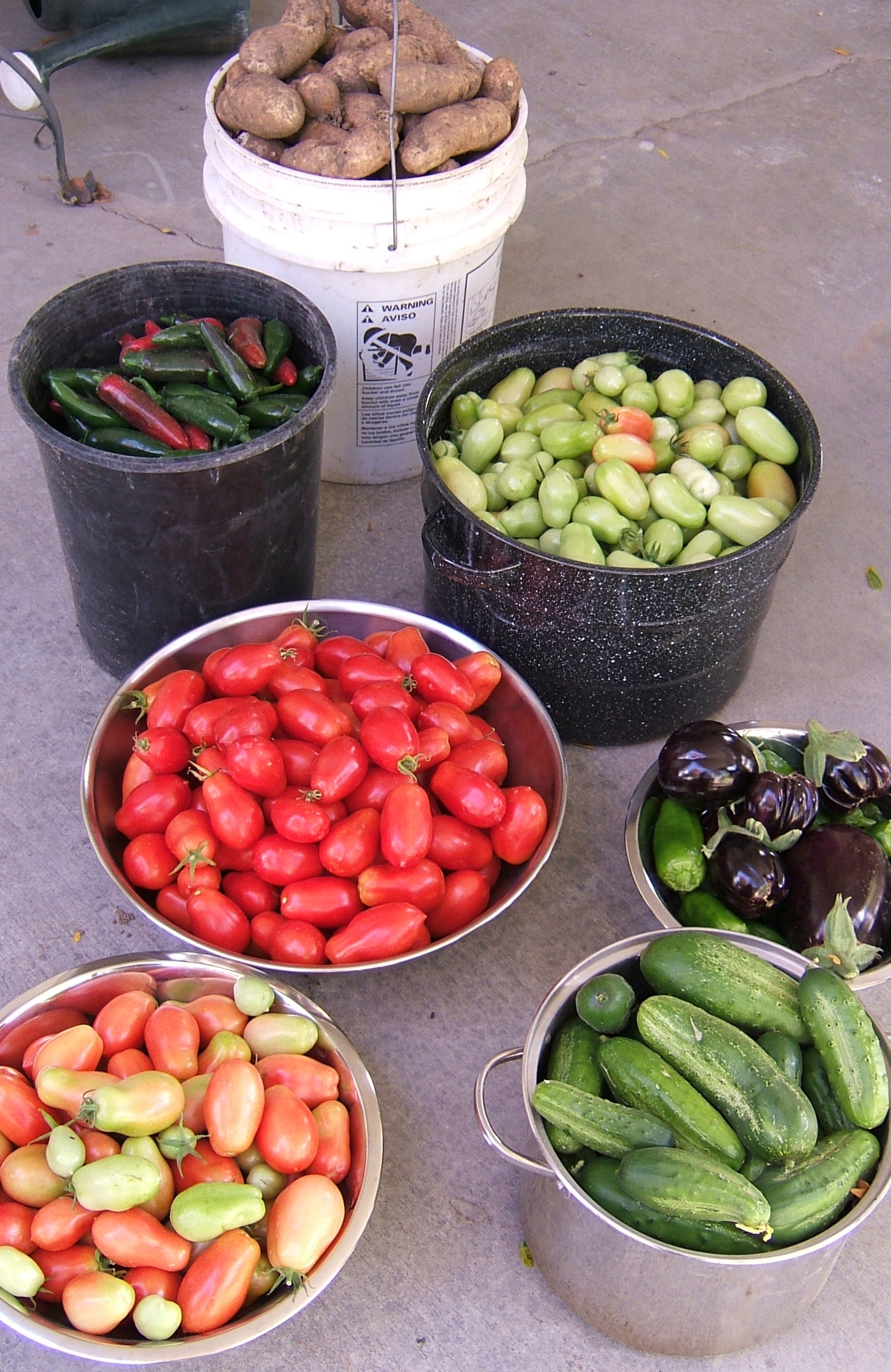
Part of this year’s harvest.

Thanksgiving is on Thursday so naturally I’ve started thinking about what I’m most grateful for this year.  (Or any year for that matter.)  I thought I’d try for at least the top ten here:

1)  Thank you for my life.  (This is always number one because the fact that I’m still alive after 53 years is nothing short of amazing to me.  For however long it lasts, thank you thank you thank you.)

2)  Thank you for starlight, waters, storms, mountain vistas, seasons, and the hikes I’ve taken through all of them. 

3)  Thank you for things I can’t control.  I hate them but I know they’re good for me.

4)  Thank you for yogurt.

5)  Thank you for the hubster, beloved son, and beloved daughter, as well as giving them the patience to love me back when I’ve made it hard.

6)  Thank you for Dane’s epilepsy cure and helping him to still be able to walk after all.  I was so scared for him.

7)  Thank you for this blog and the chance to have a voice.

8)  Thank you for all the help and support from people over the last year.  In fact, thanks for all people everywhere.  Doing this whole life-thing alone would have really sucked.

9)  Thank you for the depression easing up so much.  I can’t tell you how good it feels to be hopeful again.

10) And lastly, thank you for both light and darkness.  Having both helps keep everything in perspective, y’know?

Here’s wishing everyone a meaningful Thanksgiving full of love and healing.

More of the harvest. Yum!

copyright Dia Osborn 2011

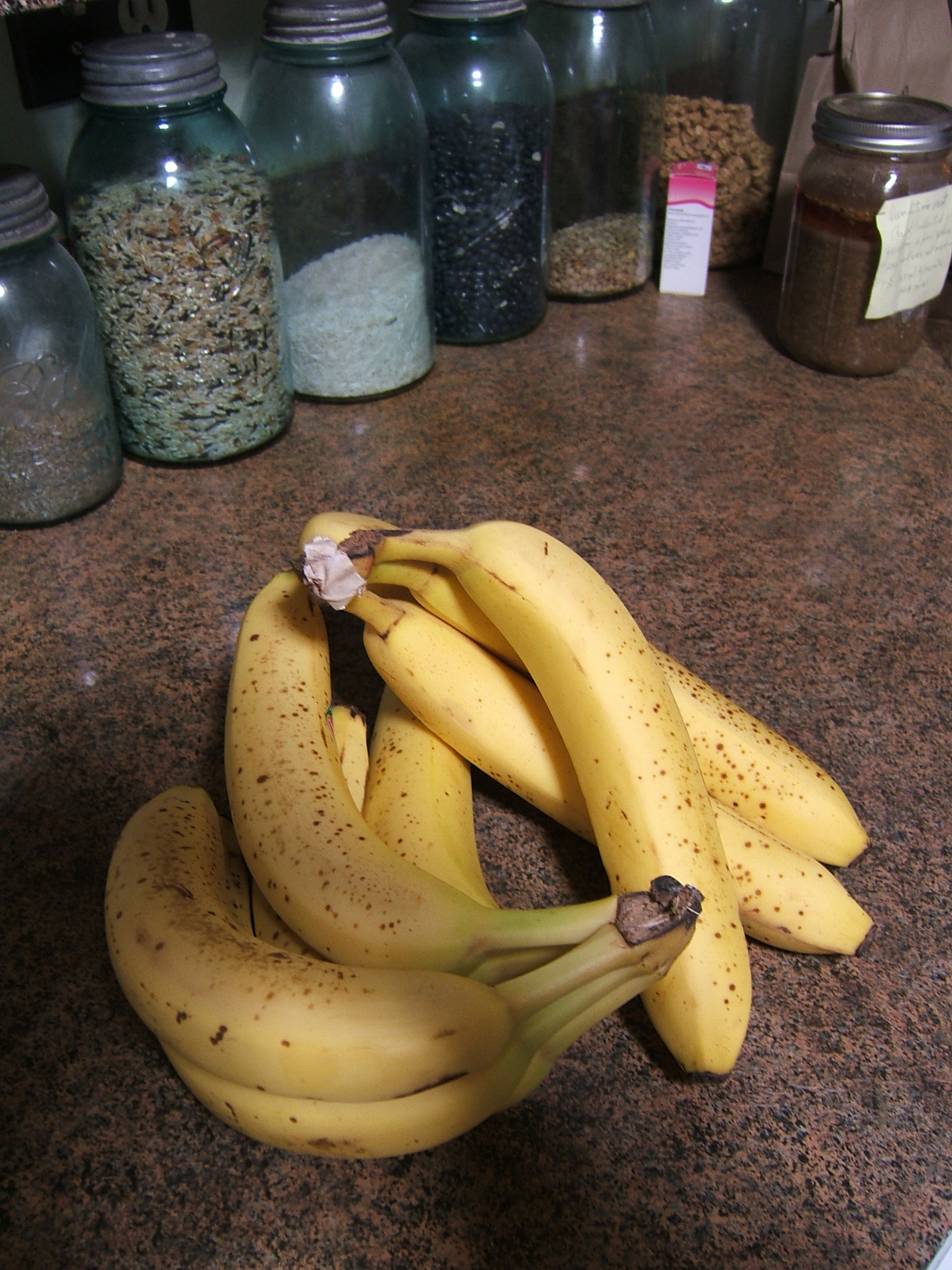
“Nobody ever got fat eating bananas…”

At least that’s what our Weight Watchers leader told us at our orientation meeting two and a half weeks ago.  On this program fruit is “free,” which means we get to eat as much of it as we want.

I’m in heaven.

P.S.  That’s not really me in the photo.

(Image from Fat Banana)

Season of Soup

Some parents’ newly-adult children continue to come home for monetary handouts or a place to do laundry.  My daughter returned to graze from the big pot of soup I always had simmering on the stove.  Soup is my staple.  My life.  It’s the natural expression of my inner low maintenance and generally uninspired chef.  If I lived alone and never had visitors the only utensils I’d own would be a couple of spoons and a large, glass bowl.

Although I admit, in the last couple of years since we stopped using air conditioning and turned to the whole house fan at night for our summer cooling, I’ve reluctantly turned towards cooler foods like salad with miscellaneous grilled things on top.  It’s an oh-so elegant alternative to soup since it can  also be served in a bowl.  But when the sun finally, finally! starts it’s slanting descent–when I sense the first hint of autumn chill on the wind–I breathe a happy sigh, get down on my knees, and drag the cauldron out from the back of the cupboard again.  The season of soup is returning.

This shift from summer to fall cooking is like my version of migration; a genetic impulse surfacing from a lost and lazy ancestor in the past, a distant grandmother who cared as little as I do if the different food groups touch each other beforehand.  Clearly, she was not from a Mediterranean climate with its joyful people who eat for love and beauty.  No, she came from someplace cold and dark, with long winters and fur shoes.  A far northern locale with scarce and unimaginative food like root vegetables and frozen meat.

She would have had the northern lights in lieu of cuisine, though, and she would have loved them.   I got that from her, too.  I’d trade a rich sauce for the Aurora Borealis any day of the week.  Here’s a Youtube video that explains why.  (For the genitalia-averse, please beware the explicit educational ad for condoms tucked in amongst the tile display of ads afterwards.  But for anyone still mystified as to proper application, this ad is probably for you.)

Today it’s in the 30’s outside and I have a cozy fire burning in the woodstove and eight or nine overripe bananas sitting on the countertop.

Traditionally I would’ve used them for banana bread but the hubster and I have recently started a diet and sweet breads, while allowed, are challenging from a portion-control perspective.  (Forgive me, but half a slice?  Really?  Whoever thought that up must have been tongueless.)  So instead I’m considering an exploratory foray into some kind of a sweet soup.  Perhaps mixed with chicken broth, caramelized (which I used to call burned-because-I-was-distracted) onions, butternut squash, cream (damn…I mean nonfat milk) and lime pieces?  Or should I go with a spicy red curry stew, with onions, pumpkin, peas, and coconut milk (damn…I mean lite coconut milk mixed half and half with nonfat milk)?  It all sounds so exotic, so gourmet, I know…until one realizes I’m driven solely by a depression-era hoarding instinct (also inherited from cold and hungry forbears) that disallows the waste of a crumb.  I could no more throw away a banana than I could eat my own child.

But oh how good it feels to be cold again.

copyright Dia Osborn 2011

(Ha ha!  Written in under two hours!!  Progress is made.)

Do’s and Don’ts Around People Who Are Wounded And Reeling

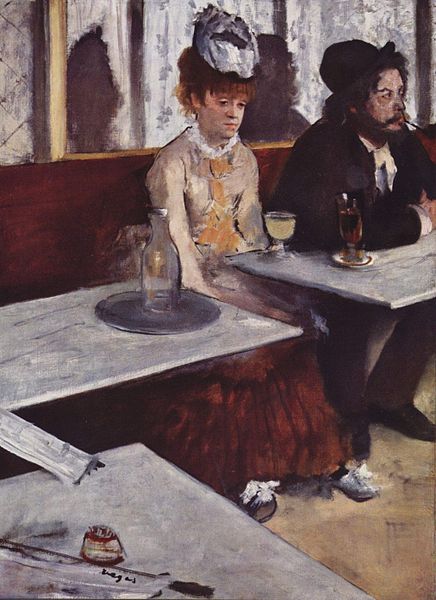
L’Absinthe by Edgar Degas

I was thumbing through the journal I kept during the hospice years and came across this entry:  [Identifiers have been changed BTW.]

“Gertie was visibly shaken yesterday.  Her mom’s youngest brother, aged 94, died this past weekend and, as she stared down at the coffee table she told me, “I’m afraid she’ll go now, too.  She’s the last one you know.”   Grammy’s appetite has been off and Gertie doesn’t think she’s eating enough to survive.

She’s not.

All the other times when Grammy was going through one of her diminished-appetite spells, Gertie would worry and I would try to gently explain that loss of appetite is natural toward the end.  But she always acknowledged and dismissed the fact simultaneously.

The truth is she’s just not ready to lose her mom and I’m now beginning to suspect she never will be.  Watching her yesterday—the way she stared off into nothingness as she spoke, eyes turned inward, searching and frightened—I wondered how long she’ll survive herself, once her mother is gone.  I even wondered if she’d go first. [Gertie was 83 at the time.]  For such a strong, stubborn, tenacious woman she is remarkably fragile underneath it all.

And quite ill herself.

So yesterday I said nothing.  Didn’t ask her, “Are you ready for this?” Or say, “You know Gertie, she may be getting ready to go now.”  Of course she knows.  Shock is already starting to creep in, an early mist rising to help shield her from the unbearable loss lying just ahead.  Instead I just sat there, as still as I could.  Quiet.  Listening.  Trying to catch and contain as many of her scattering pieces as I could.

I didn’t want to move or breathe or do anything to disturb the tendrils of mist gathering around her.   She is so achingly delicate.”

As I read it all came back to me in a rush; how grieving people (and those who are catastrophically ill or dying) are sacred.  The wounding and shock caused by any kind of profound loss makes a person vulnerable; and a society’s traditional job is to close ranks around them, shielding them until they have a chance to stop reeling and reorient.  To get through the worst of it and find their footing again.

In older times this understanding of the sacredness of those in deep grief was fairly common, but I think we may have grown a little fuzzy about it since then.

Although…I do think most people still feel this sacredness instinctively.  I often see it in the awkward pause that happens after someone confides they’ve lost a loved one, or that they have a catastrophic illness.  The person receiving the news is usually aware that something huge just fell out of the sky right in front of them, but they frequently appear confused as to what they’re supposed to do about it.

So even though I frequently fail to follow these myself (they’re appropriate…not easy) here are a few of the Do’s and Don’ts about how to interact with a person who, through no fault of their own, has become temporarily sacred:

The DO’s:

1)  Do no harm.  The disorientation of the deeply wounded is the emotional equivalent of a compromised immune system.  Even if they try joking about it or brushing it off as embarrassing, remember that their shields have taken a hit and are not functioning properly.  Be gentler, be kinder, be slower, be quieter.

2)  Do acknowledge their wounding.  Go ahead and be silent for a moment, then look at them (really look at them…don’t shuffle your feet and look at anything else but) and say I’m sorry.  Then be quiet again. That’s it. This is the traditional ceremonial acknowledgement of wounding in our culture and, when genuine, it’s enough.  Even if it’s been years since their loss took place, it’s still okay to say this.  You’d be amazed how long some wounds can last.

3)  Do follow their lead.  If they feel like talking about it and you have time, then listen.  (Listening is actually one of the greatest gifts you can give.  People usually need to tell the story of what happened, or is happening, multiple times in order to coax events out of the weird, limbo world of shock and back into practical reality where they can harness and deal with it.)

On the other hand, if they don’t want to talk about it, then it’s okay to let it go.  They don’t have to.

And if, as is often the case, they don’t know what to say and stumble around awkwardly searching for words, then just be quiet and patient while they figure it out.  Let them know you’re fine with awkward. Wounded people are bewildered and need extra time. Giving it to them willingly is like encircling them with a protective charm.

Which leads us to the final Do:

4)  Do be willing to be silent.  Sometimes words just aren’t big enough and, in that case, compassionate silence says everything necessary.

Then there are The DON’Ts:

1)  Don’t give advice unless specifically asked.   Everyone has to find their own way through this one.

2)  Don’t abandon or ignore them.  Even if you feel awkward or uncertain yourself, being willing to stay anyway is worth it’s weight in gold. Wounded people already feel a little disembodied and unconnected.  Ignoring them could make this experience chronic or permanent.

3)  But Don’t rub their noses in it either.  Everyone grapples with grief and loss differently and if they prefer to deal with their emotions privately, then respect their ability to know what they need most.

4)  And finally, Don’t try to save them from their task.  You can’t…and it’s not necessary anyway.  Wounded people are vulnerable, not incompetent.  Believe in them. The journey of illness and loss is hard but it can be strangely deepening, too, and those who navigate it with courage and grace enrich us all.  It’s more than worth our while to give them whatever help they need.

copyright Dia Osborn 2011

Hmmm…An Agnostic Reports A Light While Dying

I recently heard a fascinating dying story.

A woman told me how her elderly mother…either a scientist or an engineer (I can’t remember now, sorry) who was hours from death, drifting in and out of consciousness and totally non-lucid even when she was conscious…began to report on what she was experiencing internally, in a disembodied kind of voice.

It seems the discipline of a lifetime dies hard.

What struck us both was that the last thing she communicated was an experience of light.  She said There’s a light.  Twice.  Which seemed surprising because her mother was a firm agnostic.

The conversation paused briefly as we mused over this.  I mentioned that I’ve heard a lot about this experience of light (of course, who hasn’t?) but the scientist hanging around in my own head, while curious, has remained unconvinced  without further evidence.  The fact that her mother was a scientist and agnostic definitely carried some weight.

To which the daughter, who seemed to share her mother’s rational sensibilities, responded that it didn’t necessarily mean anything more than that her mother was having a visual experience of light.  There’s no way to know for sure what was causing it, and certainly no way to know if it was a sign of anything else.  And I got that.  There really isn’t.

But still…it comforted me.  I mean, seriously, out of all the possible experiences I can think of having to go through during my own transition, heading for light is definitely up there in the top three.  It sure beats seeing something like monsters coming to get me, or heading for a giant buzz saw, or disappearing into a gaping, empty, black void.

Light is good.  I’m all in for light.

And…if any such light turns out to be the precursor to something more cool?  Well, even the non-committal scientist in my head grins at the thought and says, IF that’s the case, then she’s totally on board, too.

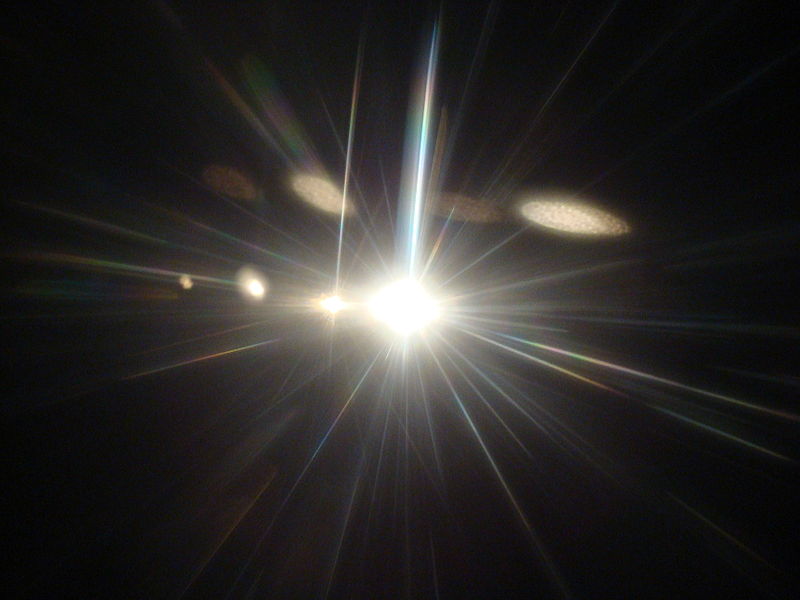
Photo by Zouavman Le Zouave at Wikpedia

copyright Dia Osborn 2011

That “thing” in the header

Someone has finally asked about it.  I was beginning to wonder.  It’s been up for the last…what?…nineteen months now, and just when I was concluding from the uninterrupted silence that nobody else found it as arresting as I do, Nel over at Life’s Infinite Possibilities (with stunning headers of her own btw) said…

What’s that “thing” (for lack of a better word) on your header?

Here she is in full.

I believe she was an arthropod of some kind but I can’t be more specific than that.  I found her exposed just as pictured, over on the coastline of the Olympic Peninsula three or four years ago. A seagull–or perhaps one of the many eagles that inhabit the place, I don’t know–had taken a couple bites out of her before being interrupted, maybe by the hubster and I as we meandered up the shore.

By the time I reached her side, she was still alive but mortally wounded. I found her extraordinarily beautiful…the colors so vibrant on an overcast, dreary March day that they took my breath away.  She was a tiny, dying spot of brilliance in a wild landscape of muted grays.

She also vaguely reminded me of female genitalia.  Like orchids do, only with an arthropod’s twist.  It both tickled my sense of humor and made me ache for her vulnerability all the more.

After I took the photograph I cupped her oh-so-gently in my hands, walked down to the water, and placed her right-side up again in the sea. She curled a little when she felt the stones beneath her…the cradling of the water…and I like to think she was happier there. Safer. Like the difference between dying peacefully at home, surrounded by the familiar and loved, versus upside down and alone in a car crash on the side of an anonymous interstate.

Here she is right-side up and back in the sea.

A little farther down the beach we also found a dead seal that was only beginning to decompose.

I originally planned to use this photo in the header but it never felt right.  Looking back now I think it’s because my primary focus here is on dying rather than death.  Both are profoundly beautiful to me, but with as much as I love the stars and stillness of deep night, it’s the elusive magic of twilight…that impossible alchemy that occurs as something is changing its very state of being into something else…that haunts me.  I guess that’s why I’ve always been drawn to transitional environments like coastlines and twilight hikes and storms and hospice. Because they provide portals into the strange, limbo world of transmutation where I can then observe and try to document its mechanics, firsthand.

copyright Dia Osborn 2011

TRUE OR FALSE? “Talking about dying will kill you.”

FALSE.  Talking about dying is non-toxic and perfectly safe for all ages.

I hit this wall a lot though, because deep down the majority of people believe it’s true.

In polite company, when it comes up that I’m writing a blog about…well…the “topic” (maybe if I don’t say the word, you won’t run)…I usually get a blank stare, long pause, and visible squirming, followed by an abrupt change of subject. Some people even turn around and walk away without saying a word.  (Which I admit makes this topic a valuable extraction tool in a pinch.  For anyone seeking to escape a chatty person, its eerie power of repulsion does have uses.)

In any case, there’s rarely an opportunity for a follow-through discussion.  The conversation is dead before taking its first breath and, so far, this hurdle has stumped me.  That’s why I spend so much time poking around the carcass in my mind afterwards, trying to find another angle which might induce more people to join me.

For instance this morning I was chewing on the common question; I’m not dying yet.  No one I know is dying yet.  So why should I think about it now?

This, of course, is the unstated question behind most blank stares and…I’m not gonna lie to you here…it’s a good one, possibly the most important question of all.  In spite of my flippancy, I fully understand why people don’t want to have this discussion: Talking about dying is a courageous act.  In order to do it, you have to stop running, turn around, and face the very monster that IS someday going to kill you and all your loved ones.  Let’s face it, as conversations go, it just doesn’t get much braver than that.

So when I broach the topic to someone who’s half-dressed at the next locker, or trapped next to me for three hours on a plane, or suddenly choking on their turkey over Thanksgiving dinner, I understand their reluctance.  I do.  I realize I’m asking them to start thinking right now about a real-life horror flick that at best they can delay, but will never escape.

Which brings me back to the question, Why should they?  The reasons had better be compelling.

Well they are.  And actually there’s just one:

It’s so they don’t have to spend their whole lives dragging the deadweight of this secret dread behind them.  Once a person learns how to talk comfortably and freely about dying, they can finally stop looking over their shoulder and relax a little. Living every hour, every day, year after year, with a yawning, existential, chronic fear…even if it’s kept pinned down in the subconscious most of the time…is draining and toxic.  Denial can help for a little while, sure, but ultimately it has huge downside.  Huge.  Trust me on this one.  As a long-time phobic I know.

Courage is a far better option and, while it’s harder to muster initially, it makes up for it by having no downside.  None.  In fact, courage not only eases the fear around talking about dying, it actually makes the event itself a whole lot easier to deal with when it finally arrives.

So when I grin at a 31-year old cashier and say Hey!  What do you think about this whole dying thing anyway?  It’s not because I’m the Grim Reaper’s administrative assistant trying to schedule an appointment for her.  It’s only because I’d like to ease some of her fear about the whole thing.  I’m willing to stay and hold her hand.

Facing into any fear shrinks it, and facing into this fear–as early in life as possible–can improve every day that follows in a way that most people don’t even know is possible yet.  I mean, how could they know when nobody ever talks about it?!

Sheesh.

So, what would make you more likely to stick around and have this chat?  If I said:

1)  I write a blog about dying.

2)  I write a blog about talking about dying.

3)  I write a blog that can help ease your fear about dying.  (Actually, is that even true?  You’ve read this.  Are you less afraid of dying now?  More afraid?  Unchanged?  Are you at least more willing to talk about it?  Are you even there?  Hello?  Hello?)

If anyone else has ideas about how to broach the topic of dying in a way that doesn’t repel everything within a hundred yards, I’m totally up for suggestions.  (And please don’t feel you have to be serious.)  Comments are even more welcome than usual on this one.

Thanks.

copyright Dia Osborn 2011

P.S.  The terrifically fun photo above is from Ambro’s Portfolio.

Sometimes the small picture IS the big picture.

Actually, most of the time it is.   But it’s easy to forget.

There’s nothing quite like the reality (or threat) of dying to help clear up any misunderstanding on this point.  I saw that a lot.  In almost six years of working with hospice I never once saw a person at the end of their life still wishing they could meet a celebrity.  Or win the lottery.  Or grab fifteen minutes of fame.

You know what they did long for?  (Besides wishing they didn’t have to die of course.)  To see their child or friend one last time.  To make sure their spouse or partner knew…really knew…how much they loved them.  To still be a part of the circle. To be in their own home, surrounded by their own things, and cared for by people they knew they could trust.

It hit me every time, how all the events that were happening in the big wide world…things that just a little while ago had seemed so huge, overwhelming, and important to them…telescoped down to the tiny, the few, and the essential.  It was a revolutionary insight.  I’d somehow completely missed this lesson before; that the small things ARE the big things.

Something reminded me of it again this morning.  A couple of YouTube videos have been hanging around my inbox for quite a while now.  They’re both on the long side, ten minutes or so, and…really…who has time for that shit?  I can’t get to all the real stuff that needs doing.  The only reason I didn’t delete them outright was because they were from people who might ask if I’d watched them.  And I suck at lying.

I’m pretty good at procrastination though.

But this morning the guilt set in so I watched them both.  And, lo and behold, what used to happen in hospice happened again.  I had the weirdest sensation of the world turning inside out (where big things get small and small things grow huge) and then I suddenly remembered what’s really important.  Yes, the broader world is something of a mess right now, but there are always plenty of little things going on in it that are perfect and beautiful and right.  And if I just remember that, then all the chaos in the universe can’t stop me from being grateful for my life, or for the many small but essential miracles that fill it.

So…if you ever have some extra time:

The first video is the story of the spontaneous boat lift that happened on 9/11, when a random flotilla of boats materialized out of nowhere to evacuate the hundreds of thousands of people trapped in lower Manhattan that morning.  (If you only have time for one video, make it this one.  It helps heal something that’s still, after a decade, surprisingly raw.)

The other video is a David Letterman segment about a young woman and her horse who got between a charging grizzly bear and the boy it was about to kill, and actually charged the bear.  Twice.  They saved the child’s life.  It’ll blow you away.

Editor’s note:  The original embedded video was taken private so I’m supplying a link to the interview which has been posted on Youtube instead.

copyright Dia Osborn 2011

Bone Monsters And The Evolution of Vocabulary

In the spirit of Halloween, here’s a spooky story.  And because I am who I am and can’t help myself, there are a few thoughts on dying that follow. (It’s like a tic.)

Without further ado I give you:

My Son And The Bone Monster

One night long ago, on a full moon in July, Father was away on a business trip leaving me, his pregnant wife, and our just-turned-three-year old son alone in the house to sleep.  It was a warm and peaceful summer night, not the kind where spectral things usually wake and wander, yet my sleep was restless and I woke up several times during the night to glimpse something shadowy passing down the hallway outside my bedroom door.  Each time I shook it off and went back to sleep, thinking it was just my imagination playing tricks on me.

In the morning I was jolted from slumber by the high-pitched screaming of my son, and I threw back the covers, leaped out of bed, and ran down the hall before I was even half-awake.

I entered the room to find him wide awake and sitting bolt upright, his back pressed hard against the headboard of his bed.  The bright morning sun streamed through the windows illuminating the entire room, yet he was looking into the empty corner near the foot of his bed as though he could see something.

As I approached the bedside he dragged his eyes away from the corner, looked at me and screamed, “It’s a bone monster!  A BONE MONSTER!!”  And I, of course, responded by doing what every good mother does; I tried to reassure him that nothing was there.  That the suspicious corner was actually empty, that bone monsters don’t really exist, that he’d just had a nightmare.

But he only shook his head in frustration, looked me straight in the eye, and said in a low, urgent, rational kind of voice, “No, Mommy.  Not that kind. This is a REAL bone monster!!!”  His voice rose back up to a scream by the last word and he raised his arm and pointed into the empty corner, as though the proof was right there before both our eyes.

That did it for me. The hair rose on the back of my neck and I climbed onto the bed, scooped him into my arms, and pressed my own back against the headboard.  I flashed back to the strange impressions I’d had during the night, of shadowy things passing down the hallway toward his room, and the coincidence gave me just enough pause to quit telling him he wasn’t experiencing something.  His terror was certainly real.  He’d done a remarkable job for a three-year old of communicating that he understood what a nightmare was and that what he was currently experiencing was something else.  I respected the effort and decided to bail on a rational approach and go with maternal instinct instead.  Here’s what She had to say:

Honey, he’s facing a monster here.  Imaginary or not, are you gonna let this thing fuck with your child?

Well, not when you put it like that.  No.

So I planted myself firmly on the bed, gripped my trembling son against my chest, and crooned ferocious words of protection into his ears.  It’s not gonna get you, sweetheart.  I won’t let it.  I will rip that freaking monster bone from bone…tear its head off, smash it down in the street, and run over it with the car a million times…before I’ll ever, EVER, let it get anywhere near you.  And trust me, I meant every word.

I continued along these lines until Bone Monster seemed to throw in the towel and leave.  I realized we’d won when my son suddenly relaxed, looked up, and told me he was hungry. Hallelujah.  We got up, got dressed, and traipsed out to the kitchen to make pancakes.

As far as I know, the Bone Monster has never returned.

Now, I don’t know why my son and I saw the things we did that night but, since it never happened again, not knowing doesn’t matter.

What’s more interesting to me is that my son called what he was seeing a Bone Monster.  Frankly, the term confused me at first.  (And apparently, only me.  Everyone else who hears the story immediately recognizes that he’s describing a skeleton.)  But when I realized what he’d done…that in lieu of the word skeleton which he hadn’t learned yet, he’d put two words together that he did know, bone and monster…the linguistic elegance of the feat just about knocked my socks off.

Think about it for a second.  The two words he chose had a lot of depth.  Both are multiple use, ancient words that have existed in pretty much every language since the dawn of time.  Bone is steeped in anthropological and folklore traditions as well as modern medical and scientific understanding while monster, still used to describe everything from childhood scary things to giant construction equipment to the heads of despotic political regimes, is quite simply one of the greatest words of all time.  (In fact, with the emotional relief its capable of delivering, I think monster ranks right up there with obscenities.  It can be that powerful.)

So separately they pack a punch, but putting these two words together created a description that was unbelievably sophisticated.  It conveyed not only a physical description of what he was seeing (a collection of bones-sans-flesh that were still arranged in the original shape of some kind of creature) but the intense emotional impact as well (monster–communicating supernatural animation, malice, and immediate threat.)

And it was all because he didn’t know the word skeleton yet.

But children do this all the time, you might argue.  So what?  And of course you’d be right.  Small children are wizards of language right out of the gate, which is probably why we usually take the sophisticated achievement that it is for granted.  I honestly don’t know why I woke up for a minute and saw it this time, but I did.  I goggled.  Positively gaped.

But here’s where it gets even more interesting.  The thing is; It’s not just kids who do this, falling back on old words to describe new thingsIt’s what we all do, whenever we try to communicate about rare experiences. Common names don’t exist yet for uncommon things so if we’re going to try and talk about them anyway, we always have to cobble together existing language in a new way.

And, finally, here it comes…

This is what I feel like I’m up against when trying to talk about my work with the dying.  I mean, I have to use the word dying.  I have to.  Physiologically, that’s just what’s happening.  But it’s also a misleading word, because when I say dying most people hear horror + terror + suffering + death, and then they shut down and that’s the end of the conversation.

For a lot of people dying is the Bone Monster.

But it means something different to me.  After working around it a while, caring for and learning from the people who were doing it, the word dying gained more grace and lost some darkness.  When I say it now there’s still horror in it, of course, but there’s also something strange and luminous involved that takes my breath away.  Its terror is countered by first hand observation of our inherent reservoir of courage, and its suffering is buoyed by my discovery of unsuspected strength.

And death?  It’s still there, too.  But now its death + the dawning awareness that our lives are so irrevocably entwined…our dreams, emotions, cells, and breath are so deeply woven into the physical fabric of the world itself…that on some weird, tangible level that I can see and touch and smell and hear and yet still can’t name, we’re indestructible.

I guess for me, dying is the whole package now, instead of just its worst parts.  I think of it as both Bone Monster and everything that protects us from bone monsters at the same time.  It reminds me of my son’s bedroom that morning; where there was a terrifying source of darkness in the corner, but there was also a fierce, radiant bond of love on the bed. That radiant bond exists in the rooms of the dying, too, and I saw it over and over again, a benign force that seems to emanate from everyone involved but also from the environment.  Almost as though it’s structural, like something we’re made out of.

Sorry, that’s the best I can do.  I don’t have adequate language to describe it except in the most primitive terms, which is incredibly frustrating and part of the reason why I started this blog.  I realize I keep harping on this over and over again.  I think it’s just my way of trying to work out some viable language.

Currently, we have hundreds of common ways to describe the horrible aspects of dying but almost none that describe the beauty involved.  It’s no wonder so many people are still dying bad deaths.  Maybe if we start developing some language for the good parts, too, it’ll get easier to start building good deaths for everyone?

copyright Dia Osborn 2011

Disappearing Pools And Our Deep Love Of Places

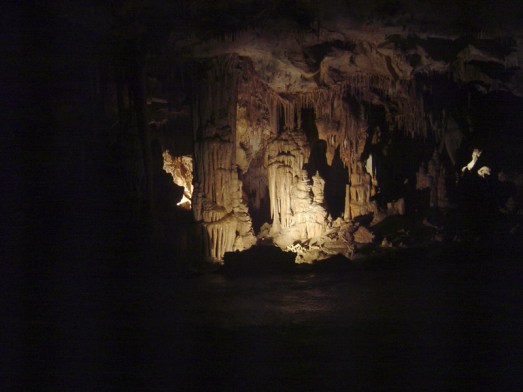
Sunken Gardens inside Lehman Caves

Editor’s note:  This post is a sad one.  Sorry.  I tried and tried but just couldn’t get it to come out any other way.  I know a lot of people who are struggling with these kinds of losses right now (I don’t know, maybe we all are to some degree, there are certainly sweeping changes afoot…) and, while fear and anger are perfectly natural responses, I personally just needed the room to feel sad.  Thought I should let you know.  Dia 

Sometimes we develop relationships with physical places that feel as intimate and necessary as anything we share with people.  It can happen with a childhood home, the family farm, a neighborhood, a church, or a sports stadium.  A stretch of coastline or a forest behind the house.  A garden, an old tree, a park, or a mountain.

Opportunities for this kind of bonding are pretty endless.

And once we sink our roots into one of these places, losing it for any reason can also be as wounding as the loss of a human relationship.  Yet these kinds of wounds are seldom recognized or acknowledged for as serious as they are.

I’m not sure why we’re so resistant to admitting that losing anything other than a first generation relative can be devastating, but we are.  I’ve seen people reel just as much or more from the death of a friend, a pet, or the loss of a home, as from that of an immediate family member.  I’ve watched them struggle just as hard to climb back out of the resulting hole and rebuild their lives afterwards.  But I’ve rarely seen them granted the necessary room to grieve.  Our reluctance to accept and dignify these other losses is both powerful and entrenched.

(But then again, we barely give each other room to grieve the loss of a close family member so I suppose this isn’t surprising.  Y’know, we really need to stop doing this to ourselves.  Communities riddled with chronic wounds aren’t healthy for anyone.)   

I bring this up because I lost a place like this a few years ago.  It was a still, dark pool hidden in a cavern deep underground, and the loss of it is still haunting me.

My mother’s people come out of Ely, Nevada in Spring Valley.  It’s one of those little towns out in the middle of nowhere that you drive through and wonder Why in the world would anyone live here?  Five generations of my family have though.  Four inhabit the cemetery.  Seven have walked the streets of the place and, even though I never lived there myself for longer than a summer, I bonded to it like it was home anyway. It was the central, unchanging hub of my early nomadic life, the one and only place my family returned to again and again, no matter how many times we moved or how many homes we abandoned.  Its high desert, mountainous lands became the geographical North Star off which the rest of my life was mapped.

Surprisingly, underneath those dry, desert lands…winding through a vast system of tunnels and caverns carved out over millions of years…is water.  A lot of it.  And when these subterranean aquifers are relatively full (as they have been for aeons), they seep up to the surface as springs, creeks, and small lakes that support an ancient and delicate ecosystem that would quickly perish without them.

This secret water also collects in countless pools underground that are, for the most part, eternally hidden from human view.  But a few of them are accessible.  When I was growing up there were a number of such pools in the Lehman Caves at the base of Mt. Wheeler which is a little over an hour’s drive from Ely.  The caves were discovered back in 1885 and when my great grandparents first moved to Ely in the early 1900’s, they used to go over and take the “tour” that was available back then.  It involved miner’s carbide lights and crawling through tight cracks (with colorful names like Fat Man’s Misery) to access the spectacular caves that are a part of the system.

Lehman Caves, Mt. Wheeler, and its surrounding lands are such a treasure in fact that they were placed under protection in 1986 and declared Great Basin National Park.

Every generation of my family since the great-grandparents has toured the caves, and it was during my own childhood visits that I became acquainted with a particular pool.  I could never see very much of it because the water stretched back into a recess outside the range of the electric light illuminating the walkway.  But what I could see of it was dark and absolutely still.

Now, some of the pools in the caves tend to ebb and flow with outside water conditions, but this pool had been there far longer.  It stirred something old and unsettled inside me as I learned about it.  How the pool was thousands of years old.  How it had always existed in total darkness and never reflected anything.  How it had never known a current because no wind ever touched it, no living thing ever swam in it, and no water ever flowed in and out to create one.  It seemed so lonely and pure to me.  So dark and foreign.  And yet, in some deep, secret place way down inside me, it was familiar, too.  Like being so sad, for so long, that finally you don’t even mind anymore, and so can be happy again at the same time.

Everything about it mesmerized me.  I wanted to slide my fingers into the water and wiggle them in that dark wetness but didn’t, because the rangers said it would harm the pool somehow and I didn’t want to hurt that still, silent, ancient thing.  It had a tangible presence that enfolded me in a sense of age and weight and peace.  It both soothed and suffocated me a little at the same time, and as a child I responded.

I fell in love with it.

Eventually, I grew up though, and there followed a gap of decades where I didn’t return.  When I did finally go back, I discovered something unexpected and devastating.  My secret, ancient pool was now half empty.  It was slowly draining away.

As the explosive growth taking place hundreds of miles to the south in Las Vegas demands more and more water to support its expansion, aquifers from farther and farther north are being tapped to supply it.  The local water tables are dropping as a result and the dark, beautiful pool I fell in love with as a child is just one small example of a much larger kind of collateral damage taking place.

The system of large, interconnected aquifers that exist throughout the Great Basin is fragile.  If more water is pumped out of it than is flowing back in, the system sustains structural damage.  Caverns can collapse without the support the water gives them, but an even greater harm comes when the layers of soil dry out and ground subsistence sets in.  The sinking, hardened, compacting earth no longer allows enough water to filter down from the surface to refill anything.  There comes a point where the aquifers can no more be recharged with water than a dead human skull can house another living brain.  As with biological life, the ancient, geological processes that created these systems only work in one direction.  In a very real sense, aquifers can die.  Indeed, this has already been the fate of the aquifers of the Las Vegas valley itself, which is why the desperate city has been thrusting its pipelines northward.

And standing there that day in the Lehman Caves, watching my dear little pool slowly drain away, I couldn’t bear to think about what was happening, much less see the evidence of it with my own eyes.  I finished the tour, climbed in the car, and then left the cave, the park, and the state behind me and stayed away for a few more years.  Eventually though, I couldn’t bear that either and I’ve gone back to the park a number of times recently, but I still haven’t been able to make myself go down to the caves.  A park ranger told me that the pool I loved is gone now and sometimes I wonder if I’ll ever go back in.  I spend my time up on top of the mountain instead, where the vast changes taking place below haven’t shown up yet.

In my years with hospice I learned how to be around human dying, how to navigate all the emotions that our final passage entails, but this is different.  Geological dying is so achingly slow.  When a person dies, no matter how important or how beloved they are, it happens and then it’s over with.  Even a long dying process finally ends and then survivors can move on with the tasks of grief and rebuilding.  Sooner or later they can climb back out of the shadowlands into sunlight.

But this? These aquifers, these ancient systems, take so much longer than that.  The disappearance of my pool was only an early symptom of a dying process that could continue for…I don’t know how long.  I don’t even know how to define when they’re alive and when they’re dead.  What does the death of a geological system look like?  They don’t have heart beats and brain waves so what am I supposed to measure instead?

I think that I’m still reeling from the loss of that pool because on some deep, genetic level I can’t make sense out of it.  I don’t have any ancestral memory for this kind of thing.  My predecessors didn’t survive global shifts of this magnitude and speed often enough to pass down the instincts I now need to navigate them.

I guess what I’m really trying to understand is this:

What am I supposed to do now?  What is the last person standing at the end of a thousands-and-thousands-of-years-long line of people supposed to do when the music suddenly stops with her?  What is my duty as witness here during the dying of a small, dark pool and the larger changes that it entails?

And as I wrote that last sentence the answer suddenly came clearer.  I guess that is what I’m supposed to do now…just bear witness and continue to love these places.  I need to do the same thing I did while working with hospice.  I never turned away from those rooms, never refused to look at those who were dying or tried to pretend like they weren’t.  I didn’t ignore or abandon them.  I was there to help and to care.  To listen and touch them as many times as they still needed to be heard and touched.  To witness their dying and affirm their lives, and to catch and contain as much of the wonder and miracle of them as I possibly could, so I could carry it forward in my own life afterwards.

I guess it’s time for me to return to the empty pool now.  I need to go back and touch its dry, limestone bed, to remember and say good-bye, thank you, and I really, really miss you.  And, for both our sakes, I also need to keep visiting, touching, and caring about the caves and mountains and high desert lands that I love so much.  Because no matter whether it happens in my lifetime or some far-off day in a different age, the dying of these places was never meant to stop my loving them.

In closing, here’s a photo of one of the larger, ebb-and-flow pools.  Beautiful, no?

Great Basin National Park Photos, Lehman Caves

copyright Dia Osborn 2011

Links about the impact of a pipeline:

Will Federal Study Save Great Basin National Park?

Sparks Tribune:  Wandering Water

The Difference Between Email Forwards and Blog Forwards

Snopes.com

In my pre-blog life I was a serial email forwarder, an affliction which had a few stages to it.  (Did anyone else go through these or was it just me?)

1)  There was that heady flush of realization as I started receiving my first forwards. Whoa! Did you see all the information and creativity just floating around out there?!  Stuff that I’d no idea existed and no access to before my first email account.  At this point I knew…I just knewI had to pass it all along.

2)  Followed by the scary warning email phase.  (Predators in mall parking lots, governments publishing cell phone numbers to marketers, flashing headlights gang initiations…oh my!!)  I passed these on because I cared dammit.  I cared!

3)  Hard on the heels of this came the righteous discovery of Snopes and other urban myth websites (for which everyone on my contacts list was deeply grateful.)

4)  After which I turned to the jokes and inspiration lists…with one caveat.  I would not, not, forward chain emails.  The “send this to ten people and something amazing (or terrible) will happen” type.  These things are totally passive aggressive and, really, I must draw the line at guilt.

5)  Then came Videos.

6)  After which I reached the Links stage, the final phase.  This was the point at which I’d grown from a forwarding sapling to a mature tree, achieving maximum speed and efficiency.  I discovered I could litter the inbox of everyone I knew with simple URLs, like seeds, that they could then open and read for themselves.  (Or not.  Usually not.)

I was completely out of hand and knew I needed intervention.  So when a professional contact suggested I start a blog, the idea fell on fertile ground.  (I guess this is also the creation story of how The Odd and Unmentionable came into being…The Odd Book of Genesis.)  And it worked.  I had a new focus and my forwarding days came to an abrupt and blessed end.

But wait.  Did they?  Have I really stopped passing along ideas, humor, creativity, and information or have I now reached the most respectable (and respectful) phase of this impulse?

As I was preparing today’s post I realized I’m still forwarding other people’s ideas and creativity in various blog posts, only now I’m 1) doing it with full acknowledgement and links back to the source, and 2) placing it into the public arena where the horse can drink at will (rather than bombarding anyone foolish enough to trust me with their email address.)

I guess that ole’ desire to share just won’t be denied.  Nor should it be of course.  I shudder to imagine a world where we were all gagged and no longer able to trade insights.  That would be hell.

So, for today’s forward, here’s a moving and provocative piece I found blog-forwarded over at Rangewriter.  (Linda covers a broad range of topics.  The common thread to all her posts is the consistently thoughtful, beautiful writing.  Wander her blog if you get a chance.)

Because her post was perfect just the way it was, I lifted the whole post…with her permission…and re-posted (i.e. forwarded) it here.  So, from Bronnie to Bill to Linda to me to you:

Bronnie Ware’s Essay (from Rangewriter)

I came across the following essay on A Dying Man’s Daily Journal. (Quick editor’s note:  Another amazing blog.  Worth checking out.)  He had reposted it from an email he recieved. It is so perfect and so central to what I believe, that I want to share it and pass the word. Thank you, Bill.

By Bronnie Ware

For many years I worked in palliative care. My patients were those who had gone home to die. Some incredibly special times were shared. I was with them for the last three to twelve weeks of their lives.

People grow a lot when they are faced with their own mortality. I learned never to underestimate someone’s capacity for growth. Some changes were phenomenal. Each experienced a variety of emotions, as expected, denial, fear, anger, remorse, more denial and eventually acceptance. Every single patient found their peace before they departed though, every one of them. When questioned about any regrets they had or anything they would do differently, common themes surfaced again and again. Here are the most common five:

1. I wish I’d had the courage to live a life true to myself, not the life others expected of me.
This was the most common regret of all. When people realize that their life is almost over and look back clearly on it, it is easy to see how many dreams have gone unfulfilled. Most people have not honored even a half of their dreams and had to die knowing that it was due to choices they had made, or not made. It is very important to try and honor at least some of your dreams along the way. From the moment that you lose your health, it is too late. Health brings a freedom very few realize, until they no longer have it.

2. I wish I didn’t work so hard.
This came from every male patient that I nursed. They missed their children’s youth and their partner’s companionship. Women also spoke of this regret. But as most were from an older generation, many of the female patients had not been breadwinners. All of the men I nursed deeply regretted spending so much of their lives on the treadmill of a work existence. By simplifying your lifestyle and making conscious choices along the way, it is possible to not need the income that you think you do. And by creating more space in your life, you become happier and more open to new opportunities, ones more suited to your new lifestyle.

3. I wish I’d had the courage to express my feelings.
Many people suppressed their feelings in order to keep peace with others. As a result, they settled for a mediocre existence and never became who they were truly capable of becoming. Many developed illnesses relating to the bitterness and resentment they carried as a result. We cannot control the reactions of others. However, although people may initially react when you change the way you are by speaking honestly, in the end it raises the relationship to a whole new and healthier level. Either that or it releases the unhealthy relationship from your life. Either way, you win.

4. I wish I had stayed in touch with my friends.
Often they would not truly realize the full benefits of old friends until their dying weeks and it was not always possible to track them down. Many had become so caught up in their own lives that they had let golden friendships slip by over the years. There were many deep regrets about not giving friendships the time and effort that they deserved. Everyone misses their friends when they are dying. It is common for anyone in a busy lifestyle to let friendships slip. But when you are faced with your approaching death, the physical details of life fall away. People do want to get their financial affairs in order if possible. But it is not money or status that holds the true importance for them. They want to get things in order more for the benefit of those they love. Usually though, they are too ill and weary to ever manage this task. It is all comes down to love and relationships in the end. That is all that remains in the final weeks, love and relationships.

5. I wish that I had let myself be happier.
This is a surprisingly common one. Many did not realize until the end that happiness is a choice. They had stayed stuck in old patterns and habits. The so-called ‘comfort’ of familiarity overflowed into their emotions, as well as their physical lives. Fear of change had them pretending to others, and to their selves, that they were content. When deep within, they longed to laugh properly and have silliness in their life again. When you are on your deathbed, what others think of you is a long way from your mind. How wonderful to be able to let go and smile again, long before you are dying. Life is a choice. It is YOUR life. Choose consciously, choose wisely, choose honestly. Choose happiness.

“We tend to forget that happiness doesn’t come as a result of getting something we don’t have, but rather of recognizing and appreciating what we do have.”
-Frederick Koenig

Thanks to everyone involved in this chain of insights, especially those who were dying.

copyright Dia Osborn 2011

How Thinking About Dying Is Helping Me Navigate Life

Rudder

This week I got a surprise dividend from all the time I’ve spent thinking about;

1) how I’d like to die, and

2) how to explain it to a loved one making choices for me.

But in order to explain the dividend I have to go back to the beginning of the year.

As I relayed in False Positives Are The Tenth Circle of Hell, starting in January the hubster and I endured four stressful months of an unnecessary prostate cancer scare.  What I didn’t mention in that post was that, during Month Three of this ordeal, I went in for my first mammogram in eight years and afterwards received a call back informing me that I needed to come in for further scans.  The radiologist had questions and wanted a second look.

I felt like I’d just been slugged.  I was already grappling with the onset of a depressive episode because of the fear and uncertainty surrounding the hubster’s prostate scare and I quickly realized there was no way I could simultaneously navigate the stress of a second scare without going down for the count.  I decided to postpone dealing with mine until I found out what was going on with the hubster’s.

Which was easier said than done.  The aggressive barrage of phone calls and letters that followed pressuring reminding me to schedule an appointment for further treatment only pressed me deeper toward the depressive episode I was fighting to stay out of.  (What’s up with that anyway?  People with real cancer don’t get that level of follow-up.)

Finally, we received the news that in spite of an elevated PSA, the hubster’s prostate was actually perfectly healthy.  The last four months were “just” a scare.  As I described in my post about the incident at the time, I didn’t feel relieved.  I felt conned.  Not by any of the people we dealt with…everyone was genuinely concerned and trying to help…but rather by a system that had gone horribly wrong for us.

Clearly, I needed to understand how it went wrong so I could navigate my own health scare differently.  I started researching.  What I discovered dismayed me.  First, I learned that the PSA test isn’t even FDA-approved for cancer screening, and the fact that it’s been widely deployed for that purpose has been the subject of controversy for over twenty years.  The jury is still out on whether the benefits of mass testing justify the resulting high rates of over-diagnosis, false positives, and over-treatment.

Then I moved on to mammograms and found some equally disturbing news.  Mammography neither prevents nor cures breast cancer and, while there does seem to be a modest benefit in decreasing mortality, the length of time screening actually extends lives has yet to be determined. Yet estimates for false positives run anywhere from a conservative 60% to a radical 90% of all callbacks, and some say over-diagnosis of breast cancers that would have regressed on their own may run as high as one in three.  Over-treatment is rife.  But the harm caused by all this is only just beginning to be studied.

Now, there are a lot of people who feel that if even one life is saved by all this over-doing, then any harm it causes is worth it.  And I really appreciate the fact that they value life that highly.  Because I do, too.

However, being one of the harmed myself now, I can’t help but feel some reluctance to continue the project.  While I’d dearly love to help save that one life, too, I can’t afford a descent into depression every time the system makes one of these frequent mistakes.

So with all this on my mind, for the last six months I’ve been considering what other course I could chart for myself; researching, sifting, weighing, and waiting for the voices battling in my head to reach some kind of consensus. On the one shoulder I’ve had all the aggressively pro-mammogram voices screaming, Go for the call back, woman! You could die! You could DIE!!  While on the other shoulder I’ve had my own voice warning, Careful Dia. You could easily slide into a depressive episode here that you can’t climb back out of.

(BTW, for those of you who asked what I meant by exercises for developing emotional endurance, this is an example.  I had to sit and hold hands with some incredibly uncomfortable, even frightening emotions while waiting for my eventual answer to put in an appearance.)

Then this week, I suddenly remembered a choice I made seven or eight years ago about dying that immediately and completely put all the voices to rest.  In her book Talking About Death Won’t Kill You (great title, no?) Virginia Morris offered a question to use when trying to talk to elderly parents about end-of-life choices.  She suggested we ask them:

If something happens and I wind up having to make medical choices for you, would you rather I erred on the side of doing too little or doing too much?

First let me say, this question is worth its wait in gold.  I kid you not.  I’ve posed it to a lot of different people over the years and the answers I received have frequently surprised me. I think this one question alone could save a boatload of suffering, if everyone only knew and asked it.

But back to what my own personal answer would be if I was asked, the instant I heard the question it was a no-brainer.  If anyone ever asked me, I’d tell them to definitely err on the side of doing too little.  Always.  I’m just not wired for the game of brinksmanship involved in trying to grab as many extra moments as possible at the risk of getting hopelessly entangled in the medical interventions that make them possible.  While that kind of extra time is worth the risk for some (particularly those with small children or other dependents who still need them) at this point in my life it certainly isn’t worth it to me.

It’ll be enough for those who love me to know that I have no qualms about giving up extra time…years if necessary…if it means being able to live a full and vibrant life, journey through a meaningful dying time, and then die a peaceful, simple death at home surrounded by people that I love.

So.  What does this understanding I’ve come to about the end of my life have to do with the current choice I’m facing in the middle of it?  Well, as you’ve probably figured out by now, it’s essentially the same question, only in a different situation.

Faced with a questionable mammogram but high rates of false positives, would I rather err on the side of doing too little or doing too much?

And as soon as I realized what the real question was, I immediately knew the answer.  I’ll choose for the least medical intervention possible, because that’s who I am.  It’s actually the same choice I’ve been making my whole life, only without realizing it.  Clearly, it’s the one I’m most comfortable with.  

It’s why I gave birth to both kids at home and navigated two decades of depression without antidepressants.  It’s why, when dealing with any illness or injury, I start with the least invasive treatment first and then work my way up from there.  It’s why I’ve spent so much time exploring less-invasive forms of medicine to supplement my use of modern medicine.  And I think it may even be part of the reason why I was so drawn to work with hospice; because it’s the way to die that usually involves the least amount of intervention.

The whole realization was kind of blinding.  I mean sure, I’d been hoping for some kind of resolution but I certainly wasn’t expecting an answer that big.  Suddenly my entire life, as well as a huge chunk of medical decisions I’m going to have to make going forward, just got a lot simpler.  And why?  Because of something I learned about myself while considering how I want to die of all things.

That’s the surprise dividend I mentioned.  Not bad, eh?

So what will I do about the current situation going forward?  Well, I’ll practice weekly home breast exams and watchful waiting until my next check-up in December.  Then I’ll discuss the whole thing with my doctor and get his input on where to go next.

And then (this is unrelated but something I’m kind of excited about)…if he’ll let me…I’d like to initiate our first conversation about how I want to eventually die a good death and see if I can get him on board with talking about the whole idea.  (I don’t think it’ll be a big leap.  Dying is totally the topic on the table as soon as you start talking cancer screening.)  I like Dr. R.  He’s a nice guy and a good doctor and if he’d be my primary till the day I died, I’d be happy.  We’ll have to see if I scare him off though.  I’ve never done this before and don’t really know what that kind of conversation is supposed to look like, but still.  There’s no time like the present to try, y’know?

copyright Dia Osborn 2011

Update:  10/10/11  Looks like I’m not the only questioning  what’s going on.  New recommendations are being mulled over for PSA tests.  See following article for details.

PSA Exams Should End in Men Without Cancer Symptoms, Panel Says: 

A draft report, released today by the Health and Human Services Department’s Preventive Services Task Force, recommends against so-called PSA tests for men who don’t have symptoms that are “highly suspicious for prostate cancer.”