I’m still here. Updates on wildfire smoke, a hospice patient in the family, and garden things.

Readers, forgive me for I have sinned.  It’s been two and a half weeks since my last blog post…which is a first.  Maybe it’s a sign that my life really has been just as busy as it feels but still, excuses are boring so I’ll just leave it at this:

Hello and I’m glad to be back.

Updates:

Mon Pere: I wrote a blog post about my father-in-law’s unique dance with aging a while back (see Elders and the Strange Gravitational Effect of Final Mystery) and since then his spiral has tightened.  He was admitted into hospice care a couple of weeks ago and, as so often happens, his symptoms have greatly improved since then.  Finally…relief.

It was interesting watching him work his way through all the many and powerful misunderstandings that still exist about hospice in the minds of most people.  He was very reluctant to take the step because, as he said, “I just don’t feel like I’m dying yet.”

And rightly so.  He’s not.  He’s still very much alive…and he will be until those final days or hours when his body begins it’s final, dramatic shut-down sequence.  Until then, he will not…I repeat NOT…be dying.  He’ll be living with a terminal illness which is not only a completely different thing from dying, it’s where hospice care really shines.

So far the hospice staff (along with family members) have managed to get his escalating pain…previously managed separately and inefficiently by three unrelated doctors in three different far-flung offices…back under control.  His medications have been consolidated, coordinated, and increased enough to actually do the job.  A nurse visits him regularly at home so he no longer has to make an appointment (then wait a week with out-of-control pain before having to drag himself down to whichever doctors’ office is involved.)

After months of debilitating pain he’s been able to finally return to his normal cheerfulness…to doing the kinds of things that he loves.  It’s a transformation we’re all profoundly grateful for.

The hospice he’s with also brought equipment and aid into the house that’s making things a lot easier for him…from getting out of bed, to going to the bathroom, to getting around the house and farther, to taking showers comfortably and safely.  He’s looked at me a couple of times in wide-eyed wonder and mentioned what a gift it is–that it’s all paid for through Medicare.

“It’s free,” he whispers, not quite believing that this help he’s needed so desperately–that’s allowed him to finally stop thinking grim and drastic thoughts and happily return to everything he still loves and longs for–is his for the asking.

I think it’s hard for all of us to believe right now, that there exists this one small part of our tortured healthcare system that’s actually delivering what we all want it to; relief and a better life.  And saving money to boot.

I just wish everyone understood that more.

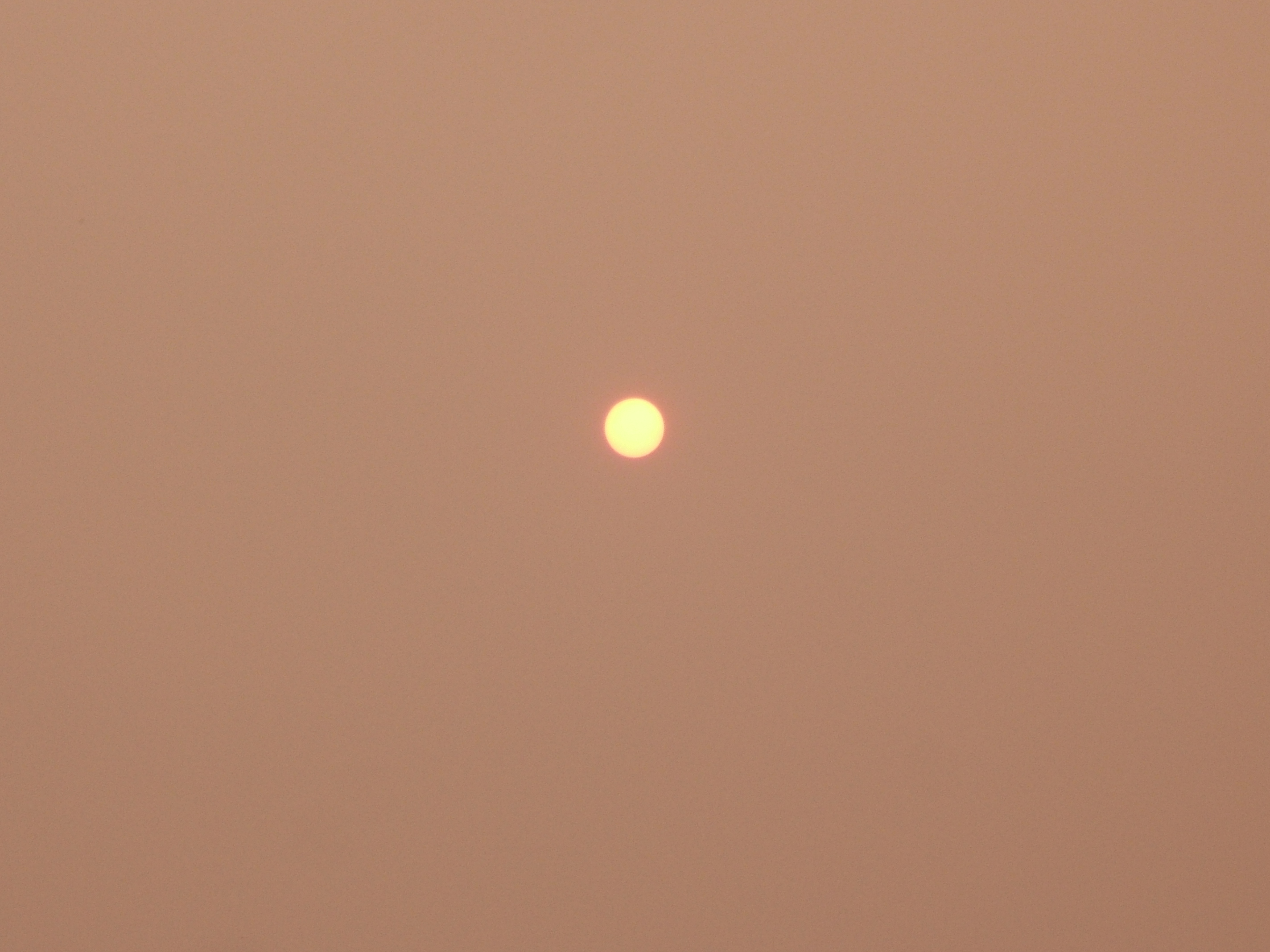
The Wildfire Smoke:  It’s awful.  It’s like hell.  Brimstone shit.  I got up the other morning, looked out the front door, and this is what the sun looked like:

Seriously.  No photo shopping.  Everyone is a smoker these days.

Air quality has been in the dangerous zone for a couple of days here but it’s far worse up in the mountains near the fires.  On an air-quality scale from green to red, the town of Salmon, Idaho’s air is rated purple…beyond red.  The mayor just had surgical masks handed out to everyone in town and yet still…the fires are likely to rage until the snows come to put them out sometime in late fall.

Prayers for early snow in the Northwest this year are currently being solicited.  You can just send them up into the air where hopefully the jet stream will blow them into a smoke plume.

And last but not least…

The Garden: Harvesting mode.  Roughly forty jars of pickles canned so far (halfway through), twenty quarts of frozen green beans, a shitload of grated zucchini both frozen and dried, pickled peaches, sun dried tomatoes, a lot of blanched and frozen turnip greens, and dehydrated elderberries coming out our ears.  (Everyone is getting elderberry brandy for the holidays this year.  Good flu fighter.)  Oh yeah.  And winter squash.  Lots of winter squash.  And tomatoes, basil, corn, potatoes, peppers, beets, and eggplants waiting in the wings.

It’s been a good year in the backyard.  Gratitude all around.

copyright Dia Osborn 2012

The differing legacies of good deaths and bad ones, and an extra bonus of grace.

Good deaths have a ripple effect that go out for a long, long way, for a long, long time and, unfortunately, so do bad deaths.

I just stumbled across a blog post titled rapture? (not what you think) on Wild Celtic Rose where she describes a personal experience with each kind of death, and she manages to convey the lasting legacy of each far more eloquently than I’ve ever been able to do.  I highly recommend a read if you get a couple free minutes sometime.  (It’s not that long and you may cry from the beauty at the end.  I sure did.)

She also brushes lightly over a couple of other interesting (and loaded) topics.

The first involves the subject of respecting another person’s right to die the way they choose (and one possible cost of not respecting said right.)

The second involves the legal right we all have to forego any treatment and die if that’s what we prefer.

And the third involves that elusive, fragile, and exquisite grace that usually surfaces when faith is respected across a divide in beliefs.  She captures the spirit of this so beautifully when she says (talking about the good death):

“Sometimes we look at other beliefs with skepticism at best.

I can say that the honest, giving, loving, non-judgmental way in which Craig and Nina lived their lives is as “Christ like” as I have ever seen.

I honestly don’t know if there is a heaven or not.

Even though we are of different faiths, I thoroughly believe that if there is one, that Craig is there and he will be joined by Nina and the rest of his family.”

A beautiful expression of how we can still love and be moved by another’s faith without necessarily sharing their beliefs.

I really, really hope you have a rapturous, awakening, living-it-like-it-was your-last kind of moment sometime this week.  We should all be that lucky.

Love,

Dia

Spontaneous Hospice Appears For A Pod of Pilot Whales

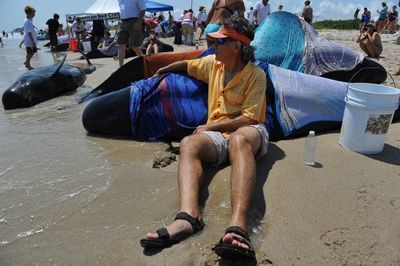
(Photo of Ed Lippisch by Eric Hasert/TCPalm.com September 2, 2012)

When working with hospice I often had people tell me, “Oh, I could never do that,” and I was never quite sure how to answer them.  Because while on the one hand I could see they were sincere, on the other I knew they were wrong.

Of course they could help care for someone who’s dying.  Bathing and toileting are not rocket science.

A more compelling reason is the fact that compassion, empathy, and the desire to alleviate each other’s suffering is an essential part of human nature.  Sure, you don’t think you can, you don’t want to, you’re scared of it, and you may even feel nauseous at the thought.  But then in the blink of an eye…boom…it’s your loved one who’s lying there so achingly vulnerable and suddenly, not only can you do it, you find doing it totally transforms you.

Never underestimate the power of your own heart.

Here’s a great example of a lot of people discovering over the course of a single day that dying is simply no barrier to loving and caring.  A pod of twenty-two pilot whales beached themselves yesterday along the south Florida coastline and, except for five babies young enough to transport and rehabilitate, the rest wound up dying there.

No one knows why they beached really, it was one of those mysterious whale things, but evidently hundreds of people showed up to help.  From the article on Foxnews.com:

“TCPalm.com reports that hundreds of residents came to the beach to assist with the rescue, helping the animals turn upright so they could breathe better. Volunteers covered the whales with moist towels and poured water over them. Red Cross volunteers helped ensure that volunteers stayed hydrated in the hot sun.

“I think that people want to help animals,” said Jacqui Thurlow-Lippisth, a Harbor Branch volunteer who worked with others to tend to juveniles in a shaded inflatable pool. “Especially whales and dolphins, because they are our counterparts in the seas. They’re mammals, they’re intelligent, they’re social. They’re a lot like us.”

Still, there was a sad undercurrent to the efforts, with rescuers aware that most of the whales were dying.”

I’m willing to bet that, if they’d been asked beforehand, most of the people on the beach that day would have also claimed that working with hospice was something they could never do.  And yet there they were anyway, tending to a pod of strangers whom they knew full well were dying and yet couldn’t bear to leave to do it alone.

Of course we can all do that kind of work.  In fact sometimes, it can be a lot harder not to.

copyright Dia Osborn 2012

Flamenco Protests and A Private Peek Into the Pain in Spain

My sister has lived in Spain since Franco was in power (for…what?  Almost forty years?) raising her Spanish children and doting on her Spanish grandchildren, and at this point is primarily Spanish with a little bit of American fringe still hanging around the edges.

Lately, she’s been keeping us all informed on what’s happening on the ground over there as the Spanish economy unravels.  Her latest email was full of interesting little tidbits and news links and I asked her if I could share some of it here, to which she graciously agreed.  I thought it might provide some insight into not only the current hardships, but the soul of Spain as well.  They’re such passionate, artistic, curious people, these Spaniards.  So cynical, proud, and joyously expressive at the same time.  No wonder they endure.

And so from Mi Hermana:

     …I suppose people will just be eating and smoking and drinking …less  That’s what’s happened here.  This happened just the other day:
     Please note how NBC deems it a “Robin Hood-style supermarket looting” whereas in mainstream Spanish press they are calling it “assaults on two supermarkets” and fail to mention that the purpose was to take the food to food banks- which are struggling more and more to cover increasing needs.
    There is no food stamp program in Spain. When laid off or when your contract ends you get 6 months unemployment and then 4 months of a bit over a 400-euro monthly payment to buy food- if you qualify.
     When deciding whether you qualify they do not take into account any family member over the age of 26 that you might be supporting- which is rampant at this point. Here in the south the unemployment rate for 18s to 34s is now 58 percent. Wowie zowie! And there are thousands upon thousands of families in which all members are long-term unemployed with no social benefits left at all.
     People are leaving in droves to northern Europe, just like during the worst period under Franco (although Brazil is a close second). So much for the starry- eyed days of “welcome to democracy” in the seventies.
    Also, what was once a health system with universal coverage went to a private-sector model some years ago, but the public was not informed. They take out a portion of your unemployment check for the health care system, and you have “universal coverage” for three months after your unemployment runs out.
     Oh they WILL mend your broken leg or sew up cuts and deliver your baby. So, people THINK they have universal coverage, but they don’t- so they don’t buy private insurance (supposing they could afford it). Then, when they get cancer or some sort of chronic disease, they get a BIG surprise – no government health coverage and they can’t buy private insurance once diagnosed with those types of illnesses.
     I do suppose that morphine to ease you through your last dying breath is freely administered- to ward off a revolution.  They’re trying to figure out what to do in cases of people with contagious diseases- like HIV, tuberculosis, et al. They’ll have no choice but to treat them or run the risk of people with coverage (including German tourists- GASP!!) getting infected- which would not be cost effective.
     Aside from the recent Robin Hood action, people are protesting in different ways: Lots of flamenco protests (banquero means banker). This is a good one, a kind of flamenco rap – no time to translate- but the lyrics are fantastic.
     Check the body language and the symbolism. In Spanish, good economic times are called “tiempos de vacas gordas” (fat cows) so of course, hard times are “vacas flacas” (scrawny cows). Note at the beginning the dancers rubbing their thumbs against their index and middle fingers- that is the symbol for money. And the man at the end lining his pockets- that’s pretty universal.
     And note the patent dilemma of the actual banker thinking “What do I do? Call the police and say we’re being assaulted by a flamenco show?”
     This one is against the rating agencies- in front of the offices of the Bank of Spain (Spain’s central bank) in Seville. Each of the girls represents the greed enabled by one of the three main agencies.  (Editor’s note: If you can only watch one…make it this one. These women are fabulous.)
     Things are definitely heating up. At some demonstrations the police have become quite violent- even attacking other policemen and firemen that were demonstrating. People have been throwing flower pots at violent police from their balconies. Oops. Not so good. But I can understand how that can come to happen- you can only watch fellow ex-consumers, I mean, citizens, being truncheoned with billysticks for so long and still remain an innocent bystander I suppose.
     Surprisingly, the main feeling I got from the atmosphere at the unemployment office was not of anger, but of extreme fragility- like a window pane being pushed against so hard that it was just about to shatter into a million pieces. 
     And broken glass cuts. It is the nature of broken glass.
     As they say in Spain, raise crows and they will peck your eyes out. There might be some eye-pecking due. Flamenco dancing doesn’t seem to be having the desired effect. France had the guillotine, but Spain, Spain will have eye peckers. They can use broken glass and wear black flamenco dresses.
     (Sorry, ran away with myself there.  Michael always has these zombie films on and I’ve become inured to gory imagery.)
     …When I saw what was happening back in 2007 I thought, hmmm, this looks like we’re heading towards feudalism. But instead of the crown, the church and the barons owning everything, it will be the banks as they repossess all the assets with which the loans are backed.
     Which they have of course done.
     So now they have a huge inventory of unsold brand new and/or unfinished homes and buildings. 
They are approving loans, but only to government workers- who can’t be fired (for now anyway!) , and large foreign financial interests, and only for their own repossessed properties. And as close to the 2007 market price as possible- especially where government workers are concerned.
     Also, almost to the last one, home mortgages in Spain are only approved as full recourse debt- so they can take away your house AND go after any other assets you may have, including future income, until the loan is fully repaid. Including compound interest. Needless to say, there is not much default on home loan mortgages in Spain. People will do ANYTHING to continue payments, including going hungry.
     I think that is why the banks have been able to show less losses on their books. Under current laws, home mortgages are an iron-clad asset. Even if you mark to market, which they don’t, they will eventually get all the original money and projected interest back. And that is why they HAVE to keep inflation down- to maintain the value of the loans.
     Commercial mortgages are another matter entirely. And that is the big problem. Huge defaults- all swept by the government into a new bank called Bankia- whose shares were aggressively sold to Spanish citizens without bothering to tell them the shares were just turds tied up with pink ribbons.  They apologized profusely to everyone last month, so everything is ok – but they did get severely assaulted with some violent flamenco dancing. So there. ¡Olé!
     Do I hear something cracking? Sounds kinda like ice on a lake in early spring.
     I can affirm that poverty definitely causes social exclusion- you kind of exclude  yourself from the company of friends not in the same situation where the conversation includes the latest great finds in restaurants and where the best buys are for clothes, good movies to see, concerts and stuff like that which require extra income for non-basic (i.e. eating and transportation) needs.  You simply have nothing to add to the conversation!
     You tend to seek out people in your own situation where you compare recipes for soapmaking, where to get the best price for broken electronic equipment, old clothes, metal, paper and the like. You patch someone’s bicycle tire in exchange for fixing a broken plug on an electric fan. Stuff like that.
     Thank god I have lots of friends in the same situation so we can get together and laugh our heads off about it- we really do, believe it or not. It’s an endless source of humor and fun. One of these days I’ll have to do a compilation of Andalusion jokes on the theme. It definitely brings people together in surprising ways. And of course, humor in the face of distress can be very healing…
     …But you really can’t talk and joke about it with people who are not experiencing it because they feel uncomfortable or seem to think you want them to feel sorry for you or that you want something from them, so you have to pretend everything is fine and dandy and you can’t go to that concert because you have to tend to the garden, or you didn’t see Snow White yet because you just haven’t had the time. And no matter how cheap those sandals on sale are, you just don’t really like them.
     The very thought of being in this situation terrifies those who are not in it and maybe they need to be shielded in order for the meme of abundance to stay alive and start to grow again. Kind of like how the hobbits were shielded from the dark lord and his plans by those who could endure and fight it. The thought really endears the little buggers to you.
     The way things are going, I’m afraid it’s those with jobs and extra income who will eventually be feeling socially excluded as they are becoming scarcer and scarcer.
     But we will be here ready to teach them how to laugh about it, and about soapmaking (thank god there’s plenty of used olive oil around for that from everyone frying with it!) and bicycle patching whenever they might need the info… 
copyright Dia Osborn 2012 (for my sister)


Prejudice Sometimes Has To Die Off With The Generations Carrying It

Jacob’s Ladder by William Blake

In an article today in the L.A. Times, GOP divide deepens on abortion, immigration, gay rights, Paul West touches on a dynamic I once observed during my hospice work.  Some areas of deep and lasting social change can’t happen until the generations carrying the old prejudices die off.

The difference between some of the social values of the GOP and a majority of the upcoming generation of new voters is just one example.  From the article: 

Polling of voters ages 18 to 29 has shown that a majority hold views that run counter to the GOP stance on same-sex marriage and abortion rights…The younger generation is the most diverse in American history and thinks of itself as very tolerant and pro-diversity…

To be fair, I think the Democrats have their own set of deep prejudices which they’re equally blind to.  (Like against religious conservatives.  And for those thinking “but that’s not prejudice, that’s just right” you might want to take a look.  The reason prejudice works at all is because it feels so true.)  But today I wanted to explore the embedded racial prejudice I saw in an elderly patient I once worked with.

As I’m sure everyone is aware, back in the early 1900’s in the deep south, racial bigotry wasn’t bigotry…it was law.  It was language.  It was culture and custom.  It was so deeply entrenched in the psyches and world view of the time that the majority of people carrying it didn’t even know.  Like I mentioned above, for them it wasn’t prejudice, it was the truth.

It went so deep in fact that the passage of almost a century ultimately couldn’t wipe it out of the psyche of an elderly woman I helped care for.

She was a person who actually prided herself on the fact that she was racially tolerant.  She was raised in the south before and during the Depression but claimed to be descended from a great man who fought to emancipate the slaves, and she clearly admired and longed to emulate him.  She told me story after glowing story about all the acts of tolerance in her own life, and yet when she temporarily descended into some profound disorientation as a result of a bad fall, a broken hip, and an unfortunate reaction to pain medication, her mind unconsciously reverted to the social mores that were dominant in her childhood.

The language that started coming out of that sweet old lady’s mouth was shocking, ugly, and unbelievably hurtful.  What made matters far worse was that, before anyone realized this was going to be a problem, she’d been placed in the home of a temporary caregiver who was African American and the verbal abuse this poor woman sustained before she finally insisted that the patient be moved somewhere else was horrifying.  The whole situation was beyond awful.  It was tragic, graphic and, frankly, a little frightening to see what’s lurking just below our society’s surface, polished veneer.

But it also provided me with a fascinating insight.  Her temporary dementia gave me a glimpse into a past that I’d only read about in the history books.  A couple of times, while watching her flailing and fighting with the demons still lurking deep in her mind, I felt like I’d stepped into a time machine and gone back with her to the 1930’s Jim Crow deep south, to stand on a dusty street for myself and listen first hand.

Beyond the ugliness it felt like a privilege, too, like I’d been allowed to witness something important and rare.  While on the one hand it was chilling and left me with a heavy sense of responsibility to live every day with more integrity and respect for everyone I come into contact with (which, let’s face it, is a lot of work) on the other hand it was reassuring to see that, with as far as we still have to go…still…we have come a long way since then.

That patient came from what I think of as an earlier, transitional generation, one that shows at least some initial signs of change–a sometimes willing/sometimes reluctant resignation to move in a new direction–but is bound to some extent by the unconscious world view they inherited in childhood.

And then I look at myself, the next generation, and how I’m bound by something else, by a prejudice against prejudice itself.  I was raised to look for, identify, and challenge the old, established prejudices, to try and change them, in myself and in the world around me.  But in the end I, too, will always be bound to some degree by the fact that I can’t help but see things in terms of their differences as a result.

And then I look at my children and their friends, at how, because of our efforts before them, they’ve turned out to be so much more truly and honestly blind to differences at all.  They’re used to seeing people of every color in the media.  They’ve grown up drawing their friends and heroes from both genders, from among the able and disabled, from those of different sexual orientations, from those who come from different nations and religions or no religion at all.  They can navigate the growing diversity in the same way they can the new technologies; intuitively and unconsciously.  For them, differences aren’t that big a deal and they’re tired of hearing us harp about it.

I admit, sometimes their blindness scares me.  I don’t know if they appreciate it enough…how far we’ve come or how fragile the changes are.  I don’t know if they’ll safeguard them adequately, push for more, and ensure that we don’t get lazy and slip back again into the older, uglier cultural norms.  But then again I come from a generation of fear.

In the end, it’s their torch to bear, not mine.  I realize that.  I have to trust them…and their children and their children…to take our collective human spirit into a future that’s beyond my ability to envision or dream.  And I have to accept that eventually I, too, am going to have to die to let them do it.

I do take faith in the fact that, looking back over history, the spiral seems to move in an upward direction over time.  As our numbers have grown and we’ve been pushed into ever closer contact with one another, it does seem like the overall trend has been up.  That’s we’re seeing less of the differences and more of the similarities, and while the older powers-that-be have been tearing everything apart in panic, the upcoming generation has been relentlessly weaving it back together only in a completely different way.

There’s a quote from Ann Frank that I love:

“It’s difficult in times like these: ideals, dreams and cherished hopes rise within us, only to be crushed by grim reality.  It’s a wonder I haven’t abandoned all my ideals, they seem so absurd and impractical.  Yet I cling to them because I still believe, in spite of everything, that people are truly good at heart.

It’s utterly impossible for me to build my life on a foundation of chaos, suffering and death.  I see the world being slowly transformed into a wilderness.  I hear the approaching thunder that, one day, will destroy us too.  I feel the suffering of millions.  And yet, when I look up at the sky, I somehow feel that everything will change for the better, that this cruelty too shall end, that peace and tranquility will return once more.  In the meantime, I must hold on to my ideals.  Perhaps the day will come when I’ll be able to realize them!”     July 15, 1944

I draw my hope from both the older generation that’s now passing and taking its old, open wounds with it, as well as our children who are pouring their new vision into the world in a flood of sweeping change.  Taken together like that they don’t seem as much like they’re in opposition; they seem more like successive steps on a ladder heading upward.

I guess I too believe, in spite of everything, that people are truly good at heart.

copyright Dia Osborn 2012

I’m more afraid of being overtreated for dying than I am of dying from it.

I’m still plugging away at completing the old advance directive I started way back in February.  I know a lot of people say just do it….  

Just.  Sometimes I hate that word.

Although frankly, I didn’t think it would be that big a deal when I started either.  But clearly, my inertia is telling a different story.  The hubster and I actually filled out the forms months ago and, as expected, that part really wasn’t a big deal.  We educated ourselves, we weighed our choices, we made our decisions, and we wrote it all down.

Check.

It’s the next step that’s killing me.  All the follow-up conversations I’m supposed to have with loved ones, alternate medical proxies, and anyone else who’s likely to get involved if I ever hit the point where I can’t make medical decisions for myself.

Fear is a powerful, powerful thing.

But finally, last week I sat down with the friend I’ve asked to be my medical proxy in case the hubster can’t do it and we started feeling our way through the labyrinth together.  It was a fascinating conversation and helped me to really boil things down to my own bottom line.  After some initial flailing and panic while trying to explain, there were a couple of important realizations I came to that helped settle me back down.

A FEW BASIC TRUTHS ABOUT MYSELF:

1)  What happens to the hubster and kids during that kind of crisis is as important to me as whatever is happening to me.  I love them and I don’t want their needs or wishes disrespected or ignored anymore than mine.  Even though it’s not my first choice, I’m absolutely willing to go through some additional suffering and linger for a while longer if they need the extra time.

2)  Money is a very big issue for me.  I do not…DO NOT…want a massive wealth transfer happening at the very end so that nothing’s left afterwards for the hubster and kids.  So don’t anybody feel guilty about considering the financial consequences of any decision.  In fact, feel guilty if you don’t.

3)  Control is an illusion.  All I can do is try and communicate now the best I can.  In the end though, whatever is going to happen, will.  I need to try and remember that, breathe, and surrender again. (And again and again and again.)

4)  The one, single, most important, overriding principle I need everyone to remember and steer by is this:  I’m more afraid of being overtreated for dying than I am of dying from it.

So in a choice between erring on the side of choosing too little intervention or choosing too much, always, always, always err on the side of too little.  I’ve lived a huge and magical, unexpected life full of wonder, surprises, love, companionship, adventure, learning, and near constant amazement.  From a distance, I haven’t really minded the pain all that much.  If I was to go tomorrow, I’m so very, very, very good and grateful with it all.

So the bottom line is you don’t have to worry about cutting me short.  You can’t.  It’s impossible.  Honestly?  I kind of can’t believe I made it this long.  You guys just take whatever time you need…(just again, sometimes I love that word)…to get your hearts wrapped around the whole thing and say your good-byes, and then let me go.

And remember…I love you.  I’ve always loved you and I always will.  There are some things that can’t be killed.

copyright Dia Osborn 2012

NASA knows it. Water management policy around here? Not so much.

First, that fabulous “We’re NASA and we know it” satirical music video commemorating Mohawk Guy and the successful landing of the Curiosity:

I know it’s a satire but still, I’m glad somebody made it.  NASA should be proud of themselves.  Go Curiosity!

On a more local note, I went for a walk along the river that runs through the middle of town this morning with my sister-in-law-in-law (hubster’s brother’s wife), Rachael Paschal Osborn, a public interest water lawyer and a champion of rivers and aquifers everywhere.  Her work deserves it’s own blog post…or more like a book, actually…but suffice it to say for now that she’s  “provided representation to Indian tribes, environmental organizations, labor unions, and small communities since 1992.” Center for Environmental Law and Policy (CELP).

(For anyone interested, here’s an historical blip about some of John and Rachael’s work over the years.  The whole family is like that btw…smart, fearless, idealistic, with jaws that lock…only each to their own area of interest.  Needless to say I had to grow a backbone in the early years to survive Christmas.)

Anyway, she came to town for yesterday’s water conference on the Boise River and she shared a few things with me this morning that are pertinent for local residents but may also prove interesting to anyone that lives near an actively managed river.

First, a little history recap of our dams and local flooding prospects:

The Boise River runs beside or through a series of municipalities including Boise, Garden City, Eagle, Star, etc. as it flows down the valley to eventually empty into the Snake River.  It’s 102 miles long with a watershed (the land collecting water and feeding it into the river) that covers approximately 4,100 square miles.  That’s a whole lot of land, my friends.

As I’ve mentioned in other posts, three dams were built upstream from Boise over the years: Arrowrock Dam (where we love to kayak) was built in 1915, Anderson Ranch Dam in 1950, and Lucky Peak Dam–the one directly above town that haunts all of our if-it-were-to-ever-break dreams–in 1955.

Now, here’s what I just learned this morning.  The latter two dams (I’m not sure about Arrowrock) were built by congressional decree and I always assumed it was primarily for flood control.  You know, to protect the cities that lay downriver from being inundated during catastrophic spring run-offs.  And as an additional side benefit, they could also supply a regulated flow of water into the widespread matrix of irrigation canals that supply the large agricultural industry that exists here in the Treasure Valley.

Well, turns out I had it backwards.  Flood control is not the primary purpose of our dams.  Irrigation is.  Which means that the dams’ water management policies are skewed a whopping 90% in favor of agricultural interests and a piddly 10% in favor of flood management.

In other words, farmers and the companies that own the irrigation canals have the last say, and as long as their homes aren’t flooding, they’ll be more concerned about getting plenty of water to their fields than about whether the city is underwater or not.  Water managers are legally required to maintain a minimum water level in the dams at all times for irrigation use.  Their hands are tied.  They can’t release any extra no matter what, even to make room for an unusually large snowpack or potentially catastrophic spring river flows.

Up until now, that hasn’t really been a problem.  Historically, winter snow, spring rain, and temperatures have been fairly predictable and cooperative.  The term “hundred year flood” was accurately coined back in the old days to describe the kind of whopper that only happened once in a hundred years.  Otherwise?  The water funneling down on us from across the length and breath of those 4100 miles has always been manageable.

Historically.

And there’s the rub.  Historical models are starting to break down.  Our weather, precipitation, and temperatures have been getting increasingly wonky of late and our water managers are growing correspondingly uneasy.  Take the spring flooding that happened this year for instance.

Snowfall was cooperative.  The winter storms were later than usual but by March we’d still managed to accumulate a decent snowpack in the average range.

Snowfall: Check.

Then came an unusually warm April with a couple days of temperatures that soared up into the 80’s–near record setting but not unprecedented.  As a result all that glorious snowpack started to melt at a rapid clip but confidence was still high that enough water could be released from the dams to meet the minimum irrigation requirements and still make room for the rising water flows.

Temperatures:  Check.

But then came that unexpected deluge.

Rainfall:  Huh-oh.

Two and a half inches in April–double the average–with a record breaking one and a half inches of it falling in a 24 hour period.

(Now I know some who hail from lush, green places are scratching their heads and saying “Huh?  We get an inch and a half in an HOUR sometimes.  So what?”   To understand the difference, get two big pitchers and fill them with water.  Take one outside and pour it on your grass.  That’s what happens where you live.  Then take the other pitcher and pour it on your desk.  That’s what happens here.  It’s about absorption.)

The torrential rain fell on an already warmed and melting snowpack and as a result, the creeks and streams feeding into the Boise River went ballistic.  The amount of water flowing into the dams surged and the water managers, who’d been maintaining the required minimum level of water for irrigation, suddenly didn’t have enough room for it all.  They found themselves in the historically unlikely position of having to open the stops and let her rip, those downstream be damned.

They deployed the spectacular rooster tail among other strategies.  The scale doesn’t come across in the video btw.  This thing is massive, like a major waterfall running sideways.


video by Rangewriter (she’s got a blog post about the rooster tail at the link for anyone interested.)

Needless to say there was some collateral damage in the municipalities downstream but luckily, it wasn’t nearly as bad as it could have been.  This year anyway, the water managers were able to walk a razor’s edge between releasing just enough water to protect the dam while inflicting the least amount of harm possible on the cities below.  There was some flooding, an overwhelmed canal, a lot of groundwater seepage into basements and crawl spaces, and several stretches of the greenbelt were submerged for a while,  but for the most part it was just chalked up to an unusual year by the unsuspecting populace.

Most people didn’t realize we dodged a bullet.

But according to Rachael, for the water managers, it was a wake up call.  She said one of them mentioned that out of all the dams he’d ever managed (the Grand Coulee dam among them) we’re the least prepared here for any deviation from historical weather norms he’s ever seen, due in large part to the fact that irrigation interests have such a stranglehold on water management policy.

Just thought you might like to know.

And now for the fun part.  You want to see how your own, particular home or business might be affected by a major flooding event in Boise?  Want to see how high the river has to be running before it starts lapping at your door?

Well NOAA has developed just the online toy for you.  Here’s an interactive map which charts how far the river would spread at higher and higher rates of water flow.  It’s among the first of it’s kind (here’s a link to an Idaho Statesman article explaining how and why it was developed and who paid for it) and you can use it to see at what stage places like the  zoo, the football stadium, and the parks would all go underwater.

(Unfortunately, the map doesn’t stretch downriver quite far enough to pinpoint when our house would submerge though.  Bummer.)

I’d encourage everyone living anywhere near the river to check it out.  I don’t see the broader politics of water management policy in our area changing anytime soon so it might be wise to make emergency plans on an individual basis instead.  In case the historical norms aren’t normal anymore.

copyright Dia Osborn 2012

Some thoughts about the incredible young men who survived everything and finally stopped Jerry Sandusky.

Thor’s battle against the Jotnar

It seems like most of the headlines I’ve seen on Google’s news feed over the last…well, almost a year now…about the sexual predation Sandusky pursued at his college and charity broke down into three basic subjects:

1) Jerry Sandusky

2) Penn State/college football

3) Joe Paterno

So very few have been about child sexual abuse and its survivors in general, or the young men who, in this case specifically, survived and finally struck back.  I feel the vacuum keenly.

Granted, there was a flurry of headlines about the young men involved when a brave handful took the stand to publicly testify about what they’d endured, but even those were disheartening.  Their tone often struck me as patronizing or downright sordid like Witness Weeps As He Testifies To Abuse or, far worse, Accuser testifies that other than abuse, times with ex-coach were ‘nice’.

Really?

It seemed like the writers wanted to evoke pity or outrage or even contempt, rather than kindle our respect for the profound resolve and commitment to truth displayed by each and every one of the witnesses.

For those who don’t understand yet, the level of courage it took for those young men to take the stand in open court was equivalent to the kind practiced by heroes in war zones.  The only way to stop Sandusky was for them to expose themselves.  It was like standing up to draw fire in order to reveal the location of the enemy.  The risks were immeasurable.  These guys deserve medals.

I understand that there wasn’t a lot anybody could or should write about them personally because their privacy and identities had to be protected.  But still, there was so much else that could have been said about their strength, cunning, and stamina, about the unbelievably complex set of skills they had to develop in order to navigate, survive, and eventually expose that degree of secret, targeted harm and cover-up.

These young men were amazing.  What they’ve accomplished is staggering.  Both the ones who came forward and told somebody about it, and the ones who couldn’t but still managed to survive and eventually get away anyway.  I’m so glad and grateful that now none of them will have to live for the rest of their lives being afraid that if they tell someone, they won’t be believed.   Because as bad as the horror of the abuse itself was, living with the secrecy, denial, disbelief, or outright shaming that can go on after the fact is even worse.

I just really, really needed to say this to them:

Thank you, gentlemen, for everything you’ve done.  Thank you for enduring and surviving in the first place.  Thank you for finally getting away from him when you could.  And, if you did, thank you for telling someone what was going on.  These things ALL, cumulatively, contributed to eventual justice.  

 And for those of you who risked everything and actually took the stand to testify, thank you for doing what some of the most powerful, privileged, and influential men in the educational world…what one of the most powerful athletic institutions in the nation as well as the vast cultural and financial empire that supported it…were too little to do.

You stopped Jerry Sandusky from ever hurting another child.  You struck the righteous, thunderbolt blow.  Kudos, gentlemen.  With all my heart I wish you the healing, dignity, and wholeness in your lives that you so richly, richly deserve.

Dia Osborn

copyright Dia Osborn 2012

Update photo for Springs Fire mentioned in last post

Sorry…having to publish this one twice.  I tried to use the shortcut new-post thingy and got it so, so wrong.  Going back to the tried and true for this one.

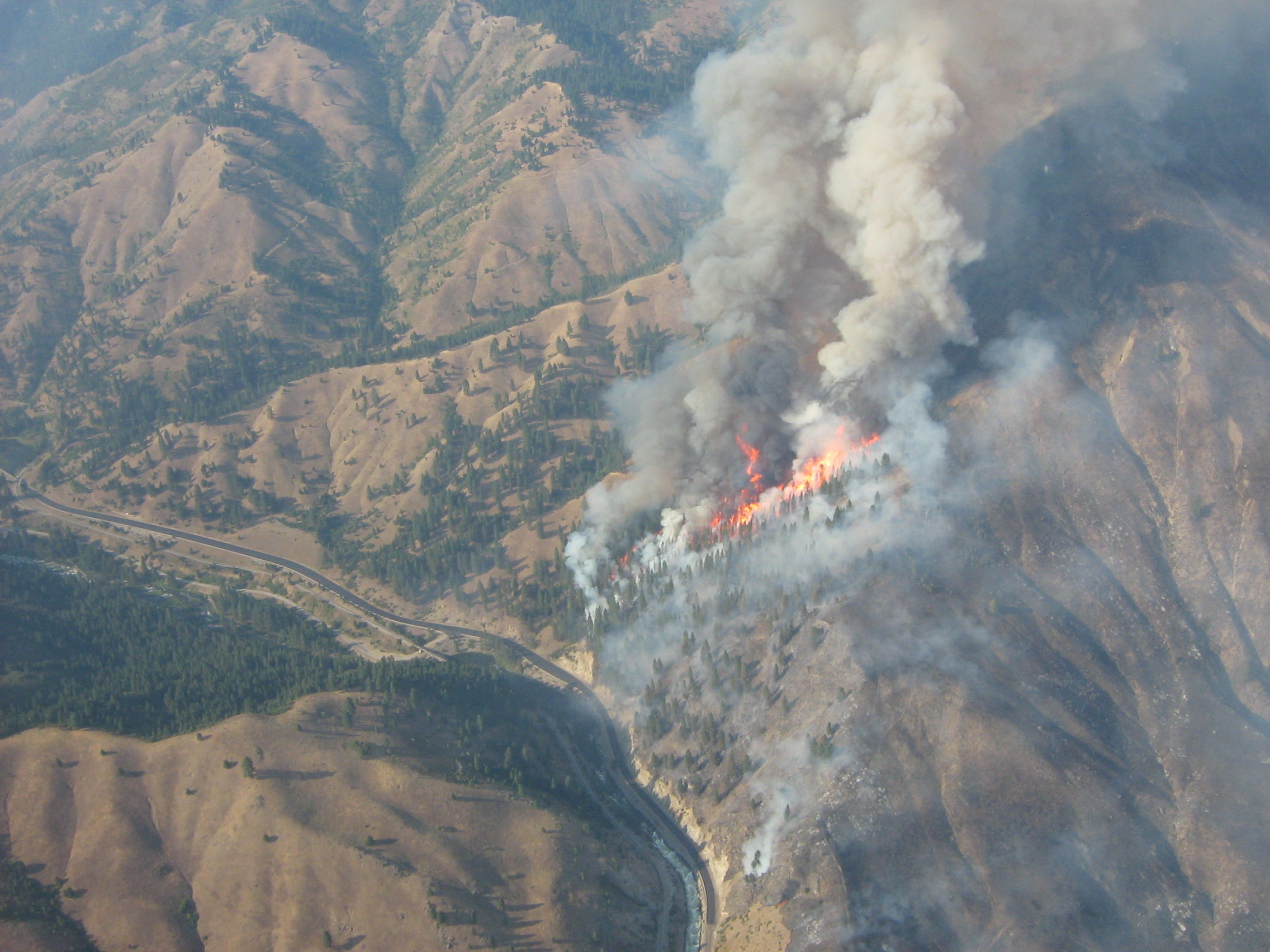
Here’s an aerial view from InciWeb (fabulous wildfire website)  You can see the highway snaking along just below the fire.


Wildfire: ‘Tis The Season

Photo shot from the bedroom window.

We just got back from a quickie vacation up to the cabin where we went kayaking for two days and did a thirteen mile hike up to a stunning alpine lake in between.  The hike was a huge, HUGE triumph for me.  I haven’t been up to this particular lake in about eight years because I got too fat and waddling over that much rocky trail made parts of my feet go numb.

Enter Weight Watchers and minus fifty pounds later…voila!  I made it….easily…and hiked all the way around the lake to boot.  I became surprisingly emotional on the return trip, fighting back tears when it hit me that my hiking days weren’t over after all.  I’d been schooling myself to let Alice Lake…and all the other beautiful, beloved wilderness places more than, say, three miles out…go, but it turns out I don’t have to now.  Not yet anyway.

Fat is evil.  I can’t tell you how grateful I am to get it off again.

Summer in Idaho is wildfire season, every year, as it is in most of the western states.  Fire is actually an ancient and integral part of the ecosystem out here but for about a century’s worth of forest management policy that fact was poorly understood.  Enter Smokey the Bear and the motto he tried to get us all to live by:

ONLY YOU CAN PREVENT FOREST FIRES!

But those days are gone and now the common practice is to allow wildfires to go ahead and burn in areas where they’re not threatening structures, roads, or lives.  They often burn in remote areas for months on end until the first snowfall finally comes to put them out, with the forest service keeping an eye on them all the while, only stepping in to herd them a little if they start heading in a wayward direction.

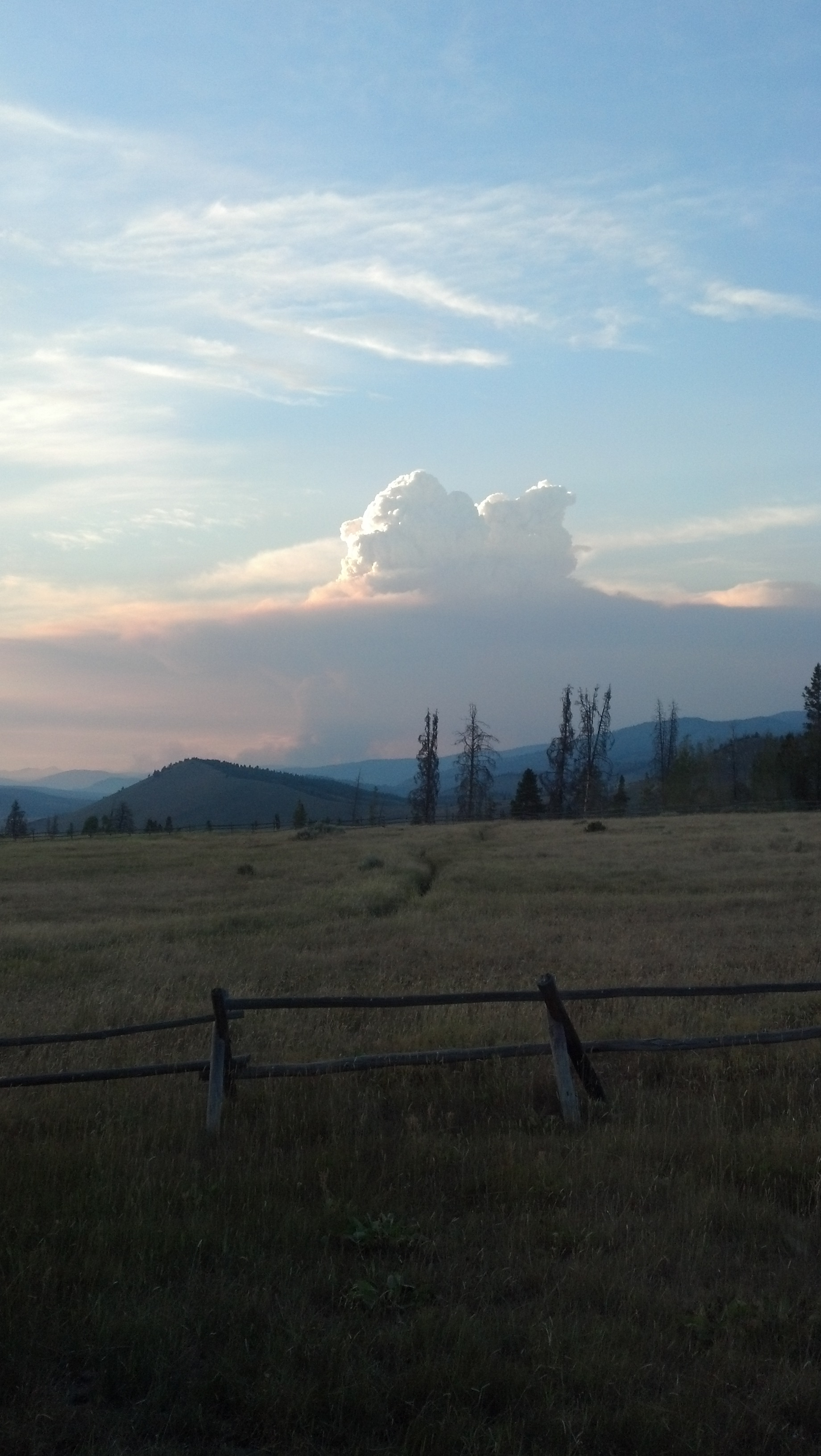
Two days before we arrived up at the cabin the Halstead wildfire flared up and grew really fast.  A cold front blew in Thursday evening and the winds that came with it were  strong enough to increase the fire by 75% overnight.  This is what it looked like from the town of Stanley on Sunday.

Wildfires tend to inhale during the day as temperatures heat up and you’ll often see this kind of mushroom shaped cloud forming above the areas where they’re burning the hottest.  Wildfires can also generate their own winds and the big ones create firestorms that are incredibly dangerous for firefighters.  The Halstead Fire is one of those, which is part of the reason why they’re just letting it burn.  Last I heard it had grown to about 22,000 acres or so, fueled by all the dry, brittle pine trees that have been killed off by the pine beetle infestation.

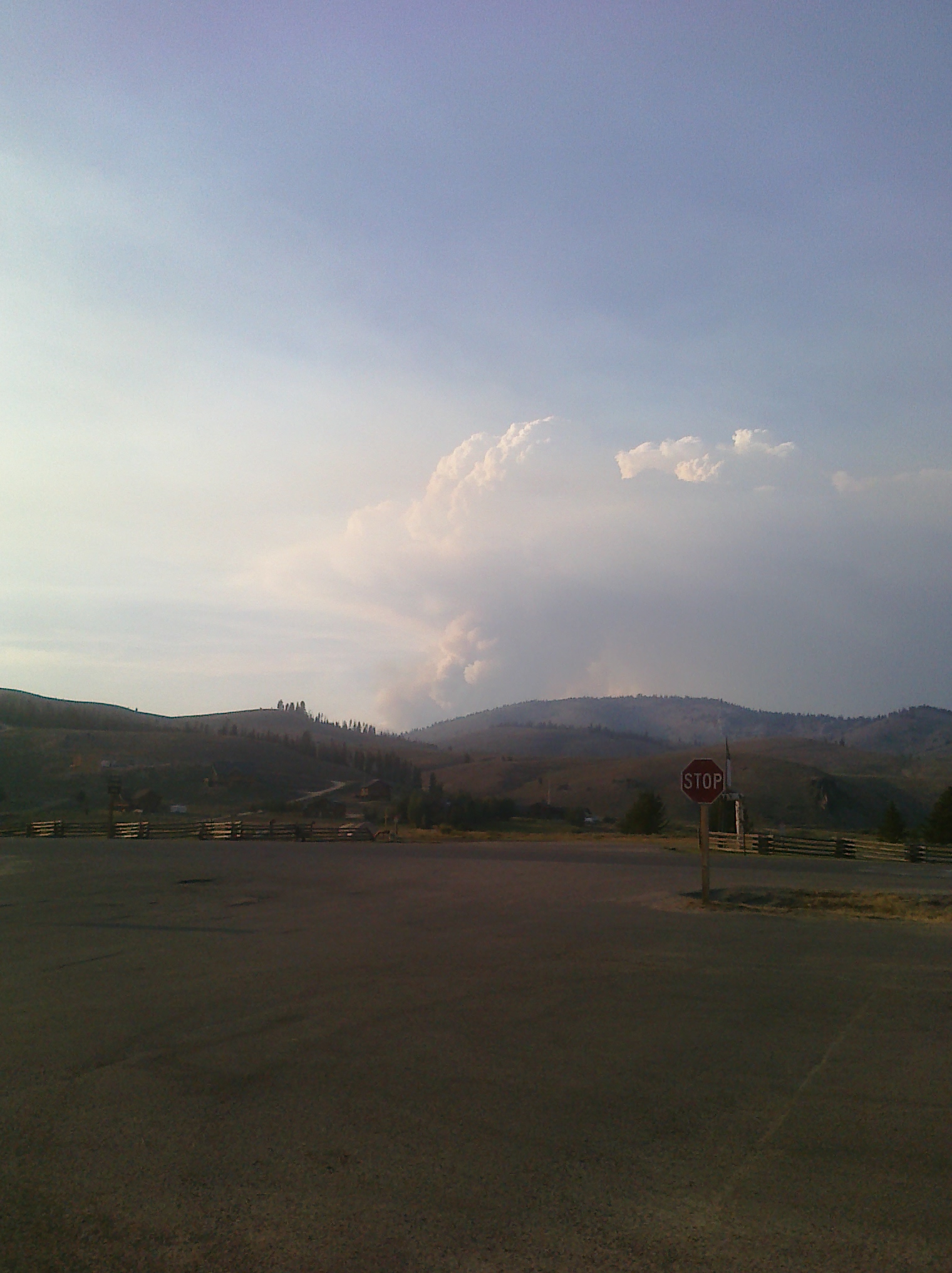
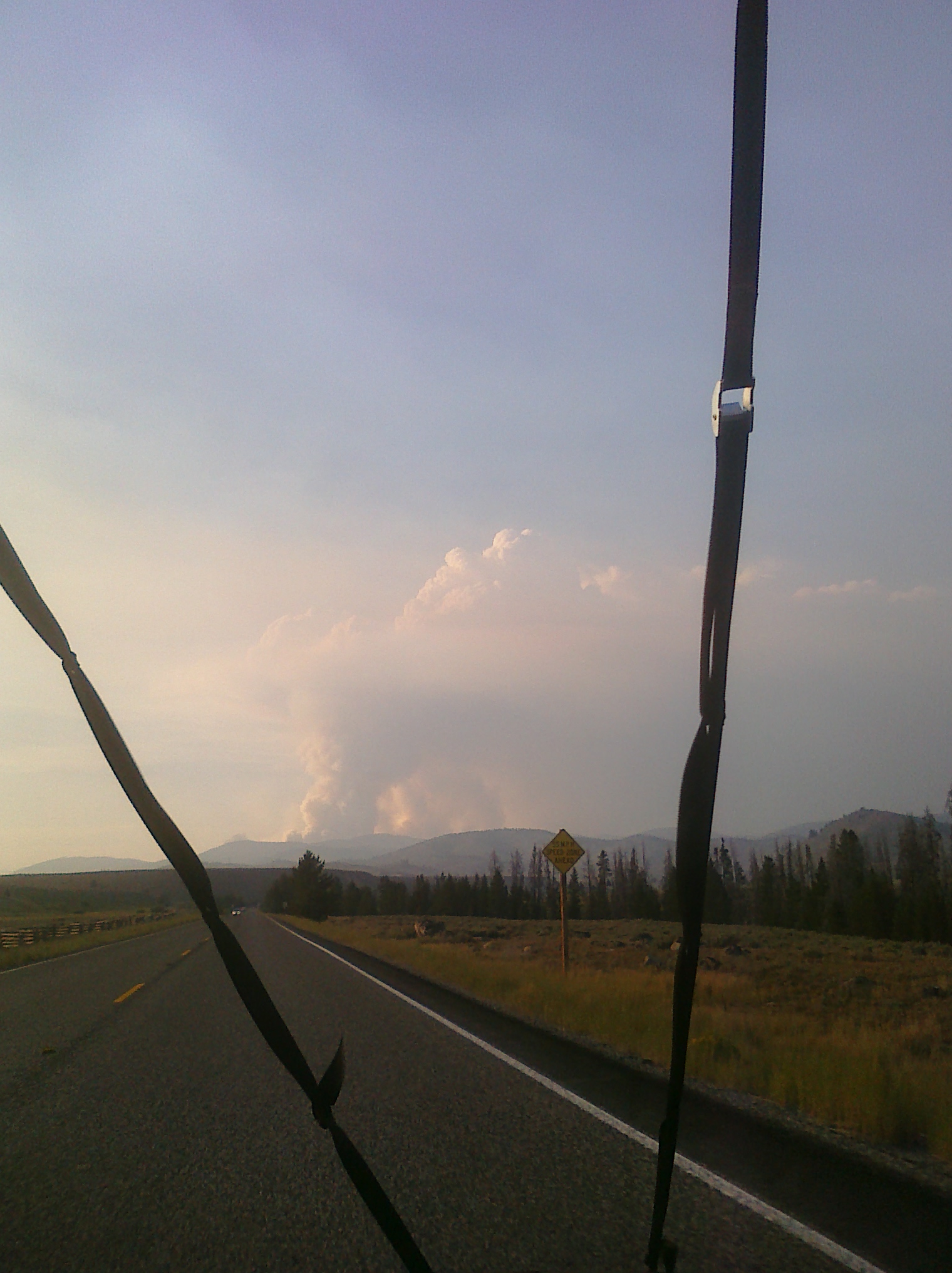
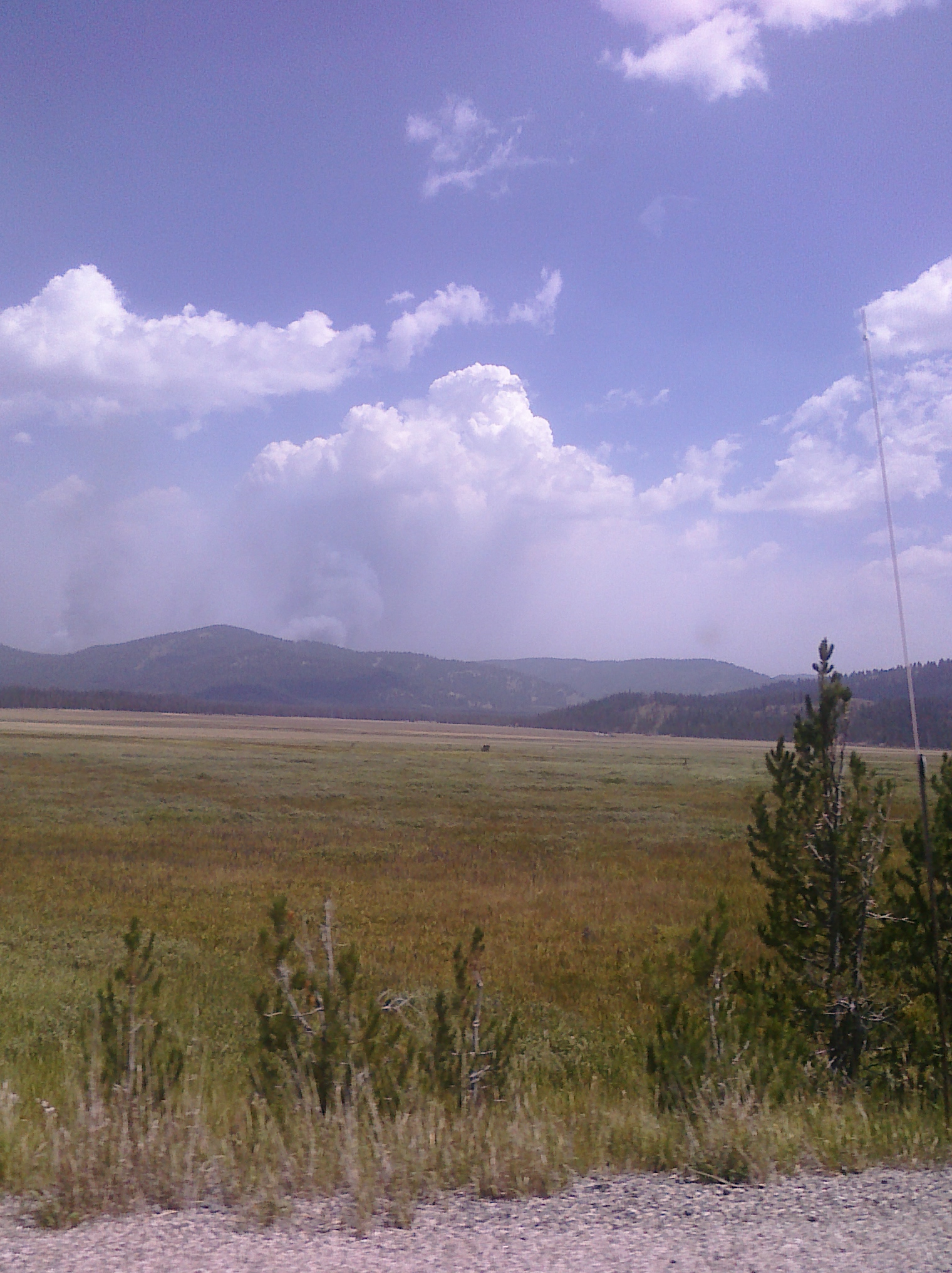
Here are a couple more shots I took as we were leaving Stanley to come back to Boise this afternoon.  (The straps are tie-downs for the kayaks on the roof of the car.  Sorry.  I know they’re annoying.)

And here’s a view from the side.  This fire stretches over a lot of ground:

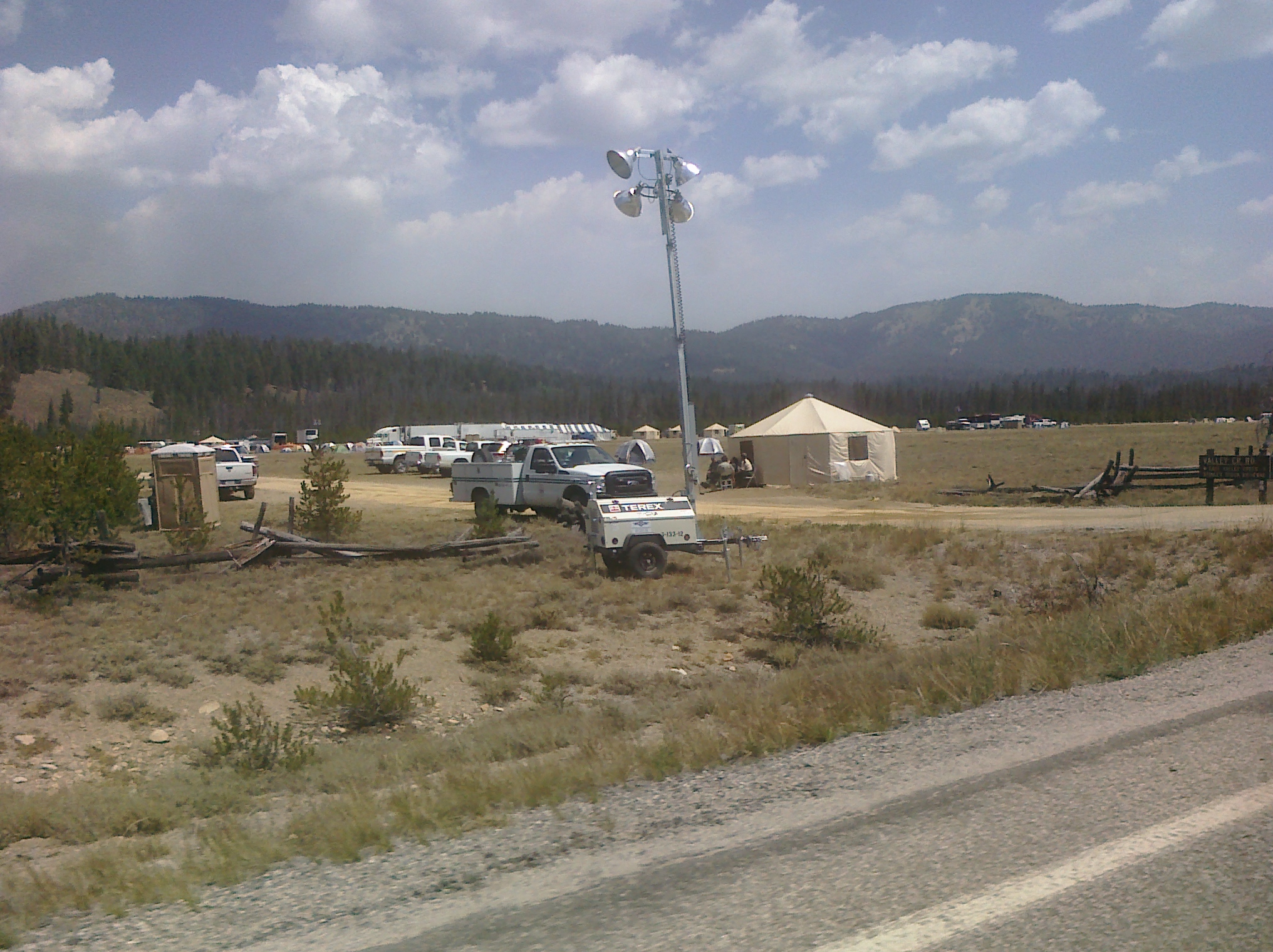
And below is part of the fire camp where headquarters have been set up for this particular wildfire.  Each one gets its own local base of operations.

A couple hours of driving later and we just happened to stumble across the next wildfire that was started last night.  While the Halstead Fire was started by lightning, the Springs Fire (below) was human caused which is always disheartening.  It seems to be burning near a local hot springs (locally known as the skinny dipper’s hot springs) that attracts a lot of people year round.  Maybe one of them got stupid.  It’s not that hard to do when things get this hot and dry.

This fire is really close to the highway so traffic through the burn area was closed down to one lane.  Here we are below in a line of cars waiting for our turn to drive through.  You can see smoke from the fire up on the hill straight ahead.

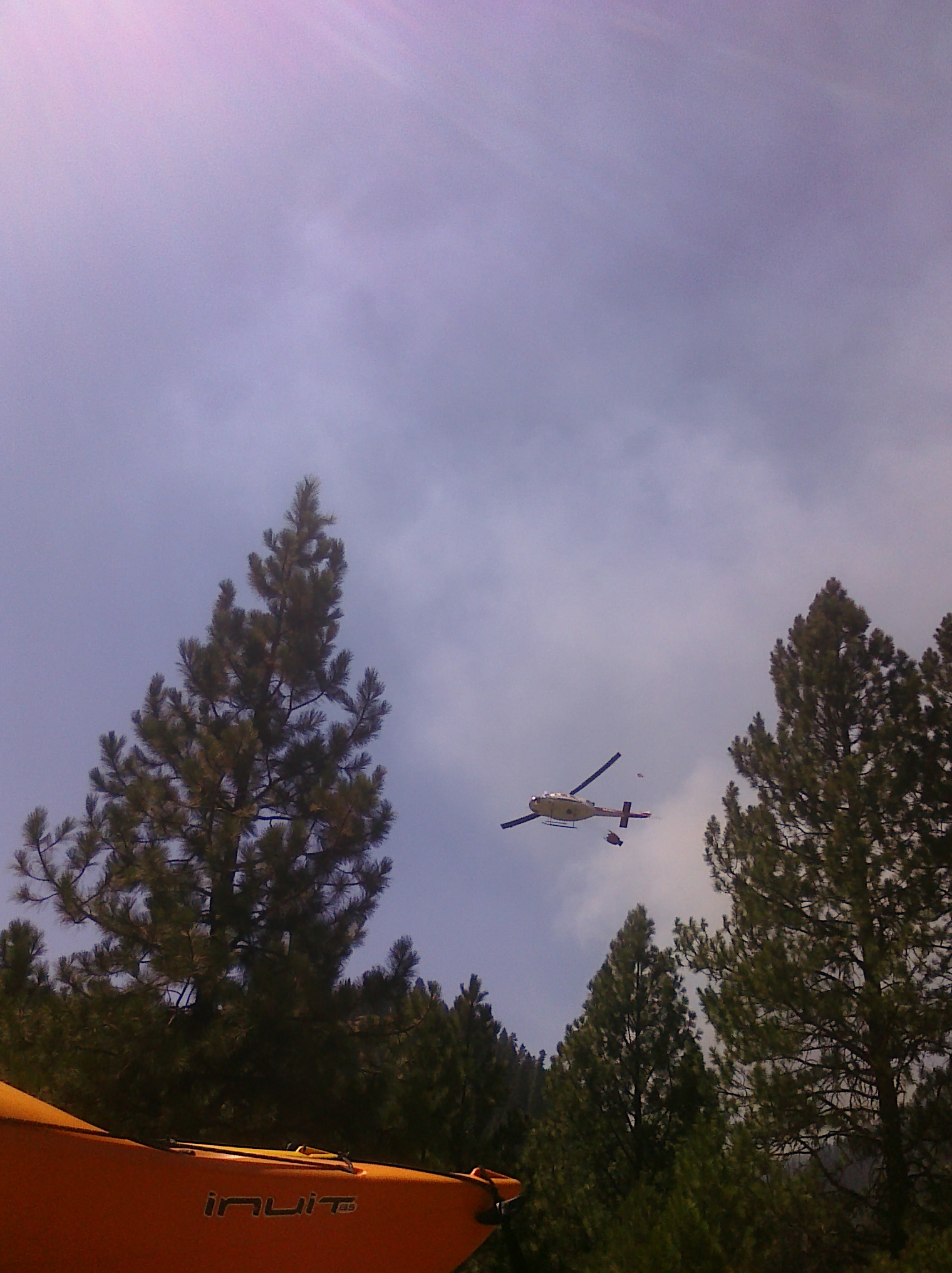
As we were waiting one of the helicopters fighting the fire flew almost directly over our heads, banked sharply in a U-turn, then flew down to the river just below us and scooped up some water in the bucket dangling underneath it.

It was outrageously cool to watch.

And this is what the approach to the fire looked like once we started moving again:

We passed the turn-out on the side of the highway where all the skinny dippers usually park only to find it now filled with emergency and fire fighting vehicles. (Photo below.)  You can also see the helicopter again, in the center of the photo, flying near the fire.  Look at the bucket.  Tiny, no?  It gives you an idea of what an enormous task it is to try and contain these things.

Here are the rest of the pics I took as we drove through.  I was pretty much just continuously snapping pics on my old, old cellphone so they’re not great.  But hopefully it’ll give you an idea.

And of course, no discussion of wildfire would be complete without some kind of reference to climate change.  Long-time fire fighters were among the earliest converts to the notion that things are heating up, mainly because they see it up close and personal every year.  The fires are getting bigger and burning hotter, regularly doing more damage and claiming more lives than they did in years past, and the brave people out there who are roping and riding these things in order to try and protect the rest of us are at greater and greater risk.

I’m not sure where it’s all headed but we’re certainly living in the middle of a big paradigm change.  It would be great if everyone could be more careful anyway.  Here are a couple of pointers if you’re headed out to recreate in a dry area:

  • Don’t drive over tall, dry vegetation.  The underside of a vehicle gets very hot and will ignite it.
  • If you smoke use a can with some water in it for an ashtray and put the spent match in there, too.  If it’s windy, then please just don’t.
  • Keep fireworks on the pavement in front of your house.  Don’t take them out into the countryside.
  • Sparks from chainsaws, welding torches, and other equipment are dangerous.  Fires get started that way every year.
  • And then there are campfires which should never, ever be left unattended:  1) use a fire ring.  2) have water and a shovel handy. 3) Don’t drop a match on the ground until it’s cold.  4)  To put it out, pour water on the fire and stir until all the materials are cold to the bare touch, including any roots that might be running through the fire ring.  (Fire can travel along roots and pop up in a completely different area.)  5) Obey any and all campfire bans.  They’re issued when the risk of wildfire gets too high.

Be safe and enjoy!

copyright Dia Osborn 2012

Writing Into The Dark, Muddy Holes

Ach.  I’m wrestling with a painful, scary part of my book right now and it’s hard slogging.  It involves writing the story of some early violence in my life and feels a lot like Brer Rabbit wrestling with the Tar Baby.  Sticky stuff.

So far every time I reach for the memories I feel like one of those old-time Mississippi fisherman going after catfish in the river bank.  Back in the day they used to swim down through the murky water to the holes in the mud where the catfish hide, then they’d stick a fist in.  If there was a catfish in there, and if it wanted to eat (but catfish allus wanna eat) it’d swallow that fist whole and not let go again till the fisherman pulled it out of its hole and all the way back up to the surface, just a-dangling off the end of his arm like a long, slimy hand.

Dinner served.

But sometimes…sometimes…a man would hook one of the old giants and then there’d be hell to pay.  Too big to pull out of its hole with a mouth too strong to break free of, the tables would be turned.  Oh, that unfortunate fisherman would struggle for a while to be sure, but in the end his thrashing would slow and stop and his body’d just float there in the current, bumping up against the bank from time to time all white and wide-eyed, like it was so surprised it was now the property of Ole’ Man River his self.

These memories of violence are like one of those old catfish giants and I have to be real careful swimming that deep.  I know which holes are theirs, down at the very bottom and darker than all the rest, but I also know that if I do this right, if I’m brave and smart and catch ’em to where they have to give me a gift to make me let ’em go, then they’ll make me not be afraid anymore.  That’s all I want.

So how do I perform this mythical feat?  How do I catch ’em?  That’s where the vast power of language comes into play.  The events themselves, those sudden and brief eruptions of rage and violation that happened so very many years ago now, are long dead.  But they set their stories loose in my life, dark tales feeding and growing down in their holes.

I need to reshape and retell these stories.  Need to put them into harness and make them work for me instead of against me.

Namazu and Kashima from Japanese mythology

It was the dying who tried to teach me how to do that and if I can just get through this first part of the book and finally reach their stories…their luminous, beautiful stories…I know it’ll get easier.

copyright Dia Osborn 2011

Starling Murmuration: Sometimes, Someone Gets Lucky and Then Shares

This brief footage is absolutely extraordinary.  I’ve seen small flocks of starlings doing this before but nothing like this.

The murmuration begins at around 26 seconds but I was also fascinated by the fact that these two women are canoeing in the weather and through the terrain that they are.  I’ve almost always experienced the most wonder and awe…seen the most unusual, even miraculous, things…when I’m out in inclement weather, or twilight or dark, or intense cold, or in other conditions that keep most people away.

I’m not sure why that is actually.  Kind of curious.

Anyway, if you have two minutes, watch and marvel.  It’s truly something to behold.

When does living stop and dying start?

This is the kind of question I understand repulses most people but for some reason fascinates me.  It’s not so much about dying…I think…as it is about transitional zones in general.  For me, they’ve always been the place where everything interesting is going on.

I ask the same kind of question when I’m lying around up in the mountains and watching the sun set…at what point does it turn from daytime into twilight and then into night?  Or standing on a beach and watching the waves roll in and out…where are the lines that define where land becomes coast becomes sea?

Where do the colors really change on a rainbow, or is there an exact moment when a marriage fails, or at what length of tail can you stop calling it a tadpole and start calling it a frog?

These kinds of questions have always struck me as important even though I’m not entirely sure why.  Maybe they give me a way to puzzle through the nature of change and the necessity for it?  Or perhaps it’s because I’m not very good with loss and transitional zones all involve losing one thing as it changes into something else?  Maybe I think about it a lot because I’m still trying to learn how to say good-bye, let go, and look forward again?

Or maybe it’s just how I was born.  I mean, really.  Who knows why any of us are fascinated by the things that we are?

But back to the original question, when exactly does dying start?

I used to unconsciously believe that it started when a doctor said that it did.  At that stomach sinking, deer-in-the-headlights moment when a person was told, “I’m sorry.  There’s nothing more we can do.”

Did anyone else think that’s when it starts?  And that everything that happens before that horrible moment…all the whirlwind of treatments and waiting and bad news and worse news and more treatments and uncertainty and all the fear…is still living?

That’s what the journey of dying looks like so often these days.  Plunging into diagnosis and treatment can be so much like being caught up and tumbled in a huge, breaking wave that scrapes you along the bottom and nearly drowns you before finally washing you up on shore, beaten, battered, and gasping…only to be told that now you’re going to die.  Honestly, thinking about it like that absolutely terrifies me. I’m not all that worried about dying but I’m petrified of being over-treated for it.

But anyway, once I started to consider the question, and once I realized what my default answer was, I started observing more closely what was going on in my work and eventually discovered a couple of things that helped reshape my answer and ease that scary feeling a lot:

1)  In hospice I learned about a thing called “active dying.”  It’s when the body starts to go through the final shut-down sequence…when you get what’s called a “cascade of organ failure.”

(For the record, I really dislike that term.  Watching a body shut down never looked like failure to me.  On the contrary, it looked like a brilliantly…BRILLIANTLY…conceived protocol designed to both protect us from further horrendous suffering, as well as extract us from a clump of physical matter that’s starting to break back down into it’s essential elements for future life.  To me, active dying looked just as miraculous and sacred and wild as birth ever did.)

The period of active dying is relatively short, lasting from a couple of days to a few hours and, in my evolving understanding anyway, became the clearest definition of when dying actually starts.

I have to admit, that conclusion really surprised me.  It turned a lot of the standard cultural view I grew up with on it’s head.  It even messed with the entire basis for referring a patient for hospice care in the first place, as they’re supposed to be dying to qualify.

And yet, it also explained something that hadn’t made sense up to that point.  When I first volunteered with hospice I thought I was going to work with “the dying.”  And yet I quickly discovered that the extraordinary people I was meeting were actually living.  Times ten.  In fact, probably more than most of the not-dying people I knew.  I quickly surmised that I’d been laboring under a misperception, but it wasn’t until I finally figured out that dying doesn’t start until the very end that the nature of that misperception became clearer.

So for me, in strictly physical terms anyway, dying starts when our bodies enter the “active dying” stage.  And everything that comes before that, no matter how turbulent or ominous or final, is still living.

So when a doctor delivers that terminal diagnosis…we’re still living.  And when we get referred for hospice care…we’re still living.  And when we start losing our appetite, energy, and bowel control and maybe can’t even get off the bed, I’ll be danged if we’re not STILL living.  Maybe in a period of uncomfortable decline which is a definite bummer, but bummers have always been a part of living, too.  So, so what?

And that was the second thing I figured out which helped ease that scary feeling.

2)  Life and death, and living and dying, are completely different things.

Life and death are nouns.  They’re things that exist as an independent fact, like cell division and tooth decay.  They’re built into the system itself so they happen to us whether we deserve them or not/want them or not/appreciate them or not.  First we’re dragged into life without any discussion and then we’re dragged back out again and, ultimately, we have zero power at either end.  Granted, that’s a little unnerving but I still find the simplicity of it appealing.  Turns out life and death are not…thank you God…something I have to try and control after all.

Living and dying on the other hand are verbs.  They’re the smaller, more manageable ways that we get to participate in these vast and fundamental forces.  Whereas we have no say whatsoever about life and death, we have enormous power over how we choose to live and die within them.  How we choose to deal with them and face them (or not.)  Depending on our inclination, we can turn either one into something meaningful, generous, and humbling or something ugly, painful, and degrading…or more likely a little of both.  We are human.

In any case, that part of it is all up to us.

Which I love a lot because I need something to control.  (As the hubster can testify.)  I will happily give up trying to control life and death as long as I have living and dying to strap into the harness instead.

So back to the original question of when exactly does dying start, over time I’ve found it most useful to think of in birthing terms of all things.  It goes kind of like this:

Life enters the world in in four stages; conception, pregnancy, labor, and delivery.  From where I’ve been standing it looks like it heads back out along the same lines.

1) Conception, for me, would be the moment when I first realize I’m officially heading for the exit.  This is it.  I’m going to die.  I think this one might be the hardest part.

2) Pregnancy would encompass most of the time I have left and would involve all the many and varied preparations required for death; wrapping up my life, finishing all the paperwork, giving and receiving any forgiveness, savoring all my “last times,” navigating all the tricks of a body in decline, saying my good-byes and thank you’s, making damn sure everyone knows how much I’ve loved them and, finally, making my peace.

3) Labor would be the briefest part and would constitute the active dying process.

4) And birth?  Well, to be honest…it’s always kind of looked like birth is happening at both ends to me.  If there’s one thing I’ve learned from studying all these different transitional zones over the years it’s that endings and beginnings are pretty much the same thing–a moment of conception.  I know there are a lot of different theories out there about what’s going to happen after death…and I think they’re all pretty interesting…but I, personally, have no idea what the exact nature of my death/birth will be…and I like it that way.  It makes it all seem like more of an adventure.

But I do know this; in all the time I spent in the rooms of “the dying” I never once saw life itself destroyed.  On the contrary, with each person’s passage I saw it becoming something more vast and measureless than I’d ever understood.

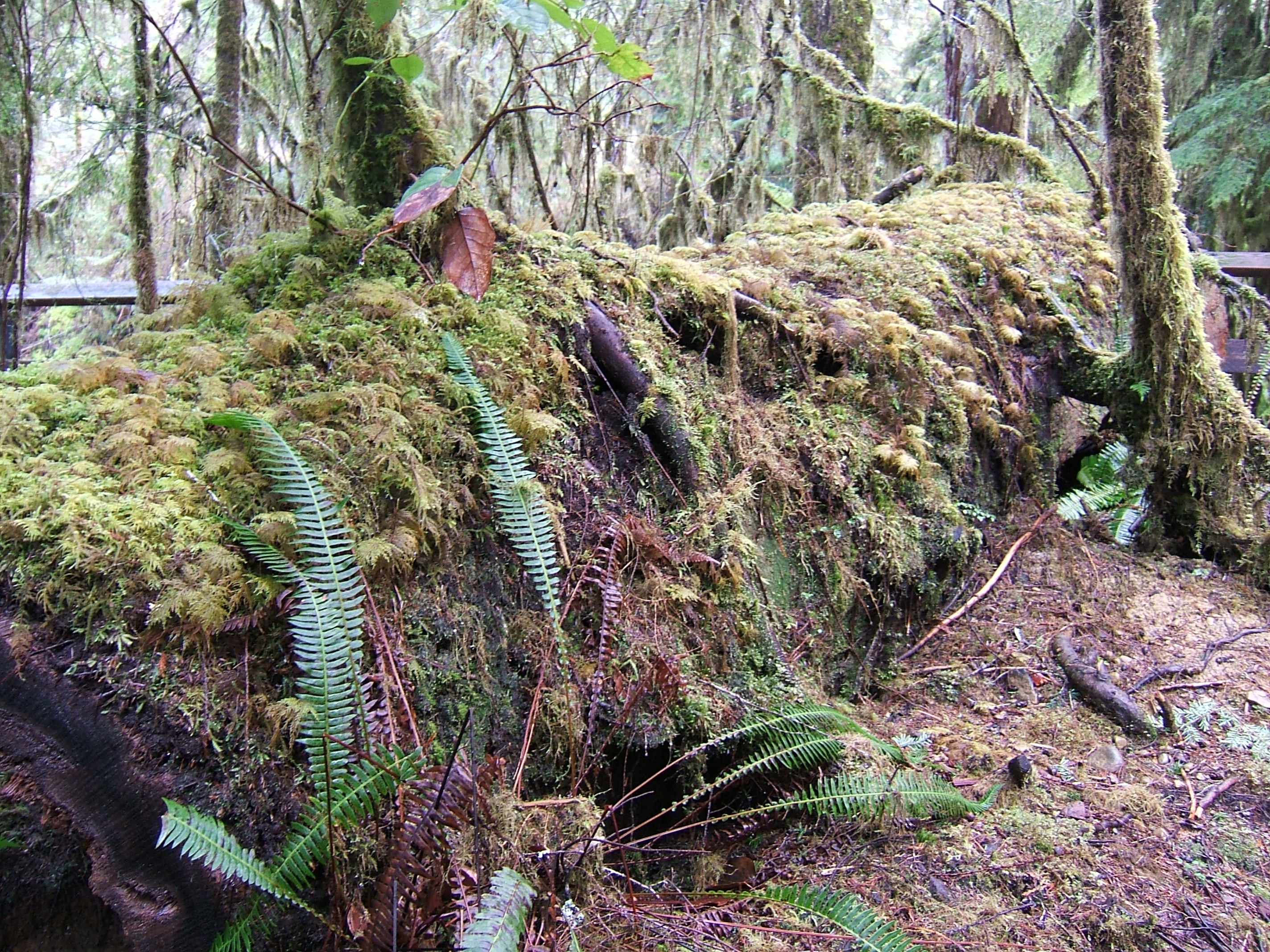
Here’s a photo I took in the Olympic rainforest that captures a little bit of that feeling for me.  The physical part of it anyway.  (Rainforests are like the transitional zone incarnate.  Changing from one thing into another is all that ever goes on in there.)  This is what’s called a “nurse log.”  It’s when one of the old giants falls to the forest floor and magically becomes a raised and fertile world for countless new seedlings to begin their tiny lives.  Nothing wasted, nothing destroyed…only transformed and renewed.

copyright Dia Osborn 2012

A Little Interview With Mr. Will To Live

(This beautiful guy is Hotei, the god of happiness.)

Since I’ve gotten serious about finishing the book I’m spending a lot less time in Blogland so first, I’d like to offer my sincerest apologies to anyone living solely for my next post.  How some people whip out well-researched, erudite, interesting posts a few times a week (or even…gasp…daily) while simultaneously self-publishing multiple books and promoting them is beyond me.  I can’t even type that fast.

Where the book is concerned, I’m currently taking a tip from that wildest of writers, Jack London, to heart.  He claims:

You can’t wait for inspiration.  You have to go after it with a club.

Accordingly, first thing each morning I get out of bed, pick up my club, give it a swing or two for warm up, then sit down at the laptop and dutifully beat on it for an hour.  I figure this way if inspiration ever strikes at my house, at least it won’t be hitting an empty chair.

But my blog-attention has clearly suffered as a result and just in case anyone 1) noticed or 2) cared, I thought I should at least offer an explanation.

And there you have it.  Now on to today’s topic of the will to live.

Lately during club hours I’ve been having some long, thoughtful conversations with an on-again/off-again companion of mine called Mr. Will To-Live.

Mr. Will has mentioned that he’s enjoying our talks enormously as most of the time people seem to take him for granted.  Well not so, me.  I’ve always found him fascinating in the most elusive of ways.

He tells me that, depending on a variety of factors, he shows up a little differently for each person; sometimes strong and pulsing, sometimes erratic, sometimes frail and tenuous, and in a handful of hardship cases like mine, fractured to the point of being almost useless at times.

I asked Mr. Will what factors determine the quality of a person’s will to live and he cocked his head to one side and thought about it for a moment, then ran through this quick sampling:

1)  the will to live has both nature and nurture components to it.  Everyone is born with some degree of a will to live, but no matter how weak or strong it is starting out, it can always change.  (In other words, don’t get too cocky on the one hand or lose hope on the other.)

2)  the will to live puts down most of its root system in childhood so it needs to be fed lots of good, yummy stuff during that period.  A few things that the will to live loves are:

     a)  safety (this lets a child know that they are very, very worth protecting)

     b)  kindness (this allows a child to unfurl all of their amazing, tender, new shoots)

     c)  encouragement (this tells the child that it’s perfectly okay to want things, even a lot)

     d)  freedom to explore (this confirms that the world really is a curious, interesting, worthwhile place to be)

     e)  tolerance for mistakes (this lets a child know that of course they can keep trying)

     f)  a lap and strong arms when things go wrong (this teaches a child that help is a good thing.)

3)  However, if a person reaches adulthood with a gimp sort-of will to live like mine, there are still things that can strengthen it.   A few of them are:

     a) finding someone or something to love (we can continue to stay alive for others even when we’ve lost all desire for ourselves)

     b)  finding a purpose (having something meaningful to accomplish will up anybody’s endurance levels by multiples of ten)

     c)  finding something to fight against or spite (hate and anger can provide powerful reasons to live but have seriously debilitating side-effects. Use with caution.)

     d)  and lastly…service of just about any kind (bringing joy, comfort, aid, companionship or meaning to others in need can nourish not only their will to live but, mysteriously, one’s own.  A marvelous trick, no?)

Service has the additional benefit of inviting Ms. Longing For Life into the room…the wind-beneath-the-wings and beautiful close cousin of Mr. Will To Live.   Hopefully, I’ll be able to secure an interview with her for a future post.

In the meantime I’d like to thank Mr. Will To Live for his time and valuable insights and encourage everyone to try nourishing him with one of his favorite foods once a day.  (Children aren’t the only ones who thrive with a little extra safety, kindness, encouragement, etc.)  It can at least bring a little lift to someone’s day and at best totally turn things around.

copyright 2012 Dia Osborn

Guinea Pig Rescue and the (Historic) War On Women

Meet Hashbrown and E. Benedict.

These are the newest additions to the family of Foxed In and, believe it or not, both their little lives have already been touched by tragedy.  Little Hashbrown, pictured on the left, was recently purchased from a well-known chain of pet stores along with poor little Nacho who is not pictured because he died suddenly and horribly a scant three days later.  I’ll let you go over to Foxed In yourself for a hint of the sad, bad news about pet mill horror that exists in the retail world.

But in the meantime, being left with a bewildered and lonely little piglet (guinea pigs are evidently “super social animals and pretty much need to be in pairs”) Foxed In then located E. Benedict, pictured on the right, with the help of an absolutely fabulous (wait for it, wait for it…) guinea pig rescue/adoption group that the vet who did the (wait for it, wait for it…) autopsy on Nacho recommended.  Seriously.  Foxed In requested an autopsy.

I find that sort of humbling actually.  Evidently, this is a woman who doesn’t discount life simply for the sake of size.  Perhaps something for us all to consider.

On a humorous little side note, Foxed In calls E. Benedict a “walking toupee.”

I think I can see it.

On another topic, I began my hospice work as a volunteer but quickly realized that it was the nurse’s aids who got to spend the most time with patients.  (i.e. my own ulterior motive.)  I therefore dutifully trotted down to the university and enrolled in a class to get my certification and become a C.N.A.

The evening classes were held at the old Idaho State Penitentiary, which is now shut down and maintained as an historical monument. I took a tour of the place once, which was pretty fascinating in a horrible kind of way, but I noticed that it entirely ignored the history of the women prisoners who were also once incarcerated there.

The Idaho women’s prison is a small building constructed outside the walls of the men’s prison and, while it’s not a part of the formal tour, there is an exhibit in the main hall explaining some of the criminal history of Idaho’s gentler sex.

Strolling around the room I was initially surprised to learn just how many women were locked up for killing their husbands. (For those interested, poison was the method of choice by a clear majority.) But it all started to make more sense as I read about some of the laws governing women back in the late 1800’s/early 1900’s.

To varying extents depending on the decade, women were not allowed to own property and had no legal right to either their children or any wages they might earn.  Everything they “owned” legally belonged to their husbands.  This complicated the divorce option for a woman whose husband chose to contest it.  If she wanted to leave the marriage he could keep everything she owned as well as prevent her from seeing her own children, not to mention confiscate her wages until the divorce was finalized, making savings impossible.  So unless a woman had a family or friends to turn to, the likeliest outcome was that she would wind up on the street, probably forced into prostitution.

Evidently, this law was not as binding for women from the upper class who retained some property rights under specific circumstances.  But for women from the middle and lower classes, the law in effect made them the property of their husbands with rights equivalent to…say…a chest of drawers..

Add to this the law commonly known as the “rule of thumb”…which defined the acceptable size of a stick that a man could legally use to beat his wife and children with as being no bigger than his thumb…and perhaps these guilty women might be forgiven for believing that murder was their only alternative.

Clearly, the underlying purpose of these laws was to bind a woman to her husband in a way that would establish his dominance and prevent her from leaving him.  (It might be wise for other men with this agenda to note that the plan backfired significantly in some cases.)

I wonder what happened to all the other Idaho women trapped in the kind of abusive marriages that laws like these actually helped to create? How many others wound up poisoning their husbands and getting away with it?  How many decided instead to escape with nothing, only to wind up in prostitution or starving or dead?  And how many simply gave up and stayed in the marriage, dying a slower, black and blue kind of stick-death?

I look at what the Idaho legislature is doing these days where its laws governing women are concerned, and I can’t help but notice a similarity between today’s governing mindset and the one at work during this earlier, abysmal period of our state history.  Yesterday’s elected officials were finally forced to abandon their sticks only to have today’s politicians embracing  some of the stick’s newer, high-tech equivalents like ultrasound machines and health care exclusions.  Laws concerning almost every aspect of a woman’s reproductive capacity are multiplying at an alarming rate (it’s amazing how obsessed our predominantly male legislature is with the subject.)…

(24 hours later…)

Blah, blah, blah.  Believe it or not I wasted three precious hours of my life yesterday on a following rant about Idaho politics.  It was such useless kvetching that finally even I couldn’t stand it anymore.

How do you spell d-e-l-e-t-e?

Let me just finish by saying this.  Women?  Respect yourself, remember how much less we once had and, if all else fails, poison the fucker.  (Kidding!!@#!!!)  Call your elected representatives and picket Congress for a century.  That’s what our foremothers did and they got us property rights and freedom from sticks.  Let’s learn by example and not drop the torch.

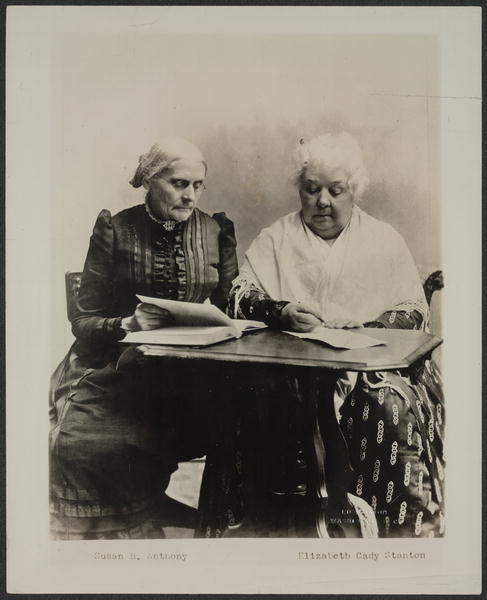
A brief tribute for two women to whom we owe much: Elizabeth Cady-Stanton and Susan B. Anthony 

(Photo credit of American Memory)

Thank you, thank you, thank you.

So.  Rather than ranting about politics, I’d rather spend my last paragraph observing that the above-mentioned guinea pig rescue/adoption people believe in the dignity and beauty of life so much that they’re willing to fight for it even in the most ridiculous of little pet-creatures.  And that gives me more hope than just about anything.

I think one of these kind of people is worth a thousand…no…a million politicians.

copyright 2012 Dia Osborn