A View From The Edge, Part I

It’s tax season and I’m buried.  No time for writing much of anything but expletives on the bathroom wall, so the next few posts will be an excerpt from the book.  I’d love to know what you think!

Chapter 5:  A View From The Edge

Journal entry:

…I lay there on the hard ground in the cold and dark, peering up into a universe unimaginably deep, and watched as the stars shifted and flowed across the heavens.  I was comforted—remembering I’m a part of something far bigger than just this ordinary, deeply beloved world.  And it’s like that for me, again, in the dying world.  Where I get the opportunity to peek out beyond this small life, if even just for a moment, at something that’s both so vast and yet impossibly, delightfully hidden most of the time–disguised by our bodies and abilities, memories and choices.

By everything we keep mistaking as ourselves.

With the advent of palliative and hospice care we’ve seen the first glimmers of change but, by and large, the modern, western medical paradigm still looks at dying as a failure and a waste.  The metaphor I hear employed most frequently outside of hospice, by medical professionals, media, friends and neighbors, is that death is the enemy and all of us must wage a war against it.  Either individually within our own, dear body or as a group using the big guns of scientific advancement and policy change.  The metaphor of war is a powerful one, invaluable for generating the will necessary to marshal our resources for a single minded, all out attempt to get better–to survive and thrive as an individual or a society.

But what many don’t realize is that the cost of a martial metaphor is a high one.  In a war whose sole aim is to preserve life, those who perish anyway die as casualties and losers.

It was always difficult to watch—the myriad ways this sense of failure manifested in the people I helped care for.  Some felt bewildered and abandoned by a system that only seemed interested if there was still a possibility of cure.  Others, that dying was their own fault and a punishment of some kind—because they didn’t get a second opinion, have more insurance, take better care of themselves, screen often enough or for the right disease.  Some felt unlucky because they didn’t respond to the drugs or treatment the way they were supposed to.  Others felt guilty because they’d just grown too exhausted and frail to fight anymore.

It seemed more than a little strange to me.  Dying is already such hard work.  Why in the world would we adopt a way of looking at it that actually increases the suffering involved?  Perhaps it’s the natural outcome of our separating dying from life, of deeming the first as a terrible and monstrous thing and the second as our only sanctuary from it.  Whatever the cause, an unintended outcome of focusing wholly on the protection and preservation of life—of regarding our natural transition into death as a sinister and horrible collapse—is that we’re unwittingly multiplying everything about dying we fear most.

It’s ironic. While the duration and quality of life have unquestionably improved over the last century, the quality of dying has been in a corresponding decline.  All our efforts to delay and defeat death have unintentionally prolonged the process so that it now takes longer than ever.  It involves new and novel layers of suffering caused by an ever-multiplying array of interventions, requires increasingly complex—sometimes unbearable–choices, and costs so much more that it frequently not only strips surviving loved ones of any remaining resources but leaves them crushed under a staggering burden of debt.

Over the years I noticed that frequently, especially in the case of a last minute referral, by the time a dying person and their loved ones washed downriver to us, we were among the first people they’d encountered who weren’t afraid of the mists gathering around them.  Every good hospice team has a host of important jobs to do but one of the first is the simple act of trying to normalize what’s taking place, to convey in both words and demeanor that in fact, everything is still okay.  We see and welcome whoever it is wholeheartedly because they are, regardless of what’s happening, still alive and vibrant and real.  If there’s enough time, if they’ve been referred for end-of-life care early enough, that wild, spinning-out-of-control feeling people so often experience in the deteriorating pursuit of a cure has a chance to stabilize, allowing them to find firmer ground so they can return to the rest of their lives.  It can make all the difference between someone fully embracing whatever time they have left or just gritting their teeth while sliding over the cliff.

I began to wonder if the transition from living to dying need be quite this traumatic.  Could there be some way to weave the acceptance of dying still largely unique to hospice and end-of-life care into the branches of medicine which focus primarily on cure?   I started casting about in my mind for a bigger metaphor than that of war I could employ, one that would contain both my longing and reverence for life as well as a deeper wisdom and regard for death.

Something that would not only arouse and inspire me to live but also reassure and cradle me when I die.

*          *          *

In the fall of 2001, after years of navigating the ups and downs of a deep depression, I decided to try a new and novel treatment option.  I was nearly paralyzed again—all the diverse and multiplying anxieties that had flourished in me over time eventually consolidating into a single, more efficient terror of just leaving the house—and one day it occurred to me that I was at a threshold.  I was either going to have to take some drastic, even reckless action to counter the trend or else surrender to life as a shut-in.

So the day my husband suggested that we hike into the mountains separately for a spiritual retreat, to spend three days and three nights alone with God at 9,000 feet in autumn during bow-hunting season without flashlight, fire, or food, something desperate leaped up inside me shrieking YEEEES! Cal had been doing this kind of thing for years, had invited me to join him every time he’d gone in the past, but somehow it never held much allure for me.  So it took him off guard at first when I agreed–he thought I was just messing with him.  But once he realized I was serious he became so excited that later, when I came to my senses, I didn’t have the heart to back out.

To be honest though, deep down I didn’t want to back out.  I’d reached the point where the constant, chronic fear I was living with finally seemed worse than anything that could conceivably happen.  It no longer sounded as bad to me; freezing to death, being impaled on a stray arrow, mauled by a drought-starved bear, trampled by a rutting, bull elk, falling off a cliff, going into hypoglycemic shock from lack of food, burning alive in a forest fire, being struck by lightning, buried in a snowstorm, or captured and toyed with in unspeakable ways by some caricature of a deep-woods crazy. Nothing I imagined anymore could possibly be worse than spending the rest of my life locked in the bedroom cowering under a blanket.  It had become unbearable, losing access to everything I loved drip by drip, the slow suffocation of walls closing in.  The time had come to summon all my fears to sit down in a circle with me–time to either break the back of the depression or die trying–and frankly, I didn’t care anymore which one.

It can be both a devastating and invigorating place to reach, the feeling there’s no longer anything left to lose.

Next week:  Chapter 5 Part II

copyright 2010 Dia Osborn

The Stars We Steer By

LH 95 star forming region of the Large Magellanic Cloud

The results are in from the thirty-seven people who voted in the poll, (hardly representative but enough for a tiny feel), and I’m both surprised and heartened.

But before I launch into that discussion, I wanted to thank everyone who voted, as well as everyone who tried to vote but couldn’t because of technical difficulties.  There were a lot of you latter, I know.  This post got about five times the number of hits as translated into votes so clearly, the glitch some of you reported was a big one.  Bummer.  I really wanted to know what you thought.  I’ve recently been assailed by doubts about the value of what I’m trying to do with this blog and the eventual book, and I was trying to establish whether there was really a need for it or not.

Note to self: Learn more, much more, about conducting a casual poll.

And now to the results.  Taking into consideration that the sampling was minuscule and the line of questioning was leading at best, I was still surprised to find that my suspicions were baseless.  In spite of all the progress medical science has made over the last century, everyone who responded still sees death as the natural conclusion to our biological destiny.  While there were those who thought our age span might be extended beyond 120 years, a few who thought we’d find a cure for aging, and some who thought disease would eventually be eradicated, nobody checked the Live Forever box.   The proponents of Immortalism will undoubtedly be bummed, but it makes the job I’ve undertaken seem more feasible.

For those who didn’t know yet, I have an agenda here.

We all have our particular stars to shoot for and I’m no different.  Mine involves trying to ease some of the unnecessary levels of fear I’ve seen around dying.  I’m not gunning for ALL the fear mind you, because some of it is appropriate and perfectly healthy.  It’s like a couple of people mentioned in their comments; the instinct to survive is in our DNA and, without the fight or flight response, we wouldn’t last long as a species.

No.  What I’d like to target is the unnecessary fear.  The excess.  The bogey man part.  The kind of terror that results from things like lack of education and unrealistic expectations, from misinterpreting symptoms to grossly underestimating our own strength.  I want to tackle the kind of creeping, obsessive fear that arises from focusing on external, technological solutions which we often can’t control, to the exclusion of internal strengths that we can.

That last one was what I was trying to gauge with the poll.  As a society, we’re dedicating our resources and faith to medical science at a rate that’s escalating geometrically, and I wanted to find out just how much faith.  Because if most people are starting to believe deep down that dying is ultimately unnecessary then, honestly, there wouldn’t be much left for me to do here.  The hope of living forever raises an entirely different set of fears about dying that I wouldn’t have a clue how to address.

If that was the case I’d be free to begin a whole new star-hunt.

However, thirty-seven out of thirty-seven people still believe that dying is biologically inevitable and, while it’s not universally representative, it’ll have to do.  I’ll just assume that trying to ease some of the fear around dying is still a relevant and worthwhile goal to pursue after all.

Note to self:  Possible things to talk about in future posts.

1)  Cultivating internal resources like courage, endurance, gratitude, trust, humility, strength, inner dignity, etc., provides the most powerful fall-back position for when technological solutions fail.  (Other options:  Despair.  Rage.  Blame.  Generally falling into the abyss.)

2)  Cultivating the above also dramatically improves the quality of life before dying.

3)  Instead of devoting all our attention to fighting over who’s going to pay for the viral growth of outside, institutional services, we can also look into designing and building closer, committed homes and communities where it’ll be easier to help care for one another.

4)  Before we pour our hearts, souls, and tax dollars into more of the bitter, divisive legislative battles raging, we could first try to weave a constructive, workable meaning for suffering to help us navigate with a little more grace.  (Of course this would require courage, trust, humility, etc., which brings us right back to the practical uses of number one.)

I know there’s a way to die that isn’t as scary as most people think it is.  I’ve seen it.  I witnessed a variety of ways to navigate the process that not only make it less devastating for the person who’s dying, but actually helps buoy and heal those who have to pick up the pieces afterwards and carry on.  I just need to figure out if there’s a practical way to communicate what I learned to anybody else.

That’s my star.

copyright 2011 Dia Osborn

Poll: Do You Think Medical Science Can Someday “Cure” Death?

Update:  There was some confusion about where to find the poll.  Bad post design.  Sorry.  I’ve now moved it up to the top.  Please click on all the answers that seem true to you.

This week, my friends, I’d really like to get your input on something.

The other night, as I was watching the usual parade of age-related drug and medical commercials during the evening news, (the target demographic for network news is pretty unmistakable these days,) I thought I heard a subliminal message running throughout.  If I’m hearing correctly, it’s an oblique, unspoken promise to the general population that goes something like this:

If we (i.e. medical scientific research) can find a cure for aging and disease, then nobody will have to die anymore.

Is it just me, or is there an unconscious (conscious?) expectation being fostered in our public awareness that someday death will be “cured”?

Do you think death is curable?

In order to take a broader pulse, I’ve developed this brief, informal poll.  (Here’s hoping it works.  I’ve never done a poll before.)

If you wouldn’t mind, I’d really appreciate your taking a moment to answer.  In fact, if you wanted to invite anybody else to take this poll, too, well that would be just dandy.  There are various ways to share the link below, or you can always cut and paste the URL yourself.

The more the merrier.

And if you’re as curious as I am to find out if there’s a real paradigm shift taking place (i.e. we’re starting to believe en masse that we don’t have to die) there should be a tab at the bottom of the poll you can click on to see the results so far.

I know the possibilities I’ve provided are pretty limited, so if you have an insight that doesn’t fit in to any of the choices provided, feel free to expand in the comment section.  I’d really like to hear what you think.  This is driving me nuts.

Thanks.

copyright Dia Osborn 2011

A Dream of Her Dead Beloved

image by Salvatore Vuono

I arrived at a patient’s house one morning to be greeted by the news that Adelle, 104 years-old, had seen her husband last night in a dream.  It was a vivid, full screen, Technicolor kind of dream that she couldn’t stop talking about once she woke up.  Father of her children, love of her life and dead for over 40 years, she told me how healthy he looked in a tone of mixed surprise and delight, her face luminous with a happiness I hadn’t seen there in the year I’d helped to care for her.

Usually, she didn’t remember her dreams—in fact she was remembering less and less of just about everything.  Nearly blind and almost deaf, her retreat into the chambers of stillness and shadows had been recently accelerating.  We’d all noticed.  The complex web of threads that had once moored her here to the people and places she loved was unraveling, while her physical senses, whose job it had been to reach outward and connect her to the things of this world, were now reversing and cutting her off.  Spinning closer and closer around her like some kind of growing cocoon.

A shower fog thick with shimmering and whispers slowly curled around us there in the bathroom as I toweled her dry. 

It was like nothin’ I ever seen before she confided softly and I felt a little breathless myself at the strange radiance lighting her face.  Her words helped lift a growing load from my heart.  She’d been turning inward, slipping away from us to struggle alone across the borderlands for so long that I was relieved she was finally coming within reach of the other side.

Adelle lived a long, clean, healthy life and her heart, while ancient, was still strong and vital.  For over a hundred years that had been a good thing.  But now, as the rest of her body was slowly grinding to a halt, her persistent, tenacious heart had unexpectedly become a liability.  It was yet another of those odd reversals that take place in the dying world—how good health can turn out, at the end, to be something unlucky.  I saw it a few times in those with unusually strong physiologies.  There was a man with the strength of an ox whose cancer advanced to a degree of horror before his heart finally (finally!) gave out.  And another woman centenarian whose muscular control and mind had long since failed but whose heart (Oh, fabulously strong, pulsing, galloping heart!) continued it’s pounding on and on.

It puzzled me, how one organ could be so oblivious to the fact that its fellow body parts were dropping around it like flies.

Or, even more bewildering, why we would step in and medically intervene with a heart or any other body part that was paying attention and trying to shut down.  Propping them up with the brilliant science and medicine we’ve developed over the decades and thereby unintentionally furthering a degree of suffering that was never naturally intended, aggressively slamming shut every other door that offers a kinder and more timely exit.

I’ve been viscerally struck by the dear and true friend that various acute diseases turn out to be as we decline and fall apart.  Even with as miserable as things like diarrhea, flu and bacterial infections are in the short term, they can save us from an equally miserable and far, far longer dying process.

Adelle was blessed with an extraordinary heart.  She was the last of her generation by a long shot, and now longed to catch up with those who had gone ahead…more than ready to leave but forced to linger on and on.  I don’t understand, in the grand scheme of things, why her journey entailed the extended suffering that it did and it’s not my job to judge it in any way.  (Thank god.)

But I’d grown to love her and in my heart I couldn’t help but feel she’d endured enough…enough joy and grief, love and loss, strength and pain, enough long, long life.  She was ready to go and as far as I was concerned she deserved to.  She’d earned it.

I was glad her beloved had come.

Van Gogh

copyright 2011 Dia Osborn

Buoyancy, A Curious Japanese Ritual, and Admitting Confusion

IMDb

Today I hurt.  In pursuit of my timid triathlon quest I lifted weights yesterday, so today it’s harder to lift anything else.  And once I finished the round of weights, I went down to the pool to swim laps for the first time in over a decade and made an awkward discovery.  Most people probably already know this but it turns out fat is really buoyant.  I mean really. There are about sixty pounds or so standing in between me and my old fighting weight and, gauging from the way my body responded to the water yesterday, I think most of it is in my butt.  I may as well have had a life-preserver strapped to it.  Or an inflatable boat.  No matter how deep I dove or how hard I kicked to stay down there, my rear-end inevitably led back up to the surface like a drowning person seeking air.  It was embarrassing.  The self-delusion I’ve clung to over the years took a critical (necessary?) hit and now I’m forced to admit there is nothing, nothing, sleek left about my body.

The poor dear.  I owe her big time.

And now on to what I really wanted to talk about in this post.  There was a powerful insight I had while watching the Japanese  film “Departures” a couple of weeks ago but the problem is, I’m still not exactly sure what it was.  (Actually, I feel kind of like a quote I found once in a whole oats forum: The answers we found only served to raise a whole new set of questions.  We’re as confused as ever, but we believe we’re now confused on a higher level and about more important things.) Please bear with me here while I struggle to explain this.  For starters, there are a few things I do know about the insight.  For instance, it was a big one.  It felt like it might explain a lot of what I’ve been trying to communicate about dying in this blog.  It’s also continued to eat at me because I suspect understanding this one insight could go a long way toward easing the excess terror a lot of people feel about dying these days.

But what is it exactly?  Well, to explain that I need to describe three of the scenes that triggered the insight.  But Spoiler Alert:  If you haven’t seen the movie yet, these scenes will give a major part of the plot away.

Ready to go ahead anyway?  Okay.  Here we go.

The first is a scene where the main character, Daigo (who’s taken employment as someone who reverently prepares the bodies of the dead for cremation) meets an old childhood friend on the street.  The friend has his family with him and Daigo stops to greet them.  But the friend gruffly sends his wife and child on up the street without introducing them, telling Daigo that he knows he’s working with the dead and therefore wants nothing to do with him.  He ends the encounter saying something like  “get yourself a decent job” before walking away.

The second scene involves the death of this old friend’s elderly mother.  Daigo is asked to perform the “encoffining” ceremony for her; an exquisite, formalized, Japanese ritual of bathing and dressing the deceased in front of the watching family.  By the time this scene arrives in the movie, we’ve already witnessed the profound and often healing influence this ceremony has on the families, so we’re expectant that something similar is about to happen to Daigo’s friend.

And we’re not disappointed.  True to form, as he watches Daigo not only restore the dignity to his mother’s body that death stripped from it, but also elevate it to an almost transcendent state of beauty, the friend’s perception of  Daigo’s work transforms.  We all watch as the childhood friend finally “gets it.”  He’s moved.  He weeps, and he thanks Daigo for the gift he’s given his whole family.

Then, in the third scene, Daigo visits the recently deceased body of the father who abandoned him in early childhood.  He stands in a strange room gazing down at a body he doesn’t recognize and with which, other than anger, he feels no emotional ties.  Suddenly, two men hurry into the room hauling a cheap coffin.  They set it down, seize the shoulders and feet of the body, and start to heave it into the box.

We’re all shocked.  This time there is no beautiful, reverent ceremony.   No respect for the family standing in observance.  No restoration of dignity to the body or anything else for that matter.  Quite the opposite.  The actions of the two men only deepen the natural horror that always goes with the violent severance of life.  They treat the body as a “thing.”  As so much trash or waste to be collected, dumped, and burned.  Far from providing healing, this callousness threatens to increase Daigo’s trauma.

Needless to say he’s outraged and this heat transforms his wound.  He stops the men mid-transfer, and drives them away.  Then he kneels down beside the body to perform the ceremony of encoffining, and in so doing finally finds the healing for himself that he’s provided for so many other families.

These scenes were aching, beautiful, and real for me.  I recognized the peculiar transformation of healing that can come through deep pain, because I often saw the same thing in my work with hospice.

And…suddenly…I’m realizing I’ve misunderstood what the source of that healing really is.  All this time, I’ve thought it was caused by the power of the dying process itself, but it’s not.  It’s more than that.

Dying generates an enormous, surging wave of energy that sweeps through the lives of everyone involved.  It’s like a tsunami of upheaval, destruction, and change; physically, mentally, emotionally, spiritually, and socially.  The sheer magnitude of the energy involved inevitably wrenches and devastates to some degree, even with a relatively benign death.  The natural, physical violence involved as a body dies dictates that.  Dying as an energy is a lot like nuclear power or the roiling energy of the sun.  It’s an elemental force of nature.

I’ve mistakenly assumed that the positive transformations portrayed in the movie, the kind I often saw in my hospice work, were built into the dying process itself.  But now I’m thinking not so much.  The energy of dying is neutral.  It doesn’t care how we feel about it.  It doesn’t care whether it traumatizes us or not.  It doesn’t care if we face it with courage and respect, or run away from it horrified and screaming.  Healing us is not its job, anymore than it’s the sun’s job to make sure our houses are warm.  The power dying generates has the potential to heal, of course, but it probably won’t unless we learn how to harness  and direct it.

In Departures, Daigo shows us one way to harness it; with respect, willingness, humility, compassion, and tremendous courage.

The movie puts a concrete face on the beauty, dignity, grace, and healing that can accompany dying and death, something that I’ve been trying to describe in this blog for a while.  (With questionable success.)   And the movie does so without romanticizing or hiding the gruesome, gritty realities that are also involved.  There are a couple of graphic scenes (skillfully deployed with humor) which add something critically important.  The truth is that dying and death are primarily energies of destruction.  Yes, they’re still crucial to the world if there’s going to be enough room and resources left for all the new life yet to come, but that fact doesn’t tend to make the graphic nature of it all easier.  It’s important to learn the tools we can use to manage the graphic elements involved, things like humor, reverence, and building a bigger context.

There’s a deep paradox embedded in our nation’s perspective about dying.  On the one hand, our national eyes look at it through a scientific medical paradigm through which we’ve increasingly grown to see dying as a failure and a waste.  Now, I don’t in any way mean to dismiss the profound gifts that medical advances have brought to our lives or suggest that we should ever return to a world without them.  However, it’s important to understand that the lens of technology we’ve adopted has created a growing distortion in our expectations about death.  In attempting to reduce it from a universal force of nature to the level of a technological glitch, we’ve objectified dying in much the same way that the two men in the third scene objectified the body of Daigo’s father.  These days, in both medical research and public awareness, we increasingly see death as a mess and a waste, and we tend to treat it with a corresponding aggressiveness, disrespect, and callousness as we attempt to conquer and eliminate it.

But something else entirely is taking place on the individual level.  While our societal consciousness reels in a kind of perpetual horror of dying, I’ve met so many individuals whose lives have been touched in a beautiful, dignified way by the death of someone they loved, usually because of the help and guidance they received from a hospice or other agency that (in direct opposition to the scientific medical view) perceived dying as an incredibly valuable time of life.  These people I met had been through hell, no question.  But they’d also learned how to see what was happening through eyes of respect.  During their difficult journeys they were allowed and encouraged to unleash the fullest extent of their love, even in the face of unalterable and permanent separation.  To varying degrees, they had each tasted what it was like to rage, to long, to grieve, to laugh, to tremble, to hope, to ache, to collapse, and then to survive and come through a deep, irreparable loss within a circle of respect and safety, holding the hands of others who didn’t minimize, dismiss, or pull back from their experience.

This paradox between a technological perspective and a reverent one is, on a deep level, tearing us apart.  Our scientific determination to conquer death is engaged in a ferocious battle with our deep human desire to die a peaceful one and, even though we know deep down that we can’t have both, we still throw all our considerable resources at the first goal, and then bitterly fight over what policies to set that can guarantee the second.

It’s made us a little schizophrenic.

I don’t pretend to know what the solution to the conflict will be.  That’s something that only time, growth, and group wisdom can reveal.

But I do know what’s helping me climb out of the clash.  In a lot of ways I felt like my job with hospice was similar to Daigo’s, only I did mine with the living.  I bathed and dressed and prepared them, too, with as much reverence and respect as I could muster, and I did my best, minute by minute, hour by hour, and day by day, to restore the people who were dying and the people who loved them to a sense of their own dignity, courage, and strength.   I know it was something I never would have learned how to do without the help of my mentors…the experienced hospice staff who taught me…and I also know that I really want to figure out some way to pass their gift to me downstream.

Which is why I recommend this movie so highly.  Because I think it can help.  If you ever get a chance, give it a look.  Departures.

copyright 2011 Dia Osborn

When Something More Important Than The Parachute Failed

image from Wikipedia

While I was browsing around yesterday researching skydiving and back-up parachutes, I came across a news story from February 2009.

It told the tale of a skydiving instructor, George Steele, who died of a heart attack mid-jump. Now, that piece of information alone would have made me sit up and keep reading because, even though I naturally link skydiving and the possibility of death in my mind, I don’t usually think of it as happening due to a heart attack.  But the story actually gets far more interesting from there.

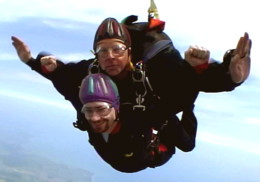
It turns out this skydiving instructor was not alone when he died.  He was doing a tandem jump and had a novice strapped to his chest.  Now this piece of information electrified me.  Like a lot people out there, I’ve considered doing a tandem jump (someday) as a bucket list kind of thing.  But of all the risks I ever thought might be involved, the instructor strapped to my back having a heart attack was never one of them.

By now I’m on the edge of my seat.  I want to know more.  I have to know more.

Turns out the newbie, Daniel Pharr, was a 25-year old soldier trained how to respond in a life-threatening situation.  His instincts proved up to the task.

The two were the last of the group to jump out of the plane.  After a minute or so of free fall Steele pulled the chute.  Everything became very quiet, which Pharr commented on, and Steele replied to.  And it was shortly after this that Steele’s heart quietly failed.  Pharr soon realized Steele had become non-responsive so, going off of what he’d seen on TV (and our mother’s told us TV would just rot our brains) he grabbed the right steering toggle and guided them safely to the ground about a third of a mile away from the designated landing site.

This was turning into such great story!  Double surprise twist with a happy ending.  Dia, I told myself.  It doesn’t get much better than this.

But wait! she answered.  It does!

Turns out Daniel Pharr’s first thought, when he recognized the danger he was in, was , “So at that point I realized I was just going to have to do what I had to do to get down to the ground and try to help him.”

The article had been great up to that point but this part totally knocked my socks off.  I was inspired.  I was in awe.  I couldn’t help but compare what my own response would have been because…well…it just wouldn’t have been as good.  I’m self aware.  I know my own mettle.  I’ve been in enough emergency situations to realize that I’m primarily driven by self-interest.  Oh sure.  If my kids were involved I’d be a little more noble (as long as they hurried) but otherwise I’d be swelling the herd stampeding for the door.  I probably would have been cursing the poor guy for having a heart attack.  But not Daniel.  Oh no.   Daniel was thinking just as much, if not more, of his partner than he was of himself.

Pharr’s evolution from victim to survivor to hero was like food for the secret, emaciated Better Person languishing inside of me.  He gave me hope, a guiding star.  I fell in love with Daniel Pharr on the spot and wished him, wherever he was and whatever he was doing, continued good fortune and everything blessed and best in life.

But having spent all this time telling you the rest of this stuff, here’s the aspect of the whole story that I really wanted to highlight:

It looks to me like, as deaths go, George Steele got to die a really good one.  Yes, he was only 49-years old and sure, he probably didn’t want to die and most likely wasn’t prepared for it.  But having said all that, clearly he got to do it doing something he loved.  In his relatively short life he’d already done over 8000 jumps.  He’s already taken numerous people out for tandem jumps, sharing in the thrill, exuberance, joy, and rush of all those he introduced to his passion for the first time.  And even though at the end he was doing a tandem jump, he was lucky enough to be doing it with someone experienced and savvy enough to survive the dangers his sudden death created.

But even with as great as all that is, this is what really got me: George Steele didn’t die alone.  When he took his last breath, he got to do it with another warm, pulsing, vibrant, strong, caring, enthusiastic companion strapped to his chest, someone sharing in the same sense of wonder, excitement, and joy that he was feeling himself.  Here’s how Pharr describes what turned out to be Steele’s last moments, floating up there in the sky:

“He pulled the chute,” Pharr said. “It got super quiet. It’s eerily quiet up there. I made the comment to him, ‘It’s surprising how quiet it is.’ And he’s like: ‘Welcome to my world.'”

Welcome to my world. Those were the last words he ever spoke.  I only hope mine will be so great.

I’m not happy for George Steele that he died.  At all.  But I am very happy for him that when he did, he died well.

copyright 2011 Dia Osborn

P.S.  By the way, when asked Daniel Pharr mentioned he’d be willing to jump again himself, but his family put the kabosh on it.  What a guy.


The Film: Departures

I finally watched the Japanese film Departures last night and was astonished and blown away, both.  The 2009 Oscar winner for Best Foreign Language Film also captured thirty-four other international film awards and, in my humble opinion, deservedly so.  It took the difficult subject of “encoffining”, the ceremonial (and totally fascinating) bathing and dressing of the recently deceased which is performed in front of the family, and treated it with a lightness of touch and reverence that made it both moving and accessible.  Add in a stunning soundtrack and cinematography and no wonder it was such a hit.

I’ve caught a rabid cold from the hubster so, much as I’d love to go on and on about it, I don’t have the energy.  It’s hard to juggle a parade of soggy tissues and tea cups while trying to type so I thought I’d just leave you with the trailer for the movie.  That way you can get a flavor of it for yourself.

The one thing I will say is that this movie captured the beautiful, uplifting experience I had over and over again with the dying and their families.  It somehow managed to portray a little of everything that’s involved; the grief and joy, anger and humor, the awkwardness that so often arises in circumstances of profound intimacy, the need for forgiveness, the graphic elements involved, the enduring love, and the ultimate affirmation of life that comes when death is received with dignity and grace.  It also captures how the gifts of those who die can pass outward in a spiral, swirling back into the lives of those left behind to aid in healing their wounds, both new and old.

I give this movie two thumbs up needless to say.  Here’s the trailer:

copyright Dia Osborn 2011

Christmas Trees and Death Panels: How Fear Sets A Snare (Republished)

As the Advanced Care  Planning Consultation legislation goes down in flames for the second time, I thought I’d revisit this post from August where I wrote about one of the biggest reasons it went down the first time.  It seemed like it was still pertinent so I’m posting it again.   

(This post was originally published on August 20, 2010.)

Like many people, the Christmas tree scene in the original 1972 Poseidon Adventure movie made a deep impression on me.  I was only fourteen when the movie was first released so I was impressionable.  Given.  But even so the scene is a classic.

It’s Christmas (New Years?) Eve on a luxury ocean liner out in the middle of the ocean and the crew and passengers are celebrating in the ballroom under the branches of a towering and heavily decorated Christmas tree.  As per disaster movie formulae, a tsunami formed by an earthquake off the coast of Crete comes rolling across the ocean and hits the ship broadside, capsizing it and tossing the above mentioned assemblage all over the slowly inverting ballroom.  Once the Poseidon settles in it’s new, upside down position, the Christmas tree is lying on it’s side on the ceiling-turned-floor.

Enter: Gene Hackman, a renegade missionary.  He swiftly marshals a group of men to raise the tree again for use as a ladder to access a service door at the bottom-now-top of the room.

We’ve seen a lot of random chaos and horror up to this point but Fear as a saboteur has been suspiciously quiet.  That changes once the Christmas tree option is presented.  Fear immediately recognizes a golden opportunity and steps in to set the first, big snare of the movie:

The survivors each have to make a choice.

Reverend Gene, on the one hand, tells everyone to climb the Christmas tree and head for the hull of the ship, because that’s the only logical place where rescuers could ever access survivors.  Reverend Gene represents original thinking and a challenge to the status quo.

But the ship’s purser disagrees and tells them no, no, no, they must all stay put in the ballroom and wait for someone to find and rescue them there because the ballroom is where rescuers will search.  The purser (read official man in a uniform) represents standard thinking and the status quo, something fatally attractive to anyone with a strong herd mentality.

It was painfully clear to all of us in the theater that the Rev was right and everyone needed to climb.  Fast.  We knew that those who couldn’t rise above convention and think outside the box were gonna die, die, die, horribly and soon.  We knew this because the whole scene was built around a basic rule of human behavior; terror tends to drive thinking out of the cerebral cortex (rational, logical, problem solving) and into the amygdala (instincts, habit, and fear).  Anytime we’re confronted with a new and terrifying situation, if we can’t master our emotions and analyze circumstances objectively then we revert to old mental ruts and knee jerk reactions.

We follow the herd because by god there’s safety in numbers.  Right?

In this case, not so much.  Fear springs the snare, paralyzing just about everyone there.  The majority of people listen to the purser and decide to stay put.  Only a handful climb the tree and, once the chosen few are safely ensconced up in the only possible escape route, explosions sound in the belly of the ship, windows and skylights shatter in the ballroom, the Christmas tree topples back down to the floor, and deep, ocean waters surge in, drowning every last screaming, thrashing person who made the mistake of defaulting to what felt, instinctively, like the safest bet.

Working in the hospice field, one grows familiar with fear and its many, (many, many, many, many, many) snares.  A fear of dying can often drive us to make unwise care and treatment decisions.  From what I can tell, a lot of this comes from the profound lack of education and understanding that exists in this country around the dying process.  The fierce denial we’ve embraced as a society doesn’t leave much room for the cerebral cortex to think about the subject at all, which means that most of the default choices people make at the end remain firmly embedded in the instinctual part of the brain.  How could it be any different?  There are few instincts more powerful than the one to survive and, if we don’t have some extraordinary and compelling reasons not to, we’ll naturally choose to continue treatments beyond (sometimes far beyond) the point where our doctors, or even we ourselves, think we should.

Yet at the same time, most of us don’t want to die wrapped up in tubing and drugged into a stupor, or with flash paddles sending electric jolts into our heart while our family looks on in traumatized shock.  But it happens all the time anyway.  Why?

There are a host of complex factors that contribute to the problem but ultimately one underlying cause rules them all:

We persistently and adamantly refuse to talk about dying.

We play right into one of Fear’s greatest snares.  Fear loves the fact that we won’t talk about dying because that prevents the cerebral cortex from getting anywhere near our decision making.  How can we possibly evaluate what’s been going wrong, learn anything new, or change anything for the better, without some calm, compassionate, respectful, thoughtful discussion about what’s going on?  We can’t.  Our fearful silence gives the old habits and instincts free rein and we default, over and over again, to the same flawed choices.  That’s how, even if it’s the last thing we ever wanted, we still so often wind up cocooned in IV lines without so much as a spare patch of skin for our loved ones to kiss or hold.

This reluctance and failure to talk about dying is the norm in individual cases.  But it happens on the national level as well, and a prime example of it  just played out during the recent health care reform debate.

Remember the small provision in the health care bill (section 1233 of HR 3200) entitled Advanced Care  Planning Consultation? (Otherwise dubbed, in a bewildering but imaginative twist, as  Death Panels.) Amazingly, it constituted only three pages out of roughly 2000, yet it wound up hijacking the debate.  Why?  Because it asked us to start talking about the dying process.  More specifically, our own dying process.  It boldly and openly addressed the current, gaping need that exists for each of us to have a conversation with the doctor who’s treating us about how we want that treatment to look.

But in so doing this tiny provision struck a major taboo.

Let me reiterate here.  The provision didn’t try to address how we’re treated, it just wanted us to start talking about how we’re treated, but it’s authors may as well have suggested we all drink poison Kool-aid.  They failed to understand how profound the fear of talking about dying is in our society, and that failure is a big part of the reason why the whole thing blew up.   

Personally, I think legislation of some sort is a good idea, but this version was doomed to fail.  I mean, come on.  Any politician planning to link death, law, and government is going to have to make a serious effort to engage the general citizenry in a calm, compassionate, respectful, informative, and thoughtful discussion about the whole thing first.  They need to institute a massive educational outreach to explain why a conversation about end of life care is so essential.

They need to do a much better job of explaining its gift.

There are stories out there that we all need to hear.  Stories about how drastically a simple end of life care discussion can improve outcomes for individuals, families, and entire communities.  For instance, we needed to hear about the two studies done by Aetna insurance.  The ones where the terminally ill who had access to both ongoing treatment and palliative and hospice care, cut their emergency room visits by half and their hospital and ICU visits by two thirds.  Costs dropped by almost 25%.  And most importantly, these people reported much higher levels of satisfaction with their care.

We needed to hear about the compelling evidence emerging from the Coping with Cancer study that suggests end of life care discussions not only decrease suffering and costs, but also increase both quality of life and even life expectancy.  As Dr. Atul Gawande explains in his article Letting Go: What should medicine do when it can’t save your life?, “These patients suffered less, were physically more capable, and were better able, for a longer period, to interact with others. Moreover, six months after the patients died their family members were much less likely to experience persistent major depression.”

And then there is the interesting case of La Crosse, Wisconsin, where life expectancy is actually one year longer and end of life costs about half the national average.  This is because  some far sighted medical leaders in the community got together back in 1991 and started a campaign to get physicians and patients to discuss end of life wishes.  Again from Dr. Gawande:

“By 1996, eighty-five per cent of La Crosse residents who died had written advanced directives, up from fifteen per cent, and doctors almost always knew of and followed the instructions…Answers to the list of questions change as patients go from entering the hospital for the delivery of a child to entering for complications of Alzheimer’s disease.  But, in La Crosse, the system means that people are far more likely to have talked about what they want and what they don’t want before they and their relatives find themselves in the throes of crisis and fear…The discussion, not the list, was what mattered most.” (Emphasis mine.)

These amazing stories and others like them are currently opening a lot of eyes to the wide ranging gifts that come from having a simple discussion about dying.

It would have been helpful if we heard these stories before the legislation was introduced.  A few realized their error and tried to get the news out, but it was too late.  Fear had already seized another golden opportunity (politics!) and set its snare.  The term Death Panels rose from the depths, Fear immediately latched onto it like a monster from a nightmare, and our group, instinctual  brain responded with a great big Hell no!! Explosions sounded from the belly of the debate, windows and skylights shattered, and Provision 1233, like the Christmas tree, slowly toppled to the floor, destroying any hope for mutual, constructive discussion during this round.

Which leaves the majority of those who are currently dying in much the same position as the unlucky Poseidon passengers who decided to sit and wait.  They’re still not having that conversation about end of life care choices, so they’re still missing out on the help, relief, grace, and extra time which are its gifts.

But there’s good news.  We don’t need legislation to talk about dying.  We can talk about it any time we want.  We can figure out, right now, who it is we’d like to choose for us if a time comes when we can no longer choose for ourselves.  Then we can talk with them, right now, as long or as often as we need to.  We can tell them about what’s important to us and what scares us.  What we’re hoping for and how hard it is to trust with something this big.  And they can talk with us, too, about how badly they need to know what we want and how scared they are of making a wrong decision.  About how much they love us and how afraid they are of the loss.

Then we can go in and sit down with our doctors and tell them, too, about these frightening, tender, sacred things we’ve discovered about each other and ourselves.  We can give them the vital information they need to have, so they can care for us in the way we want most.

If we can do all that then the legislation that follows will be far more informed, compassionate, and respectful…the kind of legislation that everyone can trust…because we’re finally talking.

If you’d like to start talking about dying and end of life care but aren’t quite sure how to start, here are a handful of reading resources that might help jump start a conversation:

1) Dr. Atul Gawande, Letting go: What should medicine do when it can’t save your life? (13 pages long but more than worth the time required to read it.)

2) Final Gifts (This book is a huge favorite with the hospice crowd…curious, beautifully written, and uplifting.  Good for easing fear.)

3)  Palliative Care Blog (Fantastic resource for everything end of life and palliative.  Contains a wealth of links to other resources as well.)

4)  Talking About Death Won’t Kill You (The title of this book pretty much says it all.)

copyright 2010 Dia Osborn

Update 8/25/10: Here’s some news. Last week New York state passed a bill (The New York Palliative Care Information Act) requiring doctors to offer terminally ill patients information about different end of life options.  It’s essentially Provision 1233 resurrected in state form.  Behold!  The Christmas tree rises again.  What I found most interesting was that the bill was passed over the objections of New York State’s medical society.  The doctors opposed it saying ‘the new law would intrude “unnecessarily upon the physician-patient relationship” and mandate “a legislatively designed standard of care.”’  Truth be told, there are studies showing medicine tends to attract people with the highest levels of anxiety about dying. Doctors as a group tend to be more reluctant to talk about it than the average person, yet they’re now the ones who are legally responsible in New York to initiate the conversation?  Hmmmmm…  What does this bode for the future?  Hopefully, now medical schools and other sources of medical education will provide more training for how to talk about dying.  As Dr. Gawande stated in Letting Go, it’s a skill that needs to be developed just as much as surgical skills.  We’ll see.  In any case I hope this will stir up more constructive discussion!

And The Death Panel Two-Step Takes Another Turn Around The Room. Damn.

This image from Wikipedia is so great I had to use it again.


Well dear readers, I just read the bombshell.  Last week, in The Death Panel Two-Step, I wrote about The New York Times revelation that, in a political style stealth-move, regulation approving Medicare reimbursement for doctors to discuss end-of-life care wishes with their patients was going to be included in the new health care reform policy after all.

When I first read the news I was happy about the policy, but dismayed and uneasy about the secrecy.

Now, my fears are confirmed.  Barely a week later there’s been a complete turn around.  The New York Times is now reporting that, since the news broke, minds have changed and the regulation was re-removed from the policy that went into effect on January 1.  The suspected reason?  The administration needs to reserve political capital for the bigger upcoming battle over the health care reform bill as a whole.

And so the dance around Advanced Care Planning Consultations continues.  For those who may not have been watching closely, the steps so far have looked something like this:

Last year: The original legislation mandating reimbursement for doctors’ time  is included as part of the overall health care reform bill.  Result:  The death panels outcry.  The legislative language is subsequently removed from the bill. 

Then last week: The story surfaces in the NYT that the bit about consultations has reappeared in the bill under the invisible cloak of regulatory language, and it will become law as of January 1.  Inevitable result:  The invisible cloak is ripped aside and the death panels outcry is renewed. 

Today: The New York Times announces that the Obama administration has reversed course yet again.  Result:  Any doctor who takes the considerable time required to educate a patient about preparing for the dying process is going to have to pay for it out of his/her own pocket.  That discussion will now only happen as an act of charity because Medicare won’t pay for it, nor will most insurance companies, nor will most patients (who can be reluctant to have that conversation in the first place, free or not.)

So for the time being it looks like politics will continue to dominate the debate about end-of-life care conversations.  The Left and the Right will continue their wheeling and reeling around the dance floor, locked in an increasingly hostile embrace, both sides far more committed to fighting for the lead than actually listening to one another (or, far more importantly, trying to communicate effectively with us.)

I’m so saddened by this.  I can’t help but think of all the suffering, frightened people this year who will be sliding backwards into the dying process, flailing and totally unprepared, with a very good chance they won’t even be able to turn to their doctor for adequate answers or guidance when it comes.

There’s a lot of blame for this mess flying around right now, and its all directed at the politics that came into play.  But I think that’s all just smoke and mirrors.  Blaming the politicians and holding them responsible for the quality of our dying is a most excellent way to avoid facing a deeper and far scarier truth; the majority of us are subconsciously grateful  for the gridlock because now we still won’t have to talk about the fact that we’re going to die.

Most people are terrified to talk about dying in general and their own dying process in particular.  Deep down, we don’t really want to have that conversation with our doctor to begin with.  We don’t want to even think about, much less fill in, a living will.  We don’t want to discuss with our spouse or children or friends what it’s going to be like as we die.  And we certainly don’t want to look close enough at the gory details involved to make effective, useful plans.

The deeper reason this legislation didn’t pass is not because Democrats and Republicans couldn’t cooperate, but because most of us don’t want them to.  Not on this one.  Who in their right mind goes to the doctor to talk about dying anyway?  Nobody?  That’s the last thing we want to pay good money to hear.  We can die for free.  No. The reason we usually go to a doctor is to find out about all the new, better, and increasingly expensive ways there are to stay alive.   And if one doctor can’t deliver a possible escape route then we’ll just keep on looking for another one who can.

Talking about dying in our culture is still a big taboo and it’s all about fear.  Deep, irrational, primal fear lurking just below the surface, waiting to sabotage any and all attempts to deal with dying directly.  It’s hard to imagine any good legislation being passed until this fear is both better understood and respectfully addressed.

With that in mind I thought I’d re-post something I wrote back in August about just this topic.  The name of the post was Christmas Trees and Death Panels: How Fear Sets a Snare and (if I can figure out the technical details of how to do it) it should be coming up next.

copyright 2011 Dia Osborn

The Death Panel Two-Step

image from Wikipedia

Remember all the hue and cry about “Death Panels” last year?  Recall how powerful the fear was that it invoked, and how the outcry wound up blocking legislation aimed at reimbursing doctors for the time required to provide patients with information regarding end-of-life care?

Well, where legislation failed, it looks like regulation will prevail.  The New York Times carried a front page article a couple days ago leaking news that under new Medicare regulation, starting on January 1, 2011, doctors will now be reimbursed for the time required to provide patients with adequate counseling for end-of-life care planning.

“The final version of the health care legislation, signed into law by President Obama in March, authorized Medicare coverage of yearly physical examinations, or wellness visits. The new rule says Medicare will cover “voluntary advance care planning,” to discuss end-of-life treatment, as part of the annual visit.

Under the rule, doctors can provide information to patients on how to prepare an “advance directive,” stating how aggressively they wish to be treated if they are so sick that they cannot make health care decisions for themselves.”

As some of you may remember, I wrote about this subject a while ago in Christmas Trees and Death Panels:  How Fear Sets A Snare.   Back then, I was disappointed but not terribly surprised that this legislation failed because it’s nigh-on impossible to legislate something that no one will even discuss.  As someone who worked for six years with hospice and who strongly advocates for end-of-life care conversations, I’m certainly glad it finally passed.

But my reaction is hardly all leaping  joy and ribbon waving.

On the one hand, I’m profoundly relieved that one of the major roadblocks to physician/patient discussions about end-of-life care is now removed.  Even though this policy doesn’t address the real elephant in the room…the fact that most doctors are clueless about how to have that particular discussion with a patient…it at least now provides a financial incentive for them to face into all their deepest fears about death and dying and try to learn how to talk about it.

And I believe that’s a good policy.  To explain why, I’ll refer once again to the decades long experiment in La Crosse, Wisconsin where doctors have been having regular end-of-life care conversations with their patients since the mid-1980’s.  I’m not exaggerating when I say that this one, simple  practice has made the quality of dying in La Crosse  among the most benign, respectful, compassionate, comfortable, and enlightened in the nation.

Having said all that however, I’m still bummed at the stealth used to get this policy instated.

“While we are very happy with the result, we won’t be shouting it from the rooftops because we aren’t out of the woods yet,” Mr. Blumenauer’s office said in an e-mail in early November to people working with him on the issue. “This regulation could be modified or reversed, especially if Republican leaders try to use this small provision to perpetuate the ‘death panel’ myth.”…

The e-mail continued: “Thus far, it seems that no press or blogs have discovered it, but we will be keeping a close watch and may be calling on you if we need a rapid, targeted response. The longer this goes unnoticed, the better our chances of keeping it.

So why does this kind of behind-the-scenes maneuvering dismay me?  Because it’s going to make having an open, constructive, educational, illuminating, respectful, national conversation about dying even harder than it already was.  (I didn’t know that was even possible.) Far from building any kind of consensus or trust, or making an attempt to listen to or address some of the real fears feeding into the Death Panels uproar, it instead seems to confirm one of the deep fears a lot of people already have about linking how we die with big government: namely, that those in power don’t really care about the concerns or desires of everyone they govern, but are only intent on imposing laws that they believe are best for everyone.

Overall, I rate this new regulation as basically two steps forward for health care policy, and one step back for public discussion and trust.

Sigh.

I foresee, with my magic crystal ball, that setting public policy around dying is going to continue to be a tough dance for everyone to learn.

copyright 2011 Dia Osborn

Update: Snoring Dog Studio expressed some confusion in the comment section as to what part of this regulation I was objecting to.  Great question.  It made me realize I didn’t reference something important that was said later in the article.  I have now included the pertinent quote.  Thanks Snoring Dog!  


Life Is Like A Trust Fund

In “Dying” Is Still Alive I talked about the cost of focusing so much on trying to cure a life threatening illness that we risk going straight from being sick to being dead, with no time left for the opportunities that dying offers in between those things.  In the comment section afterwards, Linda of What Comes Next? posed an important question:  When fighting a life threatening illness, is it possible to embrace dying too soon…to forfeit the opportunity to rise above it and live longer? This is a great question and one that a lot of people ask.

What I’d like to do is break it down into two parts.

Part # 1)  Is it possible to embrace dying too soon?

My answer, which probably won’t surprise anyone, is absolutely not.

Personally, I think we should all start embracing dying (i.e. looking at it, accepting it, and using the daily awareness to live as wisely and fully as possible) early on, ideally in childhood.  The opportunities for exposure are rife.  Like the first time we see our father crush a bug, or our mother put a cooked leg of something on our dinner plate, or have a family pet die, or hear about our little friend Emily losing her grandpa.  As I’ve mentioned before, it’s never hard to find dead bodies scattered along the side of pretty much any road in America and, if all else fails, there are the innumerable references to, and reports of, dying and dead on the news twenty-four hours a day.

However, since children learn how to embrace dying from their parents, and since most parents don’t know how to teach it, most of us wind up as adults lacking the skill.  In fact, most parents not only fail to teach how to embrace it, they treat it as something unspeakable and do their best to hide it.  The most common metaphor for dying used in our culture is The Enemy, a horrible, looming foe to fight against tooth and nail, both bitterly and indefinitely.

As a result, most of us don’t learn to embrace dying as the last, natural, grueling-but-luminous stage where, if we’re lucky and blessed, we have the time necessary to successfully wrap up our life.   Instead, we deny it as long as possible which can drastically shorten or, sometimes, even eliminate the opportunity to fulfill our end-of-life tasks.   Most people don’t seem to realize that it takes time, sometimes a lot of it, to wind up our affairs, make our bequests, and absolve and be absolved by those we care about.  To link trembling hands one last, aching, transcendent time and say I love you.  I’ve always loved you.  I will always love you.

As a death averse society, we haven’t fully grasped yet that dying at peace, with no regrets, and with our loved ones prepared for a life without us afterwards, is a necessary and worthy goal.

Instead, most us learn to look at dying as the gruesome, terrifying end of everything.  To run.  Run! Hard and fast, for as long as possible toward escalating medical intervention; drugs, surgeries, and treatment regimes that can not only consume most of the time we have left and create more layers of suffering, but actually shorten our lives as well.

In La Crosse, Wisconsin, where end-of-life discussions are the established, accepted norm, life expectancy is actually one year longer than for the average American population.  And a 2006 study by the NHPCO found that the mean survival rate for patients on hospice was 29 days longer than it was for patients who were not on hospice.

For a person who’s spent their entire life regarding dying as something horrific, it’s a real challenge to switch gears, turn around, and embrace it when it finally comes.  Not impossible mind you, but definitely harder.

Helping people make this switch was one of the major goals we always worked toward in our hospice.  We fought hard to help people make the difficult transition from fighting for life to accepting dying because we saw, consistently, what a profound and healing difference it makes.  There’s more trauma involved when the state of dying is embraced late, or never embraced at all.  There just is.  Sometimes this is unavoidable, as in the case of a swift or sudden death.  But more often in today’s medical system, it happens as a result of focusing entirely on finding a cure without also preparing for dying.

Which brings me to the second part of Linda’s question.

2)  Is it possible to forfeit the opportunity to rise above it and live longer?

While this question initially seems to reduce the situation to its simplest elements, I think it’s actually creating a trap.  To explain, I’d like to use a teaching story.

Imagine you were born with a trust fund, and in this trust fund was a billion dollars. All your life you’ve been able to draw from this fund whenever you wanted, using the money for any old thing your heart desired.  While you learned early on that the trust would eventually wind down and close, everyone was kind of fuzzy about the dates on that part.  So in the end you just kind of forgot about it and started spending.

Then one day your lawyer calls to tell you that the termination clause has been activated.  He’s learned that you’re going to lose access to the funds in about six months.  He knows there’s no way to break the clause entirely, but he thinks that if you fight it, you might be able to win a temporary stay.  Buy some extra time.  The tricky thing is, you have to draw down the money in the trust fund to mount the court battle.

You now have three forces at work:

First, there’s the hope:  You might win extra time and still have some money left in the fund afterward.

Second, there’s the real and measurable cost:  You’ll be diverting money to the fight and depleting the funds you need for everything else in your life.

And third, there’s the risk:  Court costs these days can easily eat up most of the trust.  Even if you eventually win more time, the funds might already be exhausted.

Considering these three things, you really, REALLY need to ask yourself some important questions before you decide on a strategy.  The trick is what are the best questions to ask?  Naturally, you want the ones that will give you the most insight and wisdom, the ones that will be most helpful in guiding you in your choices during the time you have left.  So what are those questions?

Linda’s question, adapted to our metaphor, is one possibility.  If I just accept the clause and forgo taking it to court, will I miss the opportunity to use the trust fund longer? The answer?  Well…yeah. Of course you would.  The answer to that one, just from the standpoint of pure logic, is obvious.  Which initially makes the right choice seem like a no-brainer.  Of course you should fight.  Anything else would be giving up.

However, this way of looking at it is actually misleading.  It makes it sound like, universally, there’s only one possible option that everyone should always make.  But that’s not true.  Why?  Because every person is different; with different needs, different dreams, different circumstances, different ages, different strengths, different fears, and different prospects.  All these things need to figure into the choices that each person makes, so the questions we ask need to include them.  Ideally, they’d run more along these lines:

Okay.  Exactly how much extra time are we talking about fighting for here?  Rough guess, what are the odds of my winning this fight?  Am I really interested in betting the farm on longer, riskier odds?  Just how much money is left in the fund to fight for at this point anyway?  Is there something other than legal fees I really want or need to spend that money on?  What will I lose by mounting a fight?  What’s more important to me; having the funds available to spend in the future, or spending them today on what I love?

And what is perhaps the most important question of all:  How much of the fund should I reserve for what I love, value, and cherish the most, to ensure I have no regrets–that my loved ones will still be okay–when the trust eventually closes?

The metaphor of a trust fund is apt because, in reality, life isn’t something that belongs to us. It’s not like our mothers gave birth and then picked up a receipt at the front desk.  Life has never been ours, something we’re entitled to own and control.  On the contrary, it’s only ever been a miraculous, incomprehensible, immeasurable resource controlled by something else too big to understand.  Life is something that we didn’t earn and don’t even necessarily deserve, but that we nevertheless get to use however we want, for free.

To me, life is exactly like a trust fund…only times a gazillion. It’s our fortune.  Our treasure.  A limitless, jaw-dropping, sphincter-releasing wealth beyond our wildest, freaking dreams.  I’m talking real-life fairy tale here, a winning-the-biggest-lottery-of-all-time kind of luck.  A staggering, incalculable store of riches that’s set up in trust for us when we’re born and that we get to draw on and use for as long as we’re here.

But of course, as with all fairy tales, there is that one small catch:  We only have access for a limited time.  And while the question how much time? is certainly a compelling one, it’s unanswerable.  For me it’s more valuable to ask instead, What is the best and brightest use of whatever time I do have?

The medical mindset at work today tends to glorify the fight to live, and skim over the deep human costs involved in such a fight.  This often leads people to continue fighting in the face of increasingly long odds, instead of devoting their remaining energy to fully living whatever time they have left.  It’s surprisingly easy for the fight itself to take over and become the goal.  That’ why it’s so important to remember that the fight is only worthwhile in so far as the life it seeks to preserve is worth living.  When it begins to consume and destroy that life instead, then it’s time to stop.

We’re living in a transitional age where developing technologies have granted us miraculous gifts.  We’ve gone from having little to no choice at all about how we die to an overwhelming explosion of options and, even though we don’t have any more power to prevent death today than we ever did, we’ve developed an extraordinary, mind-blowing capacity to manage its timing.

However, there’s still a gaping hole that exists between these developing powers and our understanding of how best to apply them.  Subconsciously, we’re wrestling with a lot of confusion.  All the old instincts about dying are alive and well and active, lurking just below the surface.  We’re still firmly in the grip of old memes, superstitions, beliefs, and attitudes about it, only now we’ve added layers of wild (and often unrealistic) expectations born of a new, more sophisticated world.  Our collective understanding and response to dying, developed through tens of thousands of years of helplessness, hasn’t evolved as quickly as our intellectual, technological knowledge, creating turmoil and chaos.  But it’s also opened the door for some amazing exploration and new possibilities in how we want to ultimately embrace and manage the way we die.

We’re living in an exciting, intoxicating age where we’re all medical pioneers, where we all get to explore and experiment in our own lives with how best to apply this new wave of knowledge.  I suspect, as we evolve and mature in our understanding of what dying and death mean in today’s world, we’ll become more skilled in balancing our profound desire to live with a deepened, more authentic acceptance of dying.   We’ll discover new and wonderful ways to navigate, treat, live…and still dance…with chronic and terminal illness.  Ways that, today, we can’t even begin to imagine.

I think the current, explosive growth in medical possibilities offers us a parallel opportunity, both as individuals and societies, to grow and develop at a pace that simply wasn’t possible before.  We now have  the chance for our deepest humanity–our collective courage, generosity, insight, humility, and wisdom–to grow at the same exponential pace as our technology.

Personally, I love it.

copyright 2010 Dia Osborn

The Linda Series

Image from Wikpedia

As I roll on into the Christmas season my time to blog is shrinking.  The extra demands are growing exponentially and the juggling is getting hairy.

But that’s okay.  I don’t really mind.  The stress is worth it to me because I adore the holidays.  (Well, mostly.  There have been tough years.) My love of Christmas is a legacy from my childhood, the gift of parents who bent over backwards to create as much magic, wonder, and joy for my four siblings and I as they possibly could.  They loved Christmas, and therefore I learned to love it from them.

It’s funny how, every once in a while, life really is that simple.

Anyway, this is all just preamble for what I really wanted to tell you:  For the rest of December I’ll (probably) only be posting on Fridays.  At least about dying.  (During the rest of the week I reserve the right to succumb to moments of yuletide exuberance and post snippets about holiday moments.)

There.  Notice served.  Now, on to the real topic.

In a recent post, “Dying” Is Still Alive”, I talked about the mistake a lot of people make in assuming that dying and death are parallel or even, in some people’s minds, the same.  In the following comments, Linda said something that, in my opinion, really helps shed light on the reason why this mistake gets made.  Here’s most of it (the emphasis is mine):

Death & dying…yes, I think I’ve probably considered these two words/ideas as synonyms. Given the choice between the two this very moment I would strongly resist BOTH. To be honest, I think I’d prefer to be dead than to be dying. Like most people, I think I fear the process far more than the fact. I subscribe to the notion that the best way to dye would be blindingly fast like a stroke or heart attack during the night from which I never woke. (My ex-husband went this way, and while the abruptness makes the loss very difficult for those left behind, we all agreed that he was the lucky one because he never saw it coming.)

But I see your point about the tendency to go from fighting death to dead without having had the opportunity to embrace the process, thereby, leaving with unfinished business: sentiments not shared, history not shared, apologies unsaid, ….

But where, I wonder, do we draw the line between fighting illness and accepting impending death? Certainly the will to live is what propels many people through God-awful illnesses and injuries. Sometimes they come out at the other end in-tact, or nearly in-tact. I’m curious how you feel about this aspect of dying. Is it possible to embrace dying to soon, too forfeit the opportunity to rise above it and live longer?

Linda’s last question is an important one that, I suspect, is on the minds of a lot of people these days, and therefore bears exploring.  She also suggests a couple other areas of consideration that I think are equally important.  (I’ve chewed on them a lot, anyway.)   I’d like to address them all but, since it’s way too much ground to cover in one post, I thought I’d break it down into four separate questions and handle them in a series.

These are the specific questions I’d like to explore:

1)  Will accepting that I’m dying interfere with my will to live? (I may actually have to break this question down into a few sections of its own because…well…its that big.  I’d like to cover whether love of life or fear of death is a better motivation during treatment, how most of us will have to consciously choose when to die as a side effect of today’s successful medical interventions, what the real value of positive thinking is when fighting an illness, Hint: it’s not for survival as many currently think, and how it’s never really a question of whether we’re going to live or not anyway.  Of course we won’t.  The only truly meaningful question is about how best to use the time we have.)

2)  Which is scarier, dying or being dead?

3)  Is there anything about dying that might be worth living for?

And the last thing I’d like to cover isn’t  necessarily something Linda brought up, but it’s a related and vitally important point.  It involves a question of context, or how we choose to look at dying:

4)  What are some possible metaphors we can use for dying and how does each one help or hurt our ability to navigate the process?

I figured I’d start next Friday with Linda’s main question:  Will accepting that I’m dying interfere with my will to live?

copyright 2010 Dia Osborn

Stray Thought

I was just thinking about whether it’s possible for anyone to really know what happens after we die and this is my personal conclusion:

1)  I think the people who say they don’t know, really don’t.

2)  I think the majority of people who say they do know, actually don’t.  They just believe they know.  Really, really hard.

And 3) I think there are probably a few people out there who really do know.  I don’t know how they know it, but I still think they do.

However, 4) Their knowledge will never be of any use to me since there’s no way I can ever, with rigorous certainty, distinguish them from the majority of people who believe they know, but really don’t.

At first glance that seems like a bummer.  But is it?

Hmmmm…

Nope.  I don’t think so.  It doesn’t feel like it anyway.  In fact, I’m a little relieved.  I don’t want anyone telling me what will happen when I die because  then it wouldn’t be a surprise and, to be honest, I’m kind of looking forward to the adventure aspect of the whole thing.

copyright Dia Osborn 2010

“Dying” is Still Alive

I’m starting to suspect a lot of people use the terms dying and death interchangeably, or link them so closely together in their minds that they can’t easily discriminate between the two.  At least subconsciously.  I suppose that’s to be expected, considering neither of them are things we talk about much.  Let’s face it, anything unfortunate enough to tumble into the closed pit of taboo topics is destined to collect a lot of misunderstanding.

But this particular area of confusion intrigues me more than most because it’s hard to find two things more different than dying and death.  Exactly how different are they?  Polar opposite different.  World’s apart different.  Different as in “If you had a choice of which one you wanted to be at this very moment, which would you pick?” different.

Death is dead.  Dying is still very, very much alive.

In fact, it may well be one of the most alive periods we get over an entire lifetime of being alive.  I think this is a very, very important point to remember because, startling though it may seem, dying can be easy to miss. 

(Not dead…dead is unmistakable.  Dying can be easy to miss.  See what your mind did there?)

With the current medical paradigm focused primarily on cure, we can spend so much time fighting not to die that we wind up going straight from being sick to being dead, thereby missing the peculiar and healing light of the world of dying that lies in between those two.  We can miss both the chance to realize Oh wow…this is it.  I’m dying now….as well as the gift that comes from spending the rest of our days in that final place where life first collapses, and then supernovas into Life itself.

So if there was only one piece of advice I could pass along it would be this:  Don’t close your eyes. Don’t condition yourself to denial and blindness.  Because, for all their power to transform and heal, the miracles at the end of life are delicate, twinkling, and brief and, if you’re not alert enough to look for them, they can be very, very easy to miss.

copyright Dia Osborn 2010

Sy the Stomach

I saw a stomach the size of an overstuffed sofa cushion lying by the side of the road the other day.  Literally.  And it wasn’t alone.  It had a partially eaten liver on one side of it and a long, flattened tube of intestinal tract trailing off towards the middle of the road like it was trying to crawl away.  Nothing else though.  No legs or body or head, hair, skin or anything.  Not even blood stains.  It looked so displaced.

I realized immediately that it was, to use the hunting vernacular, a gut pile.

I’ve heard of such a thing but, not being a hunter, never seen one.  It was the entrails of somebody’s freshly killed and dressed deer.  Usually these are left out in the field and I’m not sure why this one was plopped down on the side of a very public, albeit dirt, road.  But there it was, just sitting there.  Nonchalant and relaxed.  Looking for all the world like a great round, hairless hitchhiker slouching against the bank between rides.

I was upset.  At first, I thought it was because somebody might have shot the deer from their car.  This is an unfair practice and a big no no.  Then I thought it was because they left a gut pile right on the road which (I think but am not certain) may also be a no no.  (I’m very rule conscious and tend to ruffle and quiver when they’re not followed, especially where killing is concerned.)  But looking back now, I think I was mostly upset because a big, beautiful deer had just died and the evidence of its death was graphic and shocking.  It took me by surprise and knocked me off center.  I wasn’t prepared for it.

I was just out for a hike.

You’d think that in my preoccupation with all things dying, I couldn’t ask for a better topic than hunting, and it’s true.  It has everything to recommend it, from the complex, physiological processes involved, to the ethical considerations that so endlessly fascinate me, to its profound and shaping influence on each and every person engaging in it.  Even so, I don’t want to talk about hunting today.  People tend to react very strongly to that subject, one way or another, and right now I feel like the controversy would swamp me.

I just want to remember that stomach.

Two crows were on the pile when we were first drove around the bend but they flew away as soon as they saw the car.  I was with a friend and we stopped briefly while I got out to investigate.  Even upset I was mesmerized, because other than the displacement it looked absolutely perfect.  Round, intact, smooth as a baby’s skin.  There was an intricate web of capillaries tattooing the surface like some kind of primeval artwork.  It was still fresh.  There was no smell yet and aside from the liver, no evidence of wildlife depredation.  The stomach looked achingly exposed and yet…a little jaunty.  Like it was enjoying it’s day out.

I named it in my mind, Sy, then said sorry buddy and climbed back in the car to drive on to the hiking trail.

Hours later on our way back down the mountain we’d both forgotten about it so it took us by surprise all over again, when we drove around the bend and saw three or four crows and an eagle lifting off of it and flying into the trees.  Sy was fast turning into the Monday buffet and there was something really comforting about that.  The Cycle Of Things is always comforting to me.  We stopped again and I admired him one last time before we headed home.

And I’ve wondered ever since; why is it that the sight of a single stomach by the side of the road impacted me so much more than the sight of all the constant roadkill I see scattered along the highways and byways of this country?  I mean, it’s not like any of us are strangers to seeing gruesome, shocking examples of violent death on a regular basis.  With our national infatuation with the automobile, smeared animals are about as American as apple pie.

In fact, most of us who drive for any length of time will ourselves kill animals that way.  Perhaps, if it’s one that’s either meaningful to us (like a dog) or big enough (like a deer or a cow) we’ll have to stop and do something about it.  But otherwise we’ll just bump, thump, and  drive on, leaving it behind us fluttering or trembling or limp, helpless or suffering or dead.  Most of us will feel a little bit bad (none of us wants to hurt these critters) but essentially absolved.  These accidents are just part of the price we pay (excuse me…we?) for mobility, our own domestic type of widespread, collateral damage.

It’s not the fact of all this graphic, useless dying and death that eats at me.  It’s not.  I don’t have a problem with the fact that everything dies (although I’m forever interested in improving the quality of the experience.)

No.  What gets under my skin is our pervasive denial about it.  We argue over the ethics of hunting or vegetarianism or industrial farming or habitat loss like we really care, but then we watch a finch bounce off our fender or a raccoon lumber under our tires and barely slow down.  Or we pick up a package of ribs or ground beef, pop a chicken nugget or fish sandwich into our mouths, and don’t even think to connect it to the beautiful, sentient beings that gave up their lives so we could be nourished.

We don’t cast back in our minds for a moment, and remember them alive.  That makes me sad, even though I do it, too.

I wonder what the world would be like if we quit trying to hide, pretend, and compartmentalize about all the dying and killing so much, and just willingly received it instead.  Each time.  Opened our hands, bowed our heads, and said I’m so terribly sorry…and by the way thank you so much. I think it might change us all in big ways, and quickly, if we let ourselves recognize and care about every last, small death we’re personally involved in as much as we care about the big trends.

I wonder if we’d wake up, really see the world around us, and and maybe ache more but also fall a little more in love with life each time.

Here’s a blog post and comments from Going Gently with a beautiful example of compassionate culling.  John raises (and rescues!) a bewildering array of poultry and other animals for both farming purposes and pets.  And as anyone who does this for long quickly discovers, dying and killing are an inevitable part of the project.  A while back he rescued a few chickens that, in the process of being selectively bred for meat, had become so deformed they could no longer survive very long in a natural state.  He took them on as pets and let’s them free range and, not only have they survived longer than expected, they’ve even started laying eggs, something he hadn’t anticipated.  This post tells the story of one who finally succumbed to the inevitable fate of her breeding.         

copyright 2010 Dia Osborn