Random Hot Tip About Dying #4

(This post is continued from…wait for it…Random Hot Tip About Dying #3.)

Up next:

Tip #4: A “good death” is good for everyone.  A “bad death” is bad for everyone.  As a group we need to be shooting for a lot more good deaths than we are.

This tip is proving a lot harder to explain than the first three, perhaps because I only came to understand it myself by accident.  The way that each person dies affects FAR more than just the person who’s dying and those immediately around them, but I didn’t really understand that at first even though it seems so obvious now.  I arrived at the insight as a side effect of two other things I was doing:

1) Observing a lot of people die in a variety of ways from an assortment of causes while working with hospice, and

2) Listening to a lot of additional people tell me stories about their exposure to death and dying ranging from war zones, to murder and suicide, to accidents and mistakes, to emergency rooms and ICU’s, to the experiences of a friend during his brief stint working in a slaughter house long, long ago.

(And yes, animals, too, can die both good and bad deaths which yield a lasting influence…something else to think about.)

I’m not a counselor or anything, I’m just interested in people and like to hear their stories…which was usually all the prompting needed.  It was a little disconcerting to learn how many people there are out there who want and need to talk about these events with almost no chance to do so.

On the other hand, it was very heartening to see how much being able to talk about it…even once with a complete stranger…could help them.  It was like watching someone carrying a boulder around on their back finally put it down and rest for a bit.

Anyway, I discovered a trend that’s also been born out in the research (and is actually just common sense.) People who experienced someone dying badly suffered more lasting trauma than people who witnessed someone dying well.  They wound up needing more help themselves to deal with the trauma afterwards, it took them longer to recover and often only partially, they were less productive in their lives than they had been before the experience occurred, and their trauma translated into varying degrees of additional burden for the people who loved them.

And then these other people wound up passing on some of the burden on to their extended world.  And so on.

It’s the ripple effect.  Think of each death as a rock getting dropped into a pond, they all disturb the stillness of the water.  Each time someone dies the fierce energy it creates spreads out into their extended world and a whole lot of people…both loved ones and perfect strangers…wind up getting rocked by it.  Sometimes small rocking, sometimes capsizing.  Depending on how any one person dies it can eventually result in disability, alcoholism or drug abuse, divorce, bankruptcy, dropping out of school, estrangement, broken families, job loss, business failure, phobias, health breakdowns, and on and on.

Dying is an incredibly powerful force.  It just is.  That’s not something we can change.  But we could certainly do a better job of managing that force than we have been.  There are so many things that can be done to minimize the damaging influences and maximize the powerful healing potential that’s also available.

We really do have some control over the size of the rocks going into the pond.

So what’s the difference between a good death and a bad one?

First of all, a good death is not a black and white thing…which probably contributes to a lot of the confusion about what it is.  A good death doesn’t mean that you have to die in old age in your sleep, lying on white linen with hands folded over your breast and a beatific smile on your lips, all your loved ones sitting around the bed waving flowers and joyfully singing hallelujah, take them home.  Far from it.  It can happen in an infinite number of ways.  A good death can even be pulled out of raging carnage at the last minute sometimes.

(Seriously, you wouldn’t believe how powerful last words and gestures and other interesting phenomena can be.  They can have an effect that appears damn well miraculous to the naked eye. If we really understood as a society the force that’s available during that little window of time, and everyone started learning how to consciously harness it and put it to good use instead of allowing it to just randomly blow lives up the way we tend to now…well, I don’t know what would happen exactly.

But I suspect the rippling, transformative effect on our communities would be similar to the transformative effect it already has on the individuals directly involved.  Only collectively.  And if I’m right, there’d be a lot more hope, courage, and recovery going on and lot less crippling dread and futile treatment.)

Anyway, here are just a few things that can contribute to a bad death and increased trauma for everyone involved:

Violence, suddenness, youth, futile treatments, isolation, regrets, denial, poor communication, lack of control, abandonment, ignorance of the process, previous experience with bad deaths, in-fighting, lack of cohesion among loved ones, confusion, medical mistakes, insurance problems, uncontrolled symptoms, selfishness, poor quality care, and lack of help and guidance among others.

The list really does go on and on but I personally would put poor communication and lack of help and guidance at the top.  With those two in place it’s far harder for the others to breed and multiply the way they tend to otherwise.

Obviously, some of these things are harder to manage than others.  Accidental and violent deaths tend to cause the most damaging ripples, but a couple of ways these deaths are converted into good deaths is if they at least happen while the person’s doing something they believe in or love, or if some meaningful change can be effected in the world because of their death. It’s when they’re entirely random or pointless that recovery becomes most difficult.

Suicide, of course, is generally held to be the king of bad deaths.

Having said all that though, sudden or very quick death only happens to roughly 10% of the population.  The window in which to work on a good or bad death is going to be longer for the other 90% of us.

So what contributes to a good death?

Good communication, good education about dying, previous experience of good deaths, a long life, acceptance of dying, good relationships, respect of the dying person’s wishes, cohesion among loved ones, palliative and hospice care and adequate insurance for both, caring about the others involved, effective treatment of symptoms, loving care, completion of end-of-life tasks, enough time to get everything done, faith in something, and valuing the life still remaining among many, many others.

Enough!  I’m at about a million words now and have worked on this post for three weeks.  I really need to let this go now.

Next up: Random Hot Tip #5: There’s some version of an afterlife/afterwards for everyone.  Pick yours and start making it work for you now.


There is good in people.

And today a post about not dying. Some of these will take your breath away.  The instinct to protect life runs so very, very deep and it fills me with awe.

BTW, I found this video posted on Glenn Folkes blog here for anyone interested. He just started “following” me so of course I went to check him out, and even though his focus seems to be blogging to generate income, it looks like he offers a smattering of other quality content as well.  Anyway, I figured he deserved a plug for this one.  Thank you Glenn.

Random Hot Tip About Dying #3

(And now that the Modo Adventure has come to it’s happy conclusion I return to the Random Tips About Dying series.  This post is continued from Random Hot Tip About Dying #2.)

The third tip goes something like this:

3) Learn about dying from people who are familiar and comfortable with it.  The terrified can’t teach you much you don’t already know.

One evening I went to a restaurant with a convivial group of people to hang out after a community meeting.  There were about nine of us, all adults except for one young adolescent girl who accompanied her mom.

During the free-for-all discussion that rolled around the table over dessert the young girl, a devoted animal lover, shared with shining eyes that she wanted to start volunteering with the local Humane Society.  But before she could even finish the sentence her mother torpedoed the idea by telling her, “But honey you don’t understand.  They put animals down there.”

800px-Puppy_near_Coltani_-_17_apr_2010

I listened to the murmur of assent rising from everyone else at the table and watched the girl’s shining eyes grow stormy as one person after another tried to explain (in the kindest way) that she didn’t know what she was getting into and that, really, she wanted to stay as far away from that kind of thing as possible.

She tried to argue but no one would listen. As a group they were convinced that their deep aversion was in fact the wise and correct response.  In the meantime I was sitting there having vivid flashbacks of the same kind of reaction I received from people when I first shared that I wanted to work with hospice.

Initially, the girl was just frustrated but then I saw a kind of helplessness start to settle in as she felt the door closing on her dream of caring for vulnerable animals.  We could all see that she felt a calling deep down in that place where we get those kinds of messages, but nonetheless every set of arms present was trying to hold her back from answering it. Her shoulders finally sagged as she fell into angry silence.

I heard somebody explaining that the animals are just going to die anyway, and then there was a momentary lull as everyone nodded their heads and gazed at the girl in sympathy.

I finally spoke up.

“But, you guys,” I looked around the table as every head swung my way.  “They still need love before they die. Even more so.”

I watched as each face registered first surprise, then a dawning thoughtfulness as they considered this other perspective.  In the meantime, the girl looked like a wilting flower that had just been watered.

She sat back up, smiled, and said, “Yeah. YEAH!  That’s what I mean, that’s what I wanna do! I’m not afraid of them dying.”

She waxed on with renewed enthusiasm for about a minute as everybody else sat and digested the idea.  Then one of the men turned towards me with a puzzled smile and said, “I never thought of it like that but it’s really true. Why didn’t I think of that before?”

Which leads me back to tip #3.  This story is a prime example of what a closed loop looks like.  Everyone sitting at that table believed the same thing: that dying was something repugnant and horrible to be avoided at all costs, even if it meant abandoning a group of vulnerable animals and thwarting a young girl’s dream in the process. And because they all believed it, all they could do is reinforce and confirm each other’s belief.

Please understand, it’s not that they didn’t care about all those dogs and cats at the shelter.  They did, a lot. Boise is a powerful animal advocacy town and the adoption rates are actually higher here than most of the country.  We love our four-footed friends around here, we really do.

But in this case, the group’s fear of dying outweighed their love for animals for the simple reason that they’d never been presented with a different perspective from someone who didn’t believe that dying is repugnant and horrible and to be avoided at all costs.  Granted people like that are a minority in the population right now, but there are more of us than you’d think and the numbers are growing.  Finding someone who’s familiar and comfortable with dying isn’t nearly as hard as it used to be.

I should add that this story is a prime example of something else that bears noting: There’s a pernicious subconscious assumption permeating our cultural view that anything dying is already as good as dead.  This one drives me nuts.  It’s not true.  NOT TRUE.

NOT. TRUE. AT. ALL.

Dying animals and people are still very, very, very much alive and, more than almost any other time of life, they need to be gathered in, supported, nourished, and loved…NOT abandoned.  (That is, of course, unless they want to crawl off into the bushes and die alone in which case I’m all for respecting their wishes.  But that’s different than abandoning them.)

In a future post I’d like to publish a list of links to posts, articles, and other resources that  provide a view of dying that’s more holistic than the current, entrenched one. It’s a view that acknowledges the hardships involved but also reveals the moving and luminous beauty that involved in life at it’s last.  But that will take some time to assemble so not today.

Next post should be about Random Tip #4: A “good death” is good for everyone.  A “bad death” is bad for everyone.  As a group we need to be shooting for a lot more good deaths than we are.

copyright Dia Osborn 2013

P.S. The photo of the adorable Doberman puppy above is from a Wikipedia article about dogs and can be found here.

P.P.S. Here are the previous posts in this series:

Five Randomly Useful Hot Tips About Dying

Random Hot Tip About Dying #1 and Follow Through

Random Hot Tip About Dying #2

Modo’s Last Garden Stroll

Little Quasimodo the hunchback duckling is now gone, although in a good way.

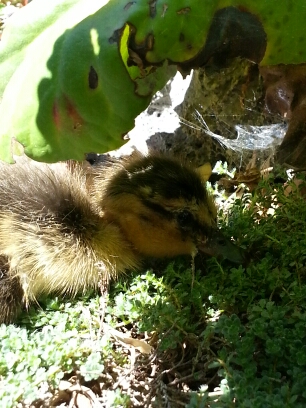
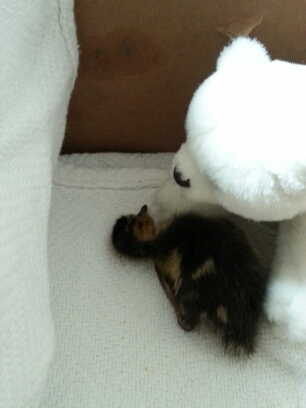
His back slowly straightened out, the hole in his head mostly disappeared beneath healthy fluff, his nub of a wing gradually lengthened to almost equal the other, he’s eating and drinking like a champ, and his mobility is quite good. One eye still looks strange but other than that’s he’s thriving. In two day’s time he transformed from an injured, weak, and misshapen little newborn into an active, thriving ball of fluff who managed to scale to the top of his stuffed bear, hop onto the lip of the crate he was in, and almost topple off into the waiting jaws of Dane the mangy rescue mutt lurking just below.

They grow up so fast, don’t they?

Clearly, we’re not duckling-proofed around here so, after nourishing fantasies all day Saturday of taking an older Modo out to paddle along contentedly behind my kayak whenever I go, I went online instead and Googled bird rescue centers in Boise and found the Ruth Melinchar Bird Center (an offshoot of Animals in Distress Association) which opens every year from April to September and takes in thousands (literally) of orphaned wild ducklings and goslings to raise and then release  back into the wild.

(Boise is a major nesting area for mallards and Canada geese and in the spring it’s not at all unusual to see cars on major city thoroughfares careening to a halt as a mother leads her newly hatched brood out across the street heading for the nearest body of water because nobody wants to run over a string of babies.  Nobody.)

I freely admit I was fighting back tears while driving over to the center to deliver Modo into his next life.  Turns out nursing a fragile baby bird through it’s first couple of days is something of a bonding experience…you wouldn’t believe how fast it happens…and I was beyond sad about giving him up, scared that he might get lost and pecked to death by a band of unsupervised ducklings, and worried that I might have already screwed him up for life by letting him imprint on me in the first place.

(A typical Mother’s Day.)

But the rescue center was delightful, the women working there were cheerful and grateful I’d brought him in, and they let me go back and peek into the tub that held eleven other shy ducklings nestled contentedly in a corner before they slipped Modo in with them.  At first I was glad that he barely paused before heading straight for the others, but then he started pecking at them which drove them all away, at which point I swung from the fear of him being pecked to death to an uneasy feeling that he might grow up to be one of those detestable drakes that chase down females and tear clumps of their feathers out while trying to mate.

I also found myself irrationally wanting to apologize for his bad manners and explain that he might have been brain-injured, but the women assured me his aggressiveness was a good sign.

In any case, he’s on his way now, saved from a cold and certain death on our driveway for some other kind of certain death later on, hopefully after he’s had a chance to fly and swim and mate and nest and fish and migrate at least a couple of times beforehand, although I’ll never know.  But anyway that’s what I’d like for him.

Or her.  I asked and was told there’s no way to tell gender when they’re still that young so I can add that to the list of things I’ll never know.

Anyway, I took one last video of Modo out in the garden with which to remember these two halcyon days of surrogate motherhood by.  Here’s all one minute and thirty-four seconds of it for anyone interested in seeing how much he improved:

(I just discovered that this video is no longer available. Evidently, when I deleted by Google+ account it deleted my YouTube account as well. First do no harm? Right. Sigh…sorry for the tease.)

Also, for anyone interested here’s the contact information for the bird rescue center:

Phone: 208-338-0897

Address: 4650 N. 36th Street, Boise, Idaho 83703

I gave them a very, very grateful donation before I left and if anyone else feels so inspired I figured I could at least make it easy for them.

copyright Dia Osborn 2013


Modo’s precarious beginning.

Here’s about four minutes of video I took of Modo day before yesterday while I was trying to assess his chances for survival.  For those who missed it, he’s a little hunchback duckling I found in the middle of our driveway.  He’d fallen over and couldn’t get back up so the mother had to leave him.

Pretty adorable.

Modo: A little hunchback duckling.

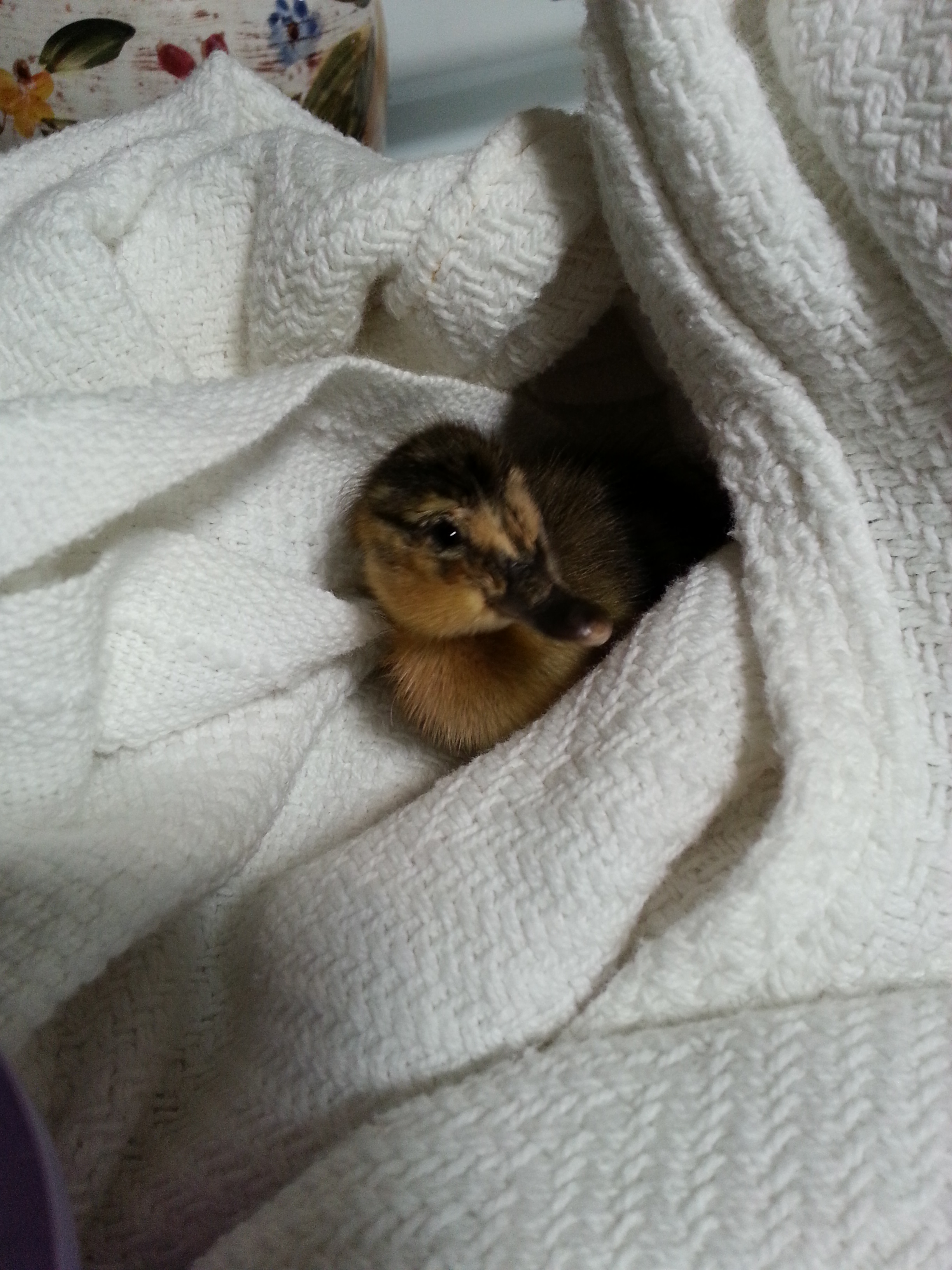
I walked out this morning to empty the trash and discovered a brand new duckling lying on his side in the driveway and struggling weakly against the cold concrete.  He’d been abandoned due to some deformity.  One wing is shortened and rather useless and has a little hunch on the shoulder above it.  Couldn’t just leave him lying there so I brought him in.

20130510_080204

He’s been steadily improving as the hours go by.  I’ve taken him out to the garden a few times to observe his mobility.  He was still falling over on his weak side but was beginning to occasionally recover without help.

20130510_113631-1

And, per advice from John Gray, the bird king over at the ever fabulous Going Gently, I’ve given him warmth, water, food, and a stuffed bear, which he’s really taken to.

20130510_123525

I’m not quite sure what to do next.  Rescue center maybe?  I’m in a quandary as I’m not an advocate of domesticating wildlife yet this little guy could never survive on his own.  Shit.

In the meantime I’ve named him Quasimodo but am calling him Modo for short.

copyright Dia Osborn 2013

Random Hot Tip About Dying #2

This post is a continuation (well done, me!) from the last one: Important Writing Skill: Follow Through.

Random Hot Tip About Dying #2 went something like this:

“Accepting dying might not always make it easier when it comes, but being horrified is guaranteed to make it worse.”

Once upon a time on a flight from Denver to St. Louis I found myself seated next to a late-boarding, extremely chatty, middle-aged woman from New Jersey who kept up a non-stop flow of conversation with everyone who would listen from the minute she first came through the front door till I got off the plane in Missouri.  I’m fairly friendly when I travel but this woman put me to shame.

I was on the aisle, she was in the middle, and a handsome thirty-ish man sat next to the window on her left.  Predictably, she engaged Mr. Handsome first and they conversed for close to half an hour before she finally turned towards me, smiled brightly, and commenced her interrogation.  We got through where are you coming from? and where are you headed? in less than a minute after which she asked me the question I’d been waiting for: So what do you do?

I smiled and said, “I work with hospice,” then sat back to watch the show.

She didn’t fail me.  In fact, she was magnificent, it was hands down the best display I’ve ever seen.  She froze at the word hospice and went pale, eyes widening and mouth forming itself into a mute little “o” as if she’d just discovered she was sitting next to the grim reaper.  She stared into my eyes for probably ten full seconds (which is a very long time to just sit there and stare at a complete stranger without saying a word…go ahead, time it) and then turned her back on me and engaged Mr. Handsome in forced conversation for the rest of the flight.

I chuckled and went back to my book.

Paul_Gustave_Dore_Raven1

Illustration of Edgar Allan Poe’s Raven by Gustave Dore (1832-1883)

Her reaction was extreme but hardly unusual.  I’d guess somewhere around ninety to ninety-five percent of the people I told over the years fell somewhere along this squirming-to-bugeyed spectrum when they learned that I worked with the dying.  Only a handful were open and willing to talk about it, which tells you something about us.

Needless to say I never chuckled when I saw this kind of horror in a person who was currently dying, or someone who loved that person who was dying, mainly because it’s so. not. funny. in real-time.  It’s tragic.  In the person who’s dying it can produce varying degrees of self-loathing and bitterness, while in a loved one it either keeps them away or, if they do force themselves to swing by and stand uneasily near the bedside for a half hour, it can make the dying person feel so bad that they wish they hadn’t come.

Look.  Dying is challenging, even for those who are ready for it.  I’d be lying to you if I told you otherwise. Physiologically, it’s full of graphic processes that are uncomfortable, undignified, and unlovely.  Emotionally, saying good-bye to everything you’ve ever known and loved is a bitch.  And existentially, everyone has to face that this is it and decide what kind of afterwards they’re looking at and deal with that if necessary.

It’s a lot of work, but just like any other kind of work, how you approach it makes a world of difference.  During my years in hospice I saw a lot of people die well, with dignity and humor and sorrow and regret and suffering and love and acceptance all bundled together in a final package of overall grace.  Without exception, these were people who eventually accepted that they were dying and found something in their life to care about to the last anyway.

And BTW, they didn’t do it alone.  They did it with a lot of help and support from those who loved them, as well as the hospice team who was working like crazy to make it happen for them.

I should mention here that everyone is a little bit horror/little bit grace when it comes to dying. That’s part of being human, to encompass the full range, and if you find you’re currently coming down hard on the horror side of things, don’t worry.  It’s perfectly normal for the shift to acceptance to be gradual and erratic and to some degree it keeps happening all the way to the end.

But it does take effort which is why accepting dying is a good goal to set your sights on now, wherever you are in your life.  It can not only improve the quality of your dying time when it comes, it can also improve the quality of your life long before then.  Not to mention that it also improves the quality of life for everyone else you know who’ll be dying before you do.  Dying is a social activity that affects the entire community so ideally we’d all be pitching in to support and include whoever’s turn it is more than we do.

Trust me, whether you’re dying yourself or visiting someone else so engaged, compassion and acceptance will do far more good than revulsion and dread ever could.  Dying is hard enough work without piling that on top of it, too.

copyright Dia Osborn 2013

Random Hot Tip About Dying #1 and Follow Through

Finish

(This photo is borrowed from an excellent post on the blog Prof KRG dealing with the same challenge from a different angle.  Useful stuff, here.)  

There are two things I’d like to cover in this post:

1)  Finishing (or not) what I start.

2) Explaining Hot Tip #1 About Dying from my last post as I (hinted suggested prevaricated half-promised wiggled and sleazed) mentioned I might.

Finishing what I start.

Follow through, where writing is concerned, is not my strong point.  I know it.  My writer’s group knows it.  Anyone who’s seen the three-year old I gotta copyright it for the book, man… notice in my sidebar and yet can find nothing else about the book anywhere on this blog has probably figured it out by now.  I’m in serious danger of turning into a writer’s cautionary tale, an Aesop’s fable about what happens when you never actually finish any of the writing you start.  (Hint: You eventually turn into a fattening, graying dilettante who spends the rest of her life writing flashy first chapters and then basking in the dwindling number of wows she gets from the dwindling number of readers who have a dwindling tolerance level for that kind of tease.)

I’m not there yet although my fear of it is rising exponentially because I’ve just launched my fourth major assault in six years on this book I’m trying to write.  It’s morphed from non-fiction into creative non-fiction into fiction.  From a kind of helpful guide into a memoir into an imaginary story.  It looks nothing…nothing…like any previous version and deep down I’m now terrified that I’m just swimming around in circles but consoling myself that at least I’m covering a lot of miles.

There are only two possibilities left:  Either it’s a structural/voice problem as I keep telling myself, or it’s a basic discipline/courage problem.

And actually, as I was writing the above I realized it’s both.  But the second problem is bigger.

It’s not that I don’t spend hours writing everyday, I do.  My butt time is duly noted and logged every morning just like it’s supposed to be.  No.  The problem is that I spend those hours writing, then rewriting, then micro-rewriting the same sentence/paragraph/page over and over again because I’m absolutely terrified of writing something that will make me look stupid/bad/inept/untalented, and because it’s a whole lot less risky to edit than create.  (Like right now I’m thinking of shelving this post because it’s already too long and who cares about my writing process anyway you narcissist and why can’t I just distill it into the heart and soul of the thing instead of using three million fucking words for a blog post and I’ve now reread/tweaked this paragraph seven times because I’m too scared to keep going…you get the picture.)

This has got to change.  Today I’ll take a stab at it with a baby step.  I’ll follow through on something I wanted to do after my last blog post, which brings me to my second object with this post:

Explaining Random Hot Tip About Dying #1 from my last post.  For those who don’t remember, the tip goes something like this:

“Dying is as much a gift as it is a punishment.  Pick which view to invest in carefully as it will affect your entire life.”

The gift-part can be a little difficult to see, especially if you’re not that familiar with dying. But there are actually a lot of gifts and they tend to be profound.

(Like, for instance, if I never finish my book at least I’ll eventually die and be done with it.)

I’m kidding…kind of…but it’s still true.  For me, as a long-time depressive, the knowledge that none of the dark periods I cycle through can last forever has lent me endurance more times than I can count, and actually saved my life on the two hardest days when I finally lost hope.

The dying people I worked with gave me another gift I’ll never be able to repay. It was while I was with them, listening to all the stories about living from those facing certain death, that I finally learned the secret of  how to long for my own life.

They also taught me about how dying can be a final act of generosity, a way of saying I’ve loved this life so dearly but have taken enough for myself. It’s someone else’s turn now, to come into the world and stand where I’ve stood, to love what I’ve loved. Thank you.

And in allowing me to watch the way their beautiful, tender, wasting bodies were unravelling and vanishing they taught me about the difference between life and Life.  How biological existence is one kind of luminous miracle, how the consciousness rising within it is a second, and how the love those two things wind up generating between them is the third and greatest miracle that transcends and outlasts them both.

But I’m getting mystical again…which, honestly, I can’t really help but need to at least try and curb a little.

In any case, these are just a handful of the gifts that I discovered about dying.  There are more, lots more, but in the end each person has to delve in and discover their own, and they’ll be different for everyone.  It’s worth the effort because it can help to change the lifelong prospect of dying from something horrible, unnecessary, miserable, and bleak to something that’s a little more helpful, even nourishing, to the life we get to live until then.

So that’s it.  I’ve actually finished follow-up baby step #1!  My confidence is building.

Next up: A post explaining Random Hot Tip About Dying #2 which goes something like this:

“Accepting dying might not always make it easier when it comes, but being horrified is guaranteed to make it worse.”  

Now if I can just press the publish button I’ll be in business.

copyright Dia Osborn 2013

Five Randomly Useful Hot Tips About Dying

(Quick note: These tips refer to dying, not death. I don’t have any hot tips for death yet. For those confused on the difference, dying is that thing we do at the end while we’re still very much alive.  –Editor)

1) Dying is as much a gift as it is a punishment.  Pick which view to invest in carefully as it will affect your entire life.

2) Accepting dying might not always make it easier when it comes, but being horrified is guaranteed to make it worse.  (Trust me on this one.)

3) Learn about dying from people who are familiar and comfortable with it.  The terrified can’t teach you much you don’t already know.

4) A “good death” is good for everyone.  A “bad death” is bad for everyone.  As a group we need to be shooting for a lot more good deaths than we are.

5) There’s some version of an afterlife/afterwards for everyone.  Pick yours and start making it work for you now.
If I don’t get distracted by another idea (a big if these days) I’ll try and elaborate on these tips in upcoming posts.  I imagine they probably need it.

copyright Dia Osborn 2013

Life’s glorious illusion

Zan_Zig_performing_with_rabbit_and_roses,_magician_poster,_1899-2

It’s something, to watch a person die.  It truly is.  It’s amazing to watch them being born, too, which I’ve also done, the way that one moment there are three or four people in the room and then the next there’s a fifth only nobody came through the door.  It’s like magic.  Like watching someone pull a rabbit out of a hat, only a gooey one, with no fur and a weird shaped head.

Watching a person die is like magic, too, only rather than someone appearing out of nowhere it’s more like watching them climb in a box and get sawed in half.  One moment they’re all in one piece and waving at you and then the next they’re split in two, a body on one side of the box and the life it used to contain on the other, and for all you’re worth, you can’t figure out how it was done.

I was shocked, the first time I saw it. Maybe the second and third time, too, or longer even, but sooner or later I started to get the hang of it and the shock wore off.  I stopped being offended by the indignities involved, which then made it easier to notice some of the other details.

Like the fact that afterwards, there’s this beautiful leftover body lying on the bed which, it suddenly becomes crystal clear, really, truly is just a body, a big bag of physical stuff that all by itself, God bless its little heart, can’t do a whole lot.  I always knew that’s what it was of course but still, I didn’t really.  I kept forgetting because it was wearing this delightful, shimmering life disguise, kind of like puffed-up peacock plumage full of rainbows and a million eyes, and it made that body look like it was more, a lot more, than just a physical bag of stuff.

It’s a helluva trick.

But still, in the end, it is what it is and has to revert to form.  I watched my first person die, my grandmother, and was stunned when her amazing, beautiful body went limp on the bed like it did.  It looked so helpless and vulnerable and smaller somehow, lying there all by itself, and I got confused. It was like someone had just pulled a big, velvet curtain back to expose the little man standing behind it with nary a wizard to be seen.  Huh-oh, I thought, and then couldn’t stop staring because it just looked so wrong. 

But that was the first time, when I was inexperienced and didn’t know any better.  Eventually though, when I got more used to it, the whole idea of a body without a life inside it turned out to be more okay than I thought.  Left to their own devices bodies, like exposed wizard imposters, are actually kind of endearing in their own fragile, comical kind of way, and when I stopped expecting them to be great and all-powerful it was a lot easier to see their smaller body-specific joys and relax.  To laugh a little and enjoy the illusion.

I was lucky to have the opportunity to see it again and again like I did…how a body and the life it contains whisper their lingering farewells and then go their separate ways.  It gave me a chance to get over the first shock and discover the mistake I’d been making, that a body really, truly is just a body and that I can still love it anyway.  Wildly and more than ever.

It would have been such a bummer to only see someone die once and then be left forever afterwards, stuck in the shock and confusion.  I wish more people could be as fortunate as me.

I wonder if it would help others be less afraid of being there for those who are dying?  Maybe even help them recover more quickly afterwards with at least one of the traumas involved lightened a little.

copyright Dia Osborn 2013

Rhythmic sea lions–what’s a scientist to do?

Here’s a piece that caught my attention this morning.  A Santa Cruz researcher trained a young sea lion to keep a musical beat which, evidently, is considered a breakthrough discovery.  Here’s the video:

What really surprised (and confused) me was the young man’s assertion that to date, scientists have maintained that mammals are incapable of keeping a beat, that it’s an ability specific to humans and some birds capable of vocal mimicry.

Huh?  Don’t they watch Youtube?

Here’s a dog tapping his foot to some rock music:

And here’s a golden retriever grooving to a jazz beat:

Honestly, scientists can be so brilliant and yet so clueless sometimes.  Especially where animals are concerned.  Of course their position is an incredibly difficult one considering what they have to do to these little companions on a daily basis to produce all the miracles we demand of them.  I imagine if it was me doing the experimenting that I’d have to deny any of them were intelligent, sentient beings capable of love and suffering, too.

Sigh.

As always, I continue hoping for a shift in paradigm on this one.  And it may be coming.

NEXT POST: The Cambridge Declaration of Consciousness–a group of leading neuroscientists announces that many animals are indeed conscious beings capable of experiencing stimuli the way that humans do.

copyright Dia Osborn 2013

What’s going on with out of body experiences? Those hanging around the outside would like to know.

414px-GoldFlwr3

The Secret of the Golden Flower from Chinese book of alchemy and meditation.

I’ve been hearing the last few months about a neurosurgeon, Eban Alexander, who had a near death experience that should have been impossible if NDE’s are really caused by lingering subtle brain activity as most skeptics believe.  Evidently, the part of his brain necessary to support such lingering brain activity was destroyed by a raging bacterial meningitis infection so that explanation, in his case anyway, is out.

It’s a fascinating case and gives some of the most compelling evidence I’ve heard to date that our consciousness might actually arise from something other than just the physical brain (which has some broad and controversial ramifications.) In addition, the story of what he experienced internally while “dead” is strange and beautiful and filled with a lot of hope…which makes for a very good listen indeed.

BTW, if his conclusions about what he experienced wind up holding true for a broader swathe of the rest of us, it’s good news. I like it anyway. He recently published a book documenting the whole thing if you’re interested.  I haven’t read it myself but it’s available on Amazon here.

I track this type of development because I basically have two conflicting minds when it comes to this kind of esoteric stuff.  On the one hand my scientific mind tenses up and rolls her eyes, even though she knows there’s no evidence-based proof either way.  Traditionally, something like NDEs isn’t a topic that science is supposed to weigh in on because it’s not measurable, so I know she shouldn’t even have an opinion which makes me squirm.

On the other hand, the rest of my mind swivels around in her chair to stare at the scientific side in disgust and says What the hell are you rolling your eyes about?  You’ve been experiencing this kind of shit since you were three.  Don’t be a hypocrite.  And because that’s true, again, I squirm.

From what I can tell, most people seem to experience something that’s scientifically unexplainable at some point during their lives, NDEs are just one example. The list covers everything from deja vu, to knowing who’s on the other end of the phone before it’s answered, to seeing or sensing deceased loved ones, to so-called hauntings, to the feeling of being watched, to psychokinesis, etc. etc. etc.

And, while none of us are usually encouraged to talk about it afterwards still, these experiences often leave long impressions, for better or worse.  And in such cases we remember and stash their memories away in safe and secret places where we can finger them again in private moments when no one’s looking.  Because even though sometimes these experiences are just small and curious and insignificant, sometimes they’re life changing.  And, at the extreme ends of the spectrum, they can wield some extreme influence, either destroying lives or saving them.

One of mine happened when I was eight or nine years old and riding in the family station wagon when we lived in Hawaii.  We were outside Honolulu on our way to one of my gymnastics meets and there was a van full of people driving along parallel to us in the next lane.  I was studying the driver, a man, wondering very intensely what it would be like to be him, driving wherever he was going, in his completely different world.

Suddenly, my physical viewpoint radically changed and I found myself looking back at our station wagon from the driver’s seat of the van.  I was stunned and looked wildly around for a moment…at the mountains beyond the station wagon and the highway just ahead of the van…and then felt a wave of panic as I realized that I knew absolutely nothing about this man’s life and certainly didn’t want to be in it.  At that point my viewpoint radically shifted again and I found myself once again sitting in my own body in my own car with my own family in my own life, and my terror quickly faded.

Being eight or nine years old I didn’t really care about explaining what happened, I was just glad it was over.  But ever afterwards I was a little more cautious about wondering that intensely about other people’s lives.  (Even so, the same thing happened a couple other times over the years and was, again, quite scary.)

I also go in and out of periods where I have intense and vivid dreams about people or events that turn out to be true.  Like the time when I dreamed that an old high school friend I hadn’t seen for ten years was happy and pregnant.  The dream made me want to reconnect and when I finally tracked her down and explained what prompted me to call, we were both amazed when she told me that she was indeed pregnant with her first child.  It happened again with a dream about another woman I’d once known in Los Angeles whom the entire community had always looked up to as having the strongest marriage around. In the dream I saw she was having severe marital problems but didn’t think much of it after I woke up.  Six months later though, I heard she had just decided to divorce her husband and everyone was surprised and shocked.  I, on the other hand, remembered the dream and thought, hmm.

To be honest, I don’t really like this particular type of experience when it happens because I don’t know what to do with it. I’d prefer to stick with my own body and life, not roam around peering into somebody else’s like some kind of creepy voyeur.  There’s so very much that I’d rather just not know.

Anyway, I guess part of why Eban Alexander’s account is so intriguing to me is because, for a variety of reasons, staying in my body has always felt a little hit and miss.  My consciousness seems to be more jellyfish than oak with a tendency to drift rather than root.

For instance, due to some early trauma I developed the trick of leaving my body whenever things got too scary or painful (which I know sounds really strange to people who aren’t familiar with it but it’s actually a common coping mechanism called dissociation.)  Then there’s a sweeter, friendlier way to float up and out that happens sometimes in deep meditation or prayer.  And I occasionally experience the vivid physical sensation of sliding back into my body again just as I’m waking up from sleep.

Then there’s this other related experience where I’m both inside and outside my body at the same time, experiencing both simultaneously, which can be either beautiful or disruptive depending on what’s immediately around me.  (Nature is wonderful, people are pretty disorienting.)

And I’ve just never dared do heavy drugs.

For all these reasons and more, the question about whether the seat of consciousness is strictly brain-based or something else feels kind of personal to me.  For the sake of my mental health I’d dearly love to have more consensus about what’s really going on.  I’ve always wished it was safer to talk about more openly…to probe and explore and have intelligent, non-biased discussions in a search for explanations and possible constructive uses.  But up till now that’s been tricky.  One runs the risk of being turned on by either a pack of rabid scientists or a pack of rabid spiritualists.  Maybe Mr. Alexander’s experience will open the door to some common ground.  I hope so.

I suppose I should probably start the calmer conversation with the two conflicting parties in my own head.  I mean if I can’t be more respectful of my own experiences and doubts and questions, then how likely is it I’ll be able to listen respectfully to anybody else?

Anyway, anyone else want to weigh in?  I’m very curious to know what others are thinking and/or experiencing out there.  Leave a comment if you’re feeling brave.


Weddings and Funerals and Hospice, Oh My!

Required: Emotional Flexibility to handle wide swings.

There’s a lot going on these days.  First: A news headline.

Beloved daughter and longtime boyfriend get engaged on Valentine’s Day, set date for June.  Mother surprises herself and approves.

Why the surprise? Well, partly because I’m not a big fan of weddings.  In my teens, I used to have nightmares about being a bride trapped in a church ceremony from which there was no escape and I’d wake up every time with my heart pounding, scared to go back to sleep.  These dreams left an impression.  In waking life, I actually ran away during my wedding to the hubster and he had to head me off before I made it into the woods, then carry me back.  (He’s both quick and strategic, thank God.  But that’s a story for another post.)

And then, of course, there are all the other things to worry about where the post-wedding marriage is concerned, especially when entered into by a couple of novices who are all dazed and happy and oblivious to that circle of glowing eyes waiting just beyond the twinkle-lit garden.

But in spite of my entrenched dread of weddings and general worrying nature, when Beloved Daughter and Soon To Be Son-In-Law (SIL) sat us down and told us the news, my first response was enthusiastic and joyful and even…god help me but it’s true…optimistic.  You could have knocked me over with a feather.  I was actually happy for them which, I should mention, is an excellent sign since my initial, gut level reaction to things is usually pretty accurate.

So, reality #1: I’m in happy wedding mode.

Then there’s the other thing happening.

The hubster’s whole family is still in hospice mode, circling the wagons around Mon Pere as he cheerfully and busily packs as much as possible into the shining, beloved life that still remains to him.  I haven’t posted any updates in a while but he continues to amaze in his approach to the whole thing.

He’s slowed down considerably and is sleeping more and more, but even so he still goes out to attend classes at the local university, voraciously reads and replenishes a stack of books that would choke a pig, gets together with family and friends for every occasion possible, and has thrown himself into a cause that would be of enormous benefit to the safety of our entire community.

He’s extraordinary.  Really.  When I think of how much earlier we probably would have lost him if he hadn’t gone on hospice and started receiving good palliative care, I shudder.  There are too many lives being worsened or cut short these days because of overly aggressive treatment or uncoordinated care late in life, and I’m profoundly grateful…every single day…that Mon Pere managed to steer clear of those treacherous shoals.

He’s a wily old fish, that one.

So, reality #2: I’m also in emotional, unpredictable hospice mode.

Then there was this third thing that happened last week.

The hubster’s oldest and best friend lost his 90+ year old mother a week and a half ago and the family held the funeral Thursday evening.  The hubster and I attended, as did Mon Pere since he’s also close to Best Friend.

In fact, Best Friend asked Mon Pere (who is an excellent public speaker) to stand up for him and read a brief vignette he’d written about his mother during the funeral, since he knew he’d break down and sob uncontrollably if he tried to read it himself.  Mon Pere was happy to help out in any way he could.

What happened next was moving and astonishing to me.

In a curious turn of events, the hospice that cared for Best Friend’s mother is the same hospice currently caring for Mon Pere, and since the chaplain presiding over the funeral proceedings was the chaplain for this hospice, Mon Pere knew her quite well.

So before he started reading the vignette, he took a moment to express his appreciation for the chaplain specifically and the kind of work that hospice people do in general, and then things became startlingly poignant when he shared that the reason he knew her was because he was currently in hospice himself with prostate cancer.

I heard the woman sitting behind us gasp when he said it, and there was a brief, electric rustle that went through the room before things settled back down again.  It was only a few sentences spoken simply and sincerely, as though he was sharing that he and the deceased had an old school friend in common, and then he bent his head to read Best Friend’s story.  And that was that.

It was a brief moment, startling and fragile and honest and moving, but everything afterwards was made a little bit more beautiful and real and immediate for it. It was like he’d taken a needle and innocently woven an additional, luminous thread into the tapestry of all of us assembled there, and suddenly life was no longer just a two-dimensional kind of us and them thing anymore—those who are alive and those who are dead.

For a heartbeat he stood there, simple and shining, as a reminder that life isn’t so much a table that we fall off and disappear from as it is a perpetually flowing river, something that’s sweeping us all from upstream to downstream to a final spill out into a big ocean that was always waiting there to receive us.  Best Friend’s mother washed into that sea a week and a half ago while Mon Pere’s pace is picking up in a final, quickening rush to get there, but that doesn’t mean either of them will ever be gone.  They can’t be gone because no matter how far ahead they and their peers get, it’s still the same water carrying us all.

So.  In my third and final reality these days I am:

Wedding-happy, hospice-reeling, funeral-touched, and bobbing somewhere along the length of a winding, luminous river filled from headwaters to ocean with dearly beloved companions.

Which makes today another very, very good day.  Shakespeare (as usual) says it best:

Image

copyright Dia Osborn 2013

Hope: Options In A World Of Growing Antibiotic Resistance

Hope_in_a_Prison_of_Despair

Hope in a Prison of Despair by Evelyn De Morgan

I’ve been following the rise of antibiotic resistant diseases (along with viral outbreaks and world touring parasites) since about 2005.

I don’t know why I do this exactly, other than being insatiably curious about these tiny, adaptively brilliant, nearly invisible little companions that outnumber us by magnitudes of trillions and wield a level of power that takes my breath away.

BTW, it’s a power for both ill AND good as we’ll see in a bit, so don’t panic yet.

You may or may not have noticed some of the headlines lately, but first the director of the U.S. Centers for Disease Control and now the U.K.’s Chief Medical Officer have come out publicly to announce that we’re heading over the predicted cliff where antibiotic resistant diseases are concerned.

Antibiotics are losing their effectiveness against a disconcerting array of infections now.  Some of those tiny bacterial companions I mentioned earlier?  Well, they’ve been very, very industrious and mutated to the point where antibiotics just aren’t slowing them down like they used to.  A couple have actually become bullet proof where no antibiotic can touch them.

The language in these bureaucratic announcements is eyebrow raising.  There were unusually dramatic words employed like catastrophic and nightmare which, if you don’t follow these things, is kind of the governmental equivalent of tearing hair and screaming from rooftops.

So what does all this mean?  Well, if you’re a bacteria, it means the future’s looking very rosy.  But if you’re human?  Not quite so much.

Picture the world as it looked before the development of penicillin and you start to get an idea of how much our lives have changed since the terror of infections ceased to rule them.  Forget about syphilis, tuberculosis, and pneumonia.  Once upon a time a splinter or scraped knee could turn fatal if they became badly infected.

Of course things won’t return to exactly the way they were back then.  On the good side, antibiotics will continue working to some extent, and on the bad side, we’ve made some of our little bacterial companions a thousand times stronger.  But in any case it’s safe to say that infections are going to be a far bigger issue than they have been for the last seventy years.

Such is the nature of shifts in power.

Naturally, the $64,000,000 question on everyone’s lips is What comes next?  What do we do about all this?  How are we going to treat infections that have achieved semi or complete immunity to antibiotics?

Well, it’s really going to have to be a multi-pronged approach.  Just like there’s no one energy source capable of completely replacing oil, there’s unlikely to be one miracle treatment that can replace antibiotics.

(Although bacteriophages…wonderful little viruses that eat bacteria…may finally get a chance to come into their own. But more on that in a minute.)

First, a couple of other possible prongs off the top of my head:

CIRCLING THE WAGONS

Trying to prolong effectiveness for the antibiotics that do still work.

This seems to be the main focus of our beloved bureaucracies.  It’s kind of a close-the-barn-doors-after-the-horses-are-gone approach but still vitally important and necessary to buy time.  It involves taking dramatic action to try and slow the spread of antibiotic resistant diseases, curb widespread antibiotic abuses, and encourage new antibiotic research.  Of course here in the U.S., any such policy that’s actually been approved hasn’t been funded, (ahem…cough, cough)  but I guess we deserve that. Our politicians’ divide simply reflects our own.

In any case, we’re effectively leaderless for the time being which is why We The People need to start harnessing some of our famed independence and creativity.  Now would be a good time to energetically explore other alternatives in individual, grassroots, and entrepreneurial ways, the leader of which has to be:

PREVENTION

I would like to stick my neck out here and make a few predictions.

1)  We’ll see a renewed love affair with stricter hygiene in clinical settings.

Remember when nuns ran the hospitals, how squeaky clean everything was?  The metal was shiny, floors were knee-scrubbed, sheets were bleached and ironed, and anyone who didn’t wash their hands had them struck hard and repeatedly with rulers?  I predict our tolerance for rulers will return.

2)  We’ll all learn the correct way to wash our hands.

Soap will once more be king.  We’ll not only start using it every time, we’ll use it liberally and scrub up to the wrists.  No more just swiping one’s fingertips under the dribble and then touching every last contaminated surface on our way out the door.  (Or worse, not washing one’s hands at all. I predict that people who don’t wash their hands thoroughly will be the future equivalent of 17th century lepers.)

3)  We’ll start rethinking just how necessary any surgery or procedure really is.

Without antibiotics to back it up, reluctance to cut ourselves open and stick foreign medical objects inside will skyrocket.  I predict fewer boob jobs and face lifts, cesarean sections and knee replacements, as well as a lot more soul searching and research before patients agree to things like stents, bypass surgeries, spinal fusions, etc.  It’s estimated that 30% of American healthcare costs are spent on overtreatment. I imagine the risk of fatal bacterial infections could cut into that.

And then there should also come a rising openness to:

OTHER ALTERNATIVE TREATMENT POSSIBILITIES LIKE:

1)  Maggot debridement therapy.

Living, disinfected maggots eat mostly dead tissue and, wisely employed, can help clean up a chronic or infected wound in the niftiest of ways.  This method fell out of widespread medical use with the advent of penicillin in the 1940’s but it’s recently been making a comeback.  It’s currently only used on a limited scale because most people think maggots are gross, but I predict that dying from an infected wound will eventually be viewed as even grosser.

2) Fecal implants. (The use of bacterial white hats against bacterial black hats.)

With success rates reportedly as high as 60-80% against drug resistant C. difficile the use of fecal transplants is already swiftly rising.  (The good bacteria in the transplanted healthy feces repopulates the compromised intestinal tract driving out bad bacteria.)  There are also early indications that fecal implants may be of benefit for a variety of other serious gastrointestinal complaints and, if so, their value will explode.  I predict that Big Pharma will double down on trying to develop and patent some kind of poop pill.

3)  Bacteriophage therapy.  (The little viruses that could.)

Every bacteria has a hungry little virus or bacteriophage…phage to their friends…that will gobble that specific bacteria right up.  (These little guys are viral white hats to be distinguished from viral black hats like flu and cold viruses, etc.)

Bacteriophage therapy is the science of matching the right virus to the right bacterial infection and then turning a bunch of them loose to have their way.  Pioneered mostly in Georgia before the fall of the U.S.S.R. the therapy was gaining momentum before the advent of penicillin.  (See a trend?  Penicillin accidentally killed more than just bacteria.)  A handful of dedicated Georgian doctors kept the therapy alive through the decades (a great story btw…these guys are fucking heroes) and currently have the most impressive stockpile of therapeutic viruses around, including a happy little phage for MRSA. As I write this some of our own venture capitalists are working furiously to get the therapy through regulatory hurdles right here in the States.

I predict that professional and public interest will continue to rise in other alternative therapies like these that were previously viewed as too weird or gross or complicated to consider.

And on the individual level there’s already a lot of enthusiasm and interest in possible infection control alternatives coming from:

4) Old home remedies and

5) Traditional medicine from other cultures

But those are a whole other blog post and I’ve already gone on for way too long here.

I guess what I’m mainly trying to say is that, while the dwindling power of antibiotics signals the end of an admittedly halcyon age in medicine, it’s by no means the end of the world.  We’ve been battling infections since the dawn of humanity so of course there are other options (a couple of which look like they may be superior to antibiotics for specific infections as in the case of fecal implants for C. diff.)  And there are plenty more options still to be explored.

The transition between medical ages won’t be easy of course.  We’ve become dependent on antibiotics in a way that makes us pretty vulnerable to their loss. I’m not trying to minimize the real and looming threat to public health that we face.

But neither do I want to climb up on the rooftop to join in screaming and tearing my hair.  While grave warnings are absolutely necessary in the current situation, there are other people far better equipped than I am who are already covering that job.

What I’d like to do is try and introduce some hope to the conversation to keep things grounded.  I remember my initial response to all this when I first learned about it some years back was that of a deer frozen in the headlight of an approaching train. It took me a while to calm down and figure out that I didn’t have to just stand there and get hit.

That’s when I started my research and, over time, the more I’ve learned the more hope for the future I’ve felt, so I thought I’d share a couple tidbits here in case it might do something like that for you.  A little hope can works wonders with a bad case of paralysis.

copyright Dia Osborn 2013

p.s. These are all articles hyperlinked in the above text.  Just thought I’m stick them here again for easier reference.

The Rise of Antibiotic-Resistant Infections

‘We Have a Limited Window of Opportunity’: CDC Warns of Resistance ‘Nightmare’

‘Catastrophic Threat’: UK Government Calls Antibiotic Resistance a ‘Ticking Time Bomb’

Are you ready for a world without antibiotics?

How to wash our hands

Phage Biology and Phage Therapy

Morningful

image

Early morning isn’t usually my time of day but I couldn’t sleep. My god it’s beautiful. I feel like I just went on vacation to some unexpected paradise with slanting fresh light and brave song birds and a sweet kind of stillness that’s so different from the deep silence of night. I think I love this, too.

Good morning world!