Writing Into The Dark, Muddy Holes

Ach.  I’m wrestling with a painful, scary part of my book right now and it’s hard slogging.  It involves writing the story of some early violence in my life and feels a lot like Brer Rabbit wrestling with the Tar Baby.  Sticky stuff.

So far every time I reach for the memories I feel like one of those old-time Mississippi fisherman going after catfish in the river bank.  Back in the day they used to swim down through the murky water to the holes in the mud where the catfish hide, then they’d stick a fist in.  If there was a catfish in there, and if it wanted to eat (but catfish allus wanna eat) it’d swallow that fist whole and not let go again till the fisherman pulled it out of its hole and all the way back up to the surface, just a-dangling off the end of his arm like a long, slimy hand.

Dinner served.

But sometimes…sometimes…a man would hook one of the old giants and then there’d be hell to pay.  Too big to pull out of its hole with a mouth too strong to break free of, the tables would be turned.  Oh, that unfortunate fisherman would struggle for a while to be sure, but in the end his thrashing would slow and stop and his body’d just float there in the current, bumping up against the bank from time to time all white and wide-eyed, like it was so surprised it was now the property of Ole’ Man River his self.

These memories of violence are like one of those old catfish giants and I have to be real careful swimming that deep.  I know which holes are theirs, down at the very bottom and darker than all the rest, but I also know that if I do this right, if I’m brave and smart and catch ’em to where they have to give me a gift to make me let ’em go, then they’ll make me not be afraid anymore.  That’s all I want.

So how do I perform this mythical feat?  How do I catch ’em?  That’s where the vast power of language comes into play.  The events themselves, those sudden and brief eruptions of rage and violation that happened so very many years ago now, are long dead.  But they set their stories loose in my life, dark tales feeding and growing down in their holes.

I need to reshape and retell these stories.  Need to put them into harness and make them work for me instead of against me.

Namazu and Kashima from Japanese mythology

It was the dying who tried to teach me how to do that and if I can just get through this first part of the book and finally reach their stories…their luminous, beautiful stories…I know it’ll get easier.

copyright Dia Osborn 2011

Starling Murmuration: Sometimes, Someone Gets Lucky and Then Shares

This brief footage is absolutely extraordinary.  I’ve seen small flocks of starlings doing this before but nothing like this.

The murmuration begins at around 26 seconds but I was also fascinated by the fact that these two women are canoeing in the weather and through the terrain that they are.  I’ve almost always experienced the most wonder and awe…seen the most unusual, even miraculous, things…when I’m out in inclement weather, or twilight or dark, or intense cold, or in other conditions that keep most people away.

I’m not sure why that is actually.  Kind of curious.

Anyway, if you have two minutes, watch and marvel.  It’s truly something to behold.

A New Standard of Absurd

I sent leftover pizza to work with the hubster today, forgetting that he has a company lunch to attend.  He just called and when I mentioned it, he laughed and said, Oh don’t worry about it.  The pizza will keep.  It’ll last for months.  Years.  It has a shelf life of a thousand years…no…ten thousand years.  The stuff is like radioactive waste. And then we laughed because the thought was just so absurd.

The hubster’s sense of humor is always escalating like that.   His jokes climb stairs, scale cliffs, then sprout wings and fly.  He loves stretching farther and higher for the most ridiculous comparison he can find and, I admit, the more ludicrous it gets the harder I laugh.

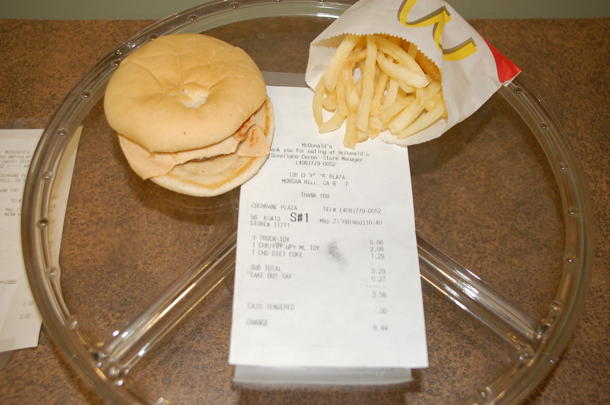
Then, out of the blue, I remembered all the photographs I’ve seen on the internet recording the daily decomposition (or lack thereof) of a McDonald’s hamburger.

And all of a sudden I wondered:  Will McDonald’s hamburgers eventually take over from radioactive waste as the new comic standard against which all decomp-resistant materials can be measured?  Instead of It has the shelf life of radioactive waste will we say: It has the shelf life of a McDonald’s hamburger?

(Evidently fifteen years and counting on this one.)

copyright Dia Osborn 2012

When does living stop and dying start?

This is the kind of question I understand repulses most people but for some reason fascinates me.  It’s not so much about dying…I think…as it is about transitional zones in general.  For me, they’ve always been the place where everything interesting is going on.

I ask the same kind of question when I’m lying around up in the mountains and watching the sun set…at what point does it turn from daytime into twilight and then into night?  Or standing on a beach and watching the waves roll in and out…where are the lines that define where land becomes coast becomes sea?

Where do the colors really change on a rainbow, or is there an exact moment when a marriage fails, or at what length of tail can you stop calling it a tadpole and start calling it a frog?

These kinds of questions have always struck me as important even though I’m not entirely sure why.  Maybe they give me a way to puzzle through the nature of change and the necessity for it?  Or perhaps it’s because I’m not very good with loss and transitional zones all involve losing one thing as it changes into something else?  Maybe I think about it a lot because I’m still trying to learn how to say good-bye, let go, and look forward again?

Or maybe it’s just how I was born.  I mean, really.  Who knows why any of us are fascinated by the things that we are?

But back to the original question, when exactly does dying start?

I used to unconsciously believe that it started when a doctor said that it did.  At that stomach sinking, deer-in-the-headlights moment when a person was told, “I’m sorry.  There’s nothing more we can do.”

Did anyone else think that’s when it starts?  And that everything that happens before that horrible moment…all the whirlwind of treatments and waiting and bad news and worse news and more treatments and uncertainty and all the fear…is still living?

That’s what the journey of dying looks like so often these days.  Plunging into diagnosis and treatment can be so much like being caught up and tumbled in a huge, breaking wave that scrapes you along the bottom and nearly drowns you before finally washing you up on shore, beaten, battered, and gasping…only to be told that now you’re going to die.  Honestly, thinking about it like that absolutely terrifies me. I’m not all that worried about dying but I’m petrified of being over-treated for it.

But anyway, once I started to consider the question, and once I realized what my default answer was, I started observing more closely what was going on in my work and eventually discovered a couple of things that helped reshape my answer and ease that scary feeling a lot:

1)  In hospice I learned about a thing called “active dying.”  It’s when the body starts to go through the final shut-down sequence…when you get what’s called a “cascade of organ failure.”

(For the record, I really dislike that term.  Watching a body shut down never looked like failure to me.  On the contrary, it looked like a brilliantly…BRILLIANTLY…conceived protocol designed to both protect us from further horrendous suffering, as well as extract us from a clump of physical matter that’s starting to break back down into it’s essential elements for future life.  To me, active dying looked just as miraculous and sacred and wild as birth ever did.)

The period of active dying is relatively short, lasting from a couple of days to a few hours and, in my evolving understanding anyway, became the clearest definition of when dying actually starts.

I have to admit, that conclusion really surprised me.  It turned a lot of the standard cultural view I grew up with on it’s head.  It even messed with the entire basis for referring a patient for hospice care in the first place, as they’re supposed to be dying to qualify.

And yet, it also explained something that hadn’t made sense up to that point.  When I first volunteered with hospice I thought I was going to work with “the dying.”  And yet I quickly discovered that the extraordinary people I was meeting were actually living.  Times ten.  In fact, probably more than most of the not-dying people I knew.  I quickly surmised that I’d been laboring under a misperception, but it wasn’t until I finally figured out that dying doesn’t start until the very end that the nature of that misperception became clearer.

So for me, in strictly physical terms anyway, dying starts when our bodies enter the “active dying” stage.  And everything that comes before that, no matter how turbulent or ominous or final, is still living.

So when a doctor delivers that terminal diagnosis…we’re still living.  And when we get referred for hospice care…we’re still living.  And when we start losing our appetite, energy, and bowel control and maybe can’t even get off the bed, I’ll be danged if we’re not STILL living.  Maybe in a period of uncomfortable decline which is a definite bummer, but bummers have always been a part of living, too.  So, so what?

And that was the second thing I figured out which helped ease that scary feeling.

2)  Life and death, and living and dying, are completely different things.

Life and death are nouns.  They’re things that exist as an independent fact, like cell division and tooth decay.  They’re built into the system itself so they happen to us whether we deserve them or not/want them or not/appreciate them or not.  First we’re dragged into life without any discussion and then we’re dragged back out again and, ultimately, we have zero power at either end.  Granted, that’s a little unnerving but I still find the simplicity of it appealing.  Turns out life and death are not…thank you God…something I have to try and control after all.

Living and dying on the other hand are verbs.  They’re the smaller, more manageable ways that we get to participate in these vast and fundamental forces.  Whereas we have no say whatsoever about life and death, we have enormous power over how we choose to live and die within them.  How we choose to deal with them and face them (or not.)  Depending on our inclination, we can turn either one into something meaningful, generous, and humbling or something ugly, painful, and degrading…or more likely a little of both.  We are human.

In any case, that part of it is all up to us.

Which I love a lot because I need something to control.  (As the hubster can testify.)  I will happily give up trying to control life and death as long as I have living and dying to strap into the harness instead.

So back to the original question of when exactly does dying start, over time I’ve found it most useful to think of in birthing terms of all things.  It goes kind of like this:

Life enters the world in in four stages; conception, pregnancy, labor, and delivery.  From where I’ve been standing it looks like it heads back out along the same lines.

1) Conception, for me, would be the moment when I first realize I’m officially heading for the exit.  This is it.  I’m going to die.  I think this one might be the hardest part.

2) Pregnancy would encompass most of the time I have left and would involve all the many and varied preparations required for death; wrapping up my life, finishing all the paperwork, giving and receiving any forgiveness, savoring all my “last times,” navigating all the tricks of a body in decline, saying my good-byes and thank you’s, making damn sure everyone knows how much I’ve loved them and, finally, making my peace.

3) Labor would be the briefest part and would constitute the active dying process.

4) And birth?  Well, to be honest…it’s always kind of looked like birth is happening at both ends to me.  If there’s one thing I’ve learned from studying all these different transitional zones over the years it’s that endings and beginnings are pretty much the same thing–a moment of conception.  I know there are a lot of different theories out there about what’s going to happen after death…and I think they’re all pretty interesting…but I, personally, have no idea what the exact nature of my death/birth will be…and I like it that way.  It makes it all seem like more of an adventure.

But I do know this; in all the time I spent in the rooms of “the dying” I never once saw life itself destroyed.  On the contrary, with each person’s passage I saw it becoming something more vast and measureless than I’d ever understood.

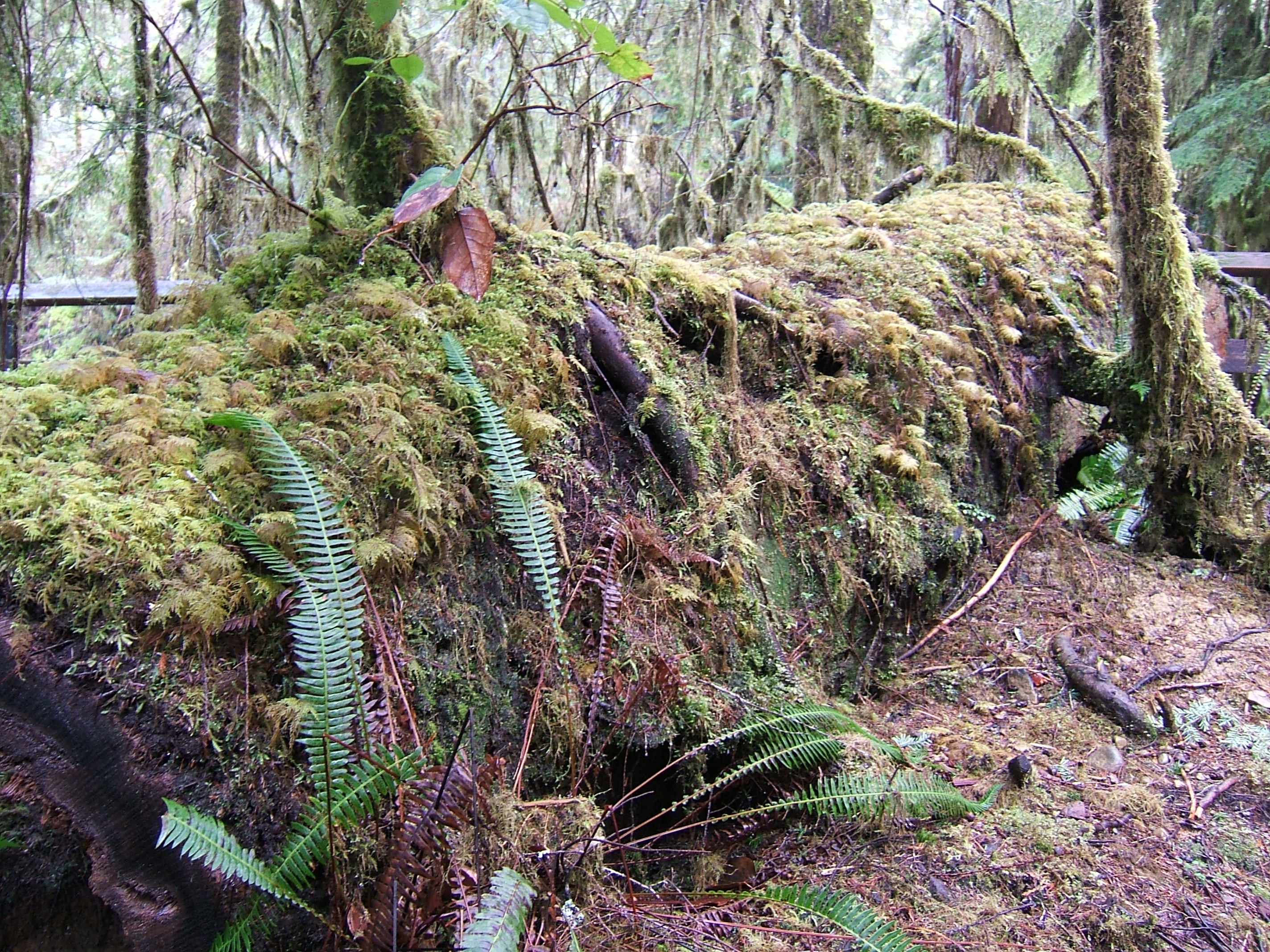
Here’s a photo I took in the Olympic rainforest that captures a little bit of that feeling for me.  The physical part of it anyway.  (Rainforests are like the transitional zone incarnate.  Changing from one thing into another is all that ever goes on in there.)  This is what’s called a “nurse log.”  It’s when one of the old giants falls to the forest floor and magically becomes a raised and fertile world for countless new seedlings to begin their tiny lives.  Nothing wasted, nothing destroyed…only transformed and renewed.

copyright Dia Osborn 2012

A Little Interview With Mr. Will To Live

(This beautiful guy is Hotei, the god of happiness.)

Since I’ve gotten serious about finishing the book I’m spending a lot less time in Blogland so first, I’d like to offer my sincerest apologies to anyone living solely for my next post.  How some people whip out well-researched, erudite, interesting posts a few times a week (or even…gasp…daily) while simultaneously self-publishing multiple books and promoting them is beyond me.  I can’t even type that fast.

Where the book is concerned, I’m currently taking a tip from that wildest of writers, Jack London, to heart.  He claims:

You can’t wait for inspiration.  You have to go after it with a club.

Accordingly, first thing each morning I get out of bed, pick up my club, give it a swing or two for warm up, then sit down at the laptop and dutifully beat on it for an hour.  I figure this way if inspiration ever strikes at my house, at least it won’t be hitting an empty chair.

But my blog-attention has clearly suffered as a result and just in case anyone 1) noticed or 2) cared, I thought I should at least offer an explanation.

And there you have it.  Now on to today’s topic of the will to live.

Lately during club hours I’ve been having some long, thoughtful conversations with an on-again/off-again companion of mine called Mr. Will To-Live.

Mr. Will has mentioned that he’s enjoying our talks enormously as most of the time people seem to take him for granted.  Well not so, me.  I’ve always found him fascinating in the most elusive of ways.

He tells me that, depending on a variety of factors, he shows up a little differently for each person; sometimes strong and pulsing, sometimes erratic, sometimes frail and tenuous, and in a handful of hardship cases like mine, fractured to the point of being almost useless at times.

I asked Mr. Will what factors determine the quality of a person’s will to live and he cocked his head to one side and thought about it for a moment, then ran through this quick sampling:

1)  the will to live has both nature and nurture components to it.  Everyone is born with some degree of a will to live, but no matter how weak or strong it is starting out, it can always change.  (In other words, don’t get too cocky on the one hand or lose hope on the other.)

2)  the will to live puts down most of its root system in childhood so it needs to be fed lots of good, yummy stuff during that period.  A few things that the will to live loves are:

     a)  safety (this lets a child know that they are very, very worth protecting)

     b)  kindness (this allows a child to unfurl all of their amazing, tender, new shoots)

     c)  encouragement (this tells the child that it’s perfectly okay to want things, even a lot)

     d)  freedom to explore (this confirms that the world really is a curious, interesting, worthwhile place to be)

     e)  tolerance for mistakes (this lets a child know that of course they can keep trying)

     f)  a lap and strong arms when things go wrong (this teaches a child that help is a good thing.)

3)  However, if a person reaches adulthood with a gimp sort-of will to live like mine, there are still things that can strengthen it.   A few of them are:

     a) finding someone or something to love (we can continue to stay alive for others even when we’ve lost all desire for ourselves)

     b)  finding a purpose (having something meaningful to accomplish will up anybody’s endurance levels by multiples of ten)

     c)  finding something to fight against or spite (hate and anger can provide powerful reasons to live but have seriously debilitating side-effects. Use with caution.)

     d)  and lastly…service of just about any kind (bringing joy, comfort, aid, companionship or meaning to others in need can nourish not only their will to live but, mysteriously, one’s own.  A marvelous trick, no?)

Service has the additional benefit of inviting Ms. Longing For Life into the room…the wind-beneath-the-wings and beautiful close cousin of Mr. Will To Live.   Hopefully, I’ll be able to secure an interview with her for a future post.

In the meantime I’d like to thank Mr. Will To Live for his time and valuable insights and encourage everyone to try nourishing him with one of his favorite foods once a day.  (Children aren’t the only ones who thrive with a little extra safety, kindness, encouragement, etc.)  It can at least bring a little lift to someone’s day and at best totally turn things around.

copyright 2012 Dia Osborn