Hmmm…An Agnostic Reports A Light While Dying

I recently heard a fascinating dying story.

A woman told me how her elderly mother…either a scientist or an engineer (I can’t remember now, sorry) who was hours from death, drifting in and out of consciousness and totally non-lucid even when she was conscious…began to report on what she was experiencing internally, in a disembodied kind of voice.

It seems the discipline of a lifetime dies hard.

What struck us both was that the last thing she communicated was an experience of light.  She said There’s a light.  Twice.  Which seemed surprising because her mother was a firm agnostic.

The conversation paused briefly as we mused over this.  I mentioned that I’ve heard a lot about this experience of light (of course, who hasn’t?) but the scientist hanging around in my own head, while curious, has remained unconvinced  without further evidence.  The fact that her mother was a scientist and agnostic definitely carried some weight.

To which the daughter, who seemed to share her mother’s rational sensibilities, responded that it didn’t necessarily mean anything more than that her mother was having a visual experience of light.  There’s no way to know for sure what was causing it, and certainly no way to know if it was a sign of anything else.  And I got that.  There really isn’t.

But still…it comforted me.  I mean, seriously, out of all the possible experiences I can think of having to go through during my own transition, heading for light is definitely up there in the top three.  It sure beats seeing something like monsters coming to get me, or heading for a giant buzz saw, or disappearing into a gaping, empty, black void.

Light is good.  I’m all in for light.

And…if any such light turns out to be the precursor to something more cool?  Well, even the non-committal scientist in my head grins at the thought and says, IF that’s the case, then she’s totally on board, too.

Photo by Zouavman Le Zouave at Wikpedia

copyright Dia Osborn 2011

That “thing” in the header

Someone has finally asked about it.  I was beginning to wonder.  It’s been up for the last…what?…nineteen months now, and just when I was concluding from the uninterrupted silence that nobody else found it as arresting as I do, Nel over at Life’s Infinite Possibilities (with stunning headers of her own btw) said…

What’s that “thing” (for lack of a better word) on your header?

Here she is in full.

I believe she was an arthropod of some kind but I can’t be more specific than that.  I found her exposed just as pictured, over on the coastline of the Olympic Peninsula three or four years ago. A seagull–or perhaps one of the many eagles that inhabit the place, I don’t know–had taken a couple bites out of her before being interrupted, maybe by the hubster and I as we meandered up the shore.

By the time I reached her side, she was still alive but mortally wounded. I found her extraordinarily beautiful…the colors so vibrant on an overcast, dreary March day that they took my breath away.  She was a tiny, dying spot of brilliance in a wild landscape of muted grays.

She also vaguely reminded me of female genitalia.  Like orchids do, only with an arthropod’s twist.  It both tickled my sense of humor and made me ache for her vulnerability all the more.

After I took the photograph I cupped her oh-so-gently in my hands, walked down to the water, and placed her right-side up again in the sea. She curled a little when she felt the stones beneath her…the cradling of the water…and I like to think she was happier there. Safer. Like the difference between dying peacefully at home, surrounded by the familiar and loved, versus upside down and alone in a car crash on the side of an anonymous interstate.

Here she is right-side up and back in the sea.

A little farther down the beach we also found a dead seal that was only beginning to decompose.

I originally planned to use this photo in the header but it never felt right.  Looking back now I think it’s because my primary focus here is on dying rather than death.  Both are profoundly beautiful to me, but with as much as I love the stars and stillness of deep night, it’s the elusive magic of twilight…that impossible alchemy that occurs as something is changing its very state of being into something else…that haunts me.  I guess that’s why I’ve always been drawn to transitional environments like coastlines and twilight hikes and storms and hospice. Because they provide portals into the strange, limbo world of transmutation where I can then observe and try to document its mechanics, firsthand.

copyright Dia Osborn 2011

TRUE OR FALSE? “Talking about dying will kill you.”

FALSE.  Talking about dying is non-toxic and perfectly safe for all ages.

I hit this wall a lot though, because deep down the majority of people believe it’s true.

In polite company, when it comes up that I’m writing a blog about…well…the “topic” (maybe if I don’t say the word, you won’t run)…I usually get a blank stare, long pause, and visible squirming, followed by an abrupt change of subject. Some people even turn around and walk away without saying a word.  (Which I admit makes this topic a valuable extraction tool in a pinch.  For anyone seeking to escape a chatty person, its eerie power of repulsion does have uses.)

In any case, there’s rarely an opportunity for a follow-through discussion.  The conversation is dead before taking its first breath and, so far, this hurdle has stumped me.  That’s why I spend so much time poking around the carcass in my mind afterwards, trying to find another angle which might induce more people to join me.

For instance this morning I was chewing on the common question; I’m not dying yet.  No one I know is dying yet.  So why should I think about it now?

This, of course, is the unstated question behind most blank stares and…I’m not gonna lie to you here…it’s a good one, possibly the most important question of all.  In spite of my flippancy, I fully understand why people don’t want to have this discussion: Talking about dying is a courageous act.  In order to do it, you have to stop running, turn around, and face the very monster that IS someday going to kill you and all your loved ones.  Let’s face it, as conversations go, it just doesn’t get much braver than that.

So when I broach the topic to someone who’s half-dressed at the next locker, or trapped next to me for three hours on a plane, or suddenly choking on their turkey over Thanksgiving dinner, I understand their reluctance.  I do.  I realize I’m asking them to start thinking right now about a real-life horror flick that at best they can delay, but will never escape.

Which brings me back to the question, Why should they?  The reasons had better be compelling.

Well they are.  And actually there’s just one:

It’s so they don’t have to spend their whole lives dragging the deadweight of this secret dread behind them.  Once a person learns how to talk comfortably and freely about dying, they can finally stop looking over their shoulder and relax a little. Living every hour, every day, year after year, with a yawning, existential, chronic fear…even if it’s kept pinned down in the subconscious most of the time…is draining and toxic.  Denial can help for a little while, sure, but ultimately it has huge downside.  Huge.  Trust me on this one.  As a long-time phobic I know.

Courage is a far better option and, while it’s harder to muster initially, it makes up for it by having no downside.  None.  In fact, courage not only eases the fear around talking about dying, it actually makes the event itself a whole lot easier to deal with when it finally arrives.

So when I grin at a 31-year old cashier and say Hey!  What do you think about this whole dying thing anyway?  It’s not because I’m the Grim Reaper’s administrative assistant trying to schedule an appointment for her.  It’s only because I’d like to ease some of her fear about the whole thing.  I’m willing to stay and hold her hand.

Facing into any fear shrinks it, and facing into this fear–as early in life as possible–can improve every day that follows in a way that most people don’t even know is possible yet.  I mean, how could they know when nobody ever talks about it?!

Sheesh.

So, what would make you more likely to stick around and have this chat?  If I said:

1)  I write a blog about dying.

2)  I write a blog about talking about dying.

3)  I write a blog that can help ease your fear about dying.  (Actually, is that even true?  You’ve read this.  Are you less afraid of dying now?  More afraid?  Unchanged?  Are you at least more willing to talk about it?  Are you even there?  Hello?  Hello?)

If anyone else has ideas about how to broach the topic of dying in a way that doesn’t repel everything within a hundred yards, I’m totally up for suggestions.  (And please don’t feel you have to be serious.)  Comments are even more welcome than usual on this one.

Thanks.

copyright Dia Osborn 2011

P.S.  The terrifically fun photo above is from Ambro’s Portfolio.

Suicide in Ohio results in the death of dozens of exotic animals.

What a tragedy.

I just learned that a man in Ohio who kept a large number of wild animals as pets, turned them all loose late yesterday afternoon before turning a gun on himself.  The carnage continued from there.  Witnesses called in sightings of roaming lions, tigers, wolves, and bears, after which local law enforcement, with consultation from the Columbus Zoo and other agencies, were given the order to shoot on sight.

As of this writing, the majority of the dozens of wild animals the troubled man set free are now dead.  Of course it could have been even worse.  Additional innocent bystanders in the area, both human and animal, might have easily added to the count.  I’m grateful…I really am…that the ripples of this bloodbath were stopped before they could spread any farther.  But I’m still sobered and deeply saddened by this unspeakable waste of life.

And also…uneasy.

There are clear signs that suicide rates are on the rise since the recession began.  Yet, even while the levels of economic stress and fear are heightening instability, federal and state funding for mental health (which was nowhere near enough to begin with) is now being slashed or eliminated entirely.  Needless to say this is not a promising combination.

IF YOU’RE CONSIDERING SUICIDE: Please, if you’ve wondered if it might stop the pain, or if those you love would be better off without you, or if you just feel so out there on the edge that you’re not sure you can take anymore, pleasebefore you take a last step that can never be undone, make at least one phone call; to a loved one or a friend or a hotline.  (I’ve listed some suicide hotline numbers below.)  If it doesn’t work, you haven’t lost anything by trying.  But if it does work…if, with some help, you’re able to find a way through the current darkness back to a life you love…then not only will you be safe but you’ll also have protected everything you care about most from any taste of the kind of carnage that happened in Ohio yesterday.

FOR FRIENDS OR LOVED ONES:  And if you’re worried about someone else, you can also call one of the numbers listed above.  Or click here for an excellent article with information on what to do if you think someone you know may be considering suicide.

With things as stressful as they are right now, and with the social safety net growing ever weaker, we need to look out for one another more than ever.  I realize the temptation is to get angry over what happened to these beautiful animals and look for someone to blame.  But it would probably do more good to look for others who are still in need of help instead.  Maybe we could prevent something like this from happening again.

My heart goes out to everyone surviving yesterday’s events; Mr.Thompson’s wife and family, their friends and neighbors, the police who were forced to shoot the innocent animals involved, the officials who had to make the difficult decisions, and the remaining animals who have to endure the trauma of loss, fear, confusion, dislocation, and possible euthanasia this has caused.  I wish everyone involved strength, clarity, and forgiveness in navigating the coming days.

SUICIDE HOTLINES:

National Suicide Prevention Lifeline:  In the U.S., call 1-800-273-8255

Veterans Suicide Hotline – Confidential Help for Veterans: Call 1-800-273-8255 and Press 1     http://veteranscrisisline.net/

Or go to  http://suicidehotlines.com/ for a list of hotlines by state as well as a hotline for the deaf.

Sometimes the small picture IS the big picture.

Actually, most of the time it is.   But it’s easy to forget.

There’s nothing quite like the reality (or threat) of dying to help clear up any misunderstanding on this point.  I saw that a lot.  In almost six years of working with hospice I never once saw a person at the end of their life still wishing they could meet a celebrity.  Or win the lottery.  Or grab fifteen minutes of fame.

You know what they did long for?  (Besides wishing they didn’t have to die of course.)  To see their child or friend one last time.  To make sure their spouse or partner knew…really knew…how much they loved them.  To still be a part of the circle. To be in their own home, surrounded by their own things, and cared for by people they knew they could trust.

It hit me every time, how all the events that were happening in the big wide world…things that just a little while ago had seemed so huge, overwhelming, and important to them…telescoped down to the tiny, the few, and the essential.  It was a revolutionary insight.  I’d somehow completely missed this lesson before; that the small things ARE the big things.

Something reminded me of it again this morning.  A couple of YouTube videos have been hanging around my inbox for quite a while now.  They’re both on the long side, ten minutes or so, and…really…who has time for that shit?  I can’t get to all the real stuff that needs doing.  The only reason I didn’t delete them outright was because they were from people who might ask if I’d watched them.  And I suck at lying.

I’m pretty good at procrastination though.

But this morning the guilt set in so I watched them both.  And, lo and behold, what used to happen in hospice happened again.  I had the weirdest sensation of the world turning inside out (where big things get small and small things grow huge) and then I suddenly remembered what’s really important.  Yes, the broader world is something of a mess right now, but there are always plenty of little things going on in it that are perfect and beautiful and right.  And if I just remember that, then all the chaos in the universe can’t stop me from being grateful for my life, or for the many small but essential miracles that fill it.

So…if you ever have some extra time:

The first video is the story of the spontaneous boat lift that happened on 9/11, when a random flotilla of boats materialized out of nowhere to evacuate the hundreds of thousands of people trapped in lower Manhattan that morning.  (If you only have time for one video, make it this one.  It helps heal something that’s still, after a decade, surprisingly raw.)

The other video is a David Letterman segment about a young woman and her horse who got between a charging grizzly bear and the boy it was about to kill, and actually charged the bear.  Twice.  They saved the child’s life.  It’ll blow you away.

Editor’s note:  The original embedded video was taken private so I’m supplying a link to the interview which has been posted on Youtube instead.

copyright Dia Osborn 2011

Bone Monsters And The Evolution of Vocabulary

In the spirit of Halloween, here’s a spooky story.  And because I am who I am and can’t help myself, there are a few thoughts on dying that follow. (It’s like a tic.)

Without further ado I give you:

My Son And The Bone Monster

One night long ago, on a full moon in July, Father was away on a business trip leaving me, his pregnant wife, and our just-turned-three-year old son alone in the house to sleep.  It was a warm and peaceful summer night, not the kind where spectral things usually wake and wander, yet my sleep was restless and I woke up several times during the night to glimpse something shadowy passing down the hallway outside my bedroom door.  Each time I shook it off and went back to sleep, thinking it was just my imagination playing tricks on me.

In the morning I was jolted from slumber by the high-pitched screaming of my son, and I threw back the covers, leaped out of bed, and ran down the hall before I was even half-awake.

I entered the room to find him wide awake and sitting bolt upright, his back pressed hard against the headboard of his bed.  The bright morning sun streamed through the windows illuminating the entire room, yet he was looking into the empty corner near the foot of his bed as though he could see something.

As I approached the bedside he dragged his eyes away from the corner, looked at me and screamed, “It’s a bone monster!  A BONE MONSTER!!”  And I, of course, responded by doing what every good mother does; I tried to reassure him that nothing was there.  That the suspicious corner was actually empty, that bone monsters don’t really exist, that he’d just had a nightmare.

But he only shook his head in frustration, looked me straight in the eye, and said in a low, urgent, rational kind of voice, “No, Mommy.  Not that kind. This is a REAL bone monster!!!”  His voice rose back up to a scream by the last word and he raised his arm and pointed into the empty corner, as though the proof was right there before both our eyes.

That did it for me. The hair rose on the back of my neck and I climbed onto the bed, scooped him into my arms, and pressed my own back against the headboard.  I flashed back to the strange impressions I’d had during the night, of shadowy things passing down the hallway toward his room, and the coincidence gave me just enough pause to quit telling him he wasn’t experiencing something.  His terror was certainly real.  He’d done a remarkable job for a three-year old of communicating that he understood what a nightmare was and that what he was currently experiencing was something else.  I respected the effort and decided to bail on a rational approach and go with maternal instinct instead.  Here’s what She had to say:

Honey, he’s facing a monster here.  Imaginary or not, are you gonna let this thing fuck with your child?

Well, not when you put it like that.  No.

So I planted myself firmly on the bed, gripped my trembling son against my chest, and crooned ferocious words of protection into his ears.  It’s not gonna get you, sweetheart.  I won’t let it.  I will rip that freaking monster bone from bone…tear its head off, smash it down in the street, and run over it with the car a million times…before I’ll ever, EVER, let it get anywhere near you.  And trust me, I meant every word.

I continued along these lines until Bone Monster seemed to throw in the towel and leave.  I realized we’d won when my son suddenly relaxed, looked up, and told me he was hungry. Hallelujah.  We got up, got dressed, and traipsed out to the kitchen to make pancakes.

As far as I know, the Bone Monster has never returned.

Now, I don’t know why my son and I saw the things we did that night but, since it never happened again, not knowing doesn’t matter.

What’s more interesting to me is that my son called what he was seeing a Bone Monster.  Frankly, the term confused me at first.  (And apparently, only me.  Everyone else who hears the story immediately recognizes that he’s describing a skeleton.)  But when I realized what he’d done…that in lieu of the word skeleton which he hadn’t learned yet, he’d put two words together that he did know, bone and monster…the linguistic elegance of the feat just about knocked my socks off.

Think about it for a second.  The two words he chose had a lot of depth.  Both are multiple use, ancient words that have existed in pretty much every language since the dawn of time.  Bone is steeped in anthropological and folklore traditions as well as modern medical and scientific understanding while monster, still used to describe everything from childhood scary things to giant construction equipment to the heads of despotic political regimes, is quite simply one of the greatest words of all time.  (In fact, with the emotional relief its capable of delivering, I think monster ranks right up there with obscenities.  It can be that powerful.)

So separately they pack a punch, but putting these two words together created a description that was unbelievably sophisticated.  It conveyed not only a physical description of what he was seeing (a collection of bones-sans-flesh that were still arranged in the original shape of some kind of creature) but the intense emotional impact as well (monster–communicating supernatural animation, malice, and immediate threat.)

And it was all because he didn’t know the word skeleton yet.

But children do this all the time, you might argue.  So what?  And of course you’d be right.  Small children are wizards of language right out of the gate, which is probably why we usually take the sophisticated achievement that it is for granted.  I honestly don’t know why I woke up for a minute and saw it this time, but I did.  I goggled.  Positively gaped.

But here’s where it gets even more interesting.  The thing is; It’s not just kids who do this, falling back on old words to describe new thingsIt’s what we all do, whenever we try to communicate about rare experiences. Common names don’t exist yet for uncommon things so if we’re going to try and talk about them anyway, we always have to cobble together existing language in a new way.

And, finally, here it comes…

This is what I feel like I’m up against when trying to talk about my work with the dying.  I mean, I have to use the word dying.  I have to.  Physiologically, that’s just what’s happening.  But it’s also a misleading word, because when I say dying most people hear horror + terror + suffering + death, and then they shut down and that’s the end of the conversation.

For a lot of people dying is the Bone Monster.

But it means something different to me.  After working around it a while, caring for and learning from the people who were doing it, the word dying gained more grace and lost some darkness.  When I say it now there’s still horror in it, of course, but there’s also something strange and luminous involved that takes my breath away.  Its terror is countered by first hand observation of our inherent reservoir of courage, and its suffering is buoyed by my discovery of unsuspected strength.

And death?  It’s still there, too.  But now its death + the dawning awareness that our lives are so irrevocably entwined…our dreams, emotions, cells, and breath are so deeply woven into the physical fabric of the world itself…that on some weird, tangible level that I can see and touch and smell and hear and yet still can’t name, we’re indestructible.

I guess for me, dying is the whole package now, instead of just its worst parts.  I think of it as both Bone Monster and everything that protects us from bone monsters at the same time.  It reminds me of my son’s bedroom that morning; where there was a terrifying source of darkness in the corner, but there was also a fierce, radiant bond of love on the bed. That radiant bond exists in the rooms of the dying, too, and I saw it over and over again, a benign force that seems to emanate from everyone involved but also from the environment.  Almost as though it’s structural, like something we’re made out of.

Sorry, that’s the best I can do.  I don’t have adequate language to describe it except in the most primitive terms, which is incredibly frustrating and part of the reason why I started this blog.  I realize I keep harping on this over and over again.  I think it’s just my way of trying to work out some viable language.

Currently, we have hundreds of common ways to describe the horrible aspects of dying but almost none that describe the beauty involved.  It’s no wonder so many people are still dying bad deaths.  Maybe if we start developing some language for the good parts, too, it’ll get easier to start building good deaths for everyone?

copyright Dia Osborn 2011

Disappearing Pools And Our Deep Love Of Places

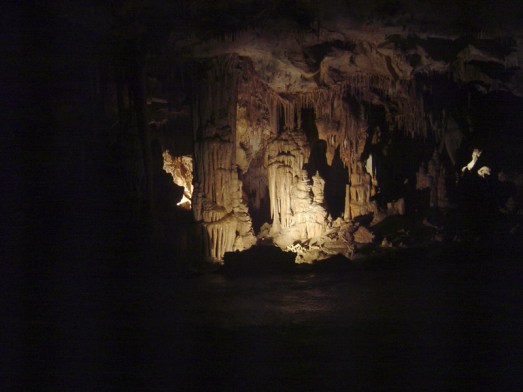
Sunken Gardens inside Lehman Caves

Editor’s note:  This post is a sad one.  Sorry.  I tried and tried but just couldn’t get it to come out any other way.  I know a lot of people who are struggling with these kinds of losses right now (I don’t know, maybe we all are to some degree, there are certainly sweeping changes afoot…) and, while fear and anger are perfectly natural responses, I personally just needed the room to feel sad.  Thought I should let you know.  Dia 

Sometimes we develop relationships with physical places that feel as intimate and necessary as anything we share with people.  It can happen with a childhood home, the family farm, a neighborhood, a church, or a sports stadium.  A stretch of coastline or a forest behind the house.  A garden, an old tree, a park, or a mountain.

Opportunities for this kind of bonding are pretty endless.

And once we sink our roots into one of these places, losing it for any reason can also be as wounding as the loss of a human relationship.  Yet these kinds of wounds are seldom recognized or acknowledged for as serious as they are.

I’m not sure why we’re so resistant to admitting that losing anything other than a first generation relative can be devastating, but we are.  I’ve seen people reel just as much or more from the death of a friend, a pet, or the loss of a home, as from that of an immediate family member.  I’ve watched them struggle just as hard to climb back out of the resulting hole and rebuild their lives afterwards.  But I’ve rarely seen them granted the necessary room to grieve.  Our reluctance to accept and dignify these other losses is both powerful and entrenched.

(But then again, we barely give each other room to grieve the loss of a close family member so I suppose this isn’t surprising.  Y’know, we really need to stop doing this to ourselves.  Communities riddled with chronic wounds aren’t healthy for anyone.)   

I bring this up because I lost a place like this a few years ago.  It was a still, dark pool hidden in a cavern deep underground, and the loss of it is still haunting me.

My mother’s people come out of Ely, Nevada in Spring Valley.  It’s one of those little towns out in the middle of nowhere that you drive through and wonder Why in the world would anyone live here?  Five generations of my family have though.  Four inhabit the cemetery.  Seven have walked the streets of the place and, even though I never lived there myself for longer than a summer, I bonded to it like it was home anyway. It was the central, unchanging hub of my early nomadic life, the one and only place my family returned to again and again, no matter how many times we moved or how many homes we abandoned.  Its high desert, mountainous lands became the geographical North Star off which the rest of my life was mapped.

Surprisingly, underneath those dry, desert lands…winding through a vast system of tunnels and caverns carved out over millions of years…is water.  A lot of it.  And when these subterranean aquifers are relatively full (as they have been for aeons), they seep up to the surface as springs, creeks, and small lakes that support an ancient and delicate ecosystem that would quickly perish without them.

This secret water also collects in countless pools underground that are, for the most part, eternally hidden from human view.  But a few of them are accessible.  When I was growing up there were a number of such pools in the Lehman Caves at the base of Mt. Wheeler which is a little over an hour’s drive from Ely.  The caves were discovered back in 1885 and when my great grandparents first moved to Ely in the early 1900’s, they used to go over and take the “tour” that was available back then.  It involved miner’s carbide lights and crawling through tight cracks (with colorful names like Fat Man’s Misery) to access the spectacular caves that are a part of the system.

Lehman Caves, Mt. Wheeler, and its surrounding lands are such a treasure in fact that they were placed under protection in 1986 and declared Great Basin National Park.

Every generation of my family since the great-grandparents has toured the caves, and it was during my own childhood visits that I became acquainted with a particular pool.  I could never see very much of it because the water stretched back into a recess outside the range of the electric light illuminating the walkway.  But what I could see of it was dark and absolutely still.

Now, some of the pools in the caves tend to ebb and flow with outside water conditions, but this pool had been there far longer.  It stirred something old and unsettled inside me as I learned about it.  How the pool was thousands of years old.  How it had always existed in total darkness and never reflected anything.  How it had never known a current because no wind ever touched it, no living thing ever swam in it, and no water ever flowed in and out to create one.  It seemed so lonely and pure to me.  So dark and foreign.  And yet, in some deep, secret place way down inside me, it was familiar, too.  Like being so sad, for so long, that finally you don’t even mind anymore, and so can be happy again at the same time.

Everything about it mesmerized me.  I wanted to slide my fingers into the water and wiggle them in that dark wetness but didn’t, because the rangers said it would harm the pool somehow and I didn’t want to hurt that still, silent, ancient thing.  It had a tangible presence that enfolded me in a sense of age and weight and peace.  It both soothed and suffocated me a little at the same time, and as a child I responded.

I fell in love with it.

Eventually, I grew up though, and there followed a gap of decades where I didn’t return.  When I did finally go back, I discovered something unexpected and devastating.  My secret, ancient pool was now half empty.  It was slowly draining away.

As the explosive growth taking place hundreds of miles to the south in Las Vegas demands more and more water to support its expansion, aquifers from farther and farther north are being tapped to supply it.  The local water tables are dropping as a result and the dark, beautiful pool I fell in love with as a child is just one small example of a much larger kind of collateral damage taking place.

The system of large, interconnected aquifers that exist throughout the Great Basin is fragile.  If more water is pumped out of it than is flowing back in, the system sustains structural damage.  Caverns can collapse without the support the water gives them, but an even greater harm comes when the layers of soil dry out and ground subsistence sets in.  The sinking, hardened, compacting earth no longer allows enough water to filter down from the surface to refill anything.  There comes a point where the aquifers can no more be recharged with water than a dead human skull can house another living brain.  As with biological life, the ancient, geological processes that created these systems only work in one direction.  In a very real sense, aquifers can die.  Indeed, this has already been the fate of the aquifers of the Las Vegas valley itself, which is why the desperate city has been thrusting its pipelines northward.

And standing there that day in the Lehman Caves, watching my dear little pool slowly drain away, I couldn’t bear to think about what was happening, much less see the evidence of it with my own eyes.  I finished the tour, climbed in the car, and then left the cave, the park, and the state behind me and stayed away for a few more years.  Eventually though, I couldn’t bear that either and I’ve gone back to the park a number of times recently, but I still haven’t been able to make myself go down to the caves.  A park ranger told me that the pool I loved is gone now and sometimes I wonder if I’ll ever go back in.  I spend my time up on top of the mountain instead, where the vast changes taking place below haven’t shown up yet.

In my years with hospice I learned how to be around human dying, how to navigate all the emotions that our final passage entails, but this is different.  Geological dying is so achingly slow.  When a person dies, no matter how important or how beloved they are, it happens and then it’s over with.  Even a long dying process finally ends and then survivors can move on with the tasks of grief and rebuilding.  Sooner or later they can climb back out of the shadowlands into sunlight.

But this? These aquifers, these ancient systems, take so much longer than that.  The disappearance of my pool was only an early symptom of a dying process that could continue for…I don’t know how long.  I don’t even know how to define when they’re alive and when they’re dead.  What does the death of a geological system look like?  They don’t have heart beats and brain waves so what am I supposed to measure instead?

I think that I’m still reeling from the loss of that pool because on some deep, genetic level I can’t make sense out of it.  I don’t have any ancestral memory for this kind of thing.  My predecessors didn’t survive global shifts of this magnitude and speed often enough to pass down the instincts I now need to navigate them.

I guess what I’m really trying to understand is this:

What am I supposed to do now?  What is the last person standing at the end of a thousands-and-thousands-of-years-long line of people supposed to do when the music suddenly stops with her?  What is my duty as witness here during the dying of a small, dark pool and the larger changes that it entails?

And as I wrote that last sentence the answer suddenly came clearer.  I guess that is what I’m supposed to do now…just bear witness and continue to love these places.  I need to do the same thing I did while working with hospice.  I never turned away from those rooms, never refused to look at those who were dying or tried to pretend like they weren’t.  I didn’t ignore or abandon them.  I was there to help and to care.  To listen and touch them as many times as they still needed to be heard and touched.  To witness their dying and affirm their lives, and to catch and contain as much of the wonder and miracle of them as I possibly could, so I could carry it forward in my own life afterwards.

I guess it’s time for me to return to the empty pool now.  I need to go back and touch its dry, limestone bed, to remember and say good-bye, thank you, and I really, really miss you.  And, for both our sakes, I also need to keep visiting, touching, and caring about the caves and mountains and high desert lands that I love so much.  Because no matter whether it happens in my lifetime or some far-off day in a different age, the dying of these places was never meant to stop my loving them.

In closing, here’s a photo of one of the larger, ebb-and-flow pools.  Beautiful, no?

Great Basin National Park Photos, Lehman Caves

copyright Dia Osborn 2011

Links about the impact of a pipeline:

Will Federal Study Save Great Basin National Park?

Sparks Tribune:  Wandering Water

Dane the Mangy Rescue Mutt And A Surprising Miracle With Homeopathics

Poor guy.  Poor us.  It’s been a struggle since May.

Dane is a big, black, mixed breed, Humane Society adoptee that we’ve had for (let me get the paperwork out to check) five and a half years now.  He’s almost seven years old and weighs in at over a hundred pounds.  He’s smart as a human toddler, playful as a puppy, imaginative (seriously…he pretends), loves children, kills small animals, is a mortal danger to cats, is cooperative and good natured, can’t get enough of people, and is constantly underfoot because he likes to be in on all the action (unless he’s sneaking tomatoes out in the garden at which point he becomes all but invisible).

He’s also had more medical problems than any dog I’ve ever owned.  We’ve dealt with everything from excessive drooling, incontinence, and hair loss to multiple accidents and epilepsy.  It’s always something with him.  Always.

But this year has been the worst.  He blew out his back knee in May, which was kind of catastrophic for both he and I because we haven’t been hiking together since.  His recovery has been complicated and slow, and I’m trying to come to grips with the fact that he’ll probably never be able to romp across hills and mountains the way he used to.  (Of course, said romping is probably what destroyed his knee in the first place, but still.)  If he can someday at least sniff and explore along trail-sides, I’ll consider us very lucky.

Around the same time our orthopedic problems were developing, we also lost control of his epileptic seizures.  Dane has grand mals and, not only was their frequency drastically increasing, they were beginning to consistently cluster in multiple events.  For those who don’t know, clusters are bad because they don’t give the brain enough time to cool off in between seizures, which can lead to brain injury and even death.  This was happening in spite of a drastic (and I mean drastic) increase in medication.  The seizures also contributed to re-injury of his leg, and the pain levels from that were growing increasingly difficult to manage.  He was losing his appetite, refusing to eat and, sometimes, even refusing to take his (many, many, many, many) meds.

The situation was clearly Spiraling Out Of Control (SOOC) and it was at this point I decided to change vets.  Old Doctor had been our vet for sixteen years so switching wasn’t easy.  However, other than surgeries and continuing to increase the dosage of his meds, (which clearly, to me anyway, wasn’t working), Old Doctor had no other options in his tool kit.  And when I asked him if he was willing to work with me in looking for other options, he told me no.

Wha…excuse me?  No?  Just…no

I was admittedly a little nonplussed but still appreciative of his honesty.

So I plunged back into the searching-for-a-new-vet world with a heavy focus on alternatives and eventually discovered our new vet, Dr. Out-There.  (You want options, baby?  I’ll give you OPTIONS…)  This woman was a banquet…a freaking cornucopia…of other possibilities, and after walking up and down the buffet line a few times I settled on a couple of new treatments to try.

You know what she suggested for his epilepsy?  A homeopathic remedy.  A small blue bottle of some kind of tincture with a dropper as delivery system.  Now, I’m not unfamiliar with homeopathics.  I’ve occasionally used them over the years on myself and the kids, with varying degrees of success.  But for advanced epilepsy?  Frankly, it seemed like a stretch.

However, I dutifully went home and administered the required dosage (plus a little more because one or two dropperfuls just didn’t seem like nearly enough) and, lo and behold, Dane has not had a seizure for 42 days!  Not one.  Which has floored me.  They were coming nine days apart in clusters but now?  Nothing.

(So far anyway.  Knock on wood.  I hope I’m not jinxing this by writing about it.)

It’s been like a miracle.  I can’t begin to describe the relief we’ve been feeling around this house since they stopped.  We’ve also had an orthopedic brace custom-made for his leg and it’s made a huge difference in terms of protecting his knee from re-injury and giving the joint support while it slowly heals.  (It’s also kind of sexy looking.  People keep walking up and telling us that, from a distance, they thought he had a bionic leg.)

The pain is still an issue but we’re able to manage it with a fairly low dose of acetaminophen.  And as for his appetite?  Well, it’s still off but it turns out that has nothing to do with pain.  Far from it.  No.  Our boy isn’t eating his dog food because he’s eating gallons of garden tomatoes instead.  (And yes, gallons is a literal measure.)

At first, I couldn’t figure out why I hadn’t gotten one ripe tomato off of five heavily-bearing plants all summer long.  Then I started finding the chewed-on but uneaten green ones he left lying around because he’d eaten so many by that point he’d actually grown picky and would only eat the red ones.  (He’d turned into a connoisseur.) That was when I realized what was really going on.  He wasn’t hungry for his dog food because he was engorged from grazing in the garden.

Well this clearly had to stop so, after erecting a bewildering maze of barriers (which utterly failed), Dane was placed on strict house arrest with only monitored visits to the backyard.

But he’s still refusing to eat.  You see, he got used to the chicken bouillon and other moist and delicious tidbits we were putting in his food to try to get him to eat and now he’s not interested in plain dog food anymore.  He’s become a picky eater.  He walks up to the bowl, sniffs a couple times, then turns and walks away to the backdoor where he collapses and lies looking longingly out at the tomatoes.  (Did I mention he’s dramatic, too?)

But…ha ha!  Little does he know he’s dealing with a mother who nipped the picky eater tendency in the bud with her other two human children early on in their little lives.  This cunning mother has a technique called hunger and, given enough time, it always, always works.

I’ll admit that he’s still wining so far because I think he’s sneaking windfall apples back behind the straw bales when he’s supposed to be pooping.  But it doesn’t matter.  I’m patient.  Unlike Dane I know that, sooner or later, this other food source will dwindle and then, my friends, he’ll be at my mercy.

Oh yes.  He’ll eat his dog food again.  And like it.  This, I promise.

To close, here’s a little video of him in his better days. 

copyright Dia Osborn 2011