Teaching Stories and Working with Dying Bodies: Context Helps A Lot

“Let me light my lamp,”

says the star,

“And never debate if it will help to

remove the darkness.”

– Rabindranath Tagore

It’s here my friends.  Autumn.  Not the calendar date which arrived weeks ago, but autumn in the trenches, where I’m scrambling to strip-harvest the last of the tender vegetables, get the cold frames covered, and dig out all the wood stove accoutrements from the garage.  Last night was our first frost and I woke up this morning reluctant to slip out from under the down comforter to a chilly house.

It was time…finally time…for the first fire.

We heat primarily with a wood stove and…let me just say before anyone gets their panties all in a bunch…we use a high-efficiency, EPA certified stove, that gets maximum energy capture with minimum greenhouse gas and particulate matter emissions.  We also live in the mountain west where pine beetles are killing off wide swathes of our forests, so our fuel consists of dead trees that would otherwise provide fuel for catastrophic forest fires spewing greenhouse gases and particular matter into the sky.  We have a back up furnace for burn bans, use only clean, seasoned wood, keep our stove and chimney clean, and burn hot fires.

While it’s not a perfect source of energy we believe, used responsibly, it’s one of the wiser choices for our neck of the woods.

It’s also a high maintenance way to heat a home which wouldn’t work for a lot of people but it’s satisfying for us.  It’s like a dance that spans the entire year.  Splitting wood in the spring, cleaning the stove in summer, stoking fires through fall and winter, and collecting ash for the garden once spring returns.  We work our way through the seasons of cold and dark, waking and sleeping to the ebb and flow of temperatures in each load.  It’s like a slow waltz with wood, axe, oxygen, and match as partners.

It’s also a lot cheaper than our ancient electric furnace.  Très bien.

Staring at the crackling fire this morning I flashed back to a story I heard long, long ago.  It was a teaching story which has helped me a lot over time, as any good teaching story should.  Thirty or so years ago I met an elderly monk one night, at a time when I was in a lot of pain.  I was pushing my dinner aimlessly around my plate in the college cafeteria when he just he showed up.  (It was not a Catholic school and had no proximity to a monastery.  Kinda spooky.)  We wound up talking in the library into the wee hours of the morning and, even though we covered a broad range of topics that night, I only remember two things:

1)  When we stood up and hugged good-bye I rubbed his back with my hand like I would a friend and afterwards, when I realized what I’d done, was aghast.   It’s not that Father Monk looked in any way offended but while I had no idea then, and still don’t today, what is the proper etiquette for hugging a monk, I assume you’re not supposed to fondle them.

And 2) he told me the story of the Log and the Flame.

I had just told him about an experience of heightened awareness I’d been having since I was a small child, one I was having increasing difficulty integrating into my everyday life.  The experience itself had always been luminous and joyful, but as I’d gotten older the contrast afterwards was becoming a problem.  Once the experience ended, the regular, daily world looked pretty bleak by comparison and I’d fall into a depression that could last for days.

Integration of any kind of extreme reality presents a challenge.  I’ve often heard people describe the shock and disorientation they felt when traveling for the first time between a wealthy country and one where grinding poverty is endemic.  The gap between the two worlds is huge and can raise a storm of new thoughts and emotions that need time and effort to wrestle to the mat.  The same dynamic exists when someone wins the lottery, or visits the dying for the first time, or enters a prison, or any other environment that lies at the opposite end of a spectrum.

This holds true for extremes of internal experience as well as external.  When I was a child the feeling of wonder and belonging that the heightened awareness gave me was easy, because I was already living in the imaginative, magical universe of childhood.  But as I entered adolescence the contrast grew more stark and by the time I went to college the wide swings of emotion involved (feeling loved and luminous one moment, then stranded, dark, and alone the next) were getting hard to deal with.

I couldn’t figure out how to rope and ride that particular whirlwind.  I needed some guidance.

Father Monk was the right man for the job.  As soon as he heard my description of the experience he nodded in understanding, then proceeded to talk about the wild swings I was having in Christian terms of purification.  It sounded kind of like a colon cleanse only spiritual.  Then he told me the story of the Log and the Flame.

When the log is first laid on the flames, he said, the two are separate and distinct, but then the fire begins to catch the bark and wood.  As it spreads and encircles it, the log starts to sizzle and hiss and then, as the fire penetrates deeper, the wood blackens and moans, cracks and crumbles.  It’s a difficult process for the log to go through but eventually, the wood glows red and then dissolves as it’s transformed into the flame itself.

I gotta tell you here…I liked it.  Not only as a constructive context for framing the struggle I was having, but as a truly dynamite teaching story as well.  Turns out it works in all kinds of situations because, as archetypes go, fire is pretty universal.  Back then Father Monk’s story helped me sort out and harness what was good in the experience I was having, as well as clearly identify the challenge involved so I could develop some tools to manage that part of the swing.

But I also remembered the story years later when I was working with hospice, and it gave me a whole new perspective on what was happening to the bodies that were basically disintegrating beneath my hands.

Watching a body separate from the life it’s been housing takes some getting used to.  It really does.  As graphic processes go, dying has to be up there with the best of them.  The sights, sounds, textures, and odors involved require some aggressive acclimation and nobody is fine with them at first.  Nobody.

But once I grew familiar with the symptoms and my gag reflex subsided, I relaxed and found myself surrendering into the journey these people were taking.  On a few occasions, while standing by their bedsides and gently, oh-so-gently, bathing their shrinking, wasting bodies, I even had that experience of heightened awareness again, where it felt like I was falling into some great stillness that cradled the room.  It reminded me of standing up in the mountains at night bathed in starlight and silence, the Milky Way brilliant and arcing across the sky.  Everything just suddenly felt so big.

And as I slowly touched and turned them, wetting and wringing the washcloth before laying it’s warmth over another patch of quivering skin, tenderly washing away the sweat and sloughing skin, the fecal matter or encrusted blood, I would notice it again.  How they seemed to be faintly glowing there in front of me, like there was something radiant just under their skin that made them look translucent, and every time it took my breath away.

It reminded me of the story of the Log and the Flame.  Only in this case it was like these people were the logs and the flame was something inside them, illuminating them as their bodies slowly dissolved.  It was extraordinary to watch and, while I have absolutely no idea what was causing the phenomenon, I found the beauty in it reassuring.  It helped me care for them better, turning my sadness from something heavy and dragging into something sweeter, more poignant, and clean.  I tumbled head over heels in love with them, each time.  Fell in love with their beautiful, crumbling bodies that were busily transforming into something else.

I think that’s the hallmark of a great teaching story.  It provides a bigger context to help explain not only the beauty, but the darker, harsher aspects of life that are always taking place, too.   It offers a map, a guide, to help navigate through events that can otherwise be confusing, overwhelming, or destructive.   The Log and the Flame was that kind of teaching story for me, one that’s continued to help across decades, and I wanted to take a moment, with a first-fire crackling merrily in the background, to look across some thirty-odd years and thank you again Father Monk, for such a great gift.  You have no idea how much it’s helped.


copyright 2010 Dia Osborn
The $3,000 Cat Will Live

I went across the street to check on Tinkerbell this afternoon and am delighted to be able to give you the following update:

It’s been a little over a week since she was attacked and the old gal is looking terrific.  I mean, really.  Wow.  I looked it up to see how cat years translate into human ones and I can only hope I’ll look as good as she does after major surgery in my eighties.

The incision (which runs around roughly a third of her torso) is healing beautifully and she goes back to the vet tomorrow to have the staples out.  Evidently, Dane’s teeth didn’t actually puncture the skin so at least there’s no danger of infection there.  The damage was due to crushing and shaking and was mainly internal.  She’s been off of pain meds for a few days and, while she’s clearly still feeling tender, she’s not crying anymore or growling when someone reaches out to touch her.  They had a cone on her head at first but she’s been so good about not licking any of her wounds that they were able to take it off fairly quickly.  She can now climb up and down on Neighbor Son’s bed, where she sleeps, with the help of some makeshift stairs and she’s eating well.  And gloriously, there’s no more gurgling sounds when she breathes so the lung involvement is improving, too.

She was shaved over nearly half her body for the surgery but is being pretty good natured about how ridiculous it makes her look.  I’ve been worried all week that the trauma might radically change her personality.  She was a very sweet cat before the attack and in the first couple days afterwards she became suspicious and hostile.  But the fear and trauma seem to be slowly resolving as well and, while she looked pretty groggy while I was over there, she was also surprisingly affectionate.

She still refuses to go outside however, and Neighbor Lady fears that she may never be able to coax her out again, but I mean really…who can blame her?  If I thought there was a gigantic, black,  hairy, quick creature with fangs lurking outside my front door, waiting to crush and shake me to death the minute I stepped outside, I’d be doing take-out and Netflix till hell freezes over.  You go, girl.  Be strong.  Stay safe.

There’s even a little silver lining to the whole thing: she’s lost some weight from the ordeal which is a good thing since she was fat as a pillow before Dane got a hold of her.  Overall, Tinkerbell is doing far, far better than we, as Dane the Cat Mauler’s owners, have any right to expect.  She’s still got some healing work ahead of her but Neighbor Lady seems to think she’s going to be just fine.

I sat on the bed to pet her for a while and the little darling was purring like a motorboat and rubbing her head against my hand whenever I stopped.  She bore me absolutely no malice whatsoever, even though it was our negligence that caused the whole thing, and frankly, it made me feel like shit.  Smaller than shit.  Suddenly, I realized that up until that moment I’d just been thinking about her as a generic kind of every-cat.  That cat.  And as a dog-not-cat person it meant that, other than the generic compassion I feel for all animals, I didn’t really care.  Even though Tinkerbell is the one who bore the brunt of the assault and suffered all the pain, fear, and indignity it entailed, all my concern was really for Neighbor Lady.

Actually, if I was to be really honest, my concern has only been about a quarter for Neighbor Lady and the rest for us.  (There they are in all their glory again, Ladies and Gentlemen…Wheedle and Cheat.)

But sitting there looking down into her cat eyes, that were so full of genuine affection and good will as they gazed back up into mine, (not the slightest shadow of harm or grudge to be seen), I kind of fell in love with her on the spot.  Powie! Just like that.  I melted and suddenly felt a wave of remorse that was truly, truly painful.  Up until that moment (even with a $3400 vet bill) I hadn’t really gotten it, how bad we’d been as dog owners. Oh, I knew we were legally responsible and financially responsible and I knew we had a responsibility as good neighbors to step up to the plate.  But somehow I didn’t get the suffering.  I just didn’t understand until Tink looked up at me with those big, innocent eyes and suddenly I was aghast at my cavalier attitude.

Neighbor Lady joked with me a couple of times about our $3,000 cat and I looked up at her and told her Yeah. I feel like we’re her godparents now. She laughed and I laughed along with her so she wouldn’t realize I was serious as a heart attack.  I do feel like I’m responsible for her in some way now.  I want her to live to be twenty-five years old, gray, and crippled so I can keep going back over, rubbing her head, and hearing her purr.

I love that cat.

copyright 2010 Dia Osborn

Master of Surprise

October is a big month for me.  It includes my mother’s birthday, my daughter’s birthday, my patron saint’s day, the anniversary of the day I was initiated into Eastern meditation (I used to convert a lot,) the anniversaries for my mother’s wedding, my brother’s wedding, and my own, a dentist appointment, a trip back east for the hubster, and what is arguably my favorite holiday of all time, Halloween.

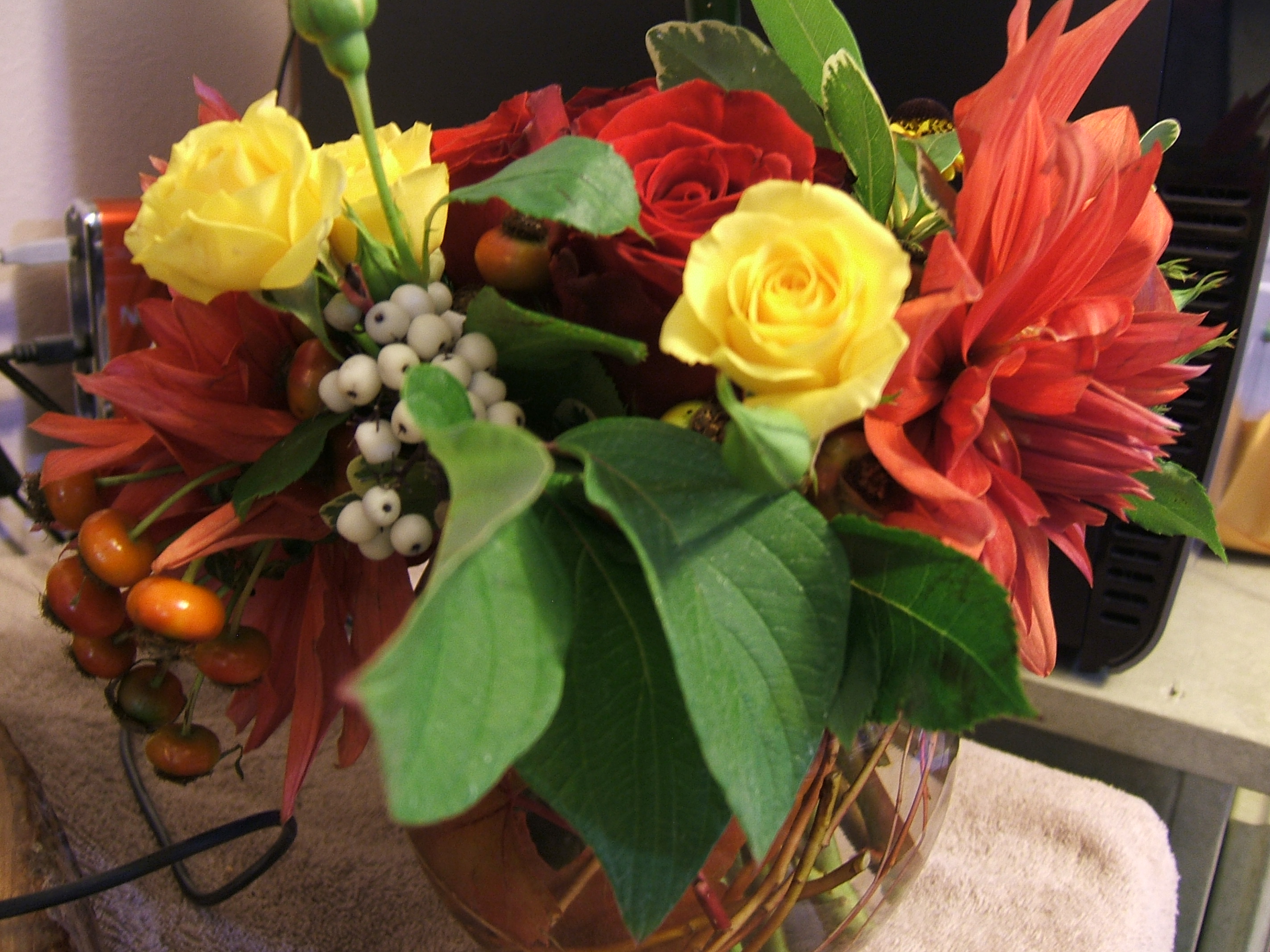
So guess which one the flowers are for?

(If you guessed the dentist, you’re wrong.  Everything went okay this time.)

No, these are an anniversary surprise from the hubster, something he arranged to have delivered while he was far, far away in New Jersey on our special day.  The card is actually signed in his handwriting so I know they aren’t just an FTD.com cover-up.  He really pre-remembered and went to all the trouble of setting things up, which makes me feel warm and fuzzy and loved, but then totally awful, too, because I pre-forgot and didn’t arrange anything.  (Which is why I’m now writing this blog post.)

Unlike me, who can’t keep a secret long enough to surprise our dog, the hubster is a master of diversion of surprise.  Yesterday morning at the crack of dawn, just as he sat down on the edge of our bed to wake me up to take him to the airport, I surged up from a dead sleep in a panic because I just remembered that I forgot.

Oh no! I wailed.  I forgot our anniversary!  I didn’t do anything for you!

Then, crafty devil that he is, he assumed a look of chagrin to match my own, hung his head a little, and echoed, Oh no…I didn’t do anything for you either.

And because not only am I incapable of keeping a secret to save my life, I’m as gullible as the day is long, I believed him.  I was wildly relieved and made him promise not to do anything to try and make it up, and then I promised him I wouldn’t either.  We agreed to do something when he got back after which I thought I was home safe and guilt-free.

But he lied, he lied, he lied…which is just one more reason why I adore the man.

Happy Anniversary, sweetheart.  And thank you, too, for marrying me on that breathtaking, autumn day back in Jefferson County Park all those years ago.  Thank you for chasing me when I took off running during the ceremony, for catching me before I got to the trees, for carrying me back to the preacher in your arms, and for understanding why, after my first marriage, that I just really, really needed to make sure.

I sure do love you.

copyright 2010 Dia Osborn


Of Troughs, Wombs, Longing, and Loss

Today is the sixteenth month anniversary of my mother’s death.  Her birthday was a week ago and I’m experiencing some sort of strange sadness-lag.  Kind of like jet lag, only emotionally.  I was fine on her birthday.  I actually had a great day with lots of fun and happy thoughts about her.

The hubster and I spent that day taking his father on a belated birthday, airboat ride down in the Snake River Canyon.

There were storms rolling in across the southern part of the state later in the afternoon and we were treated to thunder echoing off the canyon walls, one of the most spectacular double rainbows I’ve ever seen, and some distant lightning.

“Hand of God” looking isn’t it?

(Smiting?  Anyone?  Anyone?)

It was wild and intoxicating and celebratory, the kind of day my mom would have adored, and there were a few times during the day when I secretly felt like what was going on in the sky was the meteorological equivalent of confetti and giant candles on a big afterlife cake.

But that was the anniversary of her birth.  Now I’m at the anniversary of her death and the happiness engines have reversed and I’m feeling sad instead, gliding back down into one of the shadowed troughs between waves on this huge ocean of grieving.  I thought I’d grown accustomed to the ups and down of the whole process but this slide has taken me by surprise.  The troughs have grown farther apart over time, and I guess it’s been long enough since the last one that I actually forgot and thought I was done.

Silly, silly me.  Like the waves of the sea are ever done.

Maybe in the end this isn’t so much an ocean of grieving as an ocean of love, and this vast, rhythmic fluctuation of ups and downs, joy and sadness, fullness and loss is simply a continuation of the love my mother and I always shared…and still seem to share in some new yet confusing way.

On the morning that she died my sister and I gathered water, soap, and washcloths by her bedside.  We closed the door to the room and together bathed her for the last time, gently touching her arms and legs, her face and hair, all the intimate, beloved parts of her body that granted us entrance and life so many years ago.  At one point I stopped and rested both hands over her womb.  I closed my eyes, struggling to remember what it was like back then, when I was infinitely fragile, tiny, and curled.  Waiting and dreaming.  Contained and safe in the first home I ever knew in the world.

Perhaps this ocean of love I’m drifting up and down, up and down in now is like some second, larger womb I came into when I exited the first.  A continuation of the warmth, protection, and nourishment she enveloped me with after I left her body and began to grow outside of her.  What she smiled and still cradled me in as I pushed her away, developed into a woman, and came to believe I was somehow separate.  Only in the end, not quite so separate as I thought.

Thank God.

And now, even with her beautiful body collapsed and dead and returned to ash, I can still float along in the waters of this other great womb that her love for me once created, and my love for her now sustains.  It’s probably okay to welcome today’s weight of longing as much as I welcomed the joy of a few days ago because in the end, they’re each a different expression of the same exquisite gift.

I miss you, Mom.  I’ll always miss you.  Thank you for loving me.

Thank you for everything.

Taken on her 70th birthday, playing in a tributary of the Salmon River: The River of No Return

copyright 2010 Dia Osborn

The $3,399.28 Cat

I’m home again.  Finally.  Two weeks is a long time to be away, even when I’m away somewhere that I love.

We traveled all day yesterday to get back here.  Up at 4:00 a.m., long drive down to St. Louis, long wait at the airport, long flight with two stops in Denver and Salt Lake City, then home sweet home at 8:00 at night.  I was frazzled, exhausted, and shutting down hard.  My cell phone went dead around 2:00 in the afternoon, so I didn’t pick up the two frantic voice mails left on it until after recharging around 9:30 p.m.

That was when I learned that Dane the mangy, rescue mutt, oh mighty predator of predators, attacked the neighbor’s sixteen year old cat Tinkerbell in the afternoon and mauled her pretty badly.

The first voice mail was from our daughter (voice trembling uncontrollably) telling me that the attack took place but everything seemed to be okay.  Daughter was house-, dog-, and garden-sitting for us while we were gone.  Daughter was overwhelmed by those additional duties on top of the five course load she’s carrying this semester at college and the thirty hour week she works as a waitress.  Daughter couldn’t manage Dane’s afternoon walk so she called Sweet and Helpful Neighbor Lady across the street who cheerfully offered to help.  But Daughter didn’t realize that Neighbor Lady had cats and made the mistake of taking Dane Cat-Hater over to her house off-leash.  The rest, as they say, is now history.

The second voice mail was left about four hours after the first.  It was from Neighbor Lady (voice also trembling uncontrollably) letting me know they were at the vet where they’d discovered that Tinkerbell was not okay at all.  In fact, Tinkerbell had multiple broken ribs and a punctured lung, and surgery on her was going to cost about $3,000.  She was sobbing into the voice messaging center that they couldn’t afford it and, if we didn’t pay for it, they were going to have to put her down.  I about shit.  Then I told the hubster.  He about shit, too.

Which is when I first noticed the interesting little voices piping up in my head, having a spirited referendum in there.  The first voice (naturally) was Guilt.

I told you!  I told you a thousand times.  We should have made it a rule that he’s always on leash when he’s out of the house!

The next voice was Blame.

It’s the hubster!  The hubster hates leashes!  He refuses leashes! And how in the hell could Daughter not know that Neighbor Lady didn’t have cats? We’ve been neighbors for thirteen years for godsakes!

Then Wheedle and Cheat chimed in.

Y’knooooow…mentioned Wheedle.  It must be close to an hour and a half since Neighbor Lady called.

Yeaaaaah, that’s right…seconded Cheat.  I wonder…what-oh-what could have happened since then?

Do you think they may have already put her down? continued Wheedle.  It would be so sad…

so sad…echoed Cheat.

But it wouldn’t cost us nearly as much…suggested Wheedle.

It would save us a fortune! chimed Cheat.

It would put the cat out of its suffering, too…said Wheedle.

It would be a kindness, Cheat nodded his head emphatically.

Maybe…Wheedle tilted his head to one side and gazed up at the ceiling…we should just say we didn’t get the message and call in the morning?

How compassionate! Cheat agreed.

Compassionate? said Guilt much struck.

Can we really do that? said Blame perking up.

It was only after this exchange that Tattered Shred of Decency finally spoke up.

Oh, come on you guys, her voice was gentle but firm.  Couldn’t you hear the anguish in Neighbor Lady’s voice?  Tinkerbell is like her child.  We can’t dump this off on her.

But we don’t even like cats, muttered Cheat.

Remember how Tinkerbell used to come in our backyard and shit in the pea gravel pathways? reminded Blame.

And y’knoooow…Wheedle slithered back into the conversation.  Tinkerbell is a very, very old cat…

There was a significant pause here.  It was a hurdle even for Tattered Shred but she powered up and managed to clear it.

Doesn’t matter, she finally crossed her arms over her chest.  Neighbor Lady loves her and can’t bear the thought of losing her.  Not like this.  Don’t you remember all the times Neighbor Lady helped us when we were in a tight spot?

Nobody answered.

Has she ever, ever done anything to hurt us?  Or anybody else for that matter?

Silence.

And is the pain she’s in right now any fault of her own?

Four heads hung down in shame and wagged slowly back and forth.

So the hubster and I called her back.  Neighbor Lady and Neighbor Hubster were still at the vet and Tinkerbell was still alive.  Only somehow, during that hour and a half delay, the surgery’s cost had grown from $3,000 to $4,000.  And by the time I actually talked to the front desk person to give her our credit card number, the upper estimate had mysteriously mushroomed to $5,000.  I wasn’t sure what was going on but at that point I thought it wisest to let the clinic know we were capping the amount we’d pay at $4,000.  Privately, the hubster, Tattered Shred, and I remained flexible about covering more, but we didn’t want the emergency clinic thinking we were patsies.

The final amount topped out at $3399.28 and we considered ourselves lucky.  (Could that be what the clinic was trying to accomplish by raising the upper end?)

I’m not sure why it’s so much harder to be a good human being when large sums of money are involved, but it is.  Thousands of dollars just hurts.  Ow.  However, the fact that Neighbor Lady is such a genuinely good and loving person made it a whole lot easier for me to step up to the plate and do the right thing.

Is goodness contagious then?

(Shittiness certainly is.  I admit if the cat had belonged to the lady who lives behind us, the one who wanted to chop down our apple tree to keep a few apples from falling in her yard, the referendum in my head would have been longer and the outcome uncertain.)

It’s the old Golden Rule I guess.  Be unto others as you would have them be unto you.

Only you know what?  Neighbor Lady doesn’t have any strings attached where her be-unto is concerned.  She’s not kind and decent because that’s how she wants to be treated in return.  It’s just who she is.  She’s a naturally stellar human being.  Frankly, I don’t think I’ll ever be that good a person but at least her influence helped raise me a little higher this time around.  Maybe if I put a little effort into it there could be some kind of trickle down effect from all this.  Next time I’m dealing with Apple Tree Hater, maybe I’ll strive to be a little more understanding and forgiving, too.

Maybe this incident could even morph into something that winds up improving our little part of the world.  I owe it to Tinkerbell to at least try.

This morning, the hubster and I drove past a dead cat flung to the side of the road that had been hit and killed by a car.  I felt the twinge of regret I always feel with roadkill and then heard the hubster mutter, That better not be our three thousand dollar cat. We looked at each other and started laughing as we realized that for the first time, for whatever time she has left, we’re now heavily invested in the welfare of a feline.

Could it get any stranger than that?

copyright 2010 Dia Osborn

Run Over By The Amish

Well, I missed my Friday deadline and may miss next Friday’s as well.   Blogging while traveling is proving far more difficult than I thought it would be.  Serious discussions about dying, assisted suicide, and the like are just going to have to wait until I have the time to treat them with the respect they deserve.

So…in the meantime.  Last night we had dinner with old friends of the hubster.  During the meal one of his friends (an avid bicyclist) told us a story of being run down by some Amish horses gone wild.  Iowa has a large population of Amish and near the communities it’s common to see their buggies tooling along on the shoulders of the highways.  The horses are used to the sounds of car traffic and have always seemed calm and well controlled whenever I’ve driven by them.

Image from Wikipedia

But while they’re fearless around cars, evidently the horses are spooked by bicycles (who knew?) so when the bicycling friend and two of his buddies rode past an Amish family in their wagon one afternoon, the horses panicked.  They threw the wagon and family of four into a ditch before doubling back and stampeding down the highway headed back for the barn.  Our friend was unlucky enough to be riding dead in their path and, because of wind noise, didn’t hear them coming up on him from behind until they ran right over the top of him!  He said one second he was peddling along, minding his own business, and the next he was waking up in a hospital with a broken ankle and numerous cuts and bruises.

Imagine his surprise to find out the exact nature of his traffic accident.  Of course now that everything’s healed he clearly enjoys telling the story and who can blame him?  You have to admit it’s a good one.  How many people can claim they’ve been run over by the Amish?

In any case I guess the moral of this story is, for the safety of everyone concerned always beware when riding your bicycles around horses.

copyright 2010 Dia Osborn

Can You Ever Go Home Again? (We’re About To Find Out.)

The hubster and I are on the road again, heading back to visit a small town in rural Iowa where we used to live in another life, long, long ago and far, far away.  It’s where we first met one another and fell in love twenty one years ago, where we belonged to an eclectic and tight knit community of other odd, dysfunctional, and hopelessly idealistic souls, and where we had more fun and comical adventures trying to save the world than anyone has a right to.

We left fifteen years ago now and even though we’re happy and thriving in the life we’ve built for ourselves back west, and even though we’ve both changed and grown in significant ways since we left, and even though we’re not even sure if we’ll fit in there anymore still…we’ve both had the feeling while planning this trip that we’re heading home.

Is that even possible?  The expectation makes me a little nervous.

But we flew into St. Louis yesterday, picked up the rental car, and as soon as we hit the open countryside I started to cry.  I tried to hide it from Cal but he could tell anyway.  He can always tell.  He loves it when I’m melting.

I couldn’t help it.  I looked out across a gently rolling landscape of hickory and cottonwood trees, alternating prairie and farmlands and constantly changing sky, and felt like I’d just crawled back into my mother’s lap.  I had a flashback to when I first arrived in the Midwest nearly thirty five years ago and it was like slipping back into the life of somebody else I knew a long time ago.  Someone I’d almost forgotten but, it turns out, still care about deeply.

Back at seventeen years old I was already a refugee from life, broken  and barely functioning, in desperate need of someplace safe, gentle, and friendly where I could just exist for a while.  Haul my battered boat into dry dock and recover before I started trying to patch some of the gaping holes in the hull.  Rest, unknot, and stop shaking.  Unhunch my shoulders.  Unclench my fists and my heart.

And there was Fairfield, the brand new home of Maharishi International University and  a center for the blossoming T.M. movement.  It attracted a small, strange, and dynamic clutch of assorted souls around whom a community started to grow.  It was pretty commune-like back then with its mix of flower children and liberal intellectuals leftover from the 60’s, but most importantly for me, it was drug and violence free.  The thinking of the place was devoted to all the usual things like world peace and unconditional love, vegetarianism and organic food, but also veered way outside the box into things as diverse as only stirring a pot clockwise to keep the food pure and trying to learn how to fly all together in big groups (without a plane.)

I know it sounds weird and a lot of it really, really was, (and still is for that matter), but the intentions were always good and the creativity and imagination unleashed there were rampant.  It’s intoxicating stuff, living way off the map like that, and it  can really nourish one’s ability to  entertain and pursue possibilities that most people wouldn’t consider.  A lot of the things we tried didn’t work of course, but enough did, and a handful worked brilliantly only in completely different ways than anyone anticipated.

Cal and I eventually left fifteen years ago and during that time the community continued to evolve in wild, wacky, and surprisingly productive ways.  It’s produced a bewildering array of tech companies, has become a regional force for sustainability, has spun off a small satellite village that is completely off the grid, and built a convention center (in a town of not quite 10,000 people) that supports a thriving artistic community.  Who would have thought, all those years ago, that this project of lofty ideals would last at all, much less turn into what it is today.  I guess  passion, if it’s deep and lasting enough, can help make up for a host of other flaws.

So anyway, we’re back here for two weeks and I thought I’d post about some of the oddities and inspiration we encounter along the way.  So far, last night we ran into a woman who started her own church for the feminine face of God, I discovered there’s an Energy Healing Master/Teacher coming to town next weekend who’s going to be staying here at the B&B with us and holding his sessions here (that should be interesting since we weren’t told anything about it!), and the weekend after that there are Grandmothers from the indigenous cultures of Tibet, Nepal, Africa, and Central, South and North America all converging here for a women’s conference.

Never a dull moment.

copyright 2010 Dia Osborn

Why The Disabled Are Worried About It

In last Friday’s post I mentioned that, much to my surprise, the disabled seem to have good reason for worrying about assisted dying/assisted suicide (I’m going to shorten it to AD/AS here…) legislation being passed.  In this post I’d like to take a look at why.

It started with the whole Death Panels phenomenon.  After I wrote  Christmas Trees and Death Panels: How Fear Sets A Snare a few weeks ago, a thought kept nagging at me.  When Sarah Palin first threw out that now infamous term, she claimed that the government was planning to set up medical boards to decide whether her child with Down Syndrome would be allowed to live or not.  I initially thought it was a (pretty brilliant) piece of political misdirection and dismissed it.  (Admittedly, my opinion of politicians is at an all time low.  The bias runs deep.  If their lips are moving, I doubt it.)  Nonetheless, the claim reminded me of different accounts I’ve read over the years of the historical treatment of the physically disabled and mentally ill, and as I recalled some of those horror stories I began to wonder if there might not still be some deep psychic scars hanging around in our group subconscious.  It wouldn’t be unusual.  Deep fears based in old realities do tend to die slowly.  Could some element of genuine fear also be coloring Ms. Palin’s political ploys?  And was it an echo of that same fear that inspired such an overwhelming response in the American public?

(Who would have thought that my old fascination with mental asylums, body snatching, and medical experimentation on the terminally ill might eventually offer constructive insight into the deep, subconscious fears about disability and dying that are still active today?  Go figure.  Let that be a lesson to follow one’s passion, however odd it seems. )

In terms of their treatment at the hands of a larger society, historically the disabled have often drawn the short, shorter, and shortest straws.  Some of the accounts are heinous.  For example, in the Victorian era, in the early days of asylums and workhouses the disabled (both physically and mentally) were often segregated and abandoned in abysmal conditions; shackled in dungeons with no light, clothing, beds, or heat,  and left to languish in their own filth. In addition, because there was no meaningful legal protection, they were sometimes targeted for questionable medical experimentation by unscrupulous doctors.  Not to mention that, when it came to committing someone for mental illness, the definition of insanity was…well…insane.  Families could commit just about anyone to an asylum for reasons as simple as disobedience (in women) and unruliness (in children.)

It was a traumatic age to rank among society’s most vulnerable and, while conditions have improved dramatically in the western world over the last century (not always so rosy yet in pockets of the developing world though,) the old horror stories have nonetheless carried forward to today.  There are still families handing down tales of not-so-distant ancestors who were locked up in these places, and who doesn’t get a delicious chill running down their spine at the use of old asylums as settings in classic, horror movies?

Kings Park Psychiatric Center, New York (Building 93)

These stories from bygone days are still lurking deep in our group unconscious and contributing to the fear and stereotypes about disability and its treatment that exist today.   But up until recently I assumed those fears were dated and irrelevant.  Imagine my surprise then, to discover there are still compelling reasons for the disabled to not only fear segregation and discrimination, but possibly euthanasia as well.

After assuming that Ms. Palin’s stated fear for her son was not entirely political, I dug a little deeper.  I did a quick search using terms like disabled, fear, and assisted suicide and found this publication put out by RADAR: The Disability Network in the U.K.  It  addresses concerns about proposed legislation for assisted dying in the terminally ill and…please, let me first just say that in a media world as full of hype, spin, and misrepresentation of the facts as ours is currently, this little bulletin is a treasure.  It’s heartfelt and passionate, but still somehow manages to be respectful, and I read it a few times just to bask in that little miracle of miracles.

But aside from that, one piece of information I learned there shocked me.  It turns out the disabled have a right to worry about legislation sanctioning AD/AS.

Included in RADAR’s publication is a case study concerning a woman named Jane Campbell, diagnosed at birth with spinal muscular atrophy and not expected to survive her first year.  Best I can figure, at the time of this publication she was about forty and, in spite of extensive disability, living a dynamic, happy, satisfying life as a national advocate for the disabled.  However, during a hospitalization for severe pneumonia in 2003 she encountered an unconscious stereotype held by members of the medical staff that could potentially have proven fatal to her.  Her experience is important because it crystallizes some of the very real danger that AD/AS poses for the disabled, and I think it’s something that all of us healthy, strapping people need to consider carefully.

Evidently, while in the hospital she was approached by two different members of the medical staff overseeing her care who told her that, in the case of respiratory failure, they assumed she wouldn’t want to be resuscitated with a ventilator.  She was at first surprised, and then alarmed, because they didn’t seem to believe her when she insisted that, no, she wanted to continue to live very much, even on a ventilator.  Her husband eventually had to race home and collect photos and other factual evidence to convince them that in spite of her disability, she did indeed enjoy a very high quality of life.  Unlike an equally young but non-disabled patient, Jane found herself in the position of needing to prove that she still had every reason to want to live.

I imagine it was terrifying for her.  Medical personnel often have to make tough calls that influence whether a patient will survive a crisis, and if they believe that the patient doesn’t want to survive it will almost certainly influence their decisions.  Jane was confronted with medical professionals who, because of unexamined stereotypes about her quality of life, automatically assumed that she’d prefer to die.  More frightening for her was the fact that these stereotypes acted upon them so powerfully they continued to doubt her, even after she initially told them it wasn’t true.

Now some might suspect Jane was projecting her own fears onto the staff.  I might have too, except that I instantly recognized the kind of situation described because I was in it once myself, only I was on the medical side.  When Maggie, a woman who’d been left as a quadriplegic by polio sixty years earlier, was first referred to our hospice with terminal cancer, I was laboring under the same flawed assumption that she must be relieved.  When I first entered her home I thought surely she must be looking forward to her long suffering coming to an end.

Nothing could have been farther from the truth.

I found a woman devastated by the news.  She loved her life and for good reason.  Surrounded by a devoted, supportive husband, children she loved, grandchildren she adored, and a wide network of extended family and friends, she had at various times produced an educational TV show and managed a branch of the state tax commission for more than a decade.  She was sharp, beautiful, disciplined, optimistic, graceful, and dynamic…and she was not, I repeat not, ready to die.

It was a real eye opener for me.  The reason stereotypes are so damn successful is because, without any real life experience to refute them, they feel true.  It isn’t until one finally runs aground on the rocks of some contrary evidence that they crack open, revealing the blind assumptions they’re based on and allowing us to finally begin to question them.  Maggie was the rock that split my hull.  She was severely disabled but, where her desire to live was concerned, that was totally irrelevant.  While her husband told me after she died that of course she was relieved to escape the limitations placed on her body, that in no way translated into meaning that she wanted to die. Evidently, wanting to be free of a disability and wanting to be free of  life are not the same thing.

Go figure.

Now, an important question to ask is, does any of this really matter to those of us who are not disabled?  Clearly, this stereotype is potentially dangerous for someone who is but for someone who’s not, other than arousing our deep humanitarian instincts, is it pertinent?  Will it ever affect us?  Do we have any skin in this game?

You bet.

Here’s an important point to keep in mind; eventually anyone who doesn’t die instantly is going to experience what it’s like to be disabled. Because the dying are a subset of the disabled. When we begin our final journey we all enter the world of steadily decreasing ability and, to varying degrees and for however long it lasts, we each get to feel what it’s like to become helpless, dependent, weakened, and vulnerable.  And when that happens all those non-pertinent stereotypes about disability flapping around are going to catch our scent and come circling, and you better believe they’ll influence the people making critical decisions for our lives.  It won’t matter which side of the AD/AS argument any one of us falls on, whether we’ll be among those who want to live but, like Jane and Maggie, are cared for by people who don’t believe us, or whether we’ll be among those who want to die but who are cared for by people who think we’re no longer competent to decide.  Either way, left unaddressed any stereotypes about disability will almost certainly wield power over our self sovereignty.

Now you might think that this alone is a good enough reason to look more closely at the actual wording of any given legislation for AD/AS, and to have some in-depth, follow-up discussion.  But Wait! (I say like an infomercial for a new, blender/chopper/shredder/slicer kitchen appliance that one just can’t live without…) There’s more!

But…it’ll have to wait until another post.  I’ve already gone way too long already.  Next Friday, I’d like to take a look at the possibility that the blind assumption the disabled don’t have any real quality of life may also be a prime factor influencing why some people choose assisted dying/assisted suicide in the first place.

copyright 2010 Dia Osborn

Sky Burial

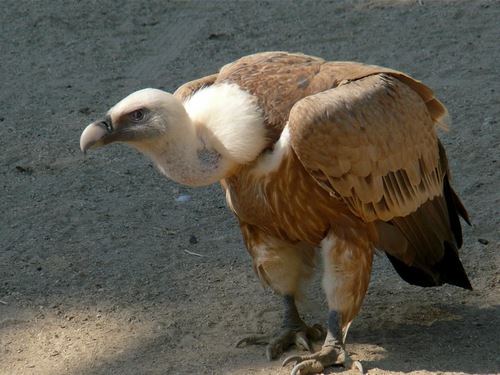
Griffon Vulture at Oakland Zoo

Photo © Ingrid Taylar

Today is the ninth anniversary of 9/11 and, judging from all the anger boiling up in the last month, it seems as a nation that we’re still pretty raw.

Forgiveness is a challenge for me.  A woman told me once that forgiveness is only granted, not chosen or earned, and I’ve thought about that one ever since.  I always thought I was a very forgiving person but really I’d just been trained to move on.  Put it behind me and not think about it anymore.  Leave the wounded parts in the past like bloody garbage, wrapped up in a cloth and stuffed in a hole.

Over the years I left a lot of wounded parts behind me.

For a variety of reasons I eventually had to go looking for them again, scattered far and wide as they were, and I managed to locate most of the pieces and collect them all in a kind of emotional basket-of-casualties that I kept next to my journal.  While it feels good to have me all back together again in one place where things start to make a lot more sense, still I’m not quite sure what to do with it now.  It’s not like these are working parts anymore.  The remains of the various traumas, big and small, are pretty mangled.

Yesterday, a friend and I went up to More’s Mountain to hike the trail up at the top, and a giant black bird with a yellow beak showed up.  It looked like a crow only three times as large and it came over the trees and flew directly at us, coming in low and circling once, studying us as we stood still, heads tilted back, watching it fly against the sky.  Then, satisfied, it flew back over the trees again and we were left a little awed, a little shaken by the contact.

I wondered if it was some species of vulture.

I went up there alone last month, with a dead crow I found in the middle of the road.  I carried it up there to give it a decent burial, to return it to mountain peak and thin air because…well, I don’t know why exactly.  Because I love crows.  Because it felt more respectful than leaving it to be squished and flattened by successive car tires.  But I think I was after something else, too.  I wanted to whisper a prayer into its wings and then maybe, just maybe, have it carry that prayer up somewhere where it might be heard.

Although it wasn’t a prayer so much as a cry for help, sent out into space, into the heavens, into the void, asking something, somewhere out there to hear and help us as we struggle with all the challenges that are coming to a head in the world right now.  Because it just seems like we need a lot of help.

But when I got up to the mountain with the crow, wrapped in cotton cloth and plastic and cradled in my backpack, I encountered a vulture instead.  It was a turkey vulture and it surprised me, flying out from behind a stone spire to my left as I stood gazing out across the valley far below.  It flew in close right in front of me, twisting its head to look at me, study me, and I realized it must have smelled the dead crow.

It was eerie, I’ve never seen a vulture that close before, and I’ve certainly never been considered quite like that.   It stirred something primal and pre-moral inside me.  I felt a kinship with the bird…and I liked the feeling.

There are still places in Tibet where they practice Sky Burial, one of the ancient, cultural burial rituals of the region.  I’ve read descriptions of the practice and it’s about as raw and graphic as it gets.  Loved ones carry the bodies of their deceased, sometimes on their backs, hundreds of miles to the sites where sky burials are still performed.  Those who perform the service receive the body and place it on great flat stones where they wait until the sun first rises in the morning, illuminating the site.  Then they butcher the body, grind the flesh and bone into paste, and signal to the waiting vultures ringing the site to come.  And they do come, by the hundreds, devouring everything before they leave again, carrying the last remains of that person’s physical life away with them into the sky.

The first time I heard of it I was both repelled and fascinated.  It sounded so strange at first, so gruesome, and yet something in my stomach relaxed at the thought.  I love my body.  I’m so grateful to have the opportunity to live in it for as long as I get to.  It’s like having the greatest horse of all time, my steed, my ally, my companion on this wild journey through the world, and when I die I want it set free again, too.  I want all the hits that it’s taken for me over the years, all the wounds it’s licked, the burdens it’s carried, the pain it’s survived wiped clean again.  Released.  Forgiven.

Not embalmed, enshrined, and buried.

Vultures aren’t afraid of dead bodies.  They don’t look at them with revulsion or disgust and I like that about them, because either do I.  Instead they accept and receive them, taking their inherent nutrients and recycling them, turning them back into something life giving, nourishing, strengthening, and sustaining.

I guess that’s what I want for all these old wounds I’m carrying around with me, these old, damaged, mangled pieces of myself that I’ve reassembled and now don’t know what to do with.

I want to somehow eat them, transform them into something that’s ultimately nourishing and strengthening.  I wonder if maybe that’s what forgiveness is supposed to be about, not some kind of lobotomized memory wipe, but a final consumption and transmutation.  I want to take these horrible old memories, the wounds and scars, and cut them apart, grind them into paste, then swallow them down into some ancient, primal place of acid and fire inside myself that can finally, finally harness what happened, release it, and make me whole and strong again.  Lend strength to my wings and help me fly back into the sky where I can soar around again through the rest of my life, loving and accepting and free.

I hope someday I’ll be granted that kind of forgiveness.  I hope someday we all will.

copyright 2010 Dia Osborn

Let’s Have a Chat

I wanted to take a moment to talk a little about the delicate topic of assisted dying/assisted suicide.  There are a lot of places, nationally and internationally, wrestling with legislation and, in my opinion, if we’re going to try and do something as ambitious as legislating death, I think we should make a serious effort to get it right.  Because if there’s one thing that everybody agrees on it’s this:

Life is a fragile commodity and the off-switch for it only works once.

The reason emotions are running so high is because the stakes are so big.  Legislation affects all of us so it’s critical we don’t leave something this important solely in the hands of politicians and lobbyists.  Instead of just playing the voyeur by sitting back and listening to the attention grabbers argue about it in headlines and news clips, we the street people, the regular Joes and Joeinas living out here in the real world, need to educate ourselves more, nose around, dig up hidden angles, make sure we look at both the shining gifts and dark underbellies of every side of the argument.  And most importantly, we need to start talking with each other about it.

That’s right folks.  I said talking. About dying.  To each other, across political, religious, ideological, racial, cultural, economic, and national lines.  Believe it or not communication can be a good thing.  Done right, it actually makes us smarter than we were before, more informed and knowledgeable, more compassionate and caring.  True communication (read: listening as well as talking) not only offers our heads more information, it helps us build bridges heart to heart which, trust me, is something you really want in place when you’re hanging out there on the raw and ragged edge, desperately clinging to someone’s hand while you’re trying to tell them that you really, really want to live…or that you really, really need to die.

This is not an idea we’re talking about here people, it’s the real thing. I’ve been there, I know what it looks like.  With hospice I saw both Democrats and Republicans die.  I saw the faithful and atheists die.  I’ve seen pro-lifers and pro-choicers, rednecks and tree huggers, rich and poor, dark and light die and I’m here to tell you that in the end, all those shallow, gritty, surface labels slough off like old skin and the person left lying in the bed is just one more beautiful, luminous, vulnerable, aching, irreplaceable and longed for human being.  Somebody that gave every last one of us a huge gift by surviving this world for as long as they did.  Someone who was our companion, whether we knew them or not, and without whom the pocket of the world they were responsible for would have been something a lot less.

We have got to drop the harsh, combative, divisive judgments we keep stabbing each other with if we’re to have any chance of getting this right.  Every one of us deserves to have the final word on what’s happening to us and our own body, to live and then die in accordance with what’s sacred, beloved, and true to us.  Every one of us deserves to feel safe knowing that nobody will ever, ever, ever try to kill us when we are wanting and longing to live, and conversely that we will never, ever be forced to experience unendurable, unending suffering when we simply can’t bear anymore.

There are valid, important points being made on all sides of this argument that we all need to take into account before any final decision is made.  Because if we don’t, some helpless, dying person (actually a lot of helpless, dying people) are going to become the tragic victims of our legislation and if that happens, we will all be responsible for it.  It will be all our faults for the simple reason that we didn’t make more of an effort to listen to one another and come up with some truly wise, compassionate, thoughtful, and inclusive solutions.

Phew!  Okay.  Enough of the soapbox.  As you can tell, some things really wind me up.

So, do you find it hard to talk about assisted dying/assisted suicide with people who feel differently than you do?  If so, what makes it challenging and what would make it easier?  I would dearly love to hear what others are thinking about this whole subject and welcome your comments.  Some ground rules though:  be respectful, think before you talk, and contribute something valuable to the discussion.  (Hint: Personal insights and feelings are valuable.  Ranting, blaming, and proselytizing are not.  Name calling will be deleted.) And humor is the best!

I’d like to spend the next few posts exploring some of the surprising things I’ve been discovering through my own investigations.  Next week:  Why the disabled are worried about it and why the rest of us should care.

copyright 2010 Dia Osborn

The Garden Undead

Okay.  It’s Saturday morning, the hubster is gone, and I’ve got a wild hair to write a post.  (It’s either that or sit down with my book on parasites…which is fascinating, entertaining, and well written, don’t get me wrong.  I just don’t feel like reading right now.)  I know I just announced that I’m only going to post on Fridays but maybe it would be safer to say that I’ll post at least on Fridays.  That way I have some wiggle room if I feel chatty in between.

I finished canning the last of the peaches yesterday and they tasted  funky, which was to be expected seeing as how I picked them all hard and green.  The squirrels this year took off about three-quarters of the fruit before I finally went out one afternoon in a rage and stripped the tree of every last piece of anything remotely edible left on it, right down to the pea-sized, green, furry, little knots that they wouldn’t want anyway.  I didn’t care.  I wasn’t gonna leave anything for those vandalizing garden rats, just in case.  They make me so angry! It wouldn’t be so bad if they would at least eat the peaches.  But they don’t.  They take one bite then throw them on the ground and move to the next one.

Which Dane the mangy rescue mutt loves of course.  He’ll eat anything (including squirrels but even he can’t catch them!)  He just stands around there under the tree with his mouth open, hopeful.

One year I bought carpet tack strips and spent the entire day tying them on every branch of the tree.  My thinking was I’d turn it into a thorn tree of sorts…make it painful for the squirrels to run along the limbs.

Poor little peach tree.  By the time I finished it looked like a bad Halloween costume, like it was going to the party all dressed up as a wannabe black locust.  The strategy worked though.  It slowed the squirrels down even though it didn’t stop them completely…nothing short of a stake through their beady little hearts can do that.  But at least they were eating with a limp.

And then, last week a squirrel nailed me in the head with an apple as I was walking under the apple tree.   That tree is theirs!  I don’t even try to stop them with the apples, I let them have everything on it.  But I swear the brat waited until I was right underneath then dropped a big, green apple, catching me square in the middle of the head where it took a big bounce and then fell off down to the ground.  I could hear them all snickering up there, behind their nasty, little claws, but there was nothing (nothing!) I could do about it.  So I went, fuming, inside and watched the squirrel catapult video again, and that made me feel a little better.

I know, I know.  That video is mean and the squirrel might have gotten injured, but honestly?  I don’t believe it did for a second.  I don’t think you can injure those things.  I saw one fall fifty feet out of a tree in our backyard once and just stand up, brush off its pants, and light a cigarette.  Hand to God.

Stake through the heart, people.  Stake through the heart.

Having said all that though, baby squirrels are just adorable.  This spring we had one that kept coming up to the patio door to look in the house.  My desk sits right next to the door where I can look out at the garden and I was utterly spellbound, watching its little hands there pressed against the glass, its innocent face peering in.  It was tiny and sweet and fearless and curious…and then Dane saw it and blew out through the dog door on to the patio like a hundred pound, black fur explosion of sharp teeth and drool.  The squirrel was too inexperienced to understand what was going on, it didn’t know how to get away, so it panicked and just kept racing back and forth from one end of the concrete to the other.  It was only going to be a matter of seconds before Dane got it but then, suddenly, I blew out through the patio door screaming like a banshee, hands splayed, electricity firing out my fingertips and hair and, hurling myself fifteen feet straight through the air, I tackled him a scant heartbeat before he was about to snap the little guy up.  The baby recognized its window of opportunity and ran up the wisteria trunk, skittering away to safety across the top of the arbor.  Needless to say, it never returned to the patio again after that.

Y’know, I just had a thought.  Could that possibly have been the same squirrel, all grown up, that dropped the apple on my head?  How ironic would that be?

Although I have to admit if it was, I’d be kind of proud of the little scamp.

copyright 2010 Dia Osborn

The Burden of Miraculous Choices

One of the strangest side effects of my years working with hospice was the collapse of my sense of belonging.  I had no idea beforehand, how much of my identity was tied up with the various beliefs I held and the different groups I identified with because of them.  National, ethnic, familial, political, economic, spiritual, you name it, I had come to define most of who I am by the ideals I held.

But then, as I entered homes filled with beautiful, vulnerable, dying people…who it just so happened believed in a wide variety of  things that were frequently different, even opposite, from my own…I made the unwelcome discovery that many of my ideals were actually fed by lurking, unconscious prejudices that lay, seeping and contaminated, just underneath.

I was naturally horrified.

One of my biggest prejudices was against the medical/industrial complex and especially the pharmaceutical branch.  (Please understand, my admission of a prejudice is not to say there isn’t a problem.  I’m not alone in my concerns about our over-prescription, over-use, and over-reliance on drugs.  A lot of thoughtful people, both in and out of the medical field, are worried about it.)

But for complex reasons, including a couple of personal encounters with disrespectful (and in one case unethical) doctors, I went beyond simple concern into deep prejudice.  I began to think badly of medical, pharmaceutical, and health insurance people as a whole.  I came to question not only their motives but their basic humanity.

I secretly began to suspect they were monsters.

But then one day I had this irresistible urge to work with the dying and as a result, actually entered into the medical/industrial complex as a participating member.  I joined a hospice, took a class, and became a nursing assistant.  I did my clinical hours in a nursing home.  Visited patients in hospitals.  Worked closely with nurses and doctors and even filled prescriptions at pharmacies, delivering them to the people I helped care for.  And lo and behold!  Somewhere along the line, in the gentle, surprising way that grace frequently delivers its gifts, I rediscovered the value, relief, and miracle that modern technological advances have to offer.

I discovered there aren’t really any monsters after all, just an odd amalgamation of deeply caring, deeply flawed human beings.

As a result of this journey, modern medical technology has taken on a slightly different cast for me.  Not so much a cold, uncaring, manipulative, disrespectful power that takes over our bodies and ignores our humanity, but an offering of something extraordinary, a possibility of the truly miraculous.

I had a patient once.  Maggie–dear, beautiful, polio stricken Maggie Full Of Grace–who wrote a little book about her sixty year journey with the disease and it’s after effects.   I read it after she died and in it I found the answer to a question I’d always wondered but never found the courage to ask her.  How did she feel to be one of the last to ever contract polio?  The vaccine was introduced two years later and the disease, for all intents and purposes, was eradicated.  Did she ever feel cheated?  Did she ever think Why me?  Why wasn’t it discovered two years sooner?

I found the answer in her book.  First, she described the terror she and her husband initially experienced in those earliest days, not for her but for their three small children, the fear that they might also contract the virus.  She’d been nursing her five-week old baby at onset so he was particularly exposed.  That description was then followed by this passage:

“One of the greatest blessings I would later thank God for is the presence of the vaccine, the fact that our children and grandchildren will never get polio.”

I started to cry when I read it.  It was as though she was still there whispering to me.  Still trying to answer the secret question, the real question, I so desperately needed to ask her.  She’d been powerless to stave off infection from the polio virus itself, but somehow she’d successfully fought off the bitterness and regret that so often follows in the wake of such trauma.  How?  In the face of decades of the resulting hardship and suffering,  how in the world did she protect her heart from that kind of collapse?

And somehow there the answer was, miraculously written down for me in her book.  Her love for her children and gratitude that they were spared served as her vaccine.   The power of those two emotions filled her heart with a kind of immunity that no bitterness, however real, however justified, could overcome.   It was something I’d always heard but somehow never really understood before, the simple difference between looking at a glass as half full rather than half empty.  Both realities are always true.  Both have an impact that must be absorbed and coped with.  But the choice of which one to cleave to is always ours, which one we’ll ultimately allow to fill our vision and heart.

I’d never understood before, how often I fill my own with emptiness.  No wonder I’ve struggled with so much sadness.

It was the people I met like Maggie Full Of Grace who started anchoring me back into an older place inside myself, turning me into a person far more tolerant and oblivious than I’d been before.  Over time things like politics and religious differences, economic backgrounds and cultural beliefs, all the myriad and ever-multiplying array of opinions that seemed to matter so freaking much beforehand just didn’t anymore.  Over time I became freer and happier and better and more loving…and increasingly confused by the change.

It was like climbing up to the peak of the very highest mountain in the middle of a vast wilderness where I could finally see forever and ever… but then the wind sucked the map out of my hands and blew it away.  The views were spectacular in a way that knocked me to my knees, sure, but how the hell was I ever gonna find my way back out?

(Don’t delete this photo again dammit…it’s my picture!)

How was I supposed to navigate without the instinctive bearings my prejudices gave me?  I’m still, five years later, struggling to figure that one out.

Maggie came forward in time sixty years to instruct me on the brutal, harsh reality of how it really was back then.  Watching her struggle every single day within her twisted, paralyzed body, hearing her stories of those long, painful, uncertain months in the polio hospital, of how many husbands abandoned their wives, how many crippled children were left behind and forgotten, all these things brought that world to life for me.  I finally got it, why the word, polio, used to strike such terror into the hearts of all who heard it.  Why Jonas Salk was such a hero and how the vaccine really was a miracle of deliverance.

Life before penicillin, immunizations, knowledge of basic hygiene, and the vast array of other developments and discoveries we have today was often cruel.  What we were forced to rely on instead back then was Adaptation with all its tools—the human qualities of creativity, determination, strength, patience, fortitude, and grace.  And now, today, we sit at the junction of these two ages, emerging from a period of helpless vulnerability when we were forced to cultivate our deepest, inner humanity just to cope and survive, and entering into an age of blossoming outer powers where we no longer have to simply grit our teeth, accept, and endure.

We’ve discovered a will, an intelligence, and an imagination within ourselves that can generate miracles…and the breakthrough is heady.  It’s created an insatiable hunger within us for more power, more knowledge, more salvation.  We now dream wild and intoxicating dreams of freedom from all disease, all aging, all pain, all suffering.

Even, perhaps, from death.

But I’ve watched a strange and disturbing thing happening as our outer powers increase.  It seems that our inner powers, the long-cultivated wisdom of our deepest humanity, seem to be diminishing as they lay, forgotten and misplaced in the hallways just outside of research labs and insurance offices and fear-filled waiting rooms.  The ancient tools that served us for thousands of years—things like courage, sacrifice, endurance, surrender, the ability to recognize and be grateful for all that we still have—are threatening to atrophy with a current wave of under-use.  And in their place things like fear, anger, blame, grasping, desperation, and bitterness frequently rise instead.

I have hope though.  I don’t think the current trends will last.  I suspect that we’re simply in the first flush of wild discovery and have yet to understand the limits, comprehend the costs, of pure, unbridled dreaming.  After eons of helpless suffering the pendulum is swinging wildly to the other extreme , but pendulums always swing back.   Someday we’ll remember that we can’t just eradicate things like suffering and death because to do so would also eradicate the great arc of wounding and joy that is life.

No.  I think we’ll eventually settle down, find some equilibrium, and begin the practical task of roping in our miracles, tethering and training them, instead of letting them stampede through our lives, trampling the older, extraordinary knowledge we’ve already developed.

Here’s hoping for a divine marriage between the two someday soon.  A day when our modern technology becomes firmly anchored in our ancient humanity, and when our collected wisdom is further deepened by the discoveries and miracles of today.

copyright 2010 Dia Osborn

My posting schedule:

Now that I’ve finally crawled out from under my log and let some of you know I have a blog, I realize I should also warn you up front not to expect a cornucopia of material.  I’m not prolific.  On the contrary,  I usually only post on Fridays because I’m slow and tortured and, in my world, no post is worth publishing unless every sentence has been worried and reworked for a minimum of an hour and a half, and every word has been tried, changed, rearranged and then put back to the original at least four times.

Predictably, this leads to a lot of garbled text.

I’m therefore forced to do a panic rewrite every Friday morning after which I finally hit the publish button in much the same spirit that I depress a toilet handle.  (I’m a little repulsed by the final product, but relieved that it’s done and blessed with a new burst of energy.)  I then redouble my efforts and spend the rest of the day re-re-editing and updating the published text.

Whenever I doubt my sanity I think of E.B. White who was also obsessive.  It was his habit, after finally working up the nerve to place a finished manuscript in the mailbox, to then panic, go to the postmaster, and beg him to fish it out and give it back.  (I understand it never worked.)  Remembering this always makes me grateful that I live in an age with the option of an update button.  Less humiliation.

Viva le blogging.

(UPDATE:  I know, I’m posting on a Tuesday to announce that I post on Fridays.  Life is full of little ironies.  This is just my contribution.)

A Parrot’s Grief


We once had two dogs.  They joined the family two years apart, lived most of their lives together frisky and inseparable, then died at the end, also two years apart.  Our big guy died first.  Swift and unexpected.  He was fine and healthy for years and years, and then one day got sick and three days later died.  Just like that.

Our second dog was lost without him.  For a month following his death she withdrew.  She’d still come to us if we called and try to look happy to see us, but as soon as her duty was done she’d slip away to the corner where they used to sleep together and lie down again, eyes open and unfocused and numb.

We were heartbroken for her and heartbroken for ourselves.  We all missed him terribly.

But time worked its magic and one day, for no particular reason, she returned.  She followed me around the house that morning, trying to flip my hand up on her head with her nose again, and my heart eased knowing she’d be okay.  We had two more wonderful years together before she, too, eventually died.

There’s a lot of controversy on whether animals experience emotions, but the suggestion that they can’t feel things like simple grief makes me angry.  I usually try to respect the beliefs of others but, because this particular belief is so often used as a justification for exploitation, neglect, or abuse, I don’t respect it.  I find it suspect.  The claim is far too riddled with conflicts of interest to take at face value.  Besides, in five decades of living, every interaction I’ve personally had with animals and birds, (and reptile, fish, and even a few insects believe it or not) has confirmed that these other strange and wonderful companions I share my world with feel a great deal, even if most of the time I don’t understand what exactly that is.

A case in point:

One of my first hospice patients had a parrot she said she’d smuggled over the border from Mexico twenty years earlier.  She was a wild, untamed kind of woman and her parrot was just like her.

I don’t remember now what kind he was, but he was smallish, maybe a little bigger than Snowball the dancing cockatoo, and he spent most of his time in those final days perched on the valance above the window next to her bed.  I was a little nervous at first because family members warned me that sometimes he flew down on people, swooping at them again and again, testing to see if they would duck and run.  He was a fierce little thing, tolerating only a handful of people and attacking the rest, but he clearly loved and needed that woman lying on the bed and was made achingly vulnerable by her approaching loss.

He never flew down on me.  I used to speak to him gently when I was on that side of the bed, changing her sheets or dressing or incontinence pad, and he’d closely monitor everything I did, anxious and curious, sometimes fluffing up into a ball of down and shaking his head rapidly, raising his wings for a moment like he just couldn’t stand the uncertainty anymore, then settling back down to watch and wait again anyway.  He’d sidle back and forth along the length of the valance, first to the left, then to the right, over and over again like a loved one pacing the corridors of a hospital.  He knew something was wrong and it seemed to fill him with unease.

Once I saw him fly down to the bed while I was in and out of the room, doing laundry.  She was asleep and he seemed to want to just be next to her, to touch her.  He awkwardly waddled up next to her head, curling into the warmth still emanating from her.  He bent his head over next to her mouth as though checking for breath and just stayed there for a long time, frozen, his feathers brushing her lips.  My heart broke for him and I wanted to pick him up, cradle and croon to him, but I knew he’d bite me if I so much as extended my hand.

First her sister told me and then her daughter.  How he wept on her body when she died.  He flew down from the valance to her chest and started nuzzling and nipping at her, trying to make her respond.  Stroke him.  Yell at him.  Anything.  But when she didn’t move he went still and stunned, and it was then that he started making the strange, small noises, noises unlike anything they’d ever heard him make before, like sobs.  His head bobbed slowly up and down to the rhythm of the sounds, and her family just stood there around the bed, surprised and stricken by his grief.

Later, when the men from the funeral home came to remove her body from the room he attacked them.  Viciously.  Angry and hysterical, he dive bombed at their heads repeatedly until one of the men ran  in the bathroom to hide.  The family finally captured him and put him in his cage while they took her body away.

I’ve often thought about him over the years and hoped that he eventually found someone else he could trust, someone he’d allow to love him, to bring him back in healing and wholeness.

Like just about every other person I’ve ever known, the deep emotional bonds I’ve shared with animals over the years have provided me with a well of strength, beauty, unconditional love, and hope.  My ties to these companions have helped shape me, often healed me, and even saved me, more times than I can count.  I really, really hope that some day soon we’ll grow past the economic and scientific need we have to deny the depth of their vulnerability to us, and instead forge a higher, kinder relationship based on mutual respect.  They’ve already given us all so much.  They deserve something far better than what they’ve gotten in return.

copyright 2010 Dia Osborn

Christmas Trees and Death Panels: How Fear Sets A Snare

(I apologize in advance.  This is a long post but there was a lot of important ground to cover.  I won’t do this often.  Promise.)

Like many people, the Christmas tree scene in the original 1972 Poseidon Adventure movie made a deep impression on me.  I was only fourteen when the movie was first released so I was impressionable.  Given.  But even so the scene is a classic.

It’s Christmas (New Years?) Eve on a luxury ocean liner out in the middle of the ocean and the crew and passengers are celebrating in the ballroom under the branches of a towering and heavily decorated Christmas tree.  As per disaster movie formulae, a tsunami formed by an earthquake off the coast of Crete comes rolling across the ocean and hits the ship broadside, capsizing it and tossing the above mentioned assemblage all over the slowly inverting ballroom.  Once the Poseidon settles in it’s new, upside down position, the Christmas tree is lying on it’s side on the ceiling-turned-floor.

Enter: Gene Hackman, a renegade missionary.  He swiftly marshals a group of men to raise the tree again for use as a ladder to access a service door at the bottom-now-top of the room.

We’ve seen a lot of random chaos and horror up to this point but Fear as a saboteur has been suspiciously quiet.  That changes once the Christmas tree option is presented.  Fear immediately recognizes a golden opportunity and steps in to set the first, big snare of the movie:

The survivors each have to make a choice.

Reverend Gene, on the one hand, tells everyone to climb the Christmas tree and head for the hull of the ship, because that’s the only logical place where rescuers could ever access survivors.  Reverend Gene represents original thinking and a challenge to the status quo.

But the ship’s purser disagrees and tells them no, no, no, they must all stay put in the ballroom and wait for someone to find and rescue them there because the ballroom is where rescuers will search.  The purser (read official man in a uniform) represents standard thinking and the status quo, something fatally attractive to anyone with a strong herd mentality.

It was painfully clear to all of us in the theater that the Rev was right and everyone needed to climb.  Fast.  We knew that those who couldn’t rise above convention and think outside the box were gonna die, die, die, horribly and soon.  We knew this because the whole scene was built around a basic rule of human behavior; terror tends to drive thinking out of the cerebral cortex (rational, logical, problem solving) and into the amygdala (instincts, habit, and fear).  Anytime we’re confronted with a new and terrifying situation, if we can’t master our emotions and analyze circumstances objectively then we revert to old mental ruts and knee jerk reactions.

We follow the herd because by god there’s safety in numbers.  Right?

In this case, not so much.  Fear springs the snare, paralyzing just about everyone there.  The majority of people listen to the purser and decide to stay put.  Only a handful climb the tree and, once the chosen few are safely ensconced up in the only possible escape route, explosions sound in the belly of the ship, windows and skylights shatter in the ballroom, the Christmas tree topples back down to the floor, and deep, ocean waters surge in, drowning every last screaming, thrashing person who made the mistake of defaulting to what felt, instinctively, like the safest bet.

Working in the hospice field, one grows familiar with fear and its many, (many, many, many, many, many) snares.  A fear of dying can often drive us to make unwise care and treatment decisions.  From what I can tell, a lot of this comes from the profound lack of education and understanding that exists in this country around the dying process.  The fierce denial we’ve embraced as a society doesn’t leave much room for the cerebral cortex to think about the subject at all, which means that most of the default choices people make at the end remain firmly embedded in the instinctual part of the brain.  How could it be any different?  There are few instincts more powerful than the one to survive and, if we don’t have some extraordinary and compelling reasons not to, we’ll naturally choose to continue treatments beyond (sometimes far beyond) the point where our doctors, or even we ourselves, think we should.

Yet at the same time, most of us don’t want to die wrapped up in tubing and drugged into a stupor, or with flash paddles sending electric jolts into our heart while our family looks on in traumatized shock.  But it happens all the time anyway.  Why?

There are a host of complex factors that contribute to the problem but ultimately one underlying cause rules them all:

We persistently and adamantly refuse to talk about dying.

We play right into one of Fear’s greatest snares.  Fear loves the fact that we won’t talk about dying because that prevents the cerebral cortex from getting anywhere near our decision making.  How can we possibly evaluate what’s been going wrong, learn anything new, or change anything for the better, without some calm, compassionate, respectful, thoughtful discussion about what’s going on?  We can’t.  Our fearful silence gives the old habits and instincts free rein and we default, over and over again, to the same flawed choices.  That’s how, even if it’s the last thing we ever wanted, we still so often wind up cocooned in IV lines without so much as a spare patch of skin for our loved ones to kiss or hold.

This reluctance and failure to talk about dying is the norm in individual cases.  But it happens on the national level as well, and a prime example of it  just played out during the recent health care reform debate.

Remember the small provision in the health care bill (section 1233 of HR 3200) entitled Advanced Care  Planning Consultation? (Otherwise dubbed, in a bewildering but imaginative twist, as  Death Panels.) Amazingly, it constituted only three pages out of roughly 2000, yet it wound up hijacking the debate.  Why?  Because it asked us to start talking about the dying process.  More specifically, our own dying process.  It boldly and openly addressed the current, gaping need that exists for each of us to have a conversation with the doctor who’s treating us about how we want that treatment to look.

But in so doing this tiny provision struck a major taboo.

Let me reiterate here.  The provision didn’t try to address how we’re treated, it just wanted us to start talking about how we’re treated, but it’s authors may as well have suggested we all drink poison Kool-aid.  They failed to understand how profound the fear of talking about dying is in our society, and that failure is a big part of the reason why the whole thing blew up.   

Personally, I think legislation of some sort is a good idea, but this version was doomed to fail.  I mean, come on.  Any politician planning to link death, law, and government is going to have to make a serious effort to engage the general citizenry in a calm, compassionate, respectful, informative, and thoughtful discussion about the whole thing first.  They need to institute a massive educational outreach to explain why a conversation about end of life care is so essential.

They need to do a much better job of explaining its gift.

There are stories out there that we all need to hear.  Stories about how drastically a simple end of life care discussion can improve outcomes for individuals, families, and entire communities.  For instance, we needed to hear about the two studies done by Aetna insurance.  The ones where the terminally ill who had access to both ongoing treatment and palliative and hospice care, cut their emergency room visits by half and their hospital and ICU visits by two thirds.  Costs dropped by almost 25%.  And most importantly, these people reported much higher levels of satisfaction with their care.

We needed to hear about the compelling evidence emerging from the Coping with Cancer study that suggests end of life care discussions not only decrease suffering and costs, but also increase both quality of life and even life expectancy.  As Dr. Atul Gawande explains in his article Letting Go: What should medicine do when it can’t save your life?, “These patients suffered less, were physically more capable, and were better able, for a longer period, to interact with others. Moreover, six months after the patients died their family members were much less likely to experience persistent major depression.”

And then there is the interesting case of La Crosse, Wisconsin, where life expectancy is actually one year longer and end of life costs about half the national average.  This is because  some far sighted medical leaders in the community got together back in 1991 and started a campaign to get physicians and patients to discuss end of life wishes.  Again from Dr. Gawande:

“By 1996, eighty-five per cent of La Crosse residents who died had written advanced directives, up from fifteen per cent, and doctors almost always knew of and followed the instructions…Answers to the list of questions change as patients go from entering the hospital for the delivery of a child to entering for complications of Alzheimer’s disease.  But, in La Crosse, the system means that people are far more likely to have talked about what they want and what they don’t want before they and their relatives find themselves in the throes of crisis and fear…The discussion, not the list, was what mattered most.” (Emphasis mine.)

These amazing stories and others like them are currently opening a lot of eyes to the wide ranging gifts that come from having a simple discussion about dying.

It would have been helpful if we heard these stories before the legislation was introduced.  A few realized their error and tried to get the news out, but it was too late.  Fear had already seized another golden opportunity (politics!) and set its snare.  The term Death Panels rose from the depths, Fear immediately latched onto it like a monster from a nightmare, and our group, instinctual  brain responded with a great big Hell no!! Explosions sounded from the belly of the debate, windows and skylights shattered, and Provision 1233, like the Christmas tree, slowly toppled to the floor, destroying any hope for mutual, constructive discussion during this round.

Which leaves the majority of those who are currently dying in much the same position as the unlucky Poseidon passengers who decided to sit and wait.  They’re still not having that conversation about end of life care choices, so they’re still missing out on the help, relief, grace, and extra time which are its gifts.

But there’s good news.  We don’t need legislation to talk about dying.  We can talk about it any time we want.  We can figure out, right now, who it is we’d like to choose for us if a time comes when we can no longer choose for ourselves.  Then we can talk with them, right now, as long or as often as we need to.  We can tell them about what’s important to us and what scares us.  What we’re hoping for and how hard it is to trust with something this big.  And they can talk with us, too, about how badly they need to know what we want and how scared they are of making a wrong decision.  About how much they love us and how afraid they are of the loss.

Then we can go in and sit down with our doctors and tell them, too, about these frightening, tender, sacred things we’ve discovered about each other and ourselves.  We can give them the vital information they need to have, so they can care for us in the way we want most.

If we can do all that then the legislation that follows will be far more informed, compassionate, and respectful…the kind of legislation that everyone can trust…because we’re finally talking.

If you’d like to start talking about dying and end of life care but aren’t quite sure how to start, here are a handful of reading resources that might help jump start a conversation:

1) Dr. Atul Gawande, Letting go: What should medicine do when it can’t save your life? (13 pages long but more than worth the time required to read it.)

2) Final Gifts (This book is a huge favorite with the hospice crowd…curious, beautifully written, and uplifting.  Good for easing fear.)

3)  Palliative Care Blog (Fantastic resource for everything end of life and palliative.  Contains a wealth of links to other resources as well.)

4)  Talking About Death Won’t Kill You (The title of this book pretty much says it all.)

copyright 2010 Dia Osborn

Update 8/25/10: Here’s some news. Last week New York state passed a bill (The New York Palliative Care Information Act) requiring doctors to offer terminally ill patients information about different end of life options.  It’s essentially Provision 1233 resurrected in state form.  Behold!  The Christmas tree rises again.  What I found most interesting was that the bill was passed over the objections of New York State’s medical society.  The doctors opposed it saying ‘the new law would intrude “unnecessarily upon the physician-patient relationship” and mandate “a legislatively designed standard of care.”’  Truth be told, there are studies showing medicine tends to attract people with the highest levels of anxiety about dying. Doctors as a group tend to be more reluctant to talk about it than the average person, yet they’re now the ones who are legally responsible in New York to initiate the conversation?  Hmmmmm…  What does this bode for the future?  Hopefully, now medical schools and other sources of medical education will provide more training for how to talk about dying.  As Dr. Gawande stated in Letting Go, it’s a skill that needs to be developed just as much as surgical skills.  We’ll see.  In any case I hope this will stir up more constructive discussion!