Random Hot Tip About Dying #1 and Follow Through

Finish

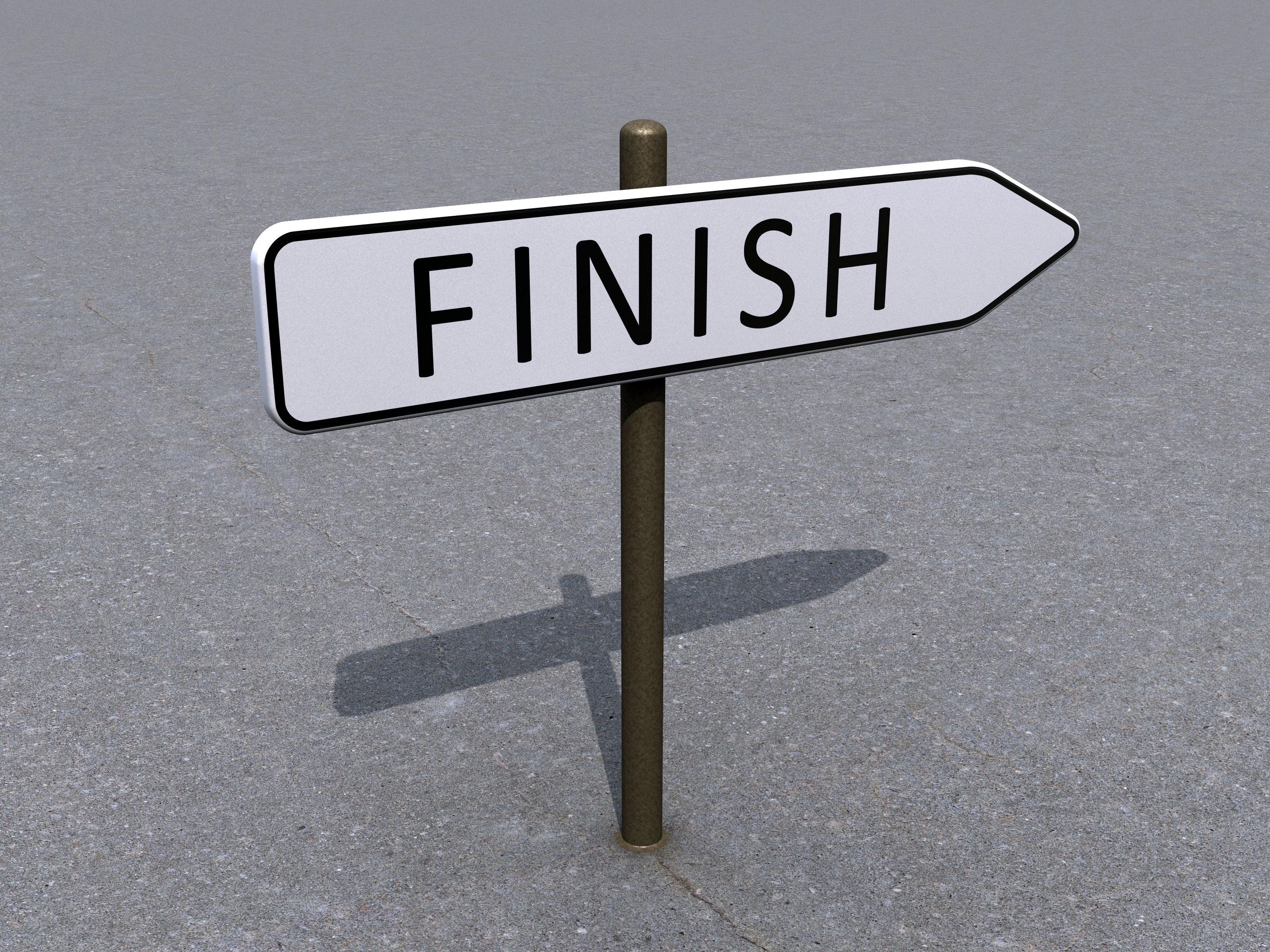
(This photo is borrowed from an excellent post on the blog Prof KRG dealing with the same challenge from a different angle.  Useful stuff, here.)  

There are two things I’d like to cover in this post:

1)  Finishing (or not) what I start.

2) Explaining Hot Tip #1 About Dying from my last post as I (hinted suggested prevaricated half-promised wiggled and sleazed) mentioned I might.

Finishing what I start.

Follow through, where writing is concerned, is not my strong point.  I know it.  My writer’s group knows it.  Anyone who’s seen the three-year old I gotta copyright it for the book, man… notice in my sidebar and yet can find nothing else about the book anywhere on this blog has probably figured it out by now.  I’m in serious danger of turning into a writer’s cautionary tale, an Aesop’s fable about what happens when you never actually finish any of the writing you start.  (Hint: You eventually turn into a fattening, graying dilettante who spends the rest of her life writing flashy first chapters and then basking in the dwindling number of wows she gets from the dwindling number of readers who have a dwindling tolerance level for that kind of tease.)

I’m not there yet although my fear of it is rising exponentially because I’ve just launched my fourth major assault in six years on this book I’m trying to write.  It’s morphed from non-fiction into creative non-fiction into fiction.  From a kind of helpful guide into a memoir into an imaginary story.  It looks nothing…nothing…like any previous version and deep down I’m now terrified that I’m just swimming around in circles but consoling myself that at least I’m covering a lot of miles.

There are only two possibilities left:  Either it’s a structural/voice problem as I keep telling myself, or it’s a basic discipline/courage problem.

And actually, as I was writing the above I realized it’s both.  But the second problem is bigger.

It’s not that I don’t spend hours writing everyday, I do.  My butt time is duly noted and logged every morning just like it’s supposed to be.  No.  The problem is that I spend those hours writing, then rewriting, then micro-rewriting the same sentence/paragraph/page over and over again because I’m absolutely terrified of writing something that will make me look stupid/bad/inept/untalented, and because it’s a whole lot less risky to edit than create.  (Like right now I’m thinking of shelving this post because it’s already too long and who cares about my writing process anyway you narcissist and why can’t I just distill it into the heart and soul of the thing instead of using three million fucking words for a blog post and I’ve now reread/tweaked this paragraph seven times because I’m too scared to keep going…you get the picture.)

This has got to change.  Today I’ll take a stab at it with a baby step.  I’ll follow through on something I wanted to do after my last blog post, which brings me to my second object with this post:

Explaining Random Hot Tip About Dying #1 from my last post.  For those who don’t remember, the tip goes something like this:

“Dying is as much a gift as it is a punishment.  Pick which view to invest in carefully as it will affect your entire life.”

The gift-part can be a little difficult to see, especially if you’re not that familiar with dying. But there are actually a lot of gifts and they tend to be profound.

(Like, for instance, if I never finish my book at least I’ll eventually die and be done with it.)

I’m kidding…kind of…but it’s still true.  For me, as a long-time depressive, the knowledge that none of the dark periods I cycle through can last forever has lent me endurance more times than I can count, and actually saved my life on the two hardest days when I finally lost hope.

The dying people I worked with gave me another gift I’ll never be able to repay. It was while I was with them, listening to all the stories about living from those facing certain death, that I finally learned the secret of  how to long for my own life.

They also taught me about how dying can be a final act of generosity, a way of saying I’ve loved this life so dearly but have taken enough for myself. It’s someone else’s turn now, to come into the world and stand where I’ve stood, to love what I’ve loved. Thank you.

And in allowing me to watch the way their beautiful, tender, wasting bodies were unravelling and vanishing they taught me about the difference between life and Life.  How biological existence is one kind of luminous miracle, how the consciousness rising within it is a second, and how the love those two things wind up generating between them is the third and greatest miracle that transcends and outlasts them both.

But I’m getting mystical again…which, honestly, I can’t really help but need to at least try and curb a little.

In any case, these are just a handful of the gifts that I discovered about dying.  There are more, lots more, but in the end each person has to delve in and discover their own, and they’ll be different for everyone.  It’s worth the effort because it can help to change the lifelong prospect of dying from something horrible, unnecessary, miserable, and bleak to something that’s a little more helpful, even nourishing, to the life we get to live until then.

So that’s it.  I’ve actually finished follow-up baby step #1!  My confidence is building.

Next up: A post explaining Random Hot Tip About Dying #2 which goes something like this:

“Accepting dying might not always make it easier when it comes, but being horrified is guaranteed to make it worse.”  

Now if I can just press the publish button I’ll be in business.

copyright Dia Osborn 2013

Five Randomly Useful Hot Tips About Dying

(Quick note: These tips refer to dying, not death. I don’t have any hot tips for death yet. For those confused on the difference, dying is that thing we do at the end while we’re still very much alive.  –Editor)

1) Dying is as much a gift as it is a punishment.  Pick which view to invest in carefully as it will affect your entire life.

2) Accepting dying might not always make it easier when it comes, but being horrified is guaranteed to make it worse.  (Trust me on this one.)

3) Learn about dying from people who are familiar and comfortable with it.  The terrified can’t teach you much you don’t already know.

4) A “good death” is good for everyone.  A “bad death” is bad for everyone.  As a group we need to be shooting for a lot more good deaths than we are.

5) There’s some version of an afterlife/afterwards for everyone.  Pick yours and start making it work for you now.

If I don’t get distracted by another idea (a big if these days) I’ll try and elaborate on these tips in upcoming posts.  I imagine they probably need it.

copyright Dia Osborn 2013

Life’s glorious illusion

Zan_Zig_performing_with_rabbit_and_roses,_magician_poster,_1899-2

It’s something, to watch a person die.  It truly is.  It’s amazing to watch them being born, too, which I’ve also done, the way that one moment there are three or four people in the room and then the next there’s a fifth only nobody came through the door.  It’s like magic.  Like watching someone pull a rabbit out of a hat, only a gooey one, with no fur and a weird shaped head.

Watching a person die is like magic, too, only rather than someone appearing out of nowhere it’s more like watching them climb in a box and get sawed in half.  One moment they’re all in one piece and waving at you and then the next they’re split in two, a body on one side of the box and the life it used to contain on the other, and for all you’re worth, you can’t figure out how it was done.

I was shocked, the first time I saw it. Maybe the second and third time, too, or longer even, but sooner or later I started to get the hang of it and the shock wore off.  I stopped being offended by the indignities involved, which then made it easier to notice some of the other details.

Like the fact that afterwards, there’s this beautiful leftover body lying on the bed which, it suddenly becomes crystal clear, really, truly is just a body, a big bag of physical stuff that all by itself, God bless its little heart, can’t do a whole lot.  I always knew that’s what it was of course but still, I didn’t really.  I kept forgetting because it was wearing this delightful, shimmering life disguise, kind of like puffed-up peacock plumage full of rainbows and a million eyes, and it made that body look like it was more, a lot more, than just a physical bag of stuff.

It’s a helluva trick.

But still, in the end, it is what it is and has to revert to form.  I watched my first person die, my grandmother, and was stunned when her amazing, beautiful body went limp on the bed like it did.  It looked so helpless and vulnerable and smaller somehow, lying there all by itself, and I got confused. It was like someone had just pulled a big, velvet curtain back to expose the little man standing behind it with nary a wizard to be seen.  Huh-oh, I thought, and then couldn’t stop staring because it just looked so wrong. 

But that was the first time, when I was inexperienced and didn’t know any better.  Eventually though, when I got more used to it, the whole idea of a body without a life inside it turned out to be more okay than I thought.  Left to their own devices bodies, like exposed wizard imposters, are actually kind of endearing in their own fragile, comical kind of way, and when I stopped expecting them to be great and all-powerful it was a lot easier to see their smaller body-specific joys and relax.  To laugh a little and enjoy the illusion.

I was lucky to have the opportunity to see it again and again like I did…how a body and the life it contains whisper their lingering farewells and then go their separate ways.  It gave me a chance to get over the first shock and discover the mistake I’d been making, that a body really, truly is just a body and that I can still love it anyway.  Wildly and more than ever.

It would have been such a bummer to only see someone die once and then be left forever afterwards, stuck in the shock and confusion.  I wish more people could be as fortunate as me.

I wonder if it would help others be less afraid of being there for those who are dying?  Maybe even help them recover more quickly afterwards with at least one of the traumas involved lightened a little.

copyright Dia Osborn 2013

Rhythmic sea lions–what’s a scientist to do?

Here’s a piece that caught my attention this morning.  A Santa Cruz researcher trained a young sea lion to keep a musical beat which, evidently, is considered a breakthrough discovery.  Here’s the video:

What really surprised (and confused) me was the young man’s assertion that to date, scientists have maintained that mammals are incapable of keeping a beat, that it’s an ability specific to humans and some birds capable of vocal mimicry.

Huh?  Don’t they watch Youtube?

Here’s a dog tapping his foot to some rock music:

And here’s a golden retriever grooving to a jazz beat:

Honestly, scientists can be so brilliant and yet so clueless sometimes.  Especially where animals are concerned.  Of course their position is an incredibly difficult one considering what they have to do to these little companions on a daily basis to produce all the miracles we demand of them.  I imagine if it was me doing the experimenting that I’d have to deny any of them were intelligent, sentient beings capable of love and suffering, too.

Sigh.

As always, I continue hoping for a shift in paradigm on this one.  And it may be coming.

NEXT POST: The Cambridge Declaration of Consciousness–a group of leading neuroscientists announces that many animals are indeed conscious beings capable of experiencing stimuli the way that humans do.

copyright Dia Osborn 2013