I’m still here. Updates on wildfire smoke, a hospice patient in the family, and garden things.

Readers, forgive me for I have sinned.  It’s been two and a half weeks since my last blog post…which is a first.  Maybe it’s a sign that my life really has been just as busy as it feels but still, excuses are boring so I’ll just leave it at this:

Hello and I’m glad to be back.

Updates:

Mon Pere: I wrote a blog post about my father-in-law’s unique dance with aging a while back (see Elders and the Strange Gravitational Effect of Final Mystery) and since then his spiral has tightened.  He was admitted into hospice care a couple of weeks ago and, as so often happens, his symptoms have greatly improved since then.  Finally…relief.

It was interesting watching him work his way through all the many and powerful misunderstandings that still exist about hospice in the minds of most people.  He was very reluctant to take the step because, as he said, “I just don’t feel like I’m dying yet.”

And rightly so.  He’s not.  He’s still very much alive…and he will be until those final days or hours when his body begins it’s final, dramatic shut-down sequence.  Until then, he will not…I repeat NOT…be dying.  He’ll be living with a terminal illness which is not only a completely different thing from dying, it’s where hospice care really shines.

So far the hospice staff (along with family members) have managed to get his escalating pain…previously managed separately and inefficiently by three unrelated doctors in three different far-flung offices…back under control.  His medications have been consolidated, coordinated, and increased enough to actually do the job.  A nurse visits him regularly at home so he no longer has to make an appointment (then wait a week with out-of-control pain before having to drag himself down to whichever doctors’ office is involved.)

After months of debilitating pain he’s been able to finally return to his normal cheerfulness…to doing the kinds of things that he loves.  It’s a transformation we’re all profoundly grateful for.

The hospice he’s with also brought equipment and aid into the house that’s making things a lot easier for him…from getting out of bed, to going to the bathroom, to getting around the house and farther, to taking showers comfortably and safely.  He’s looked at me a couple of times in wide-eyed wonder and mentioned what a gift it is–that it’s all paid for through Medicare.

“It’s free,” he whispers, not quite believing that this help he’s needed so desperately–that’s allowed him to finally stop thinking grim and drastic thoughts and happily return to everything he still loves and longs for–is his for the asking.

I think it’s hard for all of us to believe right now, that there exists this one small part of our tortured healthcare system that’s actually delivering what we all want it to; relief and a better life.  And saving money to boot.

I just wish everyone understood that more.

The Wildfire Smoke:  It’s awful.  It’s like hell.  Brimstone shit.  I got up the other morning, looked out the front door, and this is what the sun looked like:

Seriously.  No photo shopping.  Everyone is a smoker these days.

Air quality has been in the dangerous zone for a couple of days here but it’s far worse up in the mountains near the fires.  On an air-quality scale from green to red, the town of Salmon, Idaho’s air is rated purple…beyond red.  The mayor just had surgical masks handed out to everyone in town and yet still…the fires are likely to rage until the snows come to put them out sometime in late fall.

Prayers for early snow in the Northwest this year are currently being solicited.  You can just send them up into the air where hopefully the jet stream will blow them into a smoke plume.

And last but not least…

The Garden: Harvesting mode.  Roughly forty jars of pickles canned so far (halfway through), twenty quarts of frozen green beans, a shitload of grated zucchini both frozen and dried, pickled peaches, sun dried tomatoes, a lot of blanched and frozen turnip greens, and dehydrated elderberries coming out our ears.  (Everyone is getting elderberry brandy for the holidays this year.  Good flu fighter.)  Oh yeah.  And winter squash.  Lots of winter squash.  And tomatoes, basil, corn, potatoes, peppers, beets, and eggplants waiting in the wings.

It’s been a good year in the backyard.  Gratitude all around.

copyright Dia Osborn 2012
The differing legacies of good deaths and bad ones, and an extra bonus of grace.

Good deaths have a ripple effect that go out for a long, long way, for a long, long time and, unfortunately, so do bad deaths.

I just stumbled across a blog post titled rapture? (not what you think) on Wild Celtic Rose where she describes a personal experience with each kind of death, and she manages to convey the lasting legacy of each far more eloquently than I’ve ever been able to do.  I highly recommend a read if you get a couple free minutes sometime.  (It’s not that long and you may cry from the beauty at the end.  I sure did.)

She also brushes lightly over a couple of other interesting (and loaded) topics.

The first involves the subject of respecting another person’s right to die the way they choose (and one possible cost of not respecting said right.)

The second involves the legal right we all have to forego any treatment and die if that’s what we prefer.

And the third involves that elusive, fragile, and exquisite grace that usually surfaces when faith is respected across a divide in beliefs.  She captures the spirit of this so beautifully when she says (talking about the good death):

“Sometimes we look at other beliefs with skepticism at best.

I can say that the honest, giving, loving, non-judgmental way in which Craig and Nina lived their lives is as “Christ like” as I have ever seen.

I honestly don’t know if there is a heaven or not.

Even though we are of different faiths, I thoroughly believe that if there is one, that Craig is there and he will be joined by Nina and the rest of his family.”

A beautiful expression of how we can still love and be moved by another’s faith without necessarily sharing their beliefs.

I really, really hope you have a rapturous, awakening, living-it-like-it-was your-last kind of moment sometime this week.  We should all be that lucky.

Love,

Dia

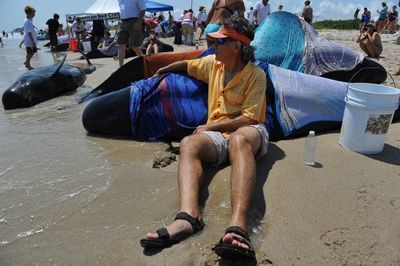
Spontaneous Hospice Appears For A Pod of Pilot Whales

(Photo of Ed Lippisch by Eric Hasert/TCPalm.com September 2, 2012)

When working with hospice I often had people tell me, “Oh, I could never do that,” and I was never quite sure how to answer them.  Because while on the one hand I could see they were sincere, on the other I knew they were wrong.

Of course they could help care for someone who’s dying.  Bathing and toileting are not rocket science.

A more compelling reason is the fact that compassion, empathy, and the desire to alleviate each other’s suffering is an essential part of human nature.  Sure, you don’t think you can, you don’t want to, you’re scared of it, and you may even feel nauseous at the thought.  But then in the blink of an eye…boom…it’s your loved one who’s lying there so achingly vulnerable and suddenly, not only can you do it, you find doing it totally transforms you.

Never underestimate the power of your own heart.

Here’s a great example of a lot of people discovering over the course of a single day that dying is simply no barrier to loving and caring.  A pod of twenty-two pilot whales beached themselves yesterday along the south Florida coastline and, except for five babies young enough to transport and rehabilitate, the rest wound up dying there.

No one knows why they beached really, it was one of those mysterious whale things, but evidently hundreds of people showed up to help.  From the article on Foxnews.com:

“TCPalm.com reports that hundreds of residents came to the beach to assist with the rescue, helping the animals turn upright so they could breathe better. Volunteers covered the whales with moist towels and poured water over them. Red Cross volunteers helped ensure that volunteers stayed hydrated in the hot sun.

“I think that people want to help animals,” said Jacqui Thurlow-Lippisth, a Harbor Branch volunteer who worked with others to tend to juveniles in a shaded inflatable pool. “Especially whales and dolphins, because they are our counterparts in the seas. They’re mammals, they’re intelligent, they’re social. They’re a lot like us.”

Still, there was a sad undercurrent to the efforts, with rescuers aware that most of the whales were dying.”

I’m willing to bet that, if they’d been asked beforehand, most of the people on the beach that day would have also claimed that working with hospice was something they could never do.  And yet there they were anyway, tending to a pod of strangers whom they knew full well were dying and yet couldn’t bear to leave to do it alone.

Of course we can all do that kind of work.  In fact sometimes, it can be a lot harder not to.

copyright Dia Osborn 2012