My posting schedule:

Now that I’ve finally crawled out from under my log and let some of you know I have a blog, I realize I should also warn you up front not to expect a cornucopia of material.  I’m not prolific.  On the contrary,  I usually only post on Fridays because I’m slow and tortured and, in my world, no post is worth publishing unless every sentence has been worried and reworked for a minimum of an hour and a half, and every word has been tried, changed, rearranged and then put back to the original at least four times.

Predictably, this leads to a lot of garbled text.

I’m therefore forced to do a panic rewrite every Friday morning after which I finally hit the publish button in much the same spirit that I depress a toilet handle.  (I’m a little repulsed by the final product, but relieved that it’s done and blessed with a new burst of energy.)  I then redouble my efforts and spend the rest of the day re-re-editing and updating the published text.

Whenever I doubt my sanity I think of E.B. White who was also obsessive.  It was his habit, after finally working up the nerve to place a finished manuscript in the mailbox, to then panic, go to the postmaster, and beg him to fish it out and give it back.  (I understand it never worked.)  Remembering this always makes me grateful that I live in an age with the option of an update button.  Less humiliation.

Viva le blogging.

(UPDATE:  I know, I’m posting on a Tuesday to announce that I post on Fridays.  Life is full of little ironies.  This is just my contribution.)

A Parrot’s Grief


We once had two dogs.  They joined the family two years apart, lived most of their lives together frisky and inseparable, then died at the end, also two years apart.  Our big guy died first.  Swift and unexpected.  He was fine and healthy for years and years, and then one day got sick and three days later died.  Just like that.

Our second dog was lost without him.  For a month following his death she withdrew.  She’d still come to us if we called and try to look happy to see us, but as soon as her duty was done she’d slip away to the corner where they used to sleep together and lie down again, eyes open and unfocused and numb.

We were heartbroken for her and heartbroken for ourselves.  We all missed him terribly.

But time worked its magic and one day, for no particular reason, she returned.  She followed me around the house that morning, trying to flip my hand up on her head with her nose again, and my heart eased knowing she’d be okay.  We had two more wonderful years together before she, too, eventually died.

There’s a lot of controversy on whether animals experience emotions, but the suggestion that they can’t feel things like simple grief makes me angry.  I usually try to respect the beliefs of others but, because this particular belief is so often used as a justification for exploitation, neglect, or abuse, I don’t respect it.  I find it suspect.  The claim is far too riddled with conflicts of interest to take at face value.  Besides, in five decades of living, every interaction I’ve personally had with animals and birds, (and reptile, fish, and even a few insects believe it or not) has confirmed that these other strange and wonderful companions I share my world with feel a great deal, even if most of the time I don’t understand what exactly that is.

A case in point:

One of my first hospice patients had a parrot she said she’d smuggled over the border from Mexico twenty years earlier.  She was a wild, untamed kind of woman and her parrot was just like her.

I don’t remember now what kind he was, but he was smallish, maybe a little bigger than Snowball the dancing cockatoo, and he spent most of his time in those final days perched on the valance above the window next to her bed.  I was a little nervous at first because family members warned me that sometimes he flew down on people, swooping at them again and again, testing to see if they would duck and run.  He was a fierce little thing, tolerating only a handful of people and attacking the rest, but he clearly loved and needed that woman lying on the bed and was made achingly vulnerable by her approaching loss.

He never flew down on me.  I used to speak to him gently when I was on that side of the bed, changing her sheets or dressing or incontinence pad, and he’d closely monitor everything I did, anxious and curious, sometimes fluffing up into a ball of down and shaking his head rapidly, raising his wings for a moment like he just couldn’t stand the uncertainty anymore, then settling back down to watch and wait again anyway.  He’d sidle back and forth along the length of the valance, first to the left, then to the right, over and over again like a loved one pacing the corridors of a hospital.  He knew something was wrong and it seemed to fill him with unease.

Once I saw him fly down to the bed while I was in and out of the room, doing laundry.  She was asleep and he seemed to want to just be next to her, to touch her.  He awkwardly waddled up next to her head, curling into the warmth still emanating from her.  He bent his head over next to her mouth as though checking for breath and just stayed there for a long time, frozen, his feathers brushing her lips.  My heart broke for him and I wanted to pick him up, cradle and croon to him, but I knew he’d bite me if I so much as extended my hand.

First her sister told me and then her daughter.  How he wept on her body when she died.  He flew down from the valance to her chest and started nuzzling and nipping at her, trying to make her respond.  Stroke him.  Yell at him.  Anything.  But when she didn’t move he went still and stunned, and it was then that he started making the strange, small noises, noises unlike anything they’d ever heard him make before, like sobs.  His head bobbed slowly up and down to the rhythm of the sounds, and her family just stood there around the bed, surprised and stricken by his grief.

Later, when the men from the funeral home came to remove her body from the room he attacked them.  Viciously.  Angry and hysterical, he dive bombed at their heads repeatedly until one of the men ran  in the bathroom to hide.  The family finally captured him and put him in his cage while they took her body away.

I’ve often thought about him over the years and hoped that he eventually found someone else he could trust, someone he’d allow to love him, to bring him back in healing and wholeness.

Like just about every other person I’ve ever known, the deep emotional bonds I’ve shared with animals over the years have provided me with a well of strength, beauty, unconditional love, and hope.  My ties to these companions have helped shape me, often healed me, and even saved me, more times than I can count.  I really, really hope that some day soon we’ll grow past the economic and scientific need we have to deny the depth of their vulnerability to us, and instead forge a higher, kinder relationship based on mutual respect.  They’ve already given us all so much.  They deserve something far better than what they’ve gotten in return.

copyright 2010 Dia Osborn

Christmas Trees and Death Panels: How Fear Sets A Snare

(I apologize in advance.  This is a long post but there was a lot of important ground to cover.  I won’t do this often.  Promise.)

Like many people, the Christmas tree scene in the original 1972 Poseidon Adventure movie made a deep impression on me.  I was only fourteen when the movie was first released so I was impressionable.  Given.  But even so the scene is a classic.

It’s Christmas (New Years?) Eve on a luxury ocean liner out in the middle of the ocean and the crew and passengers are celebrating in the ballroom under the branches of a towering and heavily decorated Christmas tree.  As per disaster movie formulae, a tsunami formed by an earthquake off the coast of Crete comes rolling across the ocean and hits the ship broadside, capsizing it and tossing the above mentioned assemblage all over the slowly inverting ballroom.  Once the Poseidon settles in it’s new, upside down position, the Christmas tree is lying on it’s side on the ceiling-turned-floor.

Enter: Gene Hackman, a renegade missionary.  He swiftly marshals a group of men to raise the tree again for use as a ladder to access a service door at the bottom-now-top of the room.

We’ve seen a lot of random chaos and horror up to this point but Fear as a saboteur has been suspiciously quiet.  That changes once the Christmas tree option is presented.  Fear immediately recognizes a golden opportunity and steps in to set the first, big snare of the movie:

The survivors each have to make a choice.

Reverend Gene, on the one hand, tells everyone to climb the Christmas tree and head for the hull of the ship, because that’s the only logical place where rescuers could ever access survivors.  Reverend Gene represents original thinking and a challenge to the status quo.

But the ship’s purser disagrees and tells them no, no, no, they must all stay put in the ballroom and wait for someone to find and rescue them there because the ballroom is where rescuers will search.  The purser (read official man in a uniform) represents standard thinking and the status quo, something fatally attractive to anyone with a strong herd mentality.

It was painfully clear to all of us in the theater that the Rev was right and everyone needed to climb.  Fast.  We knew that those who couldn’t rise above convention and think outside the box were gonna die, die, die, horribly and soon.  We knew this because the whole scene was built around a basic rule of human behavior; terror tends to drive thinking out of the cerebral cortex (rational, logical, problem solving) and into the amygdala (instincts, habit, and fear).  Anytime we’re confronted with a new and terrifying situation, if we can’t master our emotions and analyze circumstances objectively then we revert to old mental ruts and knee jerk reactions.

We follow the herd because by god there’s safety in numbers.  Right?

In this case, not so much.  Fear springs the snare, paralyzing just about everyone there.  The majority of people listen to the purser and decide to stay put.  Only a handful climb the tree and, once the chosen few are safely ensconced up in the only possible escape route, explosions sound in the belly of the ship, windows and skylights shatter in the ballroom, the Christmas tree topples back down to the floor, and deep, ocean waters surge in, drowning every last screaming, thrashing person who made the mistake of defaulting to what felt, instinctively, like the safest bet.

Working in the hospice field, one grows familiar with fear and its many, (many, many, many, many, many) snares.  A fear of dying can often drive us to make unwise care and treatment decisions.  From what I can tell, a lot of this comes from the profound lack of education and understanding that exists in this country around the dying process.  The fierce denial we’ve embraced as a society doesn’t leave much room for the cerebral cortex to think about the subject at all, which means that most of the default choices people make at the end remain firmly embedded in the instinctual part of the brain.  How could it be any different?  There are few instincts more powerful than the one to survive and, if we don’t have some extraordinary and compelling reasons not to, we’ll naturally choose to continue treatments beyond (sometimes far beyond) the point where our doctors, or even we ourselves, think we should.

Yet at the same time, most of us don’t want to die wrapped up in tubing and drugged into a stupor, or with flash paddles sending electric jolts into our heart while our family looks on in traumatized shock.  But it happens all the time anyway.  Why?

There are a host of complex factors that contribute to the problem but ultimately one underlying cause rules them all:

We persistently and adamantly refuse to talk about dying.

We play right into one of Fear’s greatest snares.  Fear loves the fact that we won’t talk about dying because that prevents the cerebral cortex from getting anywhere near our decision making.  How can we possibly evaluate what’s been going wrong, learn anything new, or change anything for the better, without some calm, compassionate, respectful, thoughtful discussion about what’s going on?  We can’t.  Our fearful silence gives the old habits and instincts free rein and we default, over and over again, to the same flawed choices.  That’s how, even if it’s the last thing we ever wanted, we still so often wind up cocooned in IV lines without so much as a spare patch of skin for our loved ones to kiss or hold.

This reluctance and failure to talk about dying is the norm in individual cases.  But it happens on the national level as well, and a prime example of it  just played out during the recent health care reform debate.

Remember the small provision in the health care bill (section 1233 of HR 3200) entitled Advanced Care  Planning Consultation? (Otherwise dubbed, in a bewildering but imaginative twist, as  Death Panels.) Amazingly, it constituted only three pages out of roughly 2000, yet it wound up hijacking the debate.  Why?  Because it asked us to start talking about the dying process.  More specifically, our own dying process.  It boldly and openly addressed the current, gaping need that exists for each of us to have a conversation with the doctor who’s treating us about how we want that treatment to look.

But in so doing this tiny provision struck a major taboo.

Let me reiterate here.  The provision didn’t try to address how we’re treated, it just wanted us to start talking about how we’re treated, but it’s authors may as well have suggested we all drink poison Kool-aid.  They failed to understand how profound the fear of talking about dying is in our society, and that failure is a big part of the reason why the whole thing blew up.   

Personally, I think legislation of some sort is a good idea, but this version was doomed to fail.  I mean, come on.  Any politician planning to link death, law, and government is going to have to make a serious effort to engage the general citizenry in a calm, compassionate, respectful, informative, and thoughtful discussion about the whole thing first.  They need to institute a massive educational outreach to explain why a conversation about end of life care is so essential.

They need to do a much better job of explaining its gift.

There are stories out there that we all need to hear.  Stories about how drastically a simple end of life care discussion can improve outcomes for individuals, families, and entire communities.  For instance, we needed to hear about the two studies done by Aetna insurance.  The ones where the terminally ill who had access to both ongoing treatment and palliative and hospice care, cut their emergency room visits by half and their hospital and ICU visits by two thirds.  Costs dropped by almost 25%.  And most importantly, these people reported much higher levels of satisfaction with their care.

We needed to hear about the compelling evidence emerging from the Coping with Cancer study that suggests end of life care discussions not only decrease suffering and costs, but also increase both quality of life and even life expectancy.  As Dr. Atul Gawande explains in his article Letting Go: What should medicine do when it can’t save your life?, “These patients suffered less, were physically more capable, and were better able, for a longer period, to interact with others. Moreover, six months after the patients died their family members were much less likely to experience persistent major depression.”

And then there is the interesting case of La Crosse, Wisconsin, where life expectancy is actually one year longer and end of life costs about half the national average.  This is because  some far sighted medical leaders in the community got together back in 1991 and started a campaign to get physicians and patients to discuss end of life wishes.  Again from Dr. Gawande:

“By 1996, eighty-five per cent of La Crosse residents who died had written advanced directives, up from fifteen per cent, and doctors almost always knew of and followed the instructions…Answers to the list of questions change as patients go from entering the hospital for the delivery of a child to entering for complications of Alzheimer’s disease.  But, in La Crosse, the system means that people are far more likely to have talked about what they want and what they don’t want before they and their relatives find themselves in the throes of crisis and fear…The discussion, not the list, was what mattered most.” (Emphasis mine.)

These amazing stories and others like them are currently opening a lot of eyes to the wide ranging gifts that come from having a simple discussion about dying.

It would have been helpful if we heard these stories before the legislation was introduced.  A few realized their error and tried to get the news out, but it was too late.  Fear had already seized another golden opportunity (politics!) and set its snare.  The term Death Panels rose from the depths, Fear immediately latched onto it like a monster from a nightmare, and our group, instinctual  brain responded with a great big Hell no!! Explosions sounded from the belly of the debate, windows and skylights shattered, and Provision 1233, like the Christmas tree, slowly toppled to the floor, destroying any hope for mutual, constructive discussion during this round.

Which leaves the majority of those who are currently dying in much the same position as the unlucky Poseidon passengers who decided to sit and wait.  They’re still not having that conversation about end of life care choices, so they’re still missing out on the help, relief, grace, and extra time which are its gifts.

But there’s good news.  We don’t need legislation to talk about dying.  We can talk about it any time we want.  We can figure out, right now, who it is we’d like to choose for us if a time comes when we can no longer choose for ourselves.  Then we can talk with them, right now, as long or as often as we need to.  We can tell them about what’s important to us and what scares us.  What we’re hoping for and how hard it is to trust with something this big.  And they can talk with us, too, about how badly they need to know what we want and how scared they are of making a wrong decision.  About how much they love us and how afraid they are of the loss.

Then we can go in and sit down with our doctors and tell them, too, about these frightening, tender, sacred things we’ve discovered about each other and ourselves.  We can give them the vital information they need to have, so they can care for us in the way we want most.

If we can do all that then the legislation that follows will be far more informed, compassionate, and respectful…the kind of legislation that everyone can trust…because we’re finally talking.

If you’d like to start talking about dying and end of life care but aren’t quite sure how to start, here are a handful of reading resources that might help jump start a conversation:

1) Dr. Atul Gawande, Letting go: What should medicine do when it can’t save your life? (13 pages long but more than worth the time required to read it.)

2) Final Gifts (This book is a huge favorite with the hospice crowd…curious, beautifully written, and uplifting.  Good for easing fear.)

3)  Palliative Care Blog (Fantastic resource for everything end of life and palliative.  Contains a wealth of links to other resources as well.)

4)  Talking About Death Won’t Kill You (The title of this book pretty much says it all.)

copyright 2010 Dia Osborn

Update 8/25/10: Here’s some news. Last week New York state passed a bill (The New York Palliative Care Information Act) requiring doctors to offer terminally ill patients information about different end of life options.  It’s essentially Provision 1233 resurrected in state form.  Behold!  The Christmas tree rises again.  What I found most interesting was that the bill was passed over the objections of New York State’s medical society.  The doctors opposed it saying ‘the new law would intrude “unnecessarily upon the physician-patient relationship” and mandate “a legislatively designed standard of care.”’  Truth be told, there are studies showing medicine tends to attract people with the highest levels of anxiety about dying. Doctors as a group tend to be more reluctant to talk about it than the average person, yet they’re now the ones who are legally responsible in New York to initiate the conversation?  Hmmmmm…  What does this bode for the future?  Hopefully, now medical schools and other sources of medical education will provide more training for how to talk about dying.  As Dr. Gawande stated in Letting Go, it’s a skill that needs to be developed just as much as surgical skills.  We’ll see.  In any case I hope this will stir up more constructive discussion!

When beliefs change…

I’ve always been something of a spiritual nomad…or possibly a spiritual polygamist,  depending on who’s judging…but it felt destined.  Like I was born into a desert too damn vast, silent, and starlit not to explore.  I had to roam.  Something deep inside would have died or worse if I hadn’t been able to wander from church to temple to tree covered glade, asking all the weird questions that have always haunted me, looking at life through every set of eyes I could borrow.

Desperate and searching for grace.

I wound up assembling a belief system from it all.  A little rag tag, to be sure, but one that helped me navigate the good times and survive the bad and, really, that’s all a good set of beliefs is supposed to do anyway.  It was enough for me.

And then I entered the homes of the dying and all my carefully collected beliefs got blown out of the water.  Kablam!  Just like that.  I looked down at the tattered shreds in my hands, muttering what?  What?! then looked up at a world that was beautiful, luminous, in a way I’d never noticed before.  So much so, in fact, that it was hard getting things done, because it’s challenging to focus when your heart swells to the point where you’re about to burst into tears all the time.

So what do I believe in all these years later?   It’s hard to answer because it feels like the thoughts drained down out of my head and into my chest.  I don’t have words for it yet—what I believe in I mean.  What I have are recollections.  Memories.  Moments of awareness.

Like standing by the bedside of a dying woman in tremendous pain, tenderly, slowly, oh-so-gently bathing her aching, quivering body.  I had the oddest sensation that my hands grew huge, full of something sweet and searing, as if they were cradling her and cradling her family and cradling their home and cradling myself.  And afterwards I walked out to the car and gripped the steering wheel like I was falling off a cliff, trembling and shaken by some vast current I felt flowing through the house.  A current that had come to collect her, surrounding and floating and washing her away to somewhere else.

There’s a memory of sitting, nodding, by a dying man’s armchair as he lay still and quiet, eyes closed.  And suddenly I noticed all the particles inside him, particles in the room.  Strange, lovely, luminous things that rose and orbited through the air, combining and recombining like  miniature constellations and galaxies.  They seemed slow and graceful and ancient to me, alive and vibrant as if they were conscious, and looking at them made me feel like my skin was glowing.  I still remember the wonder I felt, the amazement, like they were tiny, radiant beings coming together to create our bodies, our chairs and clothing and cars, all the diversity of the physical world around us.  But only for a heartbeat before they dispersed again, moving on to create something else after us, new constellations and galaxies, new bodies, new life.

I watched the wrinkling nose of a dying man as he described the stench of the field where the bodies were stacked after the attack on Pearl Harbor.   Listened to a dying woman recount playing beside the ovens of a converted German concentration camp as a child.  Felt the hair rise on the back of my neck as an old mother’s eyes darted from corner to corner, whispering how four of her children all died at once, long ago, trapped in the tree house they built and accidentally burned with a book of matches they found.

There are so many memories now, recollections of standing witness as heart after heart foundered and broke, falling one after another into a waiting pool of stillness.   It was a dark and tender pool, big enough to hold all their pain and all their lives, and each time my heart broke and fell in, too, with theirs.

Each time.

That’s what I believe in now, I guess.  I believe in that pool of tenderness, waiting and waiting to catch my heart each time it breaks.  I believe that my suffering and joy are entwined, inseparable and, in the end, the same, and that I’m fine just the way I am, whether it feels like it or not.  I believe that everything is still okay, no matter how lonely, frightening, or painful it gets, and that the more I surrender and fall, the safer I feel.  And I believe that that moment…that brief, exquisite moment…when my heart breaks and falls and finally remembers, is the biggest miracle of all.

copyright 2010 Dia Osborn

The Compass

My father sent me his compass this week.  It’s military issue,  camouflage green, weighs in at half a pound, and is nigh onto indestructible.  It’s the one he carried with him for fifty eight years, the one he used through wars and special missions to guide him across mountains, jungles, and deserts around the world.  It’s also the one, as he put it, that probably saved my life more times than I can remember and always got me home.

My father sent me his compass because he believes that I’m lost.

He and I don’t communicate all that well, which is not a big surprise.  He’s a man’s man, from the greatest generation, and prefers his communication simple, short, and aimed at a swift resolution.  He’s uncomfortable and impatient with the delicate dance required in talking about feelings and tries to either ignore a conversation that introduces them or, if that doesn’t work, shut it down altogether.  This can make it difficult for the women who are intimately involved in his life.

Because women have to talk about feelings.  It’s in our DNA.  Relationships are our genetic job and the drive to talk about them is as relentless as the instinct to protect our young.  It’s a diagnostic tool to help us determine if everything is running smoothly.  Preventing a woman from talking about the relationship is as counter productive as stopping a man from checking the oil in the car.  All that happens is the engine of each eventually blows and we all know how hard it is to get them up and running again after that.

Which is what happened with my father and I.  I needed to talk about something important but he silenced me instead, and even though we lasted a few years longer, the pressure built until it finally blew after which I stopped talking to him altogether.  And for the life of him he can’t understand why.

Yet he’s still reaching out to me with his compass.  He’s sending me a message in the language he knows, and while I stiffen at the inference that I’m lost, I’m also moved and shaken by his longing for me to come home.  Because I want to go home.  I love and miss him.  But I still don’t know how to survive closeness with a person who demands my silence.

I think all of us have an internal compass we steer by, a deep sense of knowing about what we need, what we believe in, and who we are.  This knowing is what fuels our passion and shapes our dreams and we can always tell when it’s not functioning properly because without it, we feel lost.  The directions on this internal compass are unique to each person, and I think that mine are different from my father’s in significant ways.  He steers by things like loyalty, courage, secrecy, and discipline while I find my way through curiosity, exploration, expression, and truth.  These are not qualities we’ve voluntarily chosen for ourselves, things to try on and discard at will.  They’re what we are, the cardinal elements out of which we were created, and he can no more stop being what he is than I can.

And yet, and yet.  He keeps calling and calling me home, and I keep searching for some way…some way…to reconcile the differences so I can survive a return.  Because, in spite of the hurdles and confusion and pain, we still share the same magnetic north; we love one another deeply and can’t seem to forget it.

copyright 2010 Dia Osborn

A Sense of Presence (Can you feel me now?)

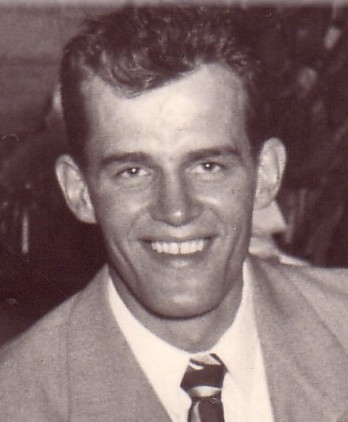
Uncle George, husband, father, friend, and legendary storyteller.

I thought a lot about my encounter with Alf and the Fly this weekend, about how vivid the sensation was when I felt Alf’s presence during the memorial service.  The subject was up again because we drove down to Reno to join extended family in celebrating the life of an uncle who died earlier this year.  During a conversation with one of my cousins (a daughter of said uncle), she described a moment, while going through his things shortly after he died, when she suddenly felt like he was right there with her, giving her an intimate message of love through, of all things, an obscure word in one of the National Geographic magazines that he loved.

She, too, experienced a sense of presence.

Many of you might recognize what she described because you’ve felt something like it yourself.  It turns out that experiencing a sense of presence is fairly common, not only among the survivors of those who’ve recently died but in a variety of other settings as well.  The experience is so common in fact that it’s been given names like the third man, widow effect, and the ever magical imaginary friend of young children. There has also been a fair amount of research done on the phenomenon and I’d like to touch on a few of the studies as referenced in a fascinating book called The Third Man Factor by John Geiger.

(BTW, if you ever get a wild hair and feel like reading a variety of personal accounts of  a sense of presence, here’s a forum on The Third Man Factor website.  These examples are unique because most of them result in a person surviving a situation where otherwise they might have perished.)

Geiger’s book deals primarily with the experience of a sensed presence in extreme, survival situations but he references other circumstances where the experience regularly manifests.  Needless to say, given my focus on dying, I was particularly interested in those dealing with the widow effect, the experience of a sense of ongoing relationship with someone who’s died.  He cites one study by researchers at the University of Arizona at Tuscon in 1988, where about half of the 500 widows questioned reported sensing the presence of their deceased partner, and another survey of 227 widows and 66 widowers in Wales which produced a similar finding.

“That study, by W. Dewi Rees, published in the British Medical Journal, found that most people who had the experience reported they had visits intermittently throughout the day, while 10 percent said they ‘felt that the dead spouse was always with them.’  All said they sensed the presence of the deceased; a few also said they actually saw or heard him.  Rees found the experiences were in no way frightening, and concluded, ‘these hallucinations are…normal and helpful accompaniments of widowhood.’  Other research into widows of men killed in automobile accidents in Japan found the incidence even higher, and there, too, the researchers concluded the presence ‘may be a positive sign in helping them adapt to the loss.'”  (pp. 153-154)

Geiger also sites a larger survey conducted in the UK in 1995 that didn’t just look at widows and widowers, but included a broader cross-section of society.  It revealed that “the continuation of an important relationship after death is not confined to those who have lost a spouse.”  People reported sensing the presence of parents and other family members as well as friends.

Clearly this experience of sensed presence is widespread among the recently bereaved.  Yet prevalent or not, as most people are painfully aware, there’s a social stigma attached to talking about it.  I’ve found the majority of people, at least initially, are reluctant.  Some, deeply so.  They’re afraid others will think less of them for believing in “that kind of thing,” or worse, that people won’t believe it happened at all.   But it does happen, to a large segment of the population, and I hope that Geiger’s book will be a watershed, marking a shift in trend where it becomes more acceptable for people to speak openly about their experiences.

Because being able to speak about these experiences is important for reasons I’ll explain in a moment.

I found it interesting that Geiger himself expected a lot of resistance to the idea that the experience of a sensed presence is real and was surprised when none materialized.  He realized most people don’t doubt that the experiences are actually happening.   The controversy centers around what might be causing them.

The first thrust of The Third Man Factor is to confirm the experience itself and Geiger lays out evidence that makes it indisputable.  People are sensing something that feels like a presence.  (This is huge.  Absolutely huge. He’s finally provided a framework within which people of all intellectual backgrounds can talk about the subject.)

The second purpose aims at reconciling the traditionally supernatural elements of these experiences with possible scientific explanations and he presents some compelling evidence for the role that stress, loneliness, and neurological function play in the phenomenon.   The book is well researched and, while his conclusions ultimately raised as many questions for me as they answered, I was still wildly relieved to hear the subject discussed in a practical, factual manner instead of the half-embarrassed, half-apologetic whispers that I usually hear.

Now, let me be clear.  While I’ve long been intrigued by the dynamic tension between science and spirituality, and I’m always curious to hear what both sides have to say, on a purely practical level I, personally, don’t care what’s causing these experiences of sensed presence.  It’s not relevant to me.  It’s an interesting question, don’t get me wrong, and fun to explore when nobody’s dying.  But when someone is dying, the arguments are really just an intellectual exercise.

Once you’re in that room and it’s you or your loved one lying on the bed suffering, once it’s you facing down the maw of unbearable loss, once it’s your family that’s been swept away in the maelström of vulnerability that dying entails, you’ll probably discover that the arguments about what’s causing an experience of sensed presence aren’t nearly as important as whether or not it helps.

It’s like drowning in the middle of the ocean.  If a boat pulls up and throws you a life buoy you probably won’t care about where the thing was manufactured.  Nor will you ask to see a business card from whoever is throwing it to you.   What you will care about, deeply, is whether or not it floats and, if it does, you’ll grab it with gusto and hang on for dear life.

I think everyone should be allowed to speak openly about any unusual experience they have during the dying process.  (FYI, there are a lot of them.) Because even though no one can definitively explain them yet, they still provide enormous comfort and reassurance during a journey that’s tough at best and devastating at worst.

I’ve often felt frustrated by the fact that such a luminous, nourishing, (and it turns out commonplace) human experience is relegated to the back of the shame-closet where we stash our bogey men and under-the-bed monsters.  I don’t think anyone should ever have to feel embarrassed because they experienced something that helped them cope and heal.  Neither should anyone have to hide the fact that they’re experiencing something lovely even if it’s odd, because doing so robs the rest of us.  I’ve studied the faces of those listening when this kind of thing is shared and the effect of these stories on others is almost always one of wonder, hope, or relief.

Which are good things, things that are in relatively short supply.  We want more wonder, hope, and relief in the rooms of the dying.  Trust me on this one.  They help.

These days, in rational society, we tend to resist things that involve Mystery.  We have our science and we like our rational explanations and we’re uncomfortable with odd-shaped things that sound weird and don’t fit.  The problem with that is, as soon as we enter the dying process we also enter the Mystery.  The two things are a package deal and the ticket covers both rides.  Everyone has to grapple with the fact that questions grossly outnumber answers at the end of life, both existentially and physiologically.

Whether these questions revolve around an experience of sensed presence, or the surprising level of foreknowledge or control many have over the actual moment of death, or the perennial biggie concerning what will happen to us once it’s all over, or the most basic question of Well…what’s causing this symptom?, one thing is certain; sooner or later something will occur during dying that everyone will guess at but no one will know.  And if that something is a sense of presence that lightens the load or eases the pain?  If it provides a pool of nourishment from which we can drink a little courage, respite, or strength?

Then perhaps the most useful explanation is simply that these experiences of sensed presence are a rare and beautiful gift at a time when we need one the most.  Maybe it’s okay to not know any more than that for now, but open both hands anyway, accept the gift, and whisper thanks.

For anyone interested, here’s a brief interview of John Geiger talking about the book, The Third Man Factor.

copyright 2010 Dia Osborn