Part III: Both The Light And The Darkness Conceal and Reveal

(In Part I and Part II of Chapter 5, I described my quirky attempt to break free of agoraphobia by hiking back into the mountains for three days and three nights alone with my fears.  When I left you last week I’d just come through my greatest terror; that of the sun setting, leaving me alone in the wilderness at night.  Part III is the conclusion.)

The perspective I gained that evening, that darkness delivers a profound gift has, over time, effected a slow yet massive transformation.  Initially, during those three days up in the mountains I clung to the realization primarily as a way to help ease my fear of being alone at night in the wild.  But over the coming years it unfolded in ways I never could have imagined, slowly permeating and changing my understanding of another, more human dimension of darkness; the kind that arises inside us from living with things like pain,  suffering, and death.

It was during this mountain retreat, six years after my grandmother’s death, that I decided to begin my work with hospice and later, by the bedsides of the dying, I wound up experiencing the same sense of revelation and coming home that I’d felt under the evening sky.  All the vulnerable, generous people I worked with were like the stars all over again—shining beings gradually re-emerging as the bodies that had veiled them faded and thinned.  During the hours I spent with them and their loved ones—bathing and turning and wiping and rinsing and listening and laughing and crying—I felt like I’d finagled a seat in their caravan as they journeyed out all together to the farthest edges of life, a beautiful, twilight place that reveals something else, something breathtaking that lies out just beyond.  And as I watched this transformation take place over and over again it slowly dawned on me that the process of dying is not so much about shrinking and expiring as it is about finally growing too big to contain anymore.

A gentleman who’d lost his wife of sixty-plus years once told me that he woke up a couple of times, in the nights immediately following her death, to glimpse her for a moment standing next to his bed looking down at him.  That sometimes, in quiet moments he’d still hear her voice clearly speaking his name.  A woman devastated by the recent loss of her husband told me it was eerie how she kept seeing an eagle overhead–a bird he’d always felt an affinity for–every time she felt like she couldn’t go on.  And still another man confided in a low voice that he’d seen his dead brother the day before, waiting by the graveside as the wife who’d only survived him by eight months was laid to rest.  Over and over I’ve heard similar stories from those who’ve bid a loved one good-bye, and while the events they relate take different forms there’s a common theme between them—a sense that the bond of love itself is not severed even though the loved one has physically disappeared.

Lying there in the mountains I was aware that many of the stars I looked at were actually gone, exploded millions and billions of years ago in supernovas.  What I was gazing at, breathless and awed, was their remaining light, the part that continues to travel through the vast reach of space and time long after the stars themselves die.  I wonder if these stories people told me of sensing the continued presence of a deceased loved one are like that somehow, indicating that sometimes, for those who are aching with injury and loss, there’s another tender, reassuring glimpse available to remind us we don’t have to worry.  We don’t entirely disappear.  No matter how dire things look in the short-term all the light…the love…that we generate over a lifetime continues on.

Here’s an example of something I experienced that falls into the pilot and lightning, lovely-but-not-a-clue category.  Over the years I noticed a phenomenon taking place in the midsections of patients engaged in the late stages of dying.  There was a faint radiance emanating from their solar plexus which increased in intensity as the wasting process accelerated.  I speculated on physical causes, wondering whether there might be a link between the physiological deterioration taking place and an emerging light source.  In physics, unstable atoms emit photons of light when one of their electrons jump from one level to the next and I wondered if perhaps a dying person’s atoms become increasingly unstable as their body shuts down, emitting a cascading increase of light.  I also considered a possible late stage, chemically-induced bioluminescence, like fireflies or the microscopic, sea organisms that light up the wakes of boats.

But most of the time I was just bemused by it.  Those glimpses had the same effect on me as struggling over the last, hot sand dune to gaze across the sparkling expanse of the sea.  The beauty soothed something hunched and shaken inside me.  The radiance in those exhausted, collapsing bodies was so unexpected and lovely that it felt as though the ordinary world was slipping out from beneath my feet and, whatever was happening, whatever was causing it, seeing that light triggered moments that made my heart both break and soar.

But as tantalizing as glimpses of that kind of phenomena were, I have to admit the view that really knocked my socks off was the one looking back towards here; this small, ordinary looking, blue, sky-encased life we live in most of the time.  It’s not that I started seeing unusual things here, too.  It was that, from out there at the edge, everything ordinary taking place back here looked like a miracle.  Changing a shirt, taking a bite out of a sandwich, saying hello, saying good-bye.  Complaining and tears.  Smiles and breath.  People longing and loving, pooping and peeing—nothing looked mundane or small anymore.  Nothing.

I remember all those moments when I turned from a dying person’s bedside and headed back to my life—when I left their homes, climbed into the car, and just sat there staring, gripping the steering wheel with white knuckles like I was about to fall off a cliff.  I’d tremble for a while, looking down the street at the trees, cars, and houses, my heart ripped wide open and bleeding down somewhere near the gas pedal because everything suddenly looked huge and luminous.  And I’d reel from the fact that just a few hours earlier I’d been totally oblivious, taking it all for granted.

Stupid, stupid me.

Knowing that in a few hours time the awareness would fade and I’d be taking it for granted all over again.

Secretly, I like to imagine there’s something mysterious and radiant hidden inside of me, too—a hitherto unsuspected light in my midsection being slowly strengthened and seasoned by all the suffering and love, loss and joy, despair and redemption I’ve managed to endure and survive.  And that when my time comes it won’t be disease or neglect, violence, incompetence, or age, but instead this very light inside that kills me by swelling to an immensity, a brilliance, that finally grows too big for further restraint.

These days I spend a lot less time thinking about how not to die and more of it trying to truly live, to touch and savor everything I can while I’ve still got the chance; the pleasant and crappy, fun and hard, dark and luminous, all of it.  It doesn’t feel so much anymore like my dying will come as the result of a final, catastrophic failure; of my body or my choices or the medical system that cares for me.  Rather it seems like it will simply be the arrival of my own promised twilight, finally coming full circle in a vast and primordial cycle encoded in my body from the start.

copyright Dia Osborn 2010
A View From The Edge (Part II)

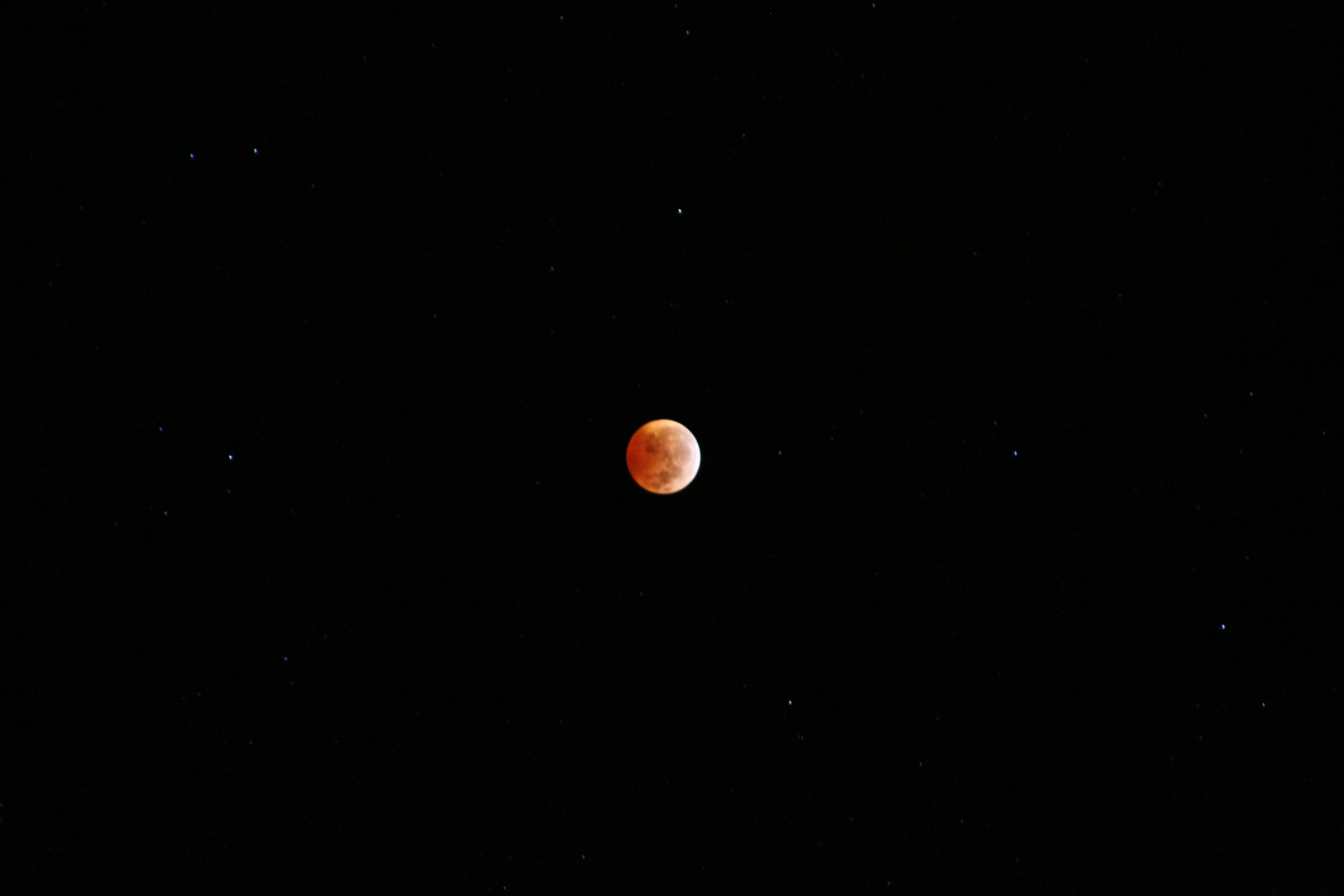
“Lunar Eclipse” by Lorin Kline (my son)

(Last week in Part I I described the forces that drove me high into the mountains for a three-day rendezvous with my deepest fears.  This is the continuing excerpt from the book, Chapter 5.  Dia)

While the list of things scaring me was varied and long, when I arrived at my campsite I discovered one fear in particular standing head and shoulders above the rest.  More than all else, hands down, the prospect of the sun setting terrified me.

There was something so final about it.  I was all alone. Cal had chosen a spot about five miles away and there was no way to communicate with him, no satellite phone or flare or even matches with which to build a signal fire. The trailhead where we’d left the truck was only a two-hour hike away, but without a flashlight I was unable to traverse the steeply forested, snow-slick, north side of the mountain I was on in the dark.  If I panicked I had no weapon to wave wildly at the night, no back door, no safety-net.  Once darkness fell I’d move beyond the reach of any help and for the next eight hours or so, whatever came into my circle I’d have to face.

Which is exactly what I’d intended of course.  Back home it seemed like such a good idea.

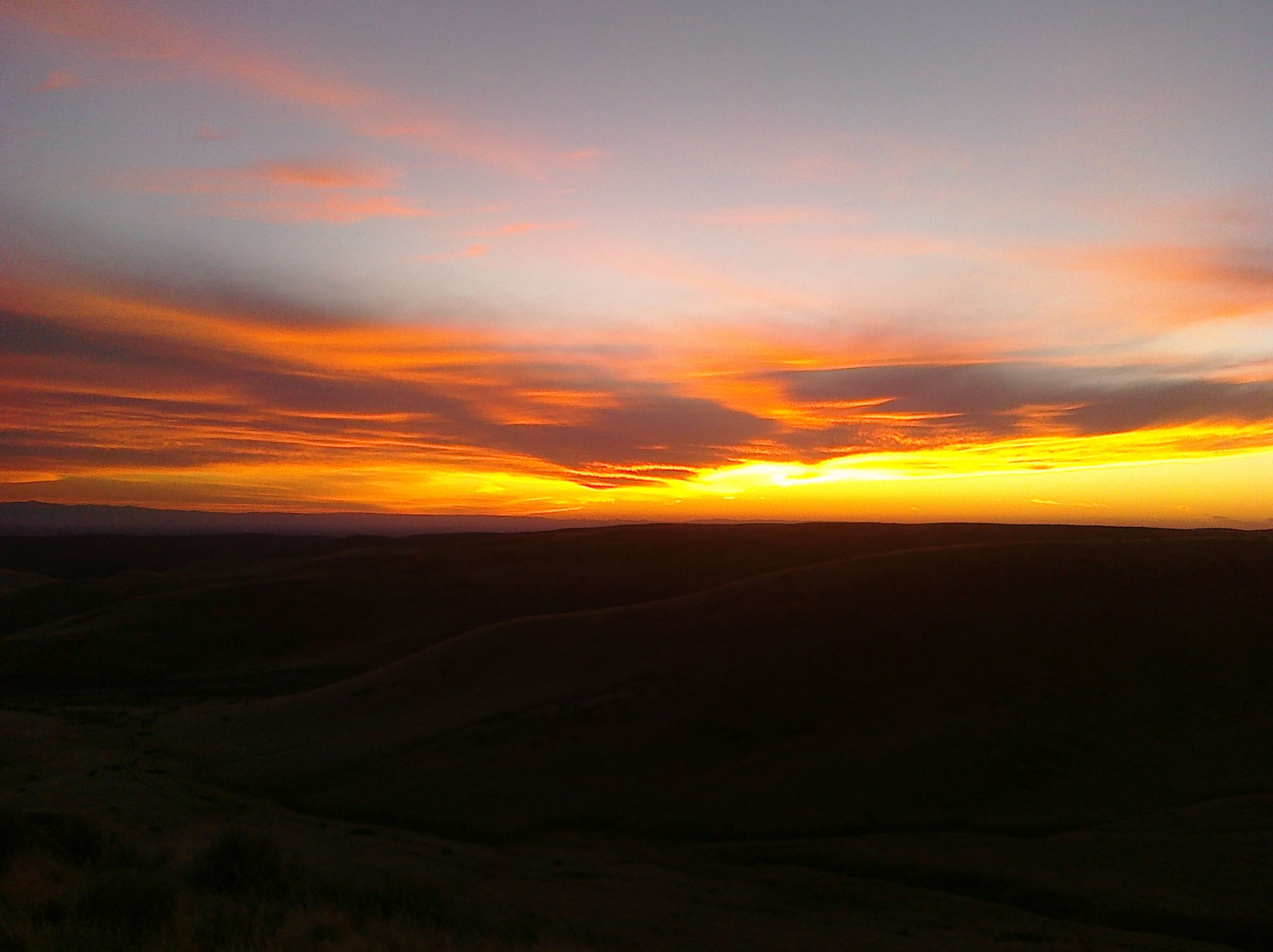
Struggling to control the impulse for white-eyed, foaming flight I forced myself to sit down on my sleeping bag facing west.  I called on the desperation that had driven me up there in the first place and made myself watch, eyes unaverted, as the sun dropped towards the peaks, observed as the light around me faded and thinned—and in the process discovered something surprising.

You may not know this but it turns out night doesn’t fall.  It rises.  Shadows start at the bottom, puddling and pooling in the hollows and roots like water and then filling things up from there.  Initially, I was suspicious as I watched the darkness climbing out of the valley towards me, enveloping each boulder, bush and bare spot in its path.  But eventually some subconscious, nightmare expectation in my mind relaxed and I realized there wouldn’t be any eerie wailing or flapping of leathery wings, nothing with foul breath descending on me from above and behind.  The big, bad dark was not coming to get me after all.  On the contrary, as the night shadow rose higher the world grew hushed and peaceful, feeling—rather than a monster—more like some great mother coming to tuck her children into bed.

I watched as she enfolded everything in a calming embrace and when the shadow finally reached my toes I sat stock-still, observing the light that bathed me fade as the sun sank behind the mountains.  Suddenly, I felt excited and couldn’t wait to change into my long underwear, brush my teeth, and climb into my good-to-15 degrees-below-zero sleeping-bag.

I zipped around and still had enough time, after climbing into my bag, to watch as the last rays of light disappeared from the higher ring of mountain peaks that surrounded me.  Everything terrestrial was now encased in the beginning shadows of twilight but it would take a couple more hours for everything to move into full darkness.  I lay there, looking up at the fading blue of the sky and realized that the shadow was still reaching skyward, enfolding even the air, molecule by molecule, and as I watched the darkness deepen in tiny degrees I began to tingle at the thought of seeing the stars.

Back in the Sierra Nevadas during the long nights of my survival training course, while lying there looking up at the brilliant, twinkling worlds spread out above me, I’d slipped into a state of quiet, serene delight.  Feeling like no matter what happened everything would still be all right, that I was safe and cradled in ways that defy explanation.  As the memories of those nights came flooding back I grew excited–couldn’t wait to feel that sense of well being again–but since I knew it would be a while yet, in the meantime I turned to gaze at the deepening shadows on the ground around me.

My enthusiasm swiftly unraveled as I watched the things of this world, the trees and mountain peaks, flitting birds, the carpet of dusty pine needles and stones, the three plastic water jugs and backpack I brought with me, disappearing into the gathering darkness.  The horrified, creeping fear returned as I felt myself being cut off and isolated, stripped of everything familiar, and I began to wonder again if something would come out of that dark unknown to get me during the night–a cougar, a drunken hunter, a wave of bone-chilling cold, a demon.  I frantically reminded myself of the stars that were coming as I turned my eyes back up to the deepening darkness of the sky.

And it was in that moment, as I lay trembling and unexpectedly longing for the darkness of full night to arrive, that I had my revelation.  In a flash I recognized a truth that seems so obvious now but that I’d somehow completely missed.

Both the light and the darkness conceal and reveal.  The light reveals the ordinary world around us.  It gives us one another and makes everything seem smaller and more manageable, wrapping us in a bright and sunny cocoon because as mortals we’re tiny and fragile and need a sense of protection.  But it conceals, too.  It creates the illusion of a blue sky, a ceiling, a world that has limits and is safe and known and predictable.

It isn’t until night arrives that this seductive illusion of containment dispels.  The darkness comes swallowing everything in its shadow,  tugging us away from the usual daylight edges we cling to with white-knuckled fingers until there, in our moment of greatest fear and isolation, it tenderly unveils the larger truth…that we’re cradled, floating in infinity.

The insight was blinding.  Even though it didn’t alter the basic realities of the situation–I was still all by myself out in the middle of nowhere exposed and trapped–it transformed the darkness from a terrifying, alien thing I had to outsmart and survive into a bringer of gifts and grace.  I felt as though I’d reluctantly entered the enemy’s camp only to discover it wasn’t an enemy at all.  It was an ancient, lovely world of starlit depths that had been longing for me, calling me home for years.

A decade of depression slipped away as I fell into an exhausted sleep and, when I woke back up again a few hours later, a twinkling universe stretched out above me.  The soft radiance bathed me as I lay there and quietly wept under the steady, pulsing of starlight.

(Next week, the conclusion.)

copyright Dia Osborn 2010

Poll: Do You Think Medical Science Can Someday “Cure” Death?

Update:  There was some confusion about where to find the poll.  Bad post design.  Sorry.  I’ve now moved it up to the top.  Please click on all the answers that seem true to you.

This week, my friends, I’d really like to get your input on something.

The other night, as I was watching the usual parade of age-related drug and medical commercials during the evening news, (the target demographic for network news is pretty unmistakable these days,) I thought I heard a subliminal message running throughout.  If I’m hearing correctly, it’s an oblique, unspoken promise to the general population that goes something like this:

If we (i.e. medical scientific research) can find a cure for aging and disease, then nobody will have to die anymore.

Is it just me, or is there an unconscious (conscious?) expectation being fostered in our public awareness that someday death will be “cured”?

Do you think death is curable?

In order to take a broader pulse, I’ve developed this brief, informal poll.  (Here’s hoping it works.  I’ve never done a poll before.)

If you wouldn’t mind, I’d really appreciate your taking a moment to answer.  In fact, if you wanted to invite anybody else to take this poll, too, well that would be just dandy.  There are various ways to share the link below, or you can always cut and paste the URL yourself.

The more the merrier.

And if you’re as curious as I am to find out if there’s a real paradigm shift taking place (i.e. we’re starting to believe en masse that we don’t have to die) there should be a tab at the bottom of the poll you can click on to see the results so far.

I know the possibilities I’ve provided are pretty limited, so if you have an insight that doesn’t fit in to any of the choices provided, feel free to expand in the comment section.  I’d really like to hear what you think.  This is driving me nuts.

Thanks.

copyright Dia Osborn 2011

Awards Season

Here’s a tag-you’re-it kind of award that’s a lot of fun.  Bloggers nominate other bloggers, and then anyone who receives the honor has to write a list of seven (eight? ten? it’s all over the map) things about themself that they haven’t disclosed before.

Well, yesterday I was nominated by the ever-so-stylish, great poultry protector, John Gray of Going Gently fame.  So in the spirit of the game, here are ten things about me you probably didn’t know:

1)  Back in the old days, my grandfather was the accountant  for, among a number of other local businesses, three of the brothels in the small, western town where my mother grew up.  One day while he was working on the books at one of these establishments, my grandmother realized she needed him to run an errand for her.  So she called over to the house and, when a woman answered the phone, asked if Gus was there.  The woman said No without missing a beat.  My grandmother got flustered and replied, But…Gus is my husband.  He told me he’d be there. After which the woman on the other end of the line repeated Nope.  Sorry.  No Gus here. It was only then my grandmother realized her mistake and started laughing.  Oh no, she informed the woman, Gus isn’t a customer, he’s your accountant.  He’s working on the books today and I need him to pick up a loaf of bread on the way home. The other woman relaxed and started laughing, too, after which she told my grandmother she’d be happy to deliver the message.

c. 1890

2)  I once went barefoot for four years and could put out cigarettes with the soles of my feet.

3)  I gave birth to both my kids at home.

4)  My mother went to an ashram in India to study with a saint when I was twelve.  Afterwards, she was rumored to be enlightened.  My father was career military and went into special ops after he retired.  He was rumored to be part of a hit squad.

5)  I’ve been to all fifty U.S. states, Canada, and deep into Mexico.  I love this continent and it’s people with all my heart.

6)  I won awards for my sculpting in papier mache and displayed in galleries.  Never sold much though.

7)  I taught trampoline.

8)  I adore the hubster.

9)  I used to type faster than the wind and was always in demand as a secretary.

IBM Selectric

10)  Andy Kaufman once did a private comedy show for me, but it was out of context and I didn’t really get it.  It wasn’t until years later, after Man On The Moon, that I finally realized just how funny he was.  I still think he had the kindest eyes I’ve ever seen.

image from Wikipedia

And now, passing the baton, I’d like to nominate Janet over at her cracking blog My Brother Andrew, where she’s raising money for research into Motor Neuron Disease (MND), and Linda at What Comes Next? who fearlessly and fluently tackles whatever topic comes her way.  Your turn girls.  Good luck!

copyright Dia Osborn 2011

When Something More Important Than The Parachute Failed

image from Wikipedia

While I was browsing around yesterday researching skydiving and back-up parachutes, I came across a news story from February 2009.

It told the tale of a skydiving instructor, George Steele, who died of a heart attack mid-jump. Now, that piece of information alone would have made me sit up and keep reading because, even though I naturally link skydiving and the possibility of death in my mind, I don’t usually think of it as happening due to a heart attack.  But the story actually gets far more interesting from there.

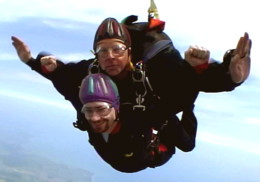
It turns out this skydiving instructor was not alone when he died.  He was doing a tandem jump and had a novice strapped to his chest.  Now this piece of information electrified me.  Like a lot people out there, I’ve considered doing a tandem jump (someday) as a bucket list kind of thing.  But of all the risks I ever thought might be involved, the instructor strapped to my back having a heart attack was never one of them.

By now I’m on the edge of my seat.  I want to know more.  I have to know more.

Turns out the newbie, Daniel Pharr, was a 25-year old soldier trained how to respond in a life-threatening situation.  His instincts proved up to the task.

The two were the last of the group to jump out of the plane.  After a minute or so of free fall Steele pulled the chute.  Everything became very quiet, which Pharr commented on, and Steele replied to.  And it was shortly after this that Steele’s heart quietly failed.  Pharr soon realized Steele had become non-responsive so, going off of what he’d seen on TV (and our mother’s told us TV would just rot our brains) he grabbed the right steering toggle and guided them safely to the ground about a third of a mile away from the designated landing site.

This was turning into such great story!  Double surprise twist with a happy ending.  Dia, I told myself.  It doesn’t get much better than this.

But wait! she answered.  It does!

Turns out Daniel Pharr’s first thought, when he recognized the danger he was in, was , “So at that point I realized I was just going to have to do what I had to do to get down to the ground and try to help him.”

The article had been great up to that point but this part totally knocked my socks off.  I was inspired.  I was in awe.  I couldn’t help but compare what my own response would have been because…well…it just wouldn’t have been as good.  I’m self aware.  I know my own mettle.  I’ve been in enough emergency situations to realize that I’m primarily driven by self-interest.  Oh sure.  If my kids were involved I’d be a little more noble (as long as they hurried) but otherwise I’d be swelling the herd stampeding for the door.  I probably would have been cursing the poor guy for having a heart attack.  But not Daniel.  Oh no.   Daniel was thinking just as much, if not more, of his partner than he was of himself.

Pharr’s evolution from victim to survivor to hero was like food for the secret, emaciated Better Person languishing inside of me.  He gave me hope, a guiding star.  I fell in love with Daniel Pharr on the spot and wished him, wherever he was and whatever he was doing, continued good fortune and everything blessed and best in life.

But having spent all this time telling you the rest of this stuff, here’s the aspect of the whole story that I really wanted to highlight:

It looks to me like, as deaths go, George Steele got to die a really good one.  Yes, he was only 49-years old and sure, he probably didn’t want to die and most likely wasn’t prepared for it.  But having said all that, clearly he got to do it doing something he loved.  In his relatively short life he’d already done over 8000 jumps.  He’s already taken numerous people out for tandem jumps, sharing in the thrill, exuberance, joy, and rush of all those he introduced to his passion for the first time.  And even though at the end he was doing a tandem jump, he was lucky enough to be doing it with someone experienced and savvy enough to survive the dangers his sudden death created.

But even with as great as all that is, this is what really got me: George Steele didn’t die alone.  When he took his last breath, he got to do it with another warm, pulsing, vibrant, strong, caring, enthusiastic companion strapped to his chest, someone sharing in the same sense of wonder, excitement, and joy that he was feeling himself.  Here’s how Pharr describes what turned out to be Steele’s last moments, floating up there in the sky:

“He pulled the chute,” Pharr said. “It got super quiet. It’s eerily quiet up there. I made the comment to him, ‘It’s surprising how quiet it is.’ And he’s like: ‘Welcome to my world.'”

Welcome to my world. Those were the last words he ever spoke.  I only hope mine will be so great.

I’m not happy for George Steele that he died.  At all.  But I am very happy for him that when he did, he died well.

copyright 2011 Dia Osborn

P.S.  By the way, when asked Daniel Pharr mentioned he’d be willing to jump again himself, but his family put the kabosh on it.  What a guy.


Life Is Like A Trust Fund

In “Dying” Is Still Alive I talked about the cost of focusing so much on trying to cure a life threatening illness that we risk going straight from being sick to being dead, with no time left for the opportunities that dying offers in between those things.  In the comment section afterwards, Linda of What Comes Next? posed an important question:  When fighting a life threatening illness, is it possible to embrace dying too soon…to forfeit the opportunity to rise above it and live longer? This is a great question and one that a lot of people ask.

What I’d like to do is break it down into two parts.

Part # 1)  Is it possible to embrace dying too soon?

My answer, which probably won’t surprise anyone, is absolutely not.

Personally, I think we should all start embracing dying (i.e. looking at it, accepting it, and using the daily awareness to live as wisely and fully as possible) early on, ideally in childhood.  The opportunities for exposure are rife.  Like the first time we see our father crush a bug, or our mother put a cooked leg of something on our dinner plate, or have a family pet die, or hear about our little friend Emily losing her grandpa.  As I’ve mentioned before, it’s never hard to find dead bodies scattered along the side of pretty much any road in America and, if all else fails, there are the innumerable references to, and reports of, dying and dead on the news twenty-four hours a day.

However, since children learn how to embrace dying from their parents, and since most parents don’t know how to teach it, most of us wind up as adults lacking the skill.  In fact, most parents not only fail to teach how to embrace it, they treat it as something unspeakable and do their best to hide it.  The most common metaphor for dying used in our culture is The Enemy, a horrible, looming foe to fight against tooth and nail, both bitterly and indefinitely.

As a result, most of us don’t learn to embrace dying as the last, natural, grueling-but-luminous stage where, if we’re lucky and blessed, we have the time necessary to successfully wrap up our life.   Instead, we deny it as long as possible which can drastically shorten or, sometimes, even eliminate the opportunity to fulfill our end-of-life tasks.   Most people don’t seem to realize that it takes time, sometimes a lot of it, to wind up our affairs, make our bequests, and absolve and be absolved by those we care about.  To link trembling hands one last, aching, transcendent time and say I love you.  I’ve always loved you.  I will always love you.

As a death averse society, we haven’t fully grasped yet that dying at peace, with no regrets, and with our loved ones prepared for a life without us afterwards, is a necessary and worthy goal.

Instead, most us learn to look at dying as the gruesome, terrifying end of everything.  To run.  Run! Hard and fast, for as long as possible toward escalating medical intervention; drugs, surgeries, and treatment regimes that can not only consume most of the time we have left and create more layers of suffering, but actually shorten our lives as well.

In La Crosse, Wisconsin, where end-of-life discussions are the established, accepted norm, life expectancy is actually one year longer than for the average American population.  And a 2006 study by the NHPCO found that the mean survival rate for patients on hospice was 29 days longer than it was for patients who were not on hospice.

For a person who’s spent their entire life regarding dying as something horrific, it’s a real challenge to switch gears, turn around, and embrace it when it finally comes.  Not impossible mind you, but definitely harder.

Helping people make this switch was one of the major goals we always worked toward in our hospice.  We fought hard to help people make the difficult transition from fighting for life to accepting dying because we saw, consistently, what a profound and healing difference it makes.  There’s more trauma involved when the state of dying is embraced late, or never embraced at all.  There just is.  Sometimes this is unavoidable, as in the case of a swift or sudden death.  But more often in today’s medical system, it happens as a result of focusing entirely on finding a cure without also preparing for dying.

Which brings me to the second part of Linda’s question.

2)  Is it possible to forfeit the opportunity to rise above it and live longer?

While this question initially seems to reduce the situation to its simplest elements, I think it’s actually creating a trap.  To explain, I’d like to use a teaching story.

Imagine you were born with a trust fund, and in this trust fund was a billion dollars. All your life you’ve been able to draw from this fund whenever you wanted, using the money for any old thing your heart desired.  While you learned early on that the trust would eventually wind down and close, everyone was kind of fuzzy about the dates on that part.  So in the end you just kind of forgot about it and started spending.

Then one day your lawyer calls to tell you that the termination clause has been activated.  He’s learned that you’re going to lose access to the funds in about six months.  He knows there’s no way to break the clause entirely, but he thinks that if you fight it, you might be able to win a temporary stay.  Buy some extra time.  The tricky thing is, you have to draw down the money in the trust fund to mount the court battle.

You now have three forces at work:

First, there’s the hope:  You might win extra time and still have some money left in the fund afterward.

Second, there’s the real and measurable cost:  You’ll be diverting money to the fight and depleting the funds you need for everything else in your life.

And third, there’s the risk:  Court costs these days can easily eat up most of the trust.  Even if you eventually win more time, the funds might already be exhausted.

Considering these three things, you really, REALLY need to ask yourself some important questions before you decide on a strategy.  The trick is what are the best questions to ask?  Naturally, you want the ones that will give you the most insight and wisdom, the ones that will be most helpful in guiding you in your choices during the time you have left.  So what are those questions?

Linda’s question, adapted to our metaphor, is one possibility.  If I just accept the clause and forgo taking it to court, will I miss the opportunity to use the trust fund longer? The answer?  Well…yeah. Of course you would.  The answer to that one, just from the standpoint of pure logic, is obvious.  Which initially makes the right choice seem like a no-brainer.  Of course you should fight.  Anything else would be giving up.

However, this way of looking at it is actually misleading.  It makes it sound like, universally, there’s only one possible option that everyone should always make.  But that’s not true.  Why?  Because every person is different; with different needs, different dreams, different circumstances, different ages, different strengths, different fears, and different prospects.  All these things need to figure into the choices that each person makes, so the questions we ask need to include them.  Ideally, they’d run more along these lines:

Okay.  Exactly how much extra time are we talking about fighting for here?  Rough guess, what are the odds of my winning this fight?  Am I really interested in betting the farm on longer, riskier odds?  Just how much money is left in the fund to fight for at this point anyway?  Is there something other than legal fees I really want or need to spend that money on?  What will I lose by mounting a fight?  What’s more important to me; having the funds available to spend in the future, or spending them today on what I love?

And what is perhaps the most important question of all:  How much of the fund should I reserve for what I love, value, and cherish the most, to ensure I have no regrets–that my loved ones will still be okay–when the trust eventually closes?

The metaphor of a trust fund is apt because, in reality, life isn’t something that belongs to us. It’s not like our mothers gave birth and then picked up a receipt at the front desk.  Life has never been ours, something we’re entitled to own and control.  On the contrary, it’s only ever been a miraculous, incomprehensible, immeasurable resource controlled by something else too big to understand.  Life is something that we didn’t earn and don’t even necessarily deserve, but that we nevertheless get to use however we want, for free.

To me, life is exactly like a trust fund…only times a gazillion. It’s our fortune.  Our treasure.  A limitless, jaw-dropping, sphincter-releasing wealth beyond our wildest, freaking dreams.  I’m talking real-life fairy tale here, a winning-the-biggest-lottery-of-all-time kind of luck.  A staggering, incalculable store of riches that’s set up in trust for us when we’re born and that we get to draw on and use for as long as we’re here.

But of course, as with all fairy tales, there is that one small catch:  We only have access for a limited time.  And while the question how much time? is certainly a compelling one, it’s unanswerable.  For me it’s more valuable to ask instead, What is the best and brightest use of whatever time I do have?

The medical mindset at work today tends to glorify the fight to live, and skim over the deep human costs involved in such a fight.  This often leads people to continue fighting in the face of increasingly long odds, instead of devoting their remaining energy to fully living whatever time they have left.  It’s surprisingly easy for the fight itself to take over and become the goal.  That’ why it’s so important to remember that the fight is only worthwhile in so far as the life it seeks to preserve is worth living.  When it begins to consume and destroy that life instead, then it’s time to stop.

We’re living in a transitional age where developing technologies have granted us miraculous gifts.  We’ve gone from having little to no choice at all about how we die to an overwhelming explosion of options and, even though we don’t have any more power to prevent death today than we ever did, we’ve developed an extraordinary, mind-blowing capacity to manage its timing.

However, there’s still a gaping hole that exists between these developing powers and our understanding of how best to apply them.  Subconsciously, we’re wrestling with a lot of confusion.  All the old instincts about dying are alive and well and active, lurking just below the surface.  We’re still firmly in the grip of old memes, superstitions, beliefs, and attitudes about it, only now we’ve added layers of wild (and often unrealistic) expectations born of a new, more sophisticated world.  Our collective understanding and response to dying, developed through tens of thousands of years of helplessness, hasn’t evolved as quickly as our intellectual, technological knowledge, creating turmoil and chaos.  But it’s also opened the door for some amazing exploration and new possibilities in how we want to ultimately embrace and manage the way we die.

We’re living in an exciting, intoxicating age where we’re all medical pioneers, where we all get to explore and experiment in our own lives with how best to apply this new wave of knowledge.  I suspect, as we evolve and mature in our understanding of what dying and death mean in today’s world, we’ll become more skilled in balancing our profound desire to live with a deepened, more authentic acceptance of dying.   We’ll discover new and wonderful ways to navigate, treat, live…and still dance…with chronic and terminal illness.  Ways that, today, we can’t even begin to imagine.

I think the current, explosive growth in medical possibilities offers us a parallel opportunity, both as individuals and societies, to grow and develop at a pace that simply wasn’t possible before.  We now have  the chance for our deepest humanity–our collective courage, generosity, insight, humility, and wisdom–to grow at the same exponential pace as our technology.

Personally, I love it.

copyright 2010 Dia Osborn

“Dying” is Still Alive

I’m starting to suspect a lot of people use the terms dying and death interchangeably, or link them so closely together in their minds that they can’t easily discriminate between the two.  At least subconsciously.  I suppose that’s to be expected, considering neither of them are things we talk about much.  Let’s face it, anything unfortunate enough to tumble into the closed pit of taboo topics is destined to collect a lot of misunderstanding.

But this particular area of confusion intrigues me more than most because it’s hard to find two things more different than dying and death.  Exactly how different are they?  Polar opposite different.  World’s apart different.  Different as in “If you had a choice of which one you wanted to be at this very moment, which would you pick?” different.

Death is dead.  Dying is still very, very much alive.

In fact, it may well be one of the most alive periods we get over an entire lifetime of being alive.  I think this is a very, very important point to remember because, startling though it may seem, dying can be easy to miss. 

(Not dead…dead is unmistakable.  Dying can be easy to miss.  See what your mind did there?)

With the current medical paradigm focused primarily on cure, we can spend so much time fighting not to die that we wind up going straight from being sick to being dead, thereby missing the peculiar and healing light of the world of dying that lies in between those two.  We can miss both the chance to realize Oh wow…this is it.  I’m dying now….as well as the gift that comes from spending the rest of our days in that final place where life first collapses, and then supernovas into Life itself.

So if there was only one piece of advice I could pass along it would be this:  Don’t close your eyes. Don’t condition yourself to denial and blindness.  Because, for all their power to transform and heal, the miracles at the end of life are delicate, twinkling, and brief and, if you’re not alert enough to look for them, they can be very, very easy to miss.

copyright Dia Osborn 2010