Name That Swear Word: A Poll

A group of British scientists conducted a study on the pain-killing effects of swearing a while back.  I read about it in an msnbc.com article titled Stub your toe? Say ‘Sh#!’ You’ll feel better back in…oh…wow.  2009.

Okay. A way while back.

Anyway, the scientists expected to find that swearing increased pain because of intensified focus on the sensation, but they discovered exactly the opposite.  The obscene participants not only reported lower levels of pain than their non-swearing counterparts, they were able to endure the painful sensation…freezing cold water on their hand…substantially longer.  Women even more so than men.

For those (like me) who wonder, the most popular obscenities fell primarily into the F and S categories.  But because it was a British experiment bullocks was evidently well represented as well.  

(Editor’s note:  Bullocks?  Is that like buttocks?  Like an American shouting “Cheeks!  Cheeks that hurts!”  Any Brits out there who could clarify?  John Gray?  You’re good at this particular aspect of language.)

The researchers were reportedly surprised by their results but I wasn’t.  Not at all.  I still vividly remember the first swear word I ever spoke.

It was in sixth grade on the grounds of the elementary school I attended, although not during school hours.  I was exploring, happily and alone, the construction site of a new, half-built cafeteria when a neighborhood kid…a male classmate I loathed…showed up and did something to enrage me.  I don’t remember what it was now, but I do remember how belligerent I felt.  (A common state of affairs at that age.)

I really disliked the boy.  I remember him as rude and aggressive and…like me…probably inundated in a hormonal flood.  Who knows?  Maybe he was actually flirting with me in that confused, taunting/hopeful way young boys so often adopt in the early stages?  If he was, it was unfortunate.  The nuclear reaction it triggered was not the pubescent heat that ever leads to a first, exploratory kiss.

The excessive internal pressure meant that something had to give, and the weakest link in the system turned out to be the long years of parental training devoted to teaching me to control my emotions and my mouth.

The forbidden word rose from the heart of the blast and I watched it come out of my mouth, shining, brilliant red, all caps, each molten letter aimed at the shocked face in front of me.

And then?  Well, to be honest I don’t remember him anymore because I was immediately swept away by the narcotic effect saying it had on me.  Seriously.  My body’s response was visceral.

It felt like descriptions I’ve heard of heroin.  As the tidal wave of whatever-brain-chemicals-were-involved hit their waiting receptors, I felt first, a powerful physical release, and second, a sense of euphoria flowing out through my body along arterial pathways.  It was amazing.  Stunning.  I just stood there, enraptured, turning into light.

Needless to say, I fell in love with swearing ever after.  Positive feedback of that magnitude will do it.  I controlled it around my parents of course, until I got a little older, and I still muzzle it around it around children, elders, and most strangers.  But when I’m with those who know and love me and I get excited, I start swearing like a soldier.  It’s never felt as good as it did that first time, of course, but it still makes me happy.

Has anyone else ever noticed a physiological effect from swearing, positive or negative?  I’m kinda curious.

Anyway, I need practice with the polling capabilities of this theme so here’s a little game.  Let’s play, name that obscenity:

If this works you should be able to click the RESULTS button to see what others are thinking.  I’ll post the answer next time.

copyright Dia Osborn 2012

The Fisher King Goes Fishing

A friend of mine was once a vital, physically dynamic. backpacking, canoeing, outdoors enthusiast and passionate, social worker powerhouse.  Then she contracted West Nile virus during one of its earliest appearances in the West, collapsed overnight, and almost died from the severe neurological complications.  It was sobering, how a tiny virus can take down a strapping, healthy, wildly intelligent woman in her prime like that.  Somehow I had thought that only the young, old, and already compromised were vulnerable.

Fortunately, she survived and has been industriously working to rebuild a new life out of the ashes of devastating illness.  One of the biggest challenges has been trying to get to know who she is now as a result of all the neurological damage that took place.   Her mind is still as keen, curious, and active as ever, but tends to quickly overload and go smoky with any kind of strain.  And while she still loves the outdoors and continues to camp and hike a little, she walks a razors edge in terms of how much physical exertion she can pursue before her brain short circuits from the flood of brain chemicals released by fatigue and stress.

For a woman who largely defined herself by her independence, extraordinary mental acuity, and physical dynamism, the loss of self she’s experienced through illness has been profound and the continuing effort to redefine herself, grueling.  But she does it anyway…and inspires me  in the process.

We used to talk a lot about how hard it is to let go of who you once were, then try to rebuild a new life according to this other, lesser version you’ve turned into.  (At least that’s what it feels like in the beginning.)  I experienced something similar during my rapid descent into a long and severe depressive episode twenty years ago, an illness that effectively blew my old life to smithereens.  Like most people in our situation I, too, spent the first few years trying to first recover, then return to the old life I’d known.  It was only after it grew apparent that could never happen that I finally got on with the job of crafting a new life and a new identity to go along with it.

Any kind of major illness or injury can create this cycle of course, but there was a unique challenge we both faced in that we still looked the same from the outside.  All of our injuries are invisible at first glance, which makes our inability to perform certain, standard tasks very confusing for others.  And when we frequently failed to meet the seemingly normal, reasonable expectations of people it wound up creating friction in our relationships with them, a fact that then made it even harder to figure out and accept who we had become.

But time is a great healer and has been slowly revealing that we didn’t actually become lesser people after all, just different ones.  Our identities have changed substantially–who we are and what we can do in relation to the world around us–but it turns out our essential selves haven’t really changed at all.  We still love the same things we’ve always loved, with the same depth.  We still strive to give, serve, behave, and belong in a way that nourishes the greater world.  We’re still just as committed to the happiness and welfare of our children and husbands, doing whatever we can to support them.  And we continue to try and pass along the little tidbits of light, inspiration, and meaning we uncover while sorting through the various piles of debris that now litter our lives.

Today, she sent me the following three minute video and it reminded me again of what an extraordinary gift and accomplishment it is to survive in this world at all.  Its many and formidable hardships aside, life is still pretty magnificent and I do so love getting to participate in it, for however long it lasts.

This is footage of an osprey fishing from the BBC archives.  First sequence: he catches half a dozen fish in one strike.  Second sequence: he dives underwater and plunges talons into a flat fish resting on the bottom.  Third sequence: he captures a huge fish that looks as if it weighs more than he does.  (How they get this kind of footage is beyond me but they do.  Pretty brilliant.)

copyright Dia Osborn 2012

Of Birthdays, Mouth Control, And The Risk of Living

My birthday just passed and the hubster and I headed outdoors to spend the day kayaking and hiking.  We always go outside for my birthday because if I were a compass, the natural world would lie at magnetic north.  This year was particularly inviting because it’s been so radically warm that it already felt like spring.  Everyone was outdoors in fact, not just us.  The young, strong, and nubile were hitting the river in wetsuits, while a caravan of towed motorboats wound its way out to the reservoirs with beach chairs and coolers of beer carefully tucked among the fishing gear.  (We lie somewhere around the middle of this spectrum.)

We’re just starting to kayak…our adventurous spirit is reviving from a near death experience as we finally shed some of this horrible weight…and we spent about an hour on a calm pond next to the river in town trying out different kinds and sizes of boats.  (Or, in the vernacular, “yaks.”)  Afterward we decided to drive up into the reservoir system northeast of Boise to scout for more exciting places to paddle once we spread our wings.

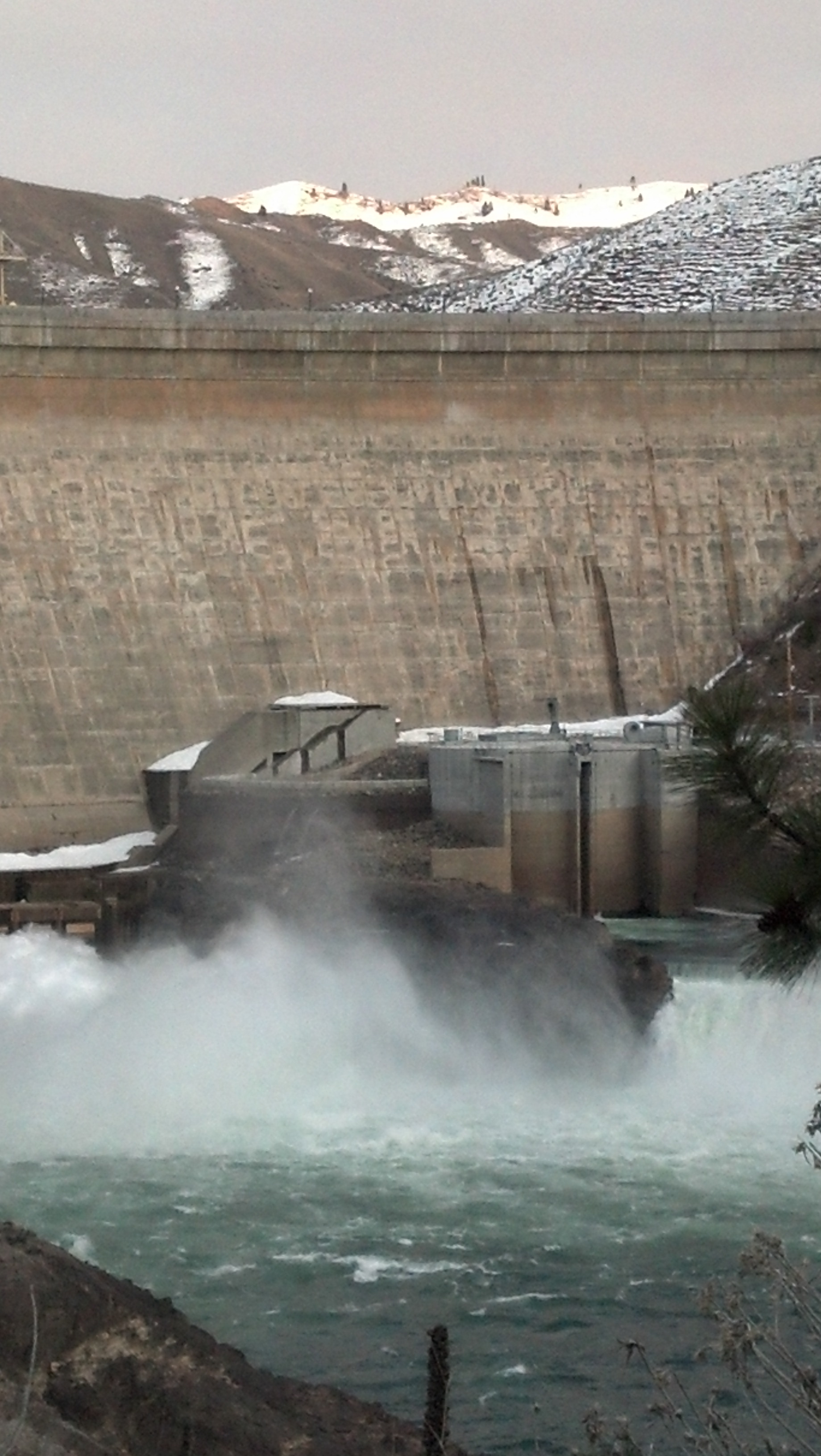
There are three dams on the middle and south forks of the Boise River…Lucky Peak, Arrowrock, and Anderson Ranch…and the reservoirs they create stretch for miles back into the mountains.  Below is a photo of Arrowrock dam with spring flows already being released due to the early snow melt.  Note the sparse snow cover on the mountains back behind.

The lack of snow bodes ill for future irrigation but it was terrific for hiking.  Normally we wouldn’t be able to access the ravine pictured below this time of year…at least without snowshoes…but we caught a great day.  The creek that runs along the bottom was low enough for us to cross since most of the lower snow had already melted and run off.  (The hubster missed one jump and got a shoe wet though.  Fortunately, he survived as seen with Dane the mangy rescue mutt below.)

It was spectacular back there, with snowy peaks capping both ends of the valley.  We had views both coming and going.  This is what it looked like hiking in:

And this is what it looked like coming out again:

As we began our hike we met a couple waiting next to a truck near the trailhead.  The woman, a pair of binoculars in hand, had just slid down a side hill and was engaged in serious consultation with the man.  They explained they were waiting for their three teenage sons who had hiked off along a high ridge running above the ravine some time earlier.  They seemed uneasy as the boys were late returning to the truck.  I got the impression the two weren’t married and that the mother was a lot more worried about her son(s) than the father, a hunting man, was about his.

She asked us to watch out for them and to deliver the message that they were waiting if we saw them, and I assured her we would.  But not before the hubster joked that the word “mother” is embedded in the word “smother.” (Sigh)  He realized from the ensuing awkward silence that it was a glaring faux pas, but couldn’t unsay it at that point.  Really, he’s come so far over the years in terms of filtering the thoughts in his head before they spill out of his mouth, but every once in a while he still just takes a hard right like that and sails over the cliff.

As a mother, I could relate to her worry because…well…that’s just what we do.  We know what can happen.  But at the same time I didn’t take her fears seriously because I was picturing boys in the sixteen to seventeen year range.  Around here, boys of that age with a hunting father are already experienced in wild terrain, so a simple hike on a clear afternoon wouldn’t usually pose any kind of meaningful risk.

We were only about a half-mile in when we sighted them up the trail and I immediately realized her worry was based on something more substantial.  The boys were younger than I thought…more in the twelve to fifteen year range…and her son, a pale, slight boy with glasses, looked to be the youngest.  By the time we met we could see that all three of them were agitated, a little scratched up and dirty, and they pounced on us wanting to know how much farther it was back to the trailhead.

They told us they’d been hiking along the ridge on the other side of the ravine when…for a boyish lark I suppose…they decided to climb down the mountainside, cross the creek, and climb back up to the trail we were on.  They pointed out the spot where they chose to make their descent and my blood went cold.  You can’t really tell from the photos but the sides of that ravine are quite steep and the boys had not only picked one of the steepest spots of all to climb down, it was a rocky, north facing slope that still held a thin layer of snow.  The descent was far more slippery and treacherous than they realized and they all exclaimed that they’d wound up slipping a few times.  If one of them had lost control of their fall, it would have meant tumbling wildly down a thousand feet of hillside, battered against jagged granite outcroppings the whole way.  Even the oldest boy (who seemed to be the son of the hunter) was visibly shaken by the experience.

We gave them the mother’s message and sent them on their way (although not before the hubster…imploding under the pressure of a stern admonition not to…helplessly blurted out to hurry because their mom was crying, which only made her son even more upset.  He then tried to backtrack by calling after their swiftly receding backs, no, no, no, it was their dad crying, not their mom, but both the intended humor and the correction sailed right over their heads.  I was just grateful she’d be gone by the time we got back.)

We talked for a while about boys of that age and how unpredictable they can be, how an older child can so easily lead younger ones into situations that escalate like that one did, and how all three of them now have a great story to add to their growing cache of adventures.   We shook our heads and reminisced about our own early scrapes, marveling yet again that kids ever survive to adulthood at all, and it made me think about the growing trend these days of trying to protect them from more…and more and more…of the perennial dangers that always lurk in the world.

To my eyes, some of these efforts lean towards the irrational, to the point where some regulatory attempts (not to mention some of the things parents are being prosecuted for) can not only interfere with basic parenting but a child’s ability to explore their world as well.  I sometimes wonder what kind of people our children will turn into under so much legislated fear, and what kind of society it might lead them to create in their turn.  Hopefully, the pendulum will eventually swing back to an attitude that’s more balanced…something that moderates the current hyper-vigilance with at least some acceptance of the fact that the very nature of life is, and always will be, unpredictable.

We stayed out for a couple hours and, as we headed back, the setting sun broke through the clouds turning the whole valley golden behind us.  A parting gift from the weather gods.

We ended the day by impulsively stopping by Mon Pere’s house on the way home and catching an impromptu dinner with him, his girlfriend of twenty-five years, and her daughter and grandson.

By the end of the day I was a very happy camper; relaxed and supremely content.  It was a most excellent birthday, to be sure.

copyright Dia Osborn 2012

Next Post

(From Odd: I’m embarrassed to say I’m one of those women who didn’t know that today was International Women’s Day.  Is Dude Not Douche REALLY a guy? I admit I’m dizzy…whipping wildly from Contraceptive Slut to Woman With A Day like this.  But whether that part is true or not, thanks for this Dude. Seriously. We all really needed it.)

Update:  Dude is, indeed, a dude.  You can look to his blog for the photo.

Writer’s Block: Why Won’t My Subconscious Talk To Me?

(Thank you M. Strekbett.)

After chronicling our little journey filling out advance directives for the last…six? seven? eight?….weeks, I’m having trouble returning to normal blog-life.  Not only does it look like I’ve lost most of my readership and Blogland friends (…there’s that dying topic at work again…) I can’t think of anything else to write about now.  Full immersion in a topic will do that to you I guess.  Who knew?

So I’ve decided to try a little free-writing to see if I can break the damn.

…whoops.  I mean dam.  Although on second thought, I probably did mean damn (as in why-am-I-so-blocked!?) down there in my subconscious.  But for some reason my conscious mind thought dam was more appropriate.

“Damn?”  Conscious Mind glanced up from his newspaper and raised his eyebrows.  “A little vulgar, don’t you think?”

“Fuck you.”  Subsconscious Mind was used to that kind of bullshit censorship by now.  “It was just a play on words.”

Here’s a thought.  Maybe…just this once…I should say what my subconscious wants me to say instead?  Throw it a crust.  A sop.

“A sop?”  Subconscious Mind tried to change position in the filth on the stone floor but the chains were tangled.  “What a pretentious bitch.”

Conscious Mind folded the paper and set it down on the table, picked up the cattle prod, and stood up.

Who knows? It might actually make it happy.  (What a concept.  A happy subconscious.)  Maybe that’s even the whole problem?  My subconscious is sending up messages and I’m not listening.

Conscious Mind stopped, startled, and glanced up at the ceiling. 

Am I sitting on something?  I should probably do that writing exercise where you write for ten minutes straight without stopping, even if it means just writing the same word over and over again.  See if there’s something there.

Subconscious Mind scrambled to his feet and started yelling.  “Hey!!  Yes!  It’s true, man!  Listen to yourself!”  He yanked the chains in frustration.  “I’ve got good shit down here!  GREAT shit!  Magic swords!  Tiger allies!  Repentant bankers feeding homeless people!  It’s crazy, man!  You could turn the world on its ASS!”

Conscious Mind switched on the cattle prod and started forward again.

I feel like I’ve gotten lost up in my head lately…out of my heart.  Where did the magic and compassion go anyway?  I miss that voice.

‘I can make you FLY, man!!  I can make you GLOW!!”  Subconscious Mind was screaming and waving his arms frantically at this point.  “I CAN HELP YOU FUCKING SLEEP!!!”

Maybe I’d finally get a good night’s sleep?  Wake up rested for a change.  Fuck!  How great would that be?!

Conscious Mind froze and Subconscious Mind held his breath.

Shit!  Why didn’t I think of this earlier?  Time to start listening to my subconscious again, man!  I’ve let my inner critic get completely out of control.  What was I thinking?

The cattle prod flew out of Conscious Mind’s hands and he staggered back as if shoved.

I NEED my subconscious…

The shackles snapped open and fell from the wrists of Subconscious Mind.  In one swift motion he stooped, picked up a handful of fresh feces, and threw it at Conscious Mind. 

…AND my conscious mind to work together!

But the feces missed and splattered against the wall.

Otherwise, I’ll just be writing a bunch of nonsensical shit that doesn’t make any sense and, really, isn’t there enough of that out there already?

They both looked over at the newspaper headline on the jailer’s table, RUSH LIMBAUGH APOLOGIZES, and the tension in the room broke.  Subconscious Mind grinned and Conscious Mind relaxed, his shoulders shaking with silent laughter.

So.  If I now go back to the original sentence that started this whole thing:

So I’ve decided to try a little free-writing to see if I can break the damn.

…which word would I really rather use?  Dam or damn?

Conscious Mind walked over and unlocked the massive timber door, swinging it back on it’s iron hinges.  He stepped back and gestured for Subconscious Mind to pass through.  Sub took one last look at his corner then walked out, clapping his shit smeared hand on Conscious’s shoulder and wiping it across the front of his white shirt as he passed.

Okay then.  Damn it is.  

copyright Dia Osborn 2012

Epiloque:

Con paused briefly and shook his head as the pungent fumes wafted up from his chest.  He chuckled and grabbed the cattle prod.  

“Hey, Sub!  Wait up,” he called, taking the steps two at a time. “You forgot something.”

But in the final draft, it would probably have to be dam.

Part IX: Out Of Town And Back Again (With Advance Directives In Tow)

(Continued from Part VIII: Advance Directives: Dying Inside Our Big, Hairy Healthcare System)

The hubster and I just spent five glorious day up in the Sawtooth Mountains.

Snowshoeing.  With heavy packs.  Uphill.  Both ways.

Kidding.

It sure seemed like it though.  The snowshoe into the family cabin at the beginning of any trip is always a bitch and this was no exception–a two mile trek from the highway to the cabin, uphill with fully loaded packs, after a four and a half hour drive to get there. The bad news was that the trail wasn’t groomed like we were expecting so Dane the Mangy Rescue Mutt (with bad knee and brace) started really struggling in the deeper powder.  (He made it though, and we’re more confident about his knee now than we have been in a while.)

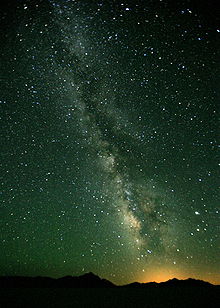
The good news was that we got a late start leaving home so we didn’t actually strap the snowshoes on and start up the hill until about 8:00 pm.  It was already dark and the stars that night…the stars my friends…were outrageous.  It was one of the clearest nights we’ve ever seen and that’s saying a lot.  We rarely use flashlights because 1) you really don’t need them once your eyes adjust and 2) the electric light is so bright it dims the night sky.

As you may have heard, there was a spectacular crescent Moon/Venus/Jupiter conjunction going on last weekend and, sure enough, that trinity was hanging just over the silhouette of snow capped mountains as we got started.   However, the moon set after only twenty minutes so we had to content ourselves with a radiant swathe of Milky Way arcing over our heads from horizon to horizon while thousands of other constellations and stars filled the rest of the sky bowl curving down to the ground on either side of it.  (We made do.)  Meanwhile, the snow reflected all that diffuse light back into the air so that after a while it felt almost like we were trudging through a softly glowing snow globe.  I couldn’t get enough of it.  I just couldn’t.  I’m sure my face would have gotten frostbite from staring up through the bitter wind for almost two hours, except that my skin was too hot to freeze.  The heavy exertion was making me huff and puff and sweat like a pig.  (The hubster loved the stars too but was more preoccupied with trying to recall what were the exact symptoms of a heart attack.)

(Photo courtesy of Steve Jurvetson)

We’re getting older.  There’s no denying it.  And we’re not sure how many more times we’ll get to have these kinds of adventures.  Physical limits are getting harder to ignore.  But so far we’ve pushed on anyway because when you think about it, there are far worse ways to die than collapsing cradled in the wild beauty of high mountains while gazing up into pure, celestial wonder for the last time.

But not until we’ve finished our advance directives of course.

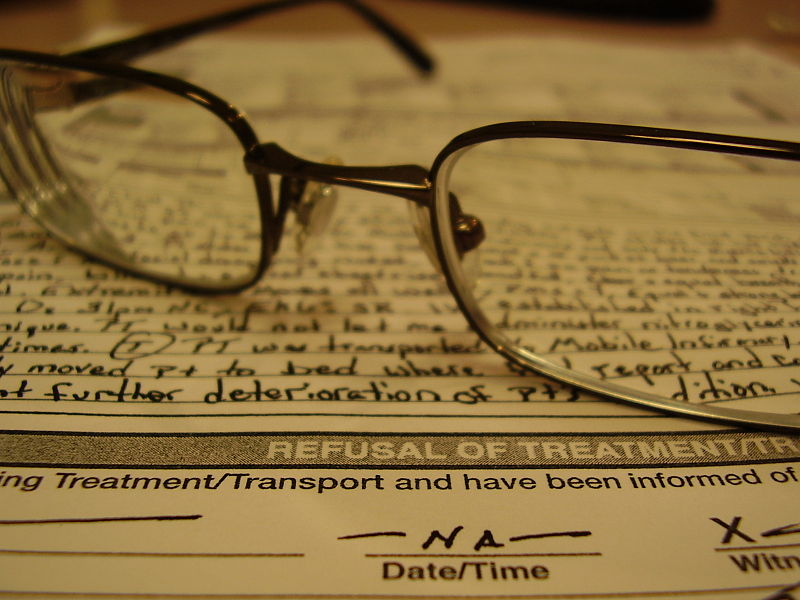
We packed these documents in along with everything else and spent one of our days at the cabin, pens in hand with a snowstorm raging outside, finally filling the things out.  It was surprisingly emotional.  We found it was one thing to sit and diligently read through them over the course of a few weekends, and something else entirely to actually write in our various notations, initial the desired boxes, and sign on the dotted line with each other as witnesses.

Everything suddenly got very final and real, and I kept hearing a heavy door swing shut with a key turning in the lock.  At first I struggled with the feeling that, by signing the thing, I was somehow giving up all my rights and instinctively, I started backing away and questioning the wisdom of the whole project.  I was surprised at how powerful…how primal…the wave of fear was.

But then I remembered something we’d read earlier, that if worst ever comes to worst and I’m finally lying unconscious and helpless and vulnerable somewhere, Somebody is going to step in and start making decisions for me. Whether I’ve filled out an advance directive or not.  Whether I’ve picked them to be the person or not.  Whether they know what I want or not.  And I suddenly got it…on a deep, gut level…that my advance directive is not the thing that will strip me of control and make me silent and helpless, it’s the thing that will help protect me in case I ever am.

That helped my resolve firm again and I was able to continue.

The hubster told me later that the fear he faced arose from a sudden and overwhelming realization that he will, absolutely, someday just cease to exist.  Poof.  Evidently, it was a huge moment for him but I never would have guessed it.  He didn’t look like he was sitting there reeling from the blinding, existential awareness of total, inescapable, physical annihilation to come.  From the outside he just looked absorbed.  Studying the paper in his hands, reading glasses perched on the end of his nose.  It’s not that he was trying to hide his fear from me, that’s just the way he is.  His courage is so unconscious most of the time that he usually doesn’t even realize that’s what’s going on.

We read and scribbled and talked about things for hours.  Sometimes we laughed, I cried some, but mostly we took turns trying to explain what we were afraid of, what we longed for, and how much we loved.  The process flushed out things that had been hidden and dormant for a long time.  Tenuous hopes and secret dreads, things to be examined, cradled in tender hands, and then placed into each others’ keeping in a final gesture of deep trust.

I’ve been really surprised throughout this whole process at the huge relationship component involved in filling out these forms.  Maybe because it was also a research project for me and we took so much time with it, maybe because we did it together as partners, I don’t really know but I tell you, it’s added a whole new level of meaning to Till death do us part. Overall it’s been a healing journey full of deepening intimacy for the hubster and I.  We’ve shared things we didn’t know we hadn’t shared, and revealed things we didn’t even know ourselves until now.

I guess if there was any advice I could give out of everything we’ve learned so far it would be this:

Do your advance directives together.  Find someone else who hasn’t done their’s yet, or who hasn’t looked at it in a long time if they have, and hold hands as you walk through it.  The person you pick doesn’t have to be the same person who will be your medical proxy.  (Although, if experience is any guide, you may want them to be by the time you’re done.)  And it doesn’t have to be only one other person either.  It could be a group…if you could find that many people brave enough.  I strongly suspect that this is one area of life where the maxim There’s strength in numbers holds especially true.  If you can possibly help it, don’t try to take this journey alone.

And take your time with it.  Break the process down over a few days or weeks.  If you let yourself sit with the questions for a while, you may be surprised by some of the answers that come up.  I know we were.

Y’know, it’s kind of funny.  In walking through our advance directives, it almost felt like an opportunity to practice for the real thing…for dying…from a safe distance. Emotionally speaking I mean.  In our imaginations the hubster and I got to slip on the experience of profound vulnerability and dependence that goes with dying temporarily, while we’re still healthy and vital and strong.  It was scary in some ways, but far less so than what I’d imagine it would be like facing it for the very first time in extremis.

And we got the chance to start honing a couple of the emotional skills that are essential to have during dying…things like the ability to surrender to the inevitable, to be openly vulnerable and reveal our needs to one another, to gratefully accept the help that’s offered and to be dependent gracefully.  Things that, in our culture anyway, we tend to think of as weaknesses or failings, and yet they’re not.  Those are things that actually require tremendous courage and strength.  I didn’t realize how much before.  To openly accept the willingness of another human being to step up and care for us isn’t easy, and accepting it with dignity is rare.  (Especially for somebody as controlling as I am.)  And yet the hubster confided a couple days ago that, during this whole process, he’s felt increasingly overwhelmed and touched by the depth of my trust.  Our willingness to open up and be vulnerable with each other turned out to be, not a burden, but a gift.

So anyway, these are just a couple of the things we discovered while filling out our advance directives.  It’s been a beautiful, frightening, surprising, hard, uplifting, sorrowful, strengthening, sobering, illuminating and profoundly intimate journey for us both.

And it’s still not over!  Next, we’ve set up an evening to meet with the people whom we’ve selected as our alternative medical proxies, to get their consent and share our advance directives with them. Then we need to get the forms notarized, witnessed, copied, distributed and filed. (Note: Because Idaho’s laws place unusually high hurdles to a simple, low intervention dying process, we’re taking precautionary legal steps with our advance directives that wouldn’t be necessary in most other states.  It’s extra insurance against something that probably won’t happen but still…better safe than sorry.)

And then, after we get ours taken care of, I’ve got the kids in my sights for theirs.

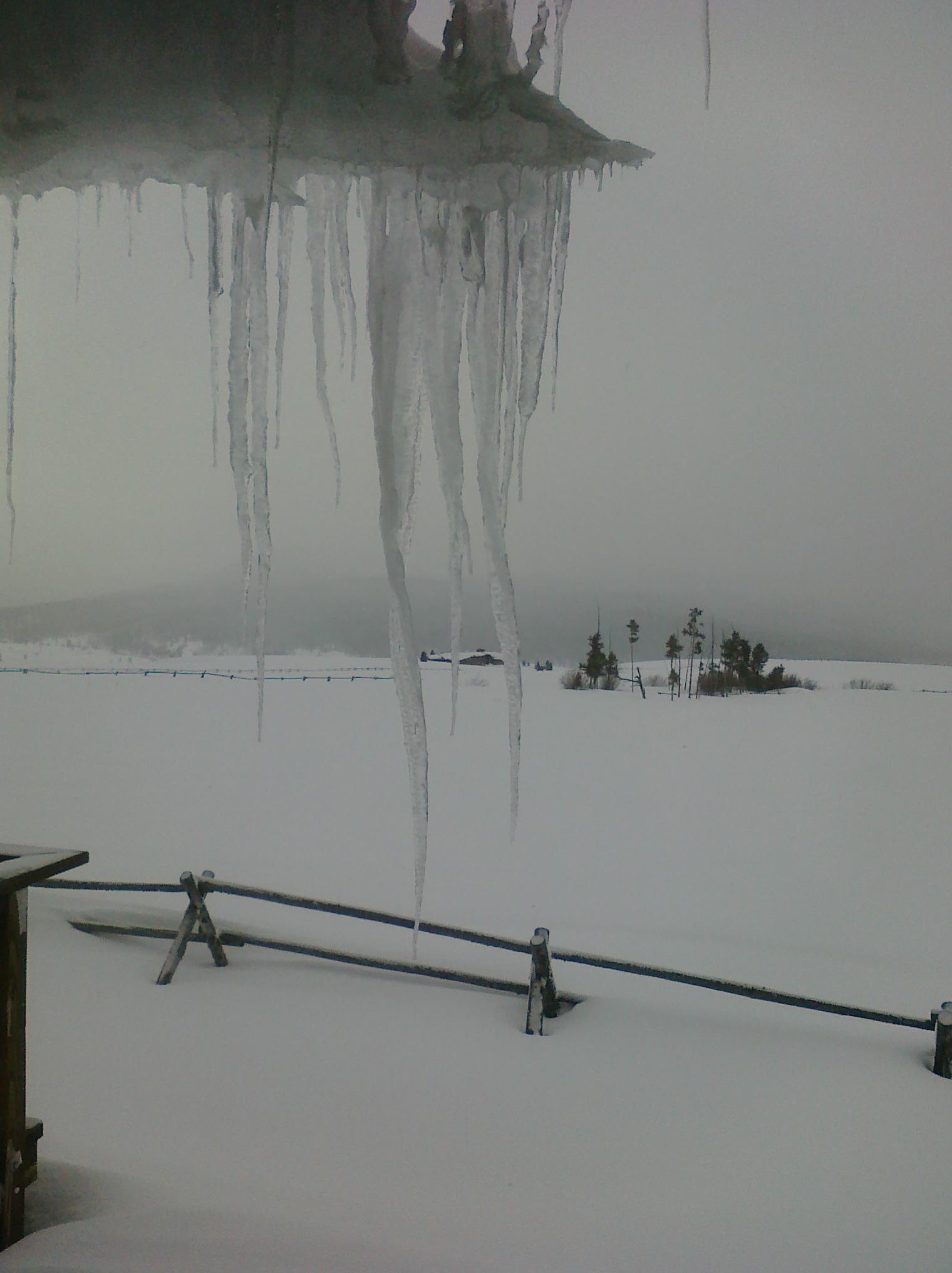
To wind this up, here are a series of photographs taken of some icicles hanging outside the cabin window during our recent stay.  The changes they went through over the days we were there feel similar to the changes the hubster and I have gone through on this whole journey with advance directives.

Stage One:  Glowing and happy from the previous night’s starlit adventure.  Delicate, sparkly and naive:

Stage 2.  Advance Directives Day–blasted by the elements, bewildered, and storm bent.  Not so sparkly anymore, but still…multiplying and stronger:

 Stage 3.  Skies are clearing, brunt of the work is done.  The amount of growth that happened during the storm is kind of surprising.  Thicker, longer, and a lot more:

Stage 4.  Older, calmer, wiser, stronger.  Not so much sparkling as glowing. We’re a lot more confident now that we can weather the storm. 

copyright Dia Osborn 2012

Part VII: Advance Directives: Ours

(Continued from Part VI: Advance Directives: Mine.)

Editor’s note: Today, I decided to just write a quick post and publish it without proof reading.  It may be the only way to save it from the fate of the other three posts I wrote this week.  (Overwritten, nitpicked, and abandoned.)  Please forgive all the errors.  

In the last post I tried not to reveal too much about the hubster’s choices out of respect for his privacy, but since then he’s let me know he’s okay with it if I do.  I’m grateful because it’ll be easier this way.  Each time we’ve sat down together it’s become more apparent that, while each of us is trying to define our own individual wishes, this process is ultimately ALL about relationships.  We don’t live in a vacuum and evidently we won’t be dying in one either.  If we don’t make the effort now to discuss this with everyone else who absolutely will be involved if either of us dies in the next few years, then it may not mean shit how brilliantly we write it down.

Getting this paperwork completed and filed is only the first step.  I may have declared February our Advance Directive Month, but 2012 is evidently going to be the Year of our Advance Directives, too.  I foresee a lot of conversations about dying in our future.

And that is, by far and above, the scariest part of this whole thing for me.  As anyone who’s been reading this blog for a while knows, I’m not particularly afraid of facing death.  What I am very afraid of is asking other people, in person, to leap across the abyss and face it with me.

Talking about dying is just so very, very taboo and I’ve already put people off with it so many times before.  It’s one thing to chat about it here on the blog, but it’s something else entirely to look directly into another person’s horrified eyes and say Hey!  Ya wanna come over and talk about plugs and when to pull ’em?

I did make the leap last night though, with Beloved Daughter.  She came over so we could watch the final episode of Downton Abbey together and before we sat down I tentatively asked if she’d be willing to fill out an advance directive with me or, if not, at least let me know what she’d want in a worst case scenario.

Her response totally surprised me.  She was not only willing, she was actually enthusiastic about it.  She even started telling me a couple thoughts she’d already had about it and she’s only twenty-five years old.  I was so relieved.

Maybe that first leap is going to be the hardest part.

A couple of specific items we discussed this weekend:

1)  Alternate medical proxies…just in case we’re in a car crash together and can’t serve as each others.  We both picked friends instead of family members.  (We haven’t actually asked them yet though.)  I had a couple of reasons.  My friend is a nurse who’s also into holistic healing and we share a similar preference for minimal medical intervention.  She’ll be more able than most to successfully bridge the gaping divide between the two systems.  I also didn’t want to burden either of the kids with having to make those choices.  They’ll be going through enough.  For the hubster, it was a toss up between his friend and his doctor-brother.  The friend won because he lives in here in town and proximity trumped professional skills.

2)  No surprise: Idaho’s statutes concerning end of life choices are extremely conservative.  Sigh.  Evidently, it can be a challenge here to decline things like blood transfusions and antibiotics because they’re not considered “life sustaining” treatments like artificial nutrition and hydration are.  The hubster and I could be 200 years old, paralyzed, and lost in dementia, and the law would still require that we’re treated for pneumonia.

We’ll have to write specific requests in our advance directives stating that we would absolutely want to have all such treatments withheld, and then also make sure we discuss it with our doctor to find out if he’s okay with it.  Honestly?  I don’t think it’ll be a problem as long as we do our footwork now.  The laws err on the side of caution but from my experience working with hospice, common sense tends to prevail in real life.  Medical professionals involved with end-of-life care tend to be very respectful of individual wishes.

That’s it for now.  It’s hard to stop because there’s so much we’re talking about and learning that I could write five posts a day and not cover it all.  I started this journey thinking an advance directive was just a set of forms we’d fill out and give to a couple of people, and then we’d be done.  However, I’ve discovered that they’re really (surprise, surprise!) about our life and the people we love.  I don’t know why it surprised me.  I’ve known along that dying is all about life, too, and that including it in my life now, long before I die, makes everything I experience richer and scarier and more adventurous and full.  Why should advance directives be anything different?  I mean, really?

The hubster and I will actually fill out the forms this weekend.  We need to check with our friends to make sure they’re okay to be our medical proxies before actually filing them with the online registry.  I’m not sure we’ll finish by the 29th (leap year!) but if not it’ll be in the week following.

(Next:  Part VIII: Advance Directives: Dying Inside Our Big, Hairy Healthcare System)

copyright Dia Osborn 2011

Part II: What Is An Advance Directive? (Or Why I’ve Been So Confused.)

Continued from: Part I: February Is Hereby Declared Advance Directive Month.  Join Us!

I had a lot of questions.

As I mentioned in my last post, the hubster and I are finally determined to get this albatross of planning out of our hair.  I know from my years working with hospice how complicated and overwhelming end-of-life scenarios can be and I realize that planning for it beforehand can make all the difference in the world.  So time to get it done.

First, the research:

Question:  WHAT IS AN ADVANCE DIRECTIVE?  Well, it’s even more complicated than I thought.  I’ve identified three different parts to the process so far: There are FORMS, what I call THE LETTER, and then the FOLLOW-UP.

THE FORMS

IN SPIRIT, an advance directive is a way of letting loved ones and medical personnel know what kind of medical treatment you would or wouldn’t want if you were unable to communicate those wishes for yourself.  The idea is to try and avoid confusion, mistakes, and extra suffering for everyone involved in either an emergency or end-of-life situation.

It’s a worthy ideal with almost universal backing.

IN PRACTICE, an advance directive is a set of actual, legal forms to fill out and this is where things start to get very confusing.

Turns out the whole concept of an advance directive is a work in progress.  The idea was originally conceived back in the 1960s as a result of the growing number of nightmarish dying scenarios taking place, but it didn’t start to take off in public awareness until the Patient Self Determination Act of 1990.  There have actually been three generations of advance directive forms developed over the years as our understanding of the need for them has evolved.  Wikipedia has an interesting article on the history, with specific references to the main forms created and what they were designed to address.  Reading it helped me understand why I’ve had so much trouble determining what paperwork we should use.

Basically, there’s a freaking cornucopia of advance directive forms to choose from out there.  Laws governing medical treatment for emergency and end-of-life care are actually generated state by state with a profound lack of coordination at the national level, so even if you fill out your own state’s advance directive, it’s kind of a crap shoot whether it’ll be honored if you get into trouble somewhere else.  Then there’s the other problem that most state directives (crafted by state bureaucrats) are too limited in scope to accomplish what we want them for in the first place.

In an attempt to address the latter issue, there have been even more advance directive forms created by national organizations that are more suited to deal with the subtler nuances involved, and while these other forms do a much better job of allowing us to communicate what we actually want, (and some of them have even been approved by some states) their legal strength has yet to be definitively proved in court. They’ll probably be honored, but there’s no guarantee.  And if you’re asking for any kind of treatment contrary to the state laws where you get into trouble, you’re shit out of luck.

Like I said, this stuff isn’t just scary, it’s confusing.

So what are WE personally going to do? 

Well, we’re going to fill out two kinds of advance directives: 1) our state form to cover our legal butts here at home and, 2) one of the other national forms that will help us better express the complexity of our wishes to our loved ones.  (We haven’t decided yet which one.  Needs more research.)  That second form is also necessary for us because the hubster travels extensively between states and there’s no way he’s going to fill out a separate advance directive for each one.  We’re hopeful that, in the particular states he visits, one of these other forms would almost certainly be respected.

(Panicking yet?  Don’t.  Whatever state you’re in and whatever forms you choose, the most important choice you’ll make is who you pick for your medical proxy; the person who communicates your wishes when you can’t.  Remember, the best paperwork in the world can be missed, misunderstood, and/or disregarded without your proxy there to back it up.  So don’t fixate on the form.  Fixate on the multiple, ongoing conversations you’re going to have with your proxy.)

To conclude this section on forms, the individual documents included in an advance directive can include a mixture of the following:

1)  Living Will* (name your treatments)

2)  Durable Power of Attorney for Health Care* (pick your proxy)

3)  Do Not Resuscitate Order** (please, please don’t)

4)  Choices for organ donation**

5)  POLST** (Physicians orders for life sustaining treatment) in states where it’s available.

*  always

** sometimes

NEXT, THE LETTER.

Even if somebody was to procrastinate and never get around to filling out the legal paperwork, they should at least craft their Letter and give it to their loved ones.  What is The Letter?  At it’s heart it’s something like a profession of faith; a declaration of belief about what makes life valuable to you.  It will lay out what you live for, believe in, and love; the particular things or circumstances that make your life worth living to you.

The medical choices we’re likely to face in catastrophic circumstances are impossible to predict, which makes it difficult to write down instructions for detailed treatment preferences. The purpose of The Letter is to instead provide a set of overarching principles that can help guide our proxy’s decision making.

For instance, one person might write as part of their Letter, I believe that my ability to think and communicate, to interact consciously with the world around me in a meaningful, nourishing way, defines who I am.  It’s what makes my life worthwhile to me.  Another might say I believe that I’m more than just my thoughts, actions, and will, that my life is valuable, sacred, and worth preserving simply because I exist.  While a third person might simply state Hey…if I can still talk and eat Chinese food then hook me up.  In any case, the Letter gives whoever has our medical power of attorney an idea of what’s most important to us, what the unique values and beliefs are that they need to consider when deciding on any given medical treatment.

Now FYI, there’s usually a place on most advanced directives where you can include something to this effect, but I personally would write it first as a separate document for two reasons:

1)  The space on the forms is really cramped, and

2)  You may want to communicate something of an intimate nature that you don’t want a bunch of strangers reading.

AND THEN LAST BUT NOT LEAST, THERE’S THE FOLLOW-UP.

So, I’ve now filled out both the legal documents and written the Letter.  Is that enough?  Am I now done?  Nope.  Not hardly.  Because…

1)  THESE FORMS AND WRITTEN STATEMENTS ARE UTTERLY USELESS IF THEY’RE NOT PUT INTO THE HANDS OF THOSE WHO WILL NEED THEM.  This seems kind of obvious but it’s surprising how many people miss this step, partially or completely.  The people who should have access to a copy include:

First and most importantly, whoever has our medical power of attorney!!

Second, our doctor and the hospital (if we’re in for some kind of procedure.)

Third, any loved ones and/or close friends who are likely to be involved.

Fourth, I’ll be keeping a copy with all our other important and legal documents.

We can hand out hard copies, let people know how to access the information through an online registry, or some mixture of the two.  There are pros and cons to each approach which I’ll cover in a later post. 

2)  ADVANCE DIRECTIVES NEED TO BE PERIODICALLY REVIEWED AND UPDATED.  Life goes on, circumstances change, people move or die, and our wishes for what we want evolve as we age.  It’s vitally important to make sure our documents reflect the changes.

3)  And last but not least, WE NEED TO TALK ABOUT IT WITH OUR LOVED ONES AND DOCTORS!!!

Personally, I think this task is probably the hardest one.  But folks, writing it down alone will never be enough.  We have to answer any questions and make sure everything’s clear, for both our sake and the ones we care about most. 

These are the people who will be our advocates when we can no longer advocate for ourselves, and if they don’t know what we want, or if they can’t prove that they know what we want, or if they can’t agree on what we want, then the risk rises we’ll be dying the way somebody else thinks we should.

And, man, would that suck.

These are also the people who will be shouldering a breathtaking burden of responsibility for our sakes, so we have a duty to protect them from any last, lingering doubts; from the painful question of wondering whether or not they did the right thing.

Next post: Advance Directives: Forms and Where To Find Them.

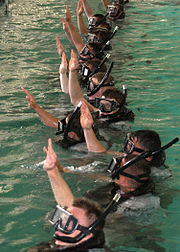
(The above photo is of U.S. Navy search and rescue students.)

copyright Dia Osborn 2011

Part I: February Is Hereby Declared Advance Directive Month. Join Us!

It’s better when we do it together.

Confession: I haven’t done my advance directive yet.

I’m embarrassed to admit it, but there it is.  In spite of my harping and spouting I haven’t walked my own talk.  (Not entirely sure why but probably because this shit is not only scary, it’s confusing.)

Well, it’s time to climb off the soapbox and dive into those cold waters like I keep telling everyone else to do.  I’ve done one thing at least…talked to the people most likely to make decisions for me if worst comes to worst…but that’s not enough.  No…ho…ho.  They’ll also need legal paperwork to prove that I mean what they say, so I need to do the deed itself.  Put pen to paper.  Download the state forms, sign on the dotted line, and give them copies.

It’s Time to Legalize And Let It Go.

The hubster is doing this with me and while we’re at it, I wanted to invite everyone else who hasn’t done their advance directive yet, but wants to (or not) to join us on our little adventure.  I’m going to try and enroll my kids and siblings and their families in the process, too, because I really want to know what they want in case (God forbid!) I wind up having to make decisions for any of them. 

IMPORTANT SAFETY TIP:  The need for an advance directive knows no age limit, anyone can wind up incapacitated and unable to make decisions at any time.  If you’re 18 or over, this sucker is a good thing to have. 

I’m assuming this process will bring up questions, fears, and insights along the way that we can all help each other with and learn from so IMHO, the more the merrier.

Are you ready to rumble?!!!

In the next couple of weeks I’ll be researching and posting about the who’s, why’s, what’s, where’s, when’s, and how’s of the process, and then in February the hubster and I will take the plunge and do all the concrete steps necessary to make sure that everyone from intimate family members to state agencies are clear on what-we-would-and-would-not-want in the event.

So if you haven’t filled out your advanced directive yet either, feel free to join us.  I figure there’s strength in numbers.

Next post:  Part II: What Is An Advance Directive? (Or Why I’ve Been So Confused.)

copyright Dia Osborn 2011
Unthinkable? No, Dying Is Perfectly Thinkable.

living will

The Los Angeles Times posted an excellent article by Steve Lopez last month discussing the urgent need we all have to not only discuss our wishes with those who are likely to make them, but codify those wishes in written and legal form.  For anyone who’s been thinking about doing so but is unsure how to proceed, please take a look.  It has links to some great resources that might help.

There’s only one thing about the article I took issue with; the title.  Having To Think About The Unthinkable.  Because it reinforces the wrong but tenacious belief in our oh-so-death-averse culture that dying is an unthinkable (not to mention unspeakable) topic.

That’s just not true.  Dying is totally thinkable.  In fact, collectively, we do it all the time.  I do it.  So does everyone who works with hospice and palliative care.  So does everyone who’s currently dying, and all the people that love them.  So do elders who are fast approaching, people who get questionable results on scans, and those who experience a close call in a plane, on a highway, or in a hospital.  Anyone who follows the news is exposed to reports about dying every day, and a movie about dying called Final Destination was seen by so many people, so many times, that it spawned three sequels and made its makers hundreds of millions of dollars.

In fact, our tendency to secretly think about dying a lot is at the heart of our entire preventive health care system. No one in their right mind would consent to (much less insist on) the discomfort, indignity, potential danger, and expense of so may foreign objects poking our veins, irradiating our tissue, and probing our various holes without the thought of dying as a strong motivation.  So, no.  The idea that dying is unthinkable is a total myth.  Not only is it perfectly thinkable, there’s a respectable portion of the population secretly doing it at any given moment.

What I’d like to do is encourage everyone to think about it more openly.  Because keeping all those thoughts and fears chained naked to the floor down in your seriously clenched gut only serves to make the prospect of dying more frightening, not less.  Trust me on this one.  Dragging the monster out from under the bed where you can negotiate with it and set up some ground rules is a very, very good thing to do. 

Okay, yeah.  I’m gonna die.  You win there.  But this is how I want to do it; no tubes, no persistent vegetative states, no bankrupting the family and leaving them destitute.  However and whenever you decide do this buddy, I want to minimize my own suffering as well as the suffering of my loved ones.  This is important to me.

I think a lot of people don’t realize that death is absolutely fine with that.  Contrary to how it’s portrayed in Final Destination, death is a neutral force, not a malevolent one.  It doesn’t want us to suffer and it doesn’t care if we take steps to prevent that from happening.  It leaves full control for how we navigate the process to us.  It’s like kayaking.  We can either take time to study the river beforehand and craft an intelligent plan for those class 5 rapids with a forty-foot waterfall at the end, or we can fall into the boat backwards and wing it.

Which ride would you rather be on?

Death is like the river.  It doesn’t care about the quality of our ride, it’s only job is to sweep us downstream.  The rest is up to us.  And if we decide we’d rather do it with foresight, skill, and courage?  Then our relationship with the dying process is transformed from a catastrophe into a partnership and the gifts of that–the power, dignity, strength, love, sacrifice, generosity, and surrender it generates–remain long after we’re gone to help those we love recover and return to a full life.

Thinking and talking about dying, long before it happens, is well worth it.

Here’s a link from the article that has an excellent guide on how to have a conversation about end-of-life-care wishes with your loved ones. (You can use it as a starting point to have a conversation about it with yourself, too.)  And to download a copy of your state’s Advanced Directive, here’s a link to a website called Caring Connections which has a wealth of other information as well.

And because I mentioned kayaking, here’s the trailer for The Halo EffectIt includes some unreal footage of kayaking elite and waterfalls.  The opening narration tries to explain why these guys do what they do and is worth a listen, but if you just want kayaking footage, it starts at 1:00 into the trailer.  It’ll knock your socks off.

copyright Dia Osborn 2012

Elders and the Strange Gravitational Effect of Final Mystery

image by chrisroll

My elderly father-in-law (I’ll call him Mon Pere) is living in the light of two very different worlds right now.  In the first, he pursues everything he enjoys with great flair.  He goes out dancing with his ladylove, attends continuing education classes at the University, tells his same beloved, off-color jokes over and over again, and takes long, contemplative walks by the river every afternoon.  In the second, he lives with metastatic cancer.  Mon Pere is what’s known as a character, and he navigates both worlds with the same idiosyncratic grace.

His cancer is slow growing and if it weren’t for a preventive screening test some time ago, he wouldn’t have even known it was there until recently.  Because of his age at the time of discovery, and because the likeliest outcome of treatment would have been to erode his treasured quality of life, he declined anything aggressive and has instead lived pretty much the same life he lived before, only with the uncomfortable knowledge that a force he could neither see, feel, nor resist was relentlessly growing inside him.

This burden of helpless knowing strikes me as unnecessary and a little cruel but, as far as I can tell, Mon Pere has no regrets.  All our conversations eventually drift to the topic of how grateful he is for the life he’s led and the deep pleasure he now takes in his daily routines.  For all I know, without the useless knowledge of his cancer over the years, he might not be feeling this heightened sense of gratitude and pleasure.  Perhaps that’s what makes the added burden of fear he’s also had to live with worthwhile.

Mon Pere has been, all his life, every year, an avid traveler but that, too, is changing.  This morning he refused an invitation from the hubster to go on a fishing trip to Maine, emotionally disclosing that, these days, he longs more for the simple charms of home.  There’s a creeping pain to be dealt with and instinct is whispering it’s time to rein in the adventures.

I’m moved and fascinated by the unconscious courage he displays.  He’s unusual in that he’s always been willing to talk about his own death as well as the life he’s determined to live on the last leg of his journey there.  He’s been clear with us all that, for him, living fully is more important than living longer.  While he’s prepared to surrender to the naturally occurring indignities of dying, he’s determined to avoid any additional medically inspired ones, and so far he’s shown an uncanny instinct for sniffing out and avoiding most of the interventions that might extend-but-strip his life simultaneously.

I admit I’ve been tracking his choices closely over the years, and I’ve learned a lot from him. The truth is that, like him, we all dream of living fully until it’s time to die.  The problem is our healthcare system isn’t designed for that.  It’s not designed to allow dying at all.  It’s designed to keep everyone alive as long as medically possible and, while that’s a decided boon during the healthy years, its lopsided effort at the end is now churning up so much turbulence that a simple death has become a rare event indeed.  I’ve looked into the haunted eyes of too many surviving loved ones and seen the same regret there; They never wanted to die like that. 

Everyone agrees there’s a problem, and there are many good efforts afoot to change it, but in the meantime passing through the medical system during aging is a lot like swimming downriver into ever-increasing amounts of flotsam and jetsam.  There’s so much to get snagged on that it requires an almost impossible degree of knowledge and native cunning to navigate through it all unscathed.

But Mon Pere is doing surprisingly well.  He’s like an old trout, refusing to rise to the fluttering lures cast over him, sinking lower into the water instead.  He’s not susceptible to the whispered promise of extra time because, as he so often says, Been there, done that, bought the t-shirt.  He doesn’t have a bucket list left of things still to do because he already lived his whole life doing them.  What he craves now are the infinitely dear, small pleasures of life.  To walk and learn, laugh and dance, savoring the wonder of each new day.

This gradual slowing reminds me of the other elders I worked with and how they, too, started to bend and change under the weight of this approaching mystery.  It often seemed like they were nearing something I couldn’t see, something with an immense gravitational pull to it, as though the closer they circled in, the denser and heavier they became.

I used to think of death itself as a null and empty void…a dark nothingness, an absence-of…with physical life perched on one side and, hopefully, some kind of spiritual life on the other.  But that was before I spent time working around its edges, before I discovered the strange, luminous field this final Unknown generates.  Some have called it the light of dying, which I’ve also glimpsed, but at the very end, in those last hours before a person dies, it took on an additional dimension.  It felt like an immense current flowing through the home, as if some subtler kind of electromagnetic field was in motion.  I noticed everyone’s emotions, muscle contractions, and breath seemed to unconsciously synchronize with it, and my own response was the same each time.  My skin would tingle and hair rise, my heart would first fill with a vast ache and then suddenly contract and break in one sharp blow.  And out of the pain it would delicately unfold again like some kind of pulsing sea anemone, opening up its thousand waving tentacles to grope the passing current…for what, I still don’t know.

The experience was reassuring but disorienting, too. There were a few times after returning to my car when I had to just sit and grip the steering wheel for a while, dazed and bemused by how sharp and crystalline everything looked, as if I was gazing out through a long-smeared window that had finally been cleaned, before the strange afterglow would fade enough for me to drive safely away.

I don’t think of death as an empty void so much anymore.  I’m not sure what I think instead, I can’t make make sense out of something I’ve only glimpsed, but the thought of it makes me feel curious, calm but a little nervous, and breathless.

Mon Pere is hardly dying yet, he may not for years, but he’s slowing.  Turning.  Caught in the outermost edges of that pull now and commencing its widest spiral.  He’s a little sad sometimes, a little scared, but mostly he’s head over heels in love with his life, as he should be.  As we all should be.

This is the most amazing ride.

copyright Dia Osborn 2011

Welcome 2012!

Happy New Year everyone!  It’s sunny, clear, and quiet today.

A perfect beginning.

Here’s a fabulous photo taken live last night from a boat in San Francisco Bay, by friend-more-like-a-daughter-really, Kit Prud’homme, who lives out in the Bay Area.  She took a series of shots that are pretty spectacular and well worth a peek if you get a chance.  (They’re a lot bigger on her site.)

Whatever “success” may mean to each, here’s wishing us all a successful next year!

copyright Dia Osborn 2011
Blip 3 From The Book and Sugar Plum Fairies

Happy Thursday!  I’m actually getting Friday’s post in a day early this week.  Still working on the writing class and trying not to get distracted by the blog.  In that spirit, the following blip is from a section of the book where I describe a walk we took along an Oregon beach during some residual storm surge.  The echoes of dying are just about everywhere, if only we allow ourselves to listen.

We stayed close to the cliffs rising at the back of the beach, scanning their sides for escape routes just in case.  The litter of driftwood at their base was a wildly tossed collection of enormous pilings and giant tree trunks ripped free from prior moorings by lashing waters of extraordinary force.  The evening before they’d all rested in settled places, tumbled long ago to fit tightly along the feet of the cliffs, bone dry and sun bleached, high above the tidal reach.  But after the night’s wild surf they were tossed about and water soaked.  Embedded with wet sand.  Some of the old pieces had been picked up and scattered down the beach or washed away entirely, while other ones were only freshly arrived.

Picking our way we came across the damp carcass of a sea lion, headless and beginning to decompose.  At first I mistook her for driftwood but as we drew nearer I saw tufts of fur still clinging to her skin and I was irresistibly drawn to her.  Kneeling, I placed my hand on her side, the damp flesh still soft, giving way beneath the pressure as if she was exhaling.  I felt a mixture of wonder and horror and grief, marveling that I, Dia…woman of Idaho, of inland rivers and sweet water lakes…was touching a sea lion. I might as well have found myself next to a unicorn or griffin.  She was miraculous to me, sleek and tapering, and I ran my hands above the contours of her body, sweeping them along her back and sides, over the folds of her torn fins as if my hands were somehow remembering the deep waters gliding over them.  Endlessly, fluidly tender. 

I wished that her head was still there.  I looked at the wound and was chilled by the neat edges of severed spinal bone where someone had clearly sawed through it.  I felt agitated murmurs fluttering up from the sand around me and I shared in the distress, made uneasy by those who move easily in the darkness, desecrating the dead.  

I spoke to her gently, whispering final words of farewell and gratitude.  But then a sneaker wave rushed up, driving Cal and I onto the higher rocks behind her.  We watched as the water surrounded and lifted her, washing her back down the beach out into the waves where she swam again one last time, headless and vulnerable.  She got stuck, tossing about in the turbulent zone where ingoing and outgoing waters meet and I wished she could somehow get past the waves and return to deeper waters.  We stood helplessly as she tossed and rolled, back and forth, trapped and jostled in the limbo zone created by conflicting tides. 

But finally, when I could barely stand to watch anymore, a strange, lone ripple of current heading away from shore washed past her and for a moment it seemed like whatever was left inside her washed away, too.  I thought I glimpsed a shimmering sea lion, whole again and beautiful, swimming just beneath the surface, riding that ripple back out to sea. 

And then it was gone.

I’d like to end this post on a completely different kind of beautiful note. Here’s a video of a couple of Polish musicians playing Tchaikovsky’s Sugar Plum Fairy on the most surprising instrument.  It’s both entertaining and exquisite.  Enjoy!

copyright Dia Osborn 2011
The “They Just Won’t Die Tax”

And now, another one from the annals of the absurd.

This time it comes from British Columbia and involves a fee currently imposed on dying people who accidentally live too long.  Philip Wolf of The Daily News reports in his article Just Die When It’s Convenient that The Vancouver Island Health Authority demands their terminally ill decline and die on schedule like they’re supposed to.  Failure to do so will result in a penalty.  Thirty dollars a day for the bed, to be exact.

It just doesn’t get much more ridiculous than this.

Now don’t get me wrong, I understand where they’re coming from.  The hour of death is highly unpredictable, and its inability to conform to a calendar can shred the schedules and finances of everyone involved, not just agencies.  On top of that, some people who are dying while out on their own, improve dramatically once they’ve entered the hospice system and start receiving good palliative care.  And, while on the one hand that can be an undeniable and profound gift, on the other hand it definitely throws a wrench into the financial administration of their cases.  I certainly don’t envy those responsible for filling the shortfall.  Everybody hates the fact that money has any influence over something as sacred as dying, and I sure wouldn’t want to be the one to remind them.

This of course ties into the larger problem of unaffordable health care costs, for which I don’t have any answers.  And I’m certainly not going to try and propose a solution to the VIHA’s problem because, frankly, this level of absurdity may not have one.  It has coyote written all over it.

I suspect the VIHA’s dilemma and decision is just the natural outcome of trying to partner bureaucracy and mystery for the dance.  Of course bureaucracy will insist on leading and naturally Mystery will tease and refuse to follow.  How could this kind of pairing not get ridiculous?  Remember the brilliant parody that Monty Python did on this very subject?  I found it in a Youtube video. (At least the VIHA didn’t go with this solution.)  Here’s Bring Out Your Dead: 

copyright Dia Osborn 2011

Blip Two From The Book: A Curious Cure

(Still tied up with the class.  Here’s more filler until I have time to write real posts.)

“11/25/04

Thanksgiving!  I’ve got half an hour to write until the turkey goes in and true bedlam begins.

I seem to be spending most of my time with Janice these days reassuring her that, Yes.  Of course.  Just like everyone else who’s ever lived from the dawn of time, she, too, is going to die.  She’s survived so many things, so many times now, it’s gotten ridiculous and she’s starting to battle horrifying visions of immortality.  I can’t help but laugh, yet feel a wave of compassion at the same time.

Whenever she starts moaning about it I point out every sign of decline I can think of, and when I hit on something that resonates her eyes light up with hope. Yesterday, we talked about two things that have to take place before a person can finally go.  One is advanced disease in the body and the other is a surrender of sorts; a  person gradually lets go of the drive to live, the one that makes them get up day after day.  I’ve seen signs of this in Janice lately.  Since she moved to the nursing home she sleeps a lot of the time and rarely participates in any activities.  She told me yesterday there are times when she doesn’t want to eat and she even said she feels “dead” inside most of the time now, which is, of course, a classic description of the depression she doesn’t believe in and refuses to treat.

So, casting about for some way to cheer her up I mentioned, “Y’know, Janice, those things might be a sign that you’re finally surrendering.”  She perked right up.

“Really?  Do you think I’ll die after all?”

God, what a character.

She’s slowly, slowly turning in some kind of invisible womb, her head shifting gradually downward toward the birth canal, preparing for her journey through the passage that connects this world to whatever comes next.  Regular activities are losing their grip and she’s starting to drift, turning increasingly to the doorway of sleep and its other dimensions.  She tells me her daughter keeps encouraging her to take part in the facility’s activities, that she would be happier if she did.

But Janice looks at me, distraught, and says, “She just doesn’t understand.  I can’t.  I don’t feel good enough.”

It would be so hard to be ready to go, to long for it, and still be stuck here.  Day after day.  Year after year, dealing with constant pain and constant loss and constantly diminishing ability.  It’s so weird—how some people can want so desperately to live but die anyway, and how others seem to get trapped.  Wouldn’t it be great if there was some kind of cosmic barter system set up where we could trade final time with one another?

“I’ll give you three of my unwanted years for your quickie.”

“Done!”

I hope I don’t die of congestive heart failure or M.S. or Alzheimer’s, something long and protracted.  Please God, can I have cancer or something else shorter?  Not a heart attack or a car crash though…I’d like time to say my good-byes, to let Cal and Lorin and McKenna know how much I love them.  It would be unbearable to leave without being able to tell them one last time.

After we talked I drove Janice over to the bank, and while we were sitting in the drive-through she spotted a Dollar Store across the parking lot.  Boy, did her eyes light up!  I asked if she wanted to go in and she grew more excited than I’ve seen her in months.  She looked…dare I say it?  Happy.

(Everyone says that, during dying, hearing is the last thing to go.  But watching Janice yesterday I couldn’t help but wonder if perhaps, with women, it’s really our love of a great bargain.)

She couldn’t shop for very long, of course, as it was a big store with a lot of stuff.  But she stubbornly managed to drag herself…doubled over her walker and sucking strangled huffs of oxygen in a way that alarmed everyone within hearing—up and down a couple of aisles before grabbing some crackers and gasping that she was ready to go.  By the time I wrestled her back into the car she looked bloodless, ghastly, and absolutely euphoric.

“That…was so…much…fun!”   She wheezed and gazed up at me with grateful eyes from where she’d slumped to the bottom of the seat.  “I really…enjoyed…that!”

She so delights me.  This Thanksgiving I’m grateful I took Janice to the dollar store.”

copyright Dia Osborn 2011